Didieji arkanai · II

Vyriausioji žynė

Silent inner knowing that reveals its truths only to those who wait and listen.

Trumpai apie kortą

Numerologija
II
Stichija
Water
Astrologija
The Moon · exalted in Taurus
Kabalistinis kelias
Gimel (Kether → Tiphereth)
Laikas
Cycles · about a month
Taip / Ne
Maybe · not yet time to know

Tiesiai

intuition subconscious mystery inner knowing silence hidden knowledge patience sacred feminine

Apverstai

blocked intuition secrets repression superficiality information overload withdrawal self-doubt

Vyriausioji žynė kiekvienoje kaladėje

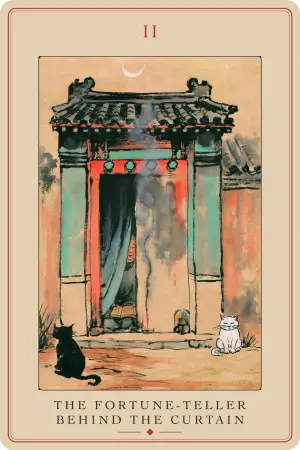
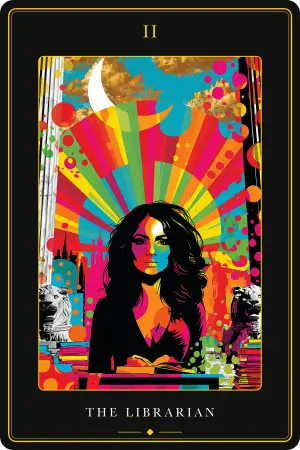
Kiekviena kaladė atspindi tą patį archetipą savais būdais. Palyginkite meną, tuomet atidarykite kaladę ir perskaitykite jos interpretaciją.

Imagery and symbolism

The Rider-Waite-Smith High Priestess sits in complete stillness at the threshold between the conscious and unconscious worlds. She is flanked by two temple pillars: the black one on her right bears the letter B for Boaz ("in his strength"), the white one on her left bears J for Jachin ("he will establish"), the twin columns that stood at the entrance to King Solomon's Temple. Seated between them, she holds light and dark, severity and mercy, in balance without falling into either.

A veil strung across the pillars is patterned with pomegranates and palm fronds in the shape of the Tree of Life. The palms carry the active masculine principle and the pomegranates the receptive feminine one, the latter tied to Persephone's descent into the Underworld and to knowledge won only by going down into the dark. Behind the veil lies a body of water, the collective unconscious from which intuition flows, and her blue robes fall like that same water over the crescent moon at her feet.

On her head sits a horned diadem holding a full globe, an echo of Isis and Hathor that marks the waxing, full, and waning moon and her command of cycles. An equal-armed solar cross rests on her chest for the balance of the four elements. In her lap, half hidden by her mantle, is a scroll lettered TORA: Divine Law, the Torah, the Akashic memory. Its partial concealment says that this truth is felt rather than studied, and rearranged in a circle the letters also spell TARO, ROTA the wheel, and ORAT to speak.

Core meaning

The High Priestess is the receptive feminine principle, the subconscious mind, and the mysteries that sit just beyond ordinary perception. She is the exact counterpart of The Magician before her: where he acts, speaks, and manifests, she waits, listens, and lets knowledge arrive on its own. Her domain is non-action and inward reflection.

To draw her is to meet the limits of logic and be pointed toward the intuitive self instead. She sits in the liminal space where contradictions coexist, a mediator of paradox rather than a solver of it. Her core message is quiet and consistent: the answer you are chasing is already inside you, and it will surface once the mind goes still enough to hear it.

Upright meaning

Upright, The High Priestess calls for intuition over intellect and patience over force. She marks a time to observe rather than act, to let hidden things come to light in their own hour. If you put a straight yes-or-no question to her, her usual reply is "not yet."

In love. She points to a bond of unusual depth, built on unspoken understanding and spiritual chemistry more than on display. As the keeper of secrets she can also mark a hidden or unconfirmed relationship, or a partner who feels a great deal and reveals little.

In career. Hold back and watch. This is not the moment to sign a contract or commit to a move until the concealed details surface. If a deal looks flawless on paper yet leaves you uneasy, trust the unease over the spreadsheet.

In finances. A time to save rather than spend, and to resist impulsive investment. Something relevant is still out of view, so wait for it before you part with money.

In health. Listen to the body's signals and honor its cycles. She favors rest and meditation over aggressive intervention, treating the body as a vessel that will tell you what it needs when the mind is calm enough to hear.

Reversed meaning

Reversed, The High Priestess signals a break with your own intuition. You may be drowning in other people's opinions and external data while an inner warning goes ignored. This is the card of "I knew something was wrong but I talked myself out of it," and it asks you to quiet the noise and return to what you actually value.

In love. Secrets fester. Someone may be withholding, hiding an agenda, or being unfaithful, and a silence that once felt meditative has hardened into a wall against intimacy.

In career. Blocked instinct and information overload. You lean on everyone else's read of the situation and override the quiet signal telling you something is off.

In finances. The unease you dismissed comes due. Decisions made against your better judgment, or on someone else's say-so, are where the trouble hides.

In health. She can point to hormonal or menstrual disruption, fertility concerns, or symptoms that grow from repressed emotion. The remedy she suggests is inner work, therapy or shadow work, to reach the root rather than the surface.

Historical notes

She began as La Papessa, the Popess, one of the more provocative images in early Tarot. Medieval folklore of Pope Joan, a learned ninth-century woman said to have disguised herself as a man, risen to the papacy, and been exposed when she went into labor during a procession, shaped the early card. The eighteenth-century Tarot de Marseille duly shows a woman in the papal tiara holding a book and keys, and Protestant countries used the figure to mock the Catholic Church.

Italian historians trace a more specific source. In the mid-fifteenth-century Visconti-Sforza deck, La Papessa wears the plain habit of an Umiliata nun and is identified as Sister Manfreda, a Visconti relative and figure in the Guglielmite sect, which prophesied a line of female popes. The Inquisition burned her at the stake in 1300, and memorializing her in the deck 150 years later read as a quiet anti-papal statement by her family. Later variants softened the sting, and Swiss decks rebranded her as Juno.

The universal archetype arrived in 1909. A.E. Waite dismissed the Pope Joan link, renamed the card The High Priestess, and tied her to Isis, Astarte, Artemis, and the Kabbalistic Shekhinah, swapping Catholic dogma for the Hermetic and pagan symbolism readers know now.

Correspondences

Number. She is II, the first division of unity into duality. Where The Magician is a single point of will, the number two introduces the "other" and the whole idea of relationship and reflection.

Astrology. The Moon rules her: the tides, memory, the emotional body, and the receptive feminine current of the collective unconscious. Its light reveals silhouettes rather than hard outlines, and it reaches its exaltation in earthy Taurus.

Element. Water. The pool behind her veil and her cascading blue robes are the depths of the subconscious from which intuition rises.

Kabbalah. She holds the 13th path, the longest on the Tree of Life, running straight down the Middle Pillar from Kether to Tiphereth and across the Abyss through the hidden Da'ath. Her Hebrew letter is Gimel, the camel, the one beast that can cross the desert on its own stored water, an image for drawing on inner reserves rather than outside help.

Elemental dignity. Beside the watery Cups her intuitive, emotional register deepens; beside airy Swords the reading tilts toward secrets held in the mind.

Psychological perspective

Psychologically, The High Priestess is the turn inward, the choice to draw on your own reserves instead of external validation. Modern readers have made her an emblem of boundaries and self-possession: the moment you stop explaining yourself, secure that your inner knowing needs no permission, proof, or applause. Sitting between the pillars, she declines to be pulled into the quarrels of the outer world and simply processes them in silence.

She has a sharper side too. Readers call her a "stalker card," the one that keeps turning up to tell an over-analyzing querent to put the deck down because they already know the answer. In a blockage position she warns against the opposite failure, using spirituality as an excuse to avoid the practical work, reading signs into every coincidence, and mistaking passivity for wisdom. Like Persephone, she carries knowledge earned by going down into the shadow and coming back.

The High Priestess across decks

Tarot de Marseille. The older La Papessa keeps her papal roots, seated in the triregnum with a book in her lap, the heretic pope of Renaissance imagination rather than a cosmic oracle.

Crowley-Thoth. Painted by Lady Frieda Harris, Crowley's Priestess sits behind no cloth veil but a "luminous veil of light," his argument being that for the high initiate even pure brilliance is one last screen over the formless spirit. A bow that doubles as a harp links her to Artemis who hunts by enchantment, and a faint camel in the background names her path.

Modern decks. Kim Krans's Wild Unknown replaces the woman with a white tiger gazing from a starry dark, casting intuition as raw animal instinct. Lisa Sterle's Modern Witch Tarot keeps the pillars and pomegranate veil but hands her an open laptop covered in occult stickers, then has her look away from the screen: the reminder that true wisdom still cannot be Googled.

In combination and context

The High Priestess tends to cast a veil of secrecy over the cards around her and to ask for an intuitive reading of them. She is the receptive Yin to The Magician's projective Yang, and when the two appear together they mark an alignment of doing and knowing, the power to act joined to the wisdom of when.

Against The Empress (III) she is the mystic set beside the mother: spiritual fertility and inward focus rather than physical creation and outward nurture. Against The Hierophant (V) she is personal revelation set beside established dogma, the unorthodox oracle to his orthodox teacher.

Her pairings sharpen the theme. With The Fool she is a leap of faith guided by inner knowing. With The Devil she warns of toxic secrets or manipulation working out of sight. With The Moon the veil thickens into illusion or paranoia, intuition either heightened or misfiring.

Klausimai apmąstymui

  • What does your gut already know that your logic keeps talking you out of?
  • Where might silence serve you better than another explanation or another answer?
  • Which truth are you seeking outside yourself that can only be found within?

Bendra reikšmė remiasi Rider-Waite-Smith tradicija, kuri yra kanoninė Tarot Academy platformoje. Atidarykite konkrečią kaladę aukščiau, kad pamatytumėte unikalią jos interpretaciją.

Frequently asked questions

Latest Posts

Atraskite senovinę Taro kortų išmintį ir atrakinkite savo dvasinio kelio paslaptis. Mūsų tinklaraštis yra jūsų vartai į Taro skaitymo turtingos simbolikos, reikšmių ir praktinių taikymų supratimą.