
 EN (English)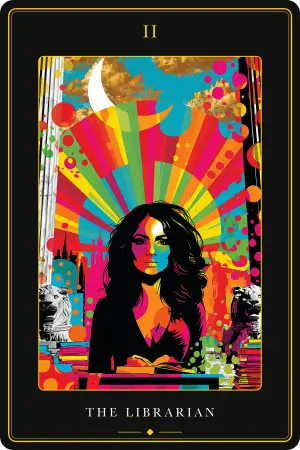



Major Arcana · 4
The Matriarch
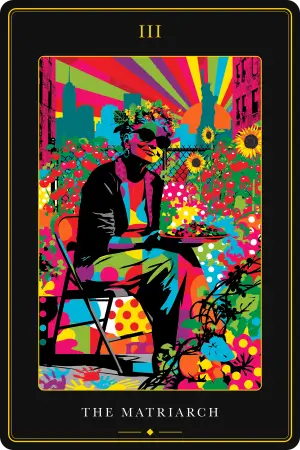
The woman on the folding chair in the community garden, holding out a full plate to whoever walks through the gate.
Card at a glance
- Numerology
- III
- Element
- Earth
- Astrology
- Venus · Taurus
- Kabbalistic path
- Daleth (Chokmah → Binah)
- Timing
- Late summer · one growing season
- Yes / No
- Yes, if you are willing to tend it
Upright
Nurturing
The full plate
Chosen family
The community garden
Abundance from tending
Matriarchal authority
Hospitality
Growth
Reversed
Caretaker burnout
The empty plate
Smothering
The garden gone to weeds
Care with strings attached
Blocked growth
Losing yourself in others' hunger
The Matriarch in each deck
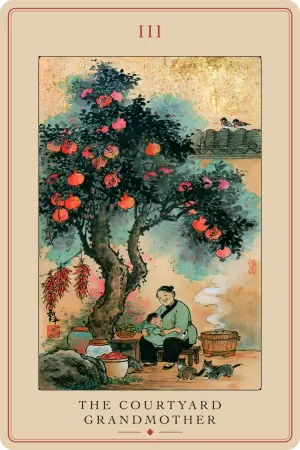
Every deck reimagines the same archetype. Compare the art, then open a deck to read its full interpretation.
Imagery and symbolism
In the Tarot of New York City the Empress becomes the Matriarch, and the lush landscape of the classic card becomes a community garden wrested from a vacant lot. The card is built in the deck's pop-art language of saturated color blocks and halftone dot fields, and it translates every element of the traditional arcana into something the five boroughs actually contain.
She sits at the center on a folding chair. Where the Rider-Waite-Smith Empress reclines on a bank of red velvet cushions, the Matriarch takes the battered metal chair found at every stoop, block party, and domino game in the city. It is a throne that can be carried and set down wherever it is needed, which makes her sovereignty portable and earned. Her posture is relaxed and open, carrying the same message the cushions carry: she is at ease because everything around her is tended and nothing here threatens her.
The crown of twelve stars becomes a crown of living flowers and tomato blossoms woven into her hair. The cycles of nature are still worn on the head, but they are grown rather than gilded. Her sunglasses are pure New York: she sees everyone while no one fully reads her, and the serenity comes with an edge of street wisdom. A single hoop earring stands in for the scepter, adornment carrying quiet authority.
The heart-shaped shield with the glyph of Venus is gone. In its place she holds a full plate of food, extended toward the viewer. This is the deck's central transformation of the card. Love is expressed as feeding, there is always a plate for you, and in this city protection tastes like dinner.
The field of ripe wheat turns into cherry tomatoes swarming over a chain-link fence, flanked by towering sunflowers. Fertility here is defiant. It is abundance coaxed out of a lot the city abandoned, growth climbing the very barrier meant to keep people out. That overgrown chain-link is the card's quiet miracle: a boundary has become a trellis.
Behind her the skyline rises, the Empire State Building on one side and the Statue of Liberty silhouetted on the other, with the sun throwing pop-art rays between them. The waterfall of the Rider-Waite-Smith card is implied by Liberty's harbor, the flow of arrivals and the current of immigrant life that feeds the garden. The sunburst serves as her halo, and she shares it with the whole block.
At her feet, children's handprints are pressed into the pavement in bright colors. They replace the pomegranates scattered across the Empress's gown. Each one records a child this garden raised, and creation is made permanent in cement rather than embroidered on cloth. Tenement walls frame the scene and hold it inside the city's embrace. This Eden sits in New York, exactly one lot wide, defended by love and a folding chair.
Core meaning
The Matriarch makes one claim: abundance comes from tending, not from buying. In a city organized around acquisition, square footage, and salary, she stands on a lot that cost nothing and produces everything, and she asks which of those two economies is real. Nothing on that lot was purchased into existence. It was tended into existence.
Her love is cultivated rather than felt. In her teaching, love is watering, weeding, cooking, and showing up. The tomatoes climbing the chain-link argue that scarcity is often just neglect, and that the ground the city wrote off is exactly as fertile as the ground priced by the square foot. Her second claim is about family: blood is one way to be related, the plate is another. By feeding whoever arrives she dissolves the line between kin and neighbor. The handprints in her cement belong to children of a dozen surnames and she claims all of them.
Inside this deck she is the third lesson. The Hustler at I shows the Newcomer that everything can be moved. The Librarian at II shows him that everything is written down somewhere. The Matriarch proves that nothing grows unless somebody feeds it. She is also the first person in the city who feeds him without asking what he can do for her, and that is what separates her from every transaction he has met so far.
Upright meaning
Upright, something is growing. It might be a relationship, a pregnancy, a project, or a version of you that is finally being fed. The situation is fertile and the plans have landed in good soil, even if that soil looks like a cracked lot between tenements. In this city abundance is rarely handed down from a penthouse. It gets coaxed up through concrete by someone who keeps watering. The card can indicate a literal pregnancy, a new home, a family event, or the arrival of your chosen family, and broadly it means that what you tend now will feed you later.
Her advice is to tend rather than force. The Matriarch never yells at a tomato to grow; she shows up every day with water. Feed the project, the relationship, or the body consistently and without drama. Accept the plate when it is offered, because receiving care is part of the lesson. Make your space hospitable, invite people in, cook for someone. Lead with warmth and let your authority end arguments with a look and a full plate rather than a raised voice.
In love. One of the warmest cards the city deals. This is the relationship where someone learns how you take your coffee, and affection is expressed through tending and remembering and showing up. Sensuality runs deep and unhurried here, more like a slow Sunday than a dramatic Saturday night. She often signals a relationship becoming family: moving in, keys exchanged, a pregnancy, a partner absorbed into your circle until nobody remembers them not being there. If you are looking, choose the person who tends, and watch how they treat waiters, plants, and their grandmother.
In career. A fertile professional season. Projects are ripening, recognition is arriving, and some corner of the workplace actually feels human. She often marks the team's nurturer: the manager who develops people instead of consuming them, the colleague who covers shifts, the mentor whose interns bloom. In this city the person who feeds the team may eat last, but they are protected first. Her professions run to everything that grows, feeds, shelters, and holds people together: community organizer and tenant association leader, chef and baker and bodega owner, urban farmer and florist, midwife and doula and lactation consultant, pediatrician and school nurse, daycare director and kindergarten teacher, social worker and foster care coordinator and shelter director, therapist, ceramicist and interior designer, the small business owner whose shop works as the neighborhood's living room, the mutual aid coordinator, the muralist who decorates the commons instead of a gallery.
In finances. The harvest card. Income increases because something planted long ago is finally fruiting, whether that is a side business maturing, an investment compounding, or property that shelters rather than speculates. She favors money tied to home and nourishment, and she can indicate help arriving through community: a loan that is really a gift, or a network that finds you an apartment. Be generous now, since under this card generosity circulates back. For the Matriarch money is soil, and it exists to grow things.
In health. The card of the well-tended body. She reframes the whole subject: your body is not a project to optimize but a garden to feed. Health improves through nourishment rather than punishment, through real meals and sleep and sunlight and water. She favors the beauty that comes from being rested and loved, and she often signals recovery, strength returning after illness. Her regimen is the daily watering, not the dramatic overhaul.
Reversed meaning
Reversed, the Matriarch is the caretaker running on empty. She is still smiling and still cooking, and secretly resenting every plate. The situation may involve giving too much and receiving nothing, or gripping something so tightly it cannot grow. The garden is either abandoned to neglect and creative drought or over-pruned by micromanagement. Growth stalls: a project that will not take root, a family plan under strain, a community curdled into obligation. Sometimes it simply means you have fed everyone on the block and forgotten that you get hungry too.
The correction is to put your own plate on the table first. Audit what you give against what you receive and renegotiate it out loud instead of through martyrdom. If you are holding a grown child, a project, or a partner too tightly, loosen the grip and let it grow crooked if it must, because things grown under total control come out stunted. If the garden has gone to weeds, start with one small bed: one meal cooked for yourself, one call, one hour of tending. If the exhaustion runs deep, let someone else hold the watering can. Asking for help is how this kind of authority survives.
In love. Nurture out of balance. One partner has become the parent, managing and fixing everything, and desire suffocates under the caretaking, because it is hard to want someone you have to raise. Or care has turned to control: jealousy dressed as concern, generosity with a ledger, help that works as a leash. She can show the depleted lover too burned out to feel intimacy because their body is never off duty, or fertility struggles, or a household where the domestic machinery runs perfectly while the romance starves.
In career. The office caretaker at the end of her rope. You may be doing the emotional labor, mentoring the juniors, and covering the gaps invisibly and unpaid, with resentment building underneath. The dynamic can also run the other way: a smothering manager who cannot delegate, or a supportive culture that functions as surveillance. Nobody is allowed to fail, so nobody learns. In business the phrase "we are a family here" becomes a mechanism for unpaid overtime. Keep the care and invoice the labor. Make the invisible work visible and ask for the pay that matches it.
In finances. The harvest is being mismanaged or devoured. Classic patterns are giving beyond your means, supporting dependents until your own security erodes, or comfort spending that soothes and depletes. Money leaks through the home via repairs or rent outpacing income, and family money gets tangled in guilt until gifts turn out to be leashes. The fix is a gardener's audit: what in this budget is seed, what is harvest, and what is being eaten by pests? Feed what grows and stop watering what does not.
In health. The caretaker's body sending the bill. This is the pattern of feeding everyone but yourself: meals skipped, sleep sacrificed, checkups postponed for years, the body treated as staff rather than family. Depletion shows up as exhaustion, stress eating, or a brittleness no product can fix because the root is neglect. Comfort can also tip into excess, or into a punishing regimen that is really control. Hormonal and fertility issues sometimes surface here and deserve real medical attention rather than endurance.
Historical notes
The figure this card renames began as a study in political power. In the fifteenth-century Visconti-Sforza deck, commissioned for the Milanese nobility when tarot was still a trick-taking game, the Empress sits on a rigid throne among ripe foliage and harvested fruit, holding a shield emblazoned with the eagle of the Holy Roman Empire. Her maternal care was bound directly to imperial dominion.
The standardized Tarot de Marseille kept her crowned and seated but changed her tools. She gained a scepter and a shield, and the imperial eagle was frequently replaced or supplemented by the symbol of Venus. That one substitution moved her center of gravity away from statecraft and toward fertility, motherhood, and the Earth Mother who feeds humanity.
The modern card arrived in 1909. A.E. Waite and Pamela Colman Smith lifted her out of the throne room and set her in a flowering landscape. In the 1910 Pictorial Key to the Tarot, Waite called this the inferior Garden of Eden, the Earthly Paradise, and named her a Refugium Peccatorum, a fruitful mother of thousands who stands for universal fecundity.
The Tarot of New York City continues that movement rather than reversing it. Each version answered a local question about where creative female power could visibly live: in an imperial court, in a Venusian nature goddess, in an Edenic countryside. Waite took her out of the palace and put her in a garden. This deck takes her out of the countryside and puts her on a lot between tenements, which is the only open ground the city had left to give her. Her shield becomes a plate because in New York the proof of abundance is not a heraldic device, it is whether anyone eats.
Correspondences
Number. Three, the first number that creates. One is the Hustler's spark of will, two is the Librarian's silent knowing, and three is what happens when spark meets knowledge and something new is born. On this card three appears everywhere: a garden is planting, tending, and harvest; a meal is cooking, serving, and eating together; the block runs on the building, the stoop, and the street. Three is the number of the triangle, the most stable shape, and the Matriarch is the stable point the neighborhood arranges itself around. It is also the number of communication and sociability, which is why her garden works as a forum as much as a farm: deals get settled there, grief gets aired, gossip gets composted into wisdom. Where two holds things in potential, three pushes them into visible, edible form.
Astrology. Venus, the planet of love, beauty, pleasure, and fertility, but Venus living in New York. She does not recline in a marble villa; she presides over a lot where sunflowers outgrow the chain-link. People gather to her the way the block gathers to a summer cookout, entirely unsummoned. Her aesthetic is Venusian too, a hand-tended beauty that exists because someone decided the neighborhood deserved it, and Venus rules the arts, so her art form is the environment itself. Venus also governs value and resources in their gentlest form. This is not the Developer's leveraged capital but the wealth of ripe things and shared meals, where prosperity is measured by who eats at your table. Because Venus rules both Taurus and Libra, readers must choose, and most place the Empress in earthy Taurus, whose bodily appetite fits her better than Libra's cooler social register.
Element. Earth. Literal soil in this deck, hauled into a lot the city forgot.
Kabbalah. Her Hebrew letter is Daleth, the door, the gateway through which life enters the physical world. On the Tree of Life she holds the path joining Chokmah (Wisdom) to Binah (Understanding), giving form and structure to raw creative force. The open gate in her chain-link fence is that letter rendered in city hardware.
Elemental dignity. Beside Pentacles her material abundance swells; beside Cups the reading warms toward family and emotional nurture.
Psychological perspective
Psychologically the Matriarch describes the nurturer-creator, a person whose ego structure is organized around growing things and feeding people. She instinctively grasps what a child, a plant, or a fledgling business needs in order to thrive, and she feels a bodily impulse to provide it. This is often a woman with a powerful maternal current, though it can as easily be a man, a grandparent, or a neighbor whose deepest satisfaction is watching something they tended stand on its own. Such people think in seasons rather than deadlines, and their identity is distributed across everything they care for. Ask how they are and they will tell you how the garden, the kids, and the block are doing.
The strengths are warmth, patience, and emotional steadiness. They can make any space feel like home within minutes, and hospitality is a reflex rather than a decision. Their creativity comes out in tangible things: food, gardens, gatherings. Their authority is quiet and comes from being trusted rather than feared, which makes them the person others confess to and recover around.
The shadow is care that cannot stop or let go. They over-give until they are depleted and then resent the people they fed, or they use nurture as leverage and weaponize guilt. Sometimes they smother what needs to struggle, keeping children and projects dependent because being needed is the whole identity. There is a neglect shadow as well: the burned-out caretaker who abandons their own finances and dreams because everyone else's hunger came first. The growth task is learning that they are also one of the living things in the garden, and that they are allowed to be tended.
The Matriarch across decks
Tarot de Marseille. The Empress stays crowned and enthroned with scepter and shield, the imperial eagle already yielding to the glyph of Venus that marks her turn toward fertility.
Rider-Waite-Smith. The 1909 figure reclines on cushions in an open landscape, crowned with twelve stars from Revelation 12:1, her gown scattered with pomegranates, a heart-shaped Venus shield in the grass beside her, ripe wheat at her feet and a waterfall behind.
Crowley-Thoth. Lady Frieda Harris painted her voluptuous and fluid before uprights of blue twisted flame, born of water and carrying the lotus of Isis. Crowley read her as pure feeling and sexuality, unintellectual but standing for the raw drive of life, for maternity and mercy.
Modern decks. Kim Krans's Wild Unknown drops the human figure for a lavish tree against a night sky with a waning crescent moon, casting the Empress as the vital force of the earth itself. Lisa Sterle's Modern Witch Tarot keeps the core symbols and celebrates a voluptuous, diverse body in the lineage of the ancient fertility goddess, back to the Venus of Willendorf.
The Tarot of New York City. The Matriarch sits closest to Sterle in her insistence on unashamed physical presence and closest to Krans in her argument that the Empress is the earth's own vitality rather than a person. What this deck adds is a specific piece of ground. Krans removes the human to reach nature; New York keeps the human and moves nature to where the humans already are, under the asphalt, waiting. The Wild Unknown's tree grows in unbroken dark. These tomatoes grow up a chain-link fence with the Empire State Building behind them, and the difference is the whole point. The wheat field becomes a lot the city abandoned, the Venus shield becomes a plate of food, and the pomegranates of fertility become handprints pressed into wet cement by children of a dozen surnames.
In combination and context
The Matriarch is read against the other figures of authority in this deck. Her defining contrast is with the Developer, who imposes order from a glass tower while she grows order from the soil up. Hers is the only authority in the deck that nobody resents, and the reason is that she fed people before she asked anything of them.
Against the Librarian at II she is the mother beside the mystic, physical creation and outward nurture set against spiritual fertility and inward focus. Readers put the classic version plainly: the Priestess is pregnant and the Empress is giving birth. Against the Hustler at I she is the answer to his question. He proves the city can be worked; she proves it can be fed, and a reading holding both asks whether you are extracting from a place or cultivating it.
She also shades into the Queen of Pentacles, and the distinction matters. The Matriarch is a Major Arcana life theme, the cosmic spirit of creation and motherly love. The Queen is the situational working mother who cooks the meal and manages the money. One births the idea and the other executes it, and some readers treat the Empress as the synthesis of all four Queens, holding the emotional depth of Cups, the passion of Wands, the intellect of Swords, and the practicality of Pentacles at a higher frequency.
In pregnancy questions her neighbors color the reading. Alongside the Ace of Cups, the Page of Cups, or the Four of Wands she leans toward fertility and family. Those same cards reversed point instead to blockage, turbulent family dynamics, or grief over what circumstances will not yet allow.
Position matters. As advice she tells you to tend something specific and to accept a plate. As the obstacle she is the care flowing in one direction only, or the ground you called barren without ever watering it. As the outcome she promises a harvest on its own schedule rather than yours.
Questions for reflection
- What have I called barren in my life that is actually just untended?
- Who feeds the feeder in my circle, and when did anyone last ask that about me?
- If someone offered me a full plate today, would I take it without performing reluctance?
The general meaning follows the Rider-Waite-Smith reading — the reference used across Tarot Academy. Open a specific deck above for its own interpretation.
Frequently asked questions
Explore the Tarot
Latest Posts
Discover the ancient wisdom of tarot cards and unlock the mysteries of your spiritual journey. Our blog is your gateway to understanding the rich symbolism, meanings, and practical applications of tarot reading.




















































