
 EN (English)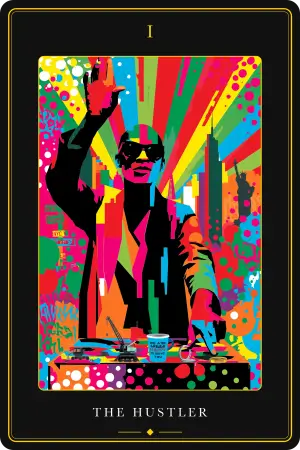


Major Arcana · 3
The Librarian
The keeper at the desk between Patience and Fortitude, holding everything the city wrote down and then chose to forget.
Card at a glance
- Numerology
- II
- Element
- Water
- Astrology
- The Moon · Cancer
- Kabbalistic path
- Gimel (Kether → Tiphereth)
- Timing
- The night shift · about a month
- Yes / No
- Maybe · look it up before you decide
Upright
Intuition
The archive
City memory
Patience
Research before action
Quiet authority
Listening under the noise
Solitude
Reversed
Sealed records
Withheld information
Ignored intuition
Headline thinking
Isolation
Manipulation by secrets
Refusing to look it up
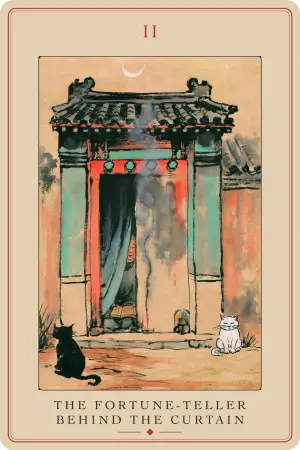
The Librarian in each deck
Every deck reimagines the same archetype. Compare the art, then open a deck to read its full interpretation.
Imagery and symbolism
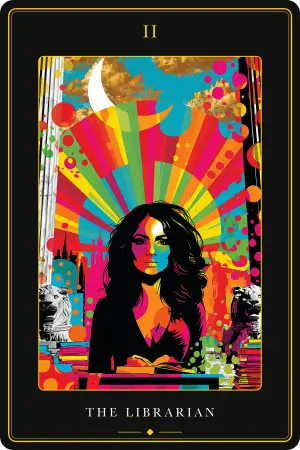
In the Tarot of New York City the High Priestess becomes the Librarian, and the temple threshold becomes the front steps of the New York Public Library on Fifth Avenue. She sits at the desk in the reading room where the ceiling is painted like a sky. Every element of the classic arcana survives the move; each one changes citizenship.
The two pillars become two marble lions. Where the Rider-Waite-Smith Priestess sits between the black Boaz and the white Jachin, the Librarian is flanked by Patience and Fortitude, one rendered in light and one in shadow. They are the city's guardians of the line between the street and the stacks, and to reach what she keeps you have to walk between them. The names were given during the Depression so the city would remember how to survive, which makes the threshold itself an act of memory.
Above her hangs a white crescent moon in a pop-art sky of gold halftone clouds. It carries the lunar crown of the classic Priestess: intuition, cycles, and the tide of the subconscious running under the grid of the conscious city. The moon over the skyline places the card on the city's night side, the hour when the reading room of the mind is open and daytime traffic has stopped.
Behind her a sunburst of saturated rays fans out like the painted ceiling of the Rose Main Reading Room, standing in for the Priestess's veil of pomegranates. The whole spectrum of hidden knowledge spreads out behind her head, ordered like a catalog. Her face is split by color, one half in warm light and one in cool shadow, holding the duality that the number two has always carried. Her dark hair falls like the Priestess's robe, flowing like water, the element of this arcana.
On the desk lies an open book, this deck's version of the TORA scroll half-hidden in the Priestess's lap. The knowledge is open, but only to the reader who came all the way to the desk and asked. Around and behind her, stacks of books in every color stand in for the city's sealed collections. The skyline and the Statue of Liberty rise in the background as the outer, public city she serves without belonging to it, and Liberty's torch of enlightenment answers the Librarian's quieter lamp. The halftone dots scattered across the card are the deck's signature: the city as a field of small points that resolves into a picture only when you step back, which is exactly what she teaches.
Core meaning
The Librarian is the claim that the city remembers. Under eight million exteriors there is a record, and someone keeps it. The generic High Priestess says the answer is already inside you. This deck narrows that: the answer already exists in the stacks, in the record, or in your own subconscious, and it will not be shouted at you over the street noise. Retrieval is the work, not invention.
She gathers knowledge through perception rather than action. People bring her half-formed questions and she answers with a call number and a look, because wisdom cannot be handed across a desk. It can only be located. That refusal to explain is her whole teaching method, and it is the oldest one the Wise Woman archetype has.
Inside this deck she is the second lesson. The Newcomer steps off the bus at Port Authority, meets the Hustler on Canal Street, and learns that the city can be worked. The Librarian teaches the other half: the city can also be read. Where the Hustler is active energy with the hands moving and the deal happening, she is the receptive pole where knowledge accumulates rather than circulates. He can get you anything. She knows where everything is.
Upright meaning
Upright, the Librarian asks for intuition, patience, and research before any move. The situation needs deep insight rather than speed, and the answer you need has already been filed. Step out of the traffic and into the reading room of your own mind. Pay attention to dreams, premonitions, and subconscious hints; what looks unobvious is usually what resolves the question. To a straight yes-or-no she generally answers that you have not looked it up yet.
In love. Love in the city's quiet register rather than its loud one. She expresses sensuality through attention: the person who remembers what you said in passing three months ago, who listens to the emotional level under the words. It looks like conversations on the fire escape that run until 2am, or two people reading in the same room in comfortable silence. The card can also mark a chosen solitude, time spent understanding your own feelings before you offer them to anyone.
In career. She is the colleague everyone consults and nobody manages. Growth comes through intuition and deep understanding of the situation, and the critical information is not lying on the surface: it is in the files, the records, and the institutional memory, and retrieving it takes effort. The card favors complex projects that need real analysis, thorough preparation over vigorous action, and often points to a wise female mentor at work. The deck's professions run to the stewardship of knowledge: librarian, archivist, museum curator, psychologist or therapist, teacher and professor, writer and poet and researching journalist, humanities scholar, astrologer, tarot reader, medium, philosopher, spiritual counselor, and the modern city's version, the information specialist, data analyst, and fact-checker who knows which record is real and where it is kept.
In finances. She is the reader of fine print in a city that buries you in it: the clause in the lease, the fee in the statement, the pattern in the market that never makes the headlines. She indicates new income or investment built on well-tuned instinct backed by research, and often a period when you finally understand where your money actually goes. Financial education or a more experienced advisor may be called for. Look it up before you sign it.
In health. She treats the body the way she treats the collection: attention, respect, quiet daily maintenance. The body keeps accurate records and its signals are catalog entries worth reading. Sleep and the night cycle matter heavily under her crescent moon, and the card favors meditation, yoga, long walks through the city, and a shift toward inner rhythm rather than trend.
Reversed meaning
Reversed, the reading room has been abandoned for the noise of the street. Intuition goes neglected, inner balance slips, and you may be living on headlines and rumors instead of checking a source. The card also runs the other way: information is withheld, records are sealed against you, or someone in the situation knows more than they are saying. The remedy is the Librarian's own. Discard the assumptions, look at the facts the way a researcher would, and verify before you believe.
In love. True feelings stay shelved, unspoken and out of reach. The relationship may not be what it looked like at first glance, functional on the surface and thin underneath. One partner withholds trust, and the closed stacks between two people stop anything from developing. At worst it is two people in the same apartment, each sealed in a separate inner world. The signs were all on the record, unread.
In career. Passivity, indecision, and concealed information: the meeting after the meeting, the record that does not match what you were told. Problems with a female colleague may surface, or the line between work and inner life may blur. A mentor's influence can be disorienting rather than useful. Professional development stalls on insufficient curiosity and the habit of guessing instead of looking things up.
In finances. Statements left unopened, terms unread, instinct ignored. This is where the classic New York traps land: the lease signed without reading, the guaranteed opportunity, the fee structure nobody explained because nobody asked. The reversed card warns plainly about being deceived or defrauded, and insufficient knowledge leads straight to loss.
In health. The signals were filed and ignored. There may be fear of self-examination, difficulty accepting your appearance, or an excessive focus on image at the expense of actual health in a city that photographs everything. Mind and body fall out of step: skipped meals, broken sleep, the 3am scroll instead of rest, exercise perpetually postponed. Get the checkup, read the results, keep the records.
Historical notes
The figure this card renames has one of the more provocative histories in Tarot. She began as La Papessa, the Popess. Medieval folklore of Pope Joan, a learned ninth-century woman said to have disguised herself as a man, risen to the papacy, and been exposed when she went into labor during a procession, shaped the early image. The eighteenth-century Tarot de Marseille shows a woman in the papal tiara holding a book and sometimes the keys of the kingdom, and Protestant countries used her to mock the Catholic Church.
Italian historians point to a specific woman. In the mid-fifteenth-century Visconti-Sforza deck, made for the Duke of Milan, La Papessa wears the plain brown habit of an Umiliata nun and is identified as Sister Manfreda (Maifreda da Pirovano), a Visconti relative. She was central to the Guglielmite sect of Lombardy, which held that its deceased leader Guglielma of Bohemia was the Holy Spirit incarnate and would return at Pentecost in 1300 to begin a line of female popes starting with Manfreda. Wealthy Lombard families supplied sacred vessels for the Mass she expected to say in Rome. The Inquisition exterminated the sect and burned her at the stake in the autumn of 1300, and memorializing her in the deck 150 years later read as a Ghibelline statement against papal authority. Swiss Troccas decks later rebranded her as Junon, and the mid-eighteenth-century Flemish Vandenborre deck swapped her out for a Commedia dell'Arte captain.
The universal archetype arrived in 1909. A.E. Waite dismissed the Pope Joan link, renamed the card The High Priestess, and tied her to Isis, Astarte, Artemis, and the Kabbalistic Shekhinah, replacing Catholic dogma with Hermetic and pagan symbolism.
The Tarot of New York City continues that line of renaming rather than breaking it. Every previous version answered a local question about where sanctioned female knowledge could live: in a heretical papacy, in a Roman goddess, in an Egyptian mystery cult. This deck answers it with an institution the city actually built and staffed, a public library with lions at the door. Waite made her cosmic. New York gives her a job.
Correspondences
Number. Trump II, and the card is built out of pairs. Two lions at the threshold, two halves of her face in light and shadow, and two cities she sits between: the loud visible one and the quiet recorded one. In the structure of the deck the 2 answers the 1. If the Hustler is primal active energy, she is the passive and receptive pole; the 1 acts while the 2 receives, holds, and understands. Two also carries the axiom "as above, so below," which in this deck reads as "as on the street, so in the stacks." In numerology it signifies diplomacy, cooperation, and partnership, and her entire function is mediation: between the reader and the archive, the question and the call number, the present city and its buried past.
Astrology. The Moon, which rules intuition, the subconscious, memory, and the emotional tide that moves under conscious life the way the subway moves under the street. The crescent hangs over the skyline on the card itself, marking her as the Moon's officer in the city, on duty when the daytime mind has gone home: the 3am city, the empty reading room, the hour when hidden things become visible to whoever is still awake. The card also corresponds to Cancer, which the Moon rules. Cancer governs the emotional sphere, home, family, ancestors, the past, and tradition, and the Librarian keeps the city's past inside its institutional home of memory. Cancer's deep feeling, sensitivity, and protective shell are all hers, and she guards what matters behind marble walls, a reserved manner, and two stone lions named for Depression-era virtues.
Element. Water. Her dark hair falls like the Priestess's robe, flowing like water, and the subconscious tide it stands for runs beneath the grid.
Kabbalah. The 13th path, the longest on the Tree of Life, running straight down the Middle Pillar from Kether to Tiphereth, across the Abyss and through the hidden Da'ath. Her Hebrew letter is Gimel, the camel, the one beast that crosses the desert on water it stores itself. The image fits a figure whose authority comes from an internal collection rather than from anyone's permission.
Elemental dignity. Beside the watery Cups her intuitive register deepens; beside airy Swords the reading tilts toward secrets held in the mind.
Psychological perspective
Psychologically the Librarian is the psyche that stays quiet in the loudest city on earth, and does so out of depth rather than timidity. She has a rich inner world and an intuitive read of herself and her surroundings, listening closely to people, to rooms, and to the city itself for connections nobody names out loud. She values silence and solitude, which in New York has to be defended like territory: the corner of the reading room, the last car of the late train, the early morning before the phones start.
The strengths are wisdom, creativity, and attention to the small detail that carries the concealed meaning. This is the friend who says one sentence at the end of your monologue and turns out to have named the whole problem. Such a person acquires knowledge without forcing events, and can often predict how things will go with unsettling accuracy, having read the story before. The archetype's radical move is stillness in a city built on rush, and it takes more nerve than it looks like.
The shadow is the same trait past its limit. Passivity becomes the trap: opportunities pass while more information is gathered, and isolation is easy in a place where you can be invisible in a crowd. Overreliance on intuition tips into naive trust or blanket suspicion. Someone can retreat so far into their own stacks that they stop checking them against the street outside, and the habit of viewing everything through the inner world creates communication problems, since not everyone can meet that depth or wants to. The reversed extreme is the keeper who abuses the position, trading in what she knows about people and reading the room only in order to play it.
The Librarian across decks
Tarot de Marseille. La Papessa keeps her papal roots, seated in the triregnum with a book in her lap: the heretic pope of Renaissance imagination rather than a cosmic oracle.
Rider-Waite-Smith. The 1909 figure sits between Boaz and Jachin under a veil of pomegranates and palms, crescent moon at her feet, horned diadem on her head, solar cross at her chest, the TORA scroll half-hidden in her mantle.
Crowley-Thoth. Painted by Lady Frieda Harris between 1938 and 1943. Crowley's Priestess sits behind no cloth veil but a luminous veil of light, his argument being that for the high initiate even pure brilliance is one last screen over the formless spirit. A bow that doubles as a harp links her to Artemis who hunts by enchantment, seeds and crystals form at the card's base, and a faint camel in the background names her path.
Modern decks. Kim Krans's Wild Unknown replaces the woman with a white tiger gazing out of a starry dark, casting intuition as raw animal instinct. Lisa Sterle's Modern Witch Tarot keeps the pillars and the pomegranate veil but hands her an open laptop covered in occult stickers, then has her look away from the screen.
The Tarot of New York City. The Librarian sits closer to Sterle's reading than to Waite's. Both put the archetype inside the information age and both insist she still looks away from the screen, but this deck gives her the institution instead of the device. The pillars become Patience and Fortitude, the veil becomes a sunburst modeled on the Rose Main Reading Room ceiling, the TORA scroll becomes an open book on a public desk, and the pool of the collective unconscious becomes stacks of sealed collections running below street level. The Wild Unknown's night is here too, translated into the 3am city. What the deck adds to every version before it is service: this Priestess has business hours, and anyone can walk up and ask.
In combination and context
The Librarian casts a veil of secrecy over the cards near her and asks for an intuitive reading of them. Beside Cups the emotional depth increases; beside Swords the theme narrows to secrets kept in the mind.
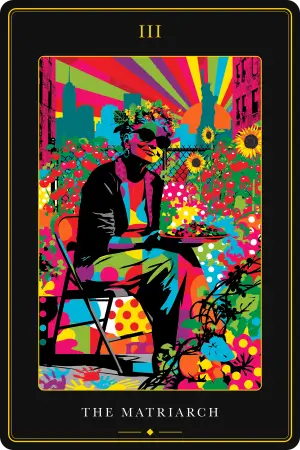
Her defining pairing in this deck is the Hustler at I. He is the street and she is the stacks, outer doing against inner knowing, the spoken deal against the guarded silence. Together they mark an alignment of action and knowledge: the power to move joined to the sense of when. A reader working with both uses her to decide what is worth pursuing and him to work out how. Against the Empress at III she is the mystic beside the mother, spiritual fertility and inward focus rather than physical creation and outward nurture. Against the Hierophant at V she is personal revelation beside established dogma, the unorthodox oracle to his orthodox teacher.
Her other pairings sharpen the theme. With the Newcomer she is a leap of faith guided by inner knowing, a path others cannot follow but that is intuitively correct. With the Devil she warns of toxic secrets or manipulation working out of sight. With the Moon the veil thickens into illusion or paranoia and intuition either heightens or misfires.
Position matters. As advice she says stop, research, and let the quiet give you what the crowd drowned out. As the obstacle she is the file you never opened and the instinct you talked yourself out of. As the outcome she promises understanding rather than resolution, which in this deck is usually the more useful of the two.
Questions for reflection
- What did I already sense about this situation before anyone told me their version of it?
- Which record have I avoided opening because I suspect what it says?
- Where in this city do I go to be quiet, and when did I last go there?
The general meaning follows the Rider-Waite-Smith reading — the reference used across Tarot Academy. Open a specific deck above for its own interpretation.
Frequently asked questions
Explore the Tarot
Latest Posts
Discover the ancient wisdom of tarot cards and unlock the mysteries of your spiritual journey. Our blog is your gateway to understanding the rich symbolism, meanings, and practical applications of tarot reading.




















































