
 EN (English)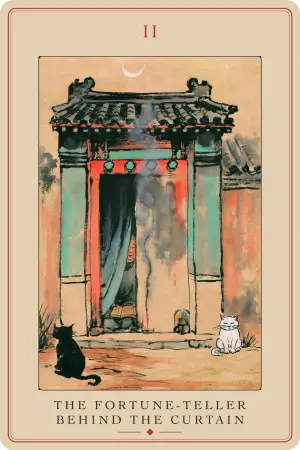


Major Arcana · 4
The Courtyard Grandmother
Abundance ruled from a hutong courtyard, where care takes the form of steaming dumplings and jars put by for winter.
Card at a glance
- Numerology
- III
- Element
- Earth
- Astrology
- Venus
- Kabbalistic path
- Daleth (Chokmah → Binah)
- Timing
- Harvest season · ripening
- Yes / No
- Yes
Upright
abundance
nourishment
motherhood
hospitality
fertility
harvest
home
preservation
Reversed
smothering
depletion
control
self-neglect
scarcity
hoarding
burnout
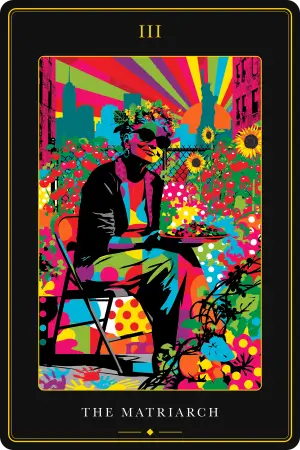
The Courtyard Grandmother in each deck
Every deck reimagines the same archetype. Compare the art, then open a deck to read its full interpretation.
Imagery and symbolism
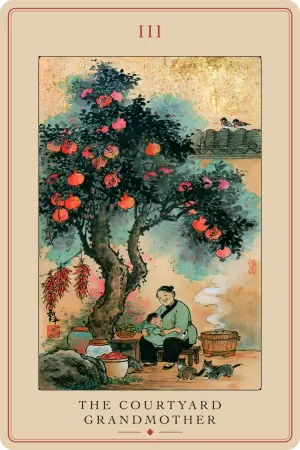
In the Tarot of Beijing the Empress is the Courtyard Grandmother (四合院大妈), sovereign of a siheyuan courtyard, drawn in the calm brush lines of Feng Zikai on gold-flecked kraft paper. The deck keeps none of the Rider-Waite regalia: no throne, no scepter, no crown of twelve stars. Here the cosmic is shown through the small and human, and her whole empire is the courtyard.
The pomegranate tree dominates the card, heavy with split, ripe fruit. Where the Rider-Waite Empress wears pomegranates embroidered on her gown, this deck grows the symbol into a living tree, a hundred seeds in one skin standing for fertility and the many lives gathered under one roof. Several fruits have burst open, their seeds already showing.
She sits on a low stool with a grandchild asleep in her lap, and that sleeping child is the deck's answer to the Empress's throne: authority measured by how safely something small can rest against it. Her smile turns down to the child, not out to the viewer. Beside her a basket steams with dumplings already cooking, so nourishment here is always underway, the rising steam the only incense in her temple.
Jars of pickled vegetables and strings of drying chilies line the wall for foresight, abundance stored against winter, the chilies adding the deck's accent of vermilion. A basket of fresh greens on the bench holds the harvest of the present, balancing the jars of the future. Two cats doze by the steamer, creatures that stay only where there is warmth and regular food. Paired birds on the tiled wall echo the Empress's Venus, the household built by two. Above the tree a gold-leaf sky replaces the Rider-Waite waterfall as the sign of grace, and a grey courtyard wall encloses the scene the way the forest encloses the older Empress. The small red seal in the corner reads almost like the household's own mark: this courtyard is claimed and kept.
Core meaning
The Courtyard Grandmother is the Empress read as housekeeping. Her power is abundance made concrete, the life force that feeds a child, a project, a garden, or a household, and she rules it by feeding rather than forcing. She carries the number three, in Chinese a homophone of growth and generation, and in tarot the point where The Newcomer's fresh will and the Fortune-Teller's hidden knowledge combine into something you can eat.
She governs all three tenses of the home at once: the fresh greens of today, the dumplings steaming now, the pickles laid up for winter. What she teaches is that creation is patient work. The pomegranate tree did not appear by decree; someone watered it for thirty years, and it splits open on its own when it is ready. To draw her is to be pulled back into the body and the daily tending where abundance actually lives.
Upright meaning
Upright, the Courtyard Grandmother marks a fruiting season. You have entered her courtyard, and what you planted begins to ripen: projects mature like the persimmons on the branch, relationships deepen like tea left to steep, and the body, the home, and the purse all incline toward plenty. Her counsel is to nourish what you want to grow and let the harvest arrive at its own pace.
In love. Love in its ripened form, warm and physical and daily, the romance of shared meals and shared quilts. The card favors deepening commitment, moving in together or marriage, and it often speaks to pregnancy or the shared wish for children, plain in the split pomegranates and the paired birds.
In career. A warm, well-fed season at work. Projects ripen to completion, earlier effort is recognized, and a nurturing mentor may feed your growth. Work tied to care, food, home, children, or beauty does especially well, and a raise or comfortable improvement in conditions is likely.
In finances. The fullest larder in the deck. She promises patient increase: income that ripens like fruit, savings that accumulate like jars along a wall, property that shelters and appreciates. Money here arrives through care-based work, family, or inheritance, and it is meant to circulate.
In health. A card of ripeness and rest. She favors real food, deep sleep, sun, touch, and unhurried movement, and she is a strong sign for fertility, women's health, and recovery after illness. Treat the body the way she treats her courtyard, fed and warm and left to ripen at its own pace.
Reversed meaning
Reversed, the Courtyard Grandmother has forgotten to eat her own dumplings. Care spills out until the pot boils dry, or it hardens into control and the courtyard becomes a cage where nothing may grow its own way. Grown children are not released, ideas are over-tended until they wilt, and concern arrives uninvited and overstays. The remedy is written on the card: sit on your own low stool and let someone pour the tea for once.
In love. The courtyard walls have grown too high. One partner mothers the other until desire suffocates, jealousy dresses itself as concern, or comfort quietly replaces passion in a home that is well fed and a little lonely. Open the gate and let care flow both ways.
In career. The burned-out provider who steams dumplings for the whole office while her own portion goes cold. Caretaking swallows the actual job, a smothering manager leaves no air, or a cozy post has become a walled courtyard you fear to leave though nothing grows there. Output stalls from depletion, not laziness.
In finances. The jars ring hollow. Watch for providing beyond your means, adult dependents draining the reserve, or comfort spending that has become a leak in the roof. Money can also tangle with guilt and control, support given with strings, or fearful hoarding that feeds no one.
In health. The cook who never sits down to eat. Self-neglect hides behind busy care for everyone else: exhaustion, sleep sacrificed to the household, checkups endlessly postponed. It can also point to fertility worry or to harshness toward a body that is simply softening and changing.
Historical notes
The Empress this card reworks began as a figure of worldly power. The fifteenth-century Visconti-Sforza Empress sits on a rigid throne among ripe foliage and holds a shield bearing the eagle of the Holy Roman Empire, her maternal care tied to political rule. The Tarot de Marseille kept the crown and throne but added a scepter and a shield and swapped the imperial eagle for the sign of Venus, moving her from statecraft toward fertility and the Earth Mother.
The early twentieth-century Rider-Waite-Smith deck lifted her out of the throne room entirely and set her in a flowering landscape, and in his 1910 Pictorial Key to the Tarot Waite named her the Earthly Paradise, a fruitful mother of thousands. The Tarot of Beijing takes that natural, abundant Empress one step further from the palace. It removes the last of the regalia and seats her on a stool in a hutong courtyard, so that everything the older cards said with crown and scepter is now said with a pomegranate tree, a steaming basket, and a sleeping child.
Correspondences
Number. Three, the number of creation and increase, and in Chinese a homophone of growth. The Daodejing's line that one gives birth to two, two to three, and three to the ten thousand things could sit under this card unchanged: from one small courtyard, whole generations issue. On the card the three is everywhere, in the grandmother, the grandchild, and the absent working generation, in the three cats, in the three tenses of fresh, cooking, and preserved food.
Astrology. Venus, the planet of love, beauty, and the enjoyment of life, but Venus in a padded jacket instead of the goddess on a shell. This is the planet's earthiest register, where love takes the form of a full rice bowl and beauty the form of a pomegranate tree at fruiting time. The paired birds carry Venus's conjugal side, the cats its sensual comfort, the jars its knack for turning raw plenty into lasting pleasure.
Element. Earth, the domain of growth, harvest, and the weight of ripe grain.
Kabbalah. The Empress's Hebrew letter is Daleth, the door, the gateway through which life enters the physical world. It rhymes with the courtyard gate that runs through this deck, the threshold a household can leave and return through precisely because it is never locked from the inside.
Elemental dignity. Beside Pentacles her material abundance swells; beside Cups the reading warms toward family and emotional nurture.
Psychological perspective
The Courtyard Grandmother's core gift is the nurturer's: sensing what a living thing needs in order to grow and supplying it daily, without applause. She may be a literal mother or grandmother, but equally a mentor who feeds juniors opportunities or a manager who keeps the team's stove warm. Her strengths are warmth, patience, practical intelligence, and a deep enjoyment of ordinary life, from good food to a cat on the knee. Around such a person, children and plants and projects all thrive, because their attention is fertile soil.
Her shadow is the courtyard gate that locks from the inside. Care becomes control, feeding becomes force-feeding, and the provider starts to need the neediness of others. There is the martyr who gives until empty and then holds up the empty jar as an accusation, and the attachment to comfort that shades into hoarding and fear of change. The walled courtyard that once sheltered can turn into the whole world, hostile to anyone who wants to walk out of it.
The Courtyard Grandmother across decks
Tarot de Marseille. The older Empress stays crowned and enthroned with scepter and shield, the imperial eagle already giving way to the glyph of Venus that marks her turn toward fertility.
Crowley-Thoth. Lady Frieda Harris painted her voluptuous and fluid before uprights of blue twisted flame, born of water and holding the lotus of Isis. Crowley read her as pure feeling and sexuality, standing for the raw drive of life, for maternity and mercy.
Modern decks. Kim Krans's Wild Unknown drops the human figure for a lavish tree against a night sky, the Empress as the vital force of the earth itself. Lisa Sterle's Modern Witch Tarot celebrates a voluptuous, diverse body in the spirit of the ancient fertility goddess.
Tarot of Beijing. This deck keeps the fertility and drops every crown. Its Empress is the siheyuan matriarch, the pomegranate tree for her forest and the jars for her granary, the same archetypal energy translated into steam, brushwork, and a gold-leaf sky.
In combination and context
The Courtyard Grandmother reads most clearly beside the deck's other women. She follows the Fortune-Teller behind the curtain (II) and reverses her polarity: where the Fortune-Teller keeps the city's hidden knowledge, the Grandmother holds its open secret, that everything alive needs feeding and someone must do the feeding. Readers of the older decks put the same point plainly, the Priestess is pregnant and the Empress is giving birth.
She also shades into the Queen of Pentacles, and telling them apart matters. The Grandmother is a Major Arcana life theme, the spirit of creation and motherly love; the Queen is the situational working mother who cooks the meal and manages the money. One births the idea, the other executes it.
In the deck's story she is the earthly mother the Newcomer (the Fool, Card 0) left in the provinces and keeps finding again in every warm kitchen of the capital, the station where he learns that creation is concrete. In pregnancy questions her neighbors color the reading: alongside the Ace of Cups, the Page of Cups, or the Four of Wands she leans toward fertility and family, while those same cards reversed point instead to blockage, grief, or a longing that circumstances will not yet allow.
Questions for reflection
- What in your courtyard is quietly ripening, and are you giving it time instead of squeezing it to hurry?
- Where do you feed everyone else so well that your own jar has stood empty the longest?
- What small, vulnerable thing in your life is asking to fall asleep somewhere safe?
The general meaning follows the Rider-Waite-Smith reading — the reference used across Tarot Academy. Open a specific deck above for its own interpretation.
Frequently asked questions
Explore the Tarot
Latest Posts
Discover the ancient wisdom of tarot cards and unlock the mysteries of your spiritual journey. Our blog is your gateway to understanding the rich symbolism, meanings, and practical applications of tarot reading.




















































