
 EN (English)


Major Arcana · 5
The Developer
The man on the top floor with glass on four sides, his name already on three buildings and the fourth lit up on the table, deciding where the shadow falls at 3pm.
Card at a glance
- Numerology
- IV
- Element
- Fire
- Astrology
- Aries · ruled by Mars
- Kabbalistic path
- Heh (Chokmah → Tiphereth)
- Timing
- Spring · Aries season · first shovel in the ground
- Yes / No
- Upright yes · Reversed no
Upright
Authority
The master plan
Ownership
The name on the building
Structure
The long view
Stability
First shovel in the ground
Reversed
Despotism
The landlord mentality
Over-leverage
Rigidity
The stalled site
Loss of control
The empty glass tower
The Developer in each deck
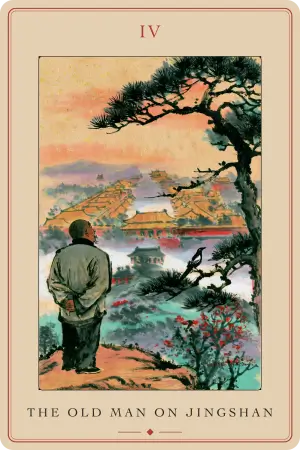
Every deck reimagines the same archetype. Compare the art, then open a deck to read its full interpretation.
Imagery and symbolism
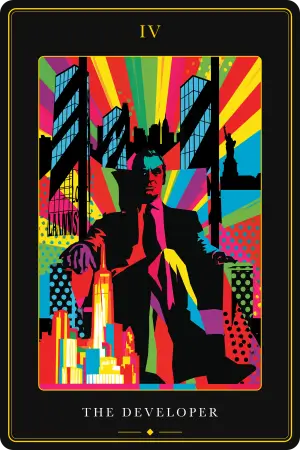
In the Tarot of New York City the Emperor becomes the Developer, and the stone empire of the classic card becomes a skyline he is still building. He sits on the top floor with glass on four sides, his name already on three buildings and a lit model of the fourth on the table. The card is drawn in the deck's pop-art language: sunburst rays in saturated red, yellow, magenta, cyan, and green behind him like a marketing rendering of his own glory, with halftone dot fields giving the towers the screen-print grain of a city sold as an image.
He sits centered and frontal in a dark suit cut like armor. Where the Rider-Waite-Smith Emperor wears plate mail beneath his red robe, the Developer wears power dressed for a board meeting. His face is split by hard light, half in shadow and half flushed red with will and appetite, and the two halves are the builder and the bulldozer in one man. His gaze is level and fixed forward, aimed at the future the way the old Emperor's always was.
His throne is the city itself. The armrests are dark high-rises stippled with halftone windows, so he rests his weight on real estate. Under his right hand, where the Emperor holds a scepter, a slender illuminated skyscraper rises glowing from the streets below, authority measured in floors. His left hand settles on a second tower the way the Emperor's rests on the orb: the world held here as property.
Behind him, black silhouettes of skyscrapers stand where the classic card put barren mountains, hard and vertical and unyielding. Signage climbs one facade in the language of leasing and lending, the quiet machinery of ownership. To his right, the Statue of Liberty stands in silhouette on the horizon, liberty within his view and within his frame. That is the card's sharpest question: the freedom of the city, seen from the window of the man who decides its shape.
At the base, the stone blocks beneath the old Emperor's throne become the foundation courses of new construction, a low cluster of bright, half-built blocks out of which the whole composition grows. Everything above rests on them. The number IV crowns the card in gold, standing for four sides of glass, four corners of the grid, and the number of foundation and order.
Core meaning
The Developer keeps every traditional Emperor meaning, authority, order, structure, and paternal power, and pours them into steel, glass, and zoning law. The archetypal reading is the one you already carry: the organizing force that gives raw energy a container. What this deck adds is the claim that order does not happen, it is imposed, maintained, and paid for. Every skyline is somebody's will made visible.
He decides where the shadow falls at 3pm, which means someone stands in that shadow. That single line is the card's whole argument. Authority that shapes the world for others owes a debt to the people it shapes it around. At his highest the Developer builds what holds everyone, the grid that makes eight million lives navigable and the codes that keep the buildings standing. At his lowest he builds what holds only his name.
Inside this deck he is the earthly father of the Newcomer. The kid who stepped off the bus at Port Authority in card 0 arrives, decades of arcana later, at the man on the top floor who decides what the city looks like. If the Matriarch grows the garden on the vacant lot, the Developer fences the lot, files the permit, and puts a building on it. Between them runs the city's oldest argument about what grows and what gets built.
Upright meaning
Upright, the Developer says you have real influence in the situation, or that the situation demands you act as if you do. Treat it like a project. Get clarity on what you are building and in what order, then act with decisiveness, because the city does not wait for the hesitant. Draw the blueprint, set the schedule, and take responsibility for the whole build rather than your corner of it. If you hit obstacles, respond the way a builder responds to bad soil, with engineering instead of panic. A structure is only as strong as the foundation you poured before anyone was watching.
In love. Stability, confidence, and commitment with a signed lease. This is a long relationship built deliberately, floor by floor, rather than stumbled into. It can mark the arrival of a partner who brings order and protection, the one who plans the future out loud, meets the family, and shows up when the boiler breaks. The card may hint at a proposal, moving in, or the conversation about what exactly you two are building. It favors structure: clarity, commitments made explicit and kept, feelings expressed directly with a clear goal.
In career. Authority, stability, and effective management, either yours or above you. It can mean a promotion into responsibility, a shift to running the team instead of being run, or the arrival of a strong boss who can put his hand on the scale for you. Take ownership of your work the way a builder takes ownership of a site: know the plan, set the schedule, sign your name to the outcome. Its professions run to command at scale: real estate developer and landlord, executive and manager, construction boss and general contractor, architect and urban planner, entrepreneur, lawyer working zoning and contracts, politician and borough official, judge, financier and investor, and the systems thinker who maps the grid beneath the chaos.
In finances. The card of real estate above all, and in this deck it speaks literally: success in property, ownership, and investments made with a thirty-year horizon. Finances are run like a well-managed building, the rent paid early and the reserve fund actually funded. It suggests the time is right for long-term goals rather than quick flips, and it can show financial support arriving from a position of strength, a backer or an institution. Prosperity here is built the slow, correct way: foundation first, floors after.
In health. The body treated as the one building you can never sell. The card emphasizes discipline and structural maintenance: a training routine kept the way a construction schedule is kept, because the whole project depends on it. It favors the Developer's signature move, systems over moods, with the standing workout, planned meals, and sleep treated as load-bearing. Do foundation work first, diet and regular movement, and introduce changes gradually and deliberately, like any sound construction.
Reversed meaning
Reversed, the Developer is the empire seen from outside: the tower nobody can afford to live in, or the boss who bulldozes the block and calls it progress. It points to unchecked power, or its mirror image, a total loss of control where a project collapses because nobody is actually in charge. Expect rules too strict, inflexibility, or power held for its own sake. It is a variance forced through and the shadow dropped on someone else's garden without a second thought. Permits stall, funding freezes, or the model on the table gathers dust. There may be a despotic figure in your life, or you may be becoming one. Audit how power is used and hold the community-board meeting you have been avoiding.
In love. The partner who confuses love with property management. One person controls, limits, and re-zones the other, deciding where you go and who you see and what the relationship is allowed to be. Commitments get disregarded while control tightens. At its worst rigidity hardens into aggression, and the relationship becomes a building the other person merely lives in, subject to inspection. It calls for a hard re-evaluation: is this built on mutual respect, or on a deed with one name on it?
In career. The stalled site: management problems, ineffective leadership, and disorder where the plan should be. It is the boss everyone routes around, or the boss everyone fears and no one tells the truth to. New ideas get dismissed because they were not invented on the top floor, and negotiations sour over turf instead of terms. There is a risk of power being abused, credit taken upstairs and blame shipped downstairs. Reassess how the operation is run, and whether the current management would pass its own inspection.
In finances. The over-leveraged tower. It points to a loss of control over money, disorder in the accounts, or decisions made for ego rather than return, buying the view instead of the value. It can warn of mounting debt or outright collapse, the construction loan that outruns the project, an empire on paper that a single bad quarter can erase. Evaluate your finances with a builder's cold eye, stress-test the foundation, and walk away from the dubious deal however tall the rendering looks.
In health. Deferred maintenance on the body: skipped training and no control over diet, the physical self treated like a building whose complaints go unanswered. The reversed card equally warns of the opposite failure, the tyrant landlord turned inward, showing up as overtraining, extreme dieting, and punishing regimens forced on a body that needed care. Take real ownership again, see the specialist, revise the diet, and rebuild the daily structure as a builder rather than a demolition crew.
Historical notes
The figure this card renames was, for most of its history, a literal monarch. The fifteenth-century Visconti-Sforza card shows a bearded king with orb and scepter, and the imperial eagle on his shield was a loaded political device, adopted by the Visconti only after Gian Galeazzo bought the ducal title in 1395. The standardized Tarot de Marseille then fixed his most famous pose: seated in profile with his legs crossed into the shape of a four, a posture that marked the highest-ranking man in the room and his right to pass legal judgment.
Politics reshaped him during the French Revolution, when printers were forced to strip the royal symbols from their woodblocks. His crown became a Phrygian liberty cap, his scepter a harmless flower, and the eagle vanished from his shield. Meanwhile nineteenth-century occultists read new meaning into the old pose, with Levi and Wirth seeing in his crossed legs and upright torso the alchemical sign for sulfur, spirit ruling matter.
The modern card came with the 1909 Rider-Waite-Smith deck, which cut the European monarchy loose. Waite and Pamela Colman Smith set him on a stone throne of four ram heads, dressed him in armor, and placed him in a barren red mountain landscape, turning a political ruler into a figure of cosmic, Aries-driven authority.
The Tarot of New York City carries that movement one step further rather than reversing it. Each version answered a local question about where secular power could visibly sit: an imperial court, a legal bench, a Martian mountain range held by will. This deck moves him to the top floor of a glass tower, because in New York the proof of authority is not a heraldic device or a conquered peak, it is whose name is on the building. The ram-carved stone throne becomes a throne of high-rises, the scepter becomes an illuminated skyscraper, and the barren mountains become a skyline he is still raising.
Correspondences
Number. He is IV, the number of foundation and physical reality: four sides of glass on the top floor, four corners of a city block, and the four legs of the grid that holds Manhattan in order. Four is the poured foundation, the framed structure, the load-bearing wall, the fact of the building rather than the dream of it. The deck folds its own architecture into the number through its four suits, Cranes, Cups, Subways, and Tokens, the engines of the city, and the Developer's authority draws on all of them: ambition, feeling managed, mind applied, and money commanded. His four is not a static form but a base course, prepared precisely so something taller can rise on it.
Astrology. He answers to Aries, the cardinal fire of initiative, and New York gives the sign a street address. Aries is the first shovel in the ground, the pre-dawn call that starts the pour, and the appetite to be first and biggest. Like the ram, the Developer breaks ground for a living, unafraid to cross a boundary or contest a lot line. He carries the sign's shadow too, the impatience that bulldozes first and consults never, the will so forward-facing it forgets who stands in the shadow it casts. The Sun finds its exaltation in Aries, deepening the card's link to willful command.
Element. Fire. The martial, forging heat that breaks ground and holds it, translated here into the crane's swing and the drive to build.
Kabbalah. His Hebrew letter is Heh, the window, and on the Tree of Life he walks the path from Chokmah to Tiphereth. Crowley later swapped this letter with The Star, giving the Emperor Tzaddi, the fish hook, though most readers keep the older Heh. In this deck the window is literal, the glass on four sides through which he watches the city answer to a plan.
Elemental dignity. Beside Cranes and other Fire company his drive intensifies, turning strategy into forceful, goal-driven action. Beside Tokens his authority reads as capital and ownership.
Psychological perspective
Psychologically the Developer is the psyche's structural engineer, the part of a person that pours foundations, holds schedules, and keeps the whole project of a life standing upright. He is the Ruler of Jung's collective unconscious and the Father of Civilization, an echo of Zeus, Jupiter, Odin, and Osiris. Someone embodying him has a strong spirit and innate authority. They are organized and goal-oriented, they handle obstacles the way a crew handles bad weather, factored in and worked through, and they hold a plan steady across years rather than weekends. This is the person on whom everything in their orbit quietly rests: the rent gets paid, the family holds, the business survives the bad quarter.
Their strengths are a fast, unsentimental read of a situation, like a site survey, and the ease of organizing people around a shared build. Their authority is quiet and comes from being trusted with weight. Jessica Dore frames the card's real power as the capacity to stay stable and deliberate inside chaos, a mature refusal to be ruled by impulse.
The shadow is high up and the glass is soundproof. The Developer can harden into inflexibility, stubborn and unwilling to admit a design flaw as the cracks show. The desire for control can curdle into what the Thoth tradition calls rational despotism, every relationship managed and every conversation a negotiation, until a beautifully built tower stands completely empty. Focused on the skyline, he can forget the street. The cure, always, is to ride down to the lobby and remember who the building is for.
The Developer across decks
Tarot de Marseille. The classic Emperor sits in profile, legs crossed into a four, the eagle shield at his side, the image of a ruler entitled to judge.
Rider-Waite-Smith. The 1909 figure sits on a stone throne carved with four ram heads for Aries, plate armor beneath a red robe, scepter and orb in hand, set against a range of barren rust-red mountains that say his order is imposed on hard ground by will.
Crowley-Thoth. Crowley reassigned his Hebrew letter from Heh to Tzaddi, the fish hook, in the famous switch with The Star, and read the shadow of the archetype as rational despotism, a rulership drained of feeling.
Modern decks. Recent creators work to save the card's core of protection and structure from its monarchical baggage. Jen Cownie and Fiona Lensvelt argue the Emperor need not be male or even human, and could as easily be a calm air traffic controller or the seatbelt on a bad flight. Others render him as a field of ordered poppies in the Spacious Tarot, a chess player thinking several moves ahead in the Anna K, or a deep-rooted evergreen that holds through winter in the Botanical Deck.
The Tarot of New York City. This deck keeps the RWS reading whole and gives it an address. The stone throne becomes a throne of towers, the ram-carved authority becomes zoning and capital, and the barren mountains become a skyline the figure is still building. Where the classic Emperor rules ground he conquered and holds, the Developer rules a city that bends to a structure he carries in his head, with the Statue of Liberty set on his horizon to ask who the freedom of the city actually belongs to.
In combination and context
The Developer is read against the other figures of authority in this deck, and his defining contrast is with the Matriarch. She grows order from the soil up on a lot the city forgot, while he imposes it from a glass tower. Hers is the authority nobody resents because she fed people before she asked anything of them, and his is the authority the city both depends on and argues with. A reading that holds both asks whether you are cultivating a place or developing it.
Against the Newcomer at 0 he is the far end of the same life. The kid with the duffel bag becomes the man who decides what the skyline looks like, so a spread holding both frames the whole arc from arrival to ownership, from surviving the city to shaping it. Set beside the classic Empress energy he completes a whole, his boundaries giving her boundless creativity a place to take form.
In money and business spreads he is the master-plan card: order, structure, and the drive for stability, a strong sign for negotiations, contract signings, and expansion done from strength. His fire compounds with momentum, so alongside cards of drive he becomes an almost unstoppable will, strategy married to force.
Position sharpens him. As advice he tells you to treat the situation like a project, draw the plan, and sign your name to it. As the obstacle he is control flowing one way only, the variance forced through, the shadow dropped on someone who never agreed to stand in it. As the outcome he promises a structure that holds, built foundation first on all the experience that came before it.
Questions for reflection
- Where in my life am I renting when I could be building, waiting for permission the city is never going to hand me?
- When my decisions cast a shadow, who stands in it, and have I ever asked them?
- What am I ready to take real ownership of, and what foundation would I have to pour first to hold it?
The general meaning follows the Rider-Waite-Smith reading — the reference used across Tarot Academy. Open a specific deck above for its own interpretation.
Frequently asked questions
Explore the Tarot
Latest Posts
Discover the ancient wisdom of tarot cards and unlock the mysteries of your spiritual journey. Our blog is your gateway to understanding the rich symbolism, meanings, and practical applications of tarot reading.




















































