
 EN (English)



Major Arcana · III
The Empress
Pamela Colman Smith's mother of the Earthly Paradise, ripe with harvest, Venus, and the abundance of the natural world.
Card at a glance
- Numerology
- III
- Element
- Earth
- Astrology
- Venus · Taurus
- Kabbalistic path
- Daleth (Chokmah → Binah)
- Timing
- Spring · nine months
- Yes / No
- Yes
Upright
abundance
fertility
nurturing
creativity
nature
sensuality
motherhood
growth
Reversed
creative block
dependence
smothering
scarcity
self-neglect
burnout
body shame
The Empress in each deck
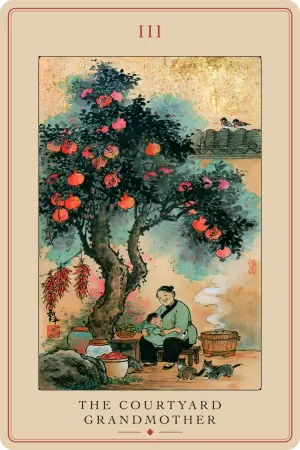
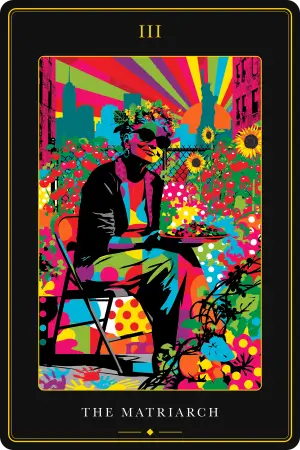
Every deck reimagines the same archetype. Compare the art, then open a deck to read its full interpretation.
Imagery and symbolism
This is the card Pamela Colman Smith drew for A.E. Waite, and its most radical move was where she put her. Earlier decks kept the Empress in a throne room; Smith set her in a lush garden ringed by trees, with a field of ripe wheat at her feet and a river pouring through the landscape behind. Waite called the setting the Earthly Paradise and named her a fruitful mother of thousands, and it is this natural, abundant Empress that most readers picture today.
Her symbols read one by one. The crown of twelve stars, drawn from Revelation 12:1, gives her dominion over the natural order: the twelve months, the twelve signs of the zodiac, the twelve hours of the clock. Her flowing gown is scattered with pomegranates for fertility, love, and the seeds of life, an image reaching back to Persephone, Demeter, and Cybele. The wheat at her feet is a direct nod to Demeter and the harvest, the ground's own power to grow and provide. The river behind her carries life's energy and emotional richness, the feminine element in constant motion.
Smith's staging fills in the rest. The Empress reclines on a red plush throne heaped with cushions: red for passion and action, the soft cushions for care, tenderness, and a comfortable authority. Her relaxed pose is not idleness but the ease of someone with strength to spare, gentle and unhurried, sustaining life without strain. In her right hand she holds a scepter raised over the material world, her spiritual authority over growth and creation, and beside her in the grass rests a heart-shaped shield bearing the glyph of Venus, planet of love and beauty, marking the harmony and protection she extends to others.
Core meaning
In the Rider-Waite reading the Empress is creative power, motherhood, and fertility made visible: the feminine principle in the physical world, life's force in full splendor. Her domain is everything natural and organic, and her gift is fecundity itself, the same energy behind a pregnancy, a harvest, a business, or a work of art. She is Trump III, and the number carries the meaning: she is the synthesis of The Magician's will and The High Priestess's inner depth, the point where action meets receptive potential and something tangible is finally born.
Where the Priestess holds knowledge behind her veil, the Empress is the observable result, the wild outgrowth pushing up into the sensory world. To draw her in this deck is to be called back into the body, into beauty and growth and the patient rhythm of things that ripen in their own time. She teaches cooperation with natural law: a harvest cannot be hurried, and what is grown in love blooms the brightest.
Upright meaning
Upright, the Rider-Waite Empress marks a season of prosperity and growth, in career, creativity, and personal life alike. She is a deeply physical card, asking you to reconnect with your senses, honor natural cycles, and make full use of the energy and openings in front of you. Plans have fallen on fertile ground and will come to fruition, so take initiative rather than waiting.
In love. Love, sensuality, and protection, often with real sexual attraction and a pull toward romance. She shows a mutually supportive bond warming toward deeper commitment, and she frequently points to pregnancy or an active wish for children.
In career. A fertile stretch for projects and creative work, with rapid growth and the successful completion of what you start. In business her fertility becomes a run of good ideas and profitable expansion, best kept sustainable through attentive management.
In finances. Abundance, sound investment, and a favorable period for building capital. She signals the maturity of your financial ideas and confidence in the future, where generosity and ethical practice lead straight to well-being.
In health. Growth, fertility, and renewal in the body: better health, self-love, and comfort in how the body changes over time. In fertility questions she often points to conception, though careful readers treat that as timing and preparation rather than a medical verdict.
Reversed meaning
Reversed, the Empress shows an excess or a deficiency of her energy. She surfaces as exhaustion from caring for others with nothing coming back, or as too tight a grip that keeps ideas from growing freely. Just as often she flags the loss of self-respect, healthy boundaries, and gentleness, the nurturing figure who over-gives to the point of self-erasure.
In love. Disrupted harmony and lost balance. Passion may wane or fertility may falter, and care curdles into dependency, anxious attachment, or a swing between smothering control and complete disinterest.
In career. Creative block and stalled projects. Poor organization, an overload pushing toward burnout, and a widening gap between the creative and practical sides of the work.
In finances. Instability and misallocated resources more than sheer shortfall. Investments underperform, unexpected costs arrive, and the card warns against careless spending and loose management.
In health. Neglect of the body and its basic needs: skipped care, poor eating, ignored symptoms. A lack of self-love erodes confidence, and the card is a blunt call to treat your health with respect again.
Historical notes
In the earliest surviving decks, The Empress was a figure of secular power. The fifteenth-century Visconti-Sforza Empress sits on a rigid throne among ripe foliage and holds a shield bearing the eagle of the Holy Roman Empire, tying maternal care to political dominion. As the Tarot de Marseille standardized the imagery, she kept her crown and throne but gained a scepter and a shield, and the imperial eagle gave way to the symbol of Venus. That single swap moved her center of gravity from statecraft toward fertility and the Earth Mother who feeds humanity.
The modern card arrived with the Rider-Waite-Smith deck. Waite and Pamela Colman Smith lifted her out of the throne room entirely and set her in a flowering landscape. In his 1910 Pictorial Key to the Tarot, Waite framed her as the Earthly Paradise, a Refugium Peccatorum and fruitful mother of thousands. Smith's illustration is the one this deck fixed in place, and it is the version most readers still work from.
Correspondences
Number. She is III, the number of synthesis and creation. One (The Magician) and two (The High Priestess) combine in her to produce a tangible third thing, and the triad also carries beginning, middle, and end, past, present, and future. As a prime number, three stands for what is indivisible and stable.
Astrology. Venus rules her, the planet of love, beauty, harmony, and the enjoyment of life, and also of motherhood and the birth of new life. Venus governs both Taurus and Libra, and most readers place the Empress in earthy Taurus, whose bodily, sensual appetite matches her better than Libra's cooler social register.
Element. Earth. Her domain is the physical world of growth, harvest, and the weight of ripe grain.
Kabbalah. Her Hebrew letter is Daleth, the door, the gateway through which life enters the physical world. On the Tree of Life she holds the path joining Chokmah (Wisdom) to Binah (Understanding), lending form and structure to raw creative force.
Elemental dignity. Beside Pentacles her material abundance swells; beside Cups the reading warms toward emotional nurture and family.
Psychological perspective
The Rider-Waite Empress describes a personality built for creation, with an intuitive read on what growth needs in both the material and spiritual sense. This is often someone with a maternal instinct and a talent for nurturing, though it can be anyone showing the gentle, protective side of themselves. They bring abundance to their surroundings, they are empathetic, loving, and generous, and their warmth makes them people others gather around.
Her shadow is the other half of the same trait. The drive for well-being can harden into selfishness or a domineering, overprotective streak, and a retreat into an idealized world of comfort loses touch with reality. Overindulgence tips into extravagance, and a fixation on beauty and success can crowd out inner depth. Modern readers have made her the face of a quiet revolt against hustle culture, carried by the mantra "I do not chase, I attract," a reminder that power can be rooted in softness and that abundance answers to alignment more than to force.
The Empress across decks
Smith's version is the reference point most other decks are measured against, and comparing them shows what she settled and what she left open.
Tarot de Marseille. The older Empress stays crowned and enthroned, holding scepter and shield, the imperial eagle already yielding to the glyph of Venus that marks her turn toward fertility.
Crowley-Thoth. Lady Frieda Harris painted her voluptuous and fluid before uprights of blue twisted flame, born of water and carrying the lotus of Isis. Crowley read her as pure feeling and sexuality, unintellectual but standing for the raw drive of life itself, for maternity and mercy.
Modern decks. Kim Krans's Wild Unknown drops the human figure for a lavish tree against a night sky and a waning crescent moon, the Empress as the vital force of the earth itself. Lisa Sterle's Modern Witch Tarot keeps Smith's core symbols but celebrates a voluptuous, diverse body in the spirit of the ancient fertility goddess, from the Venus of Willendorf onward, demanding that embodiment be met without shame.
In combination and context
The Empress is best read beside the other feminine figures of the deck. She follows The High Priestess (II) and reverses her polarity: where the Priestess is lunar, inward, and hidden, the Empress is Venusian, outward, and abundantly visible. Readers put it plainly, the Priestess is pregnant and the Empress is giving birth.
She also shades into the Queen of Pentacles, and telling them apart matters. The Empress is a Major Arcana life theme, the cosmic spirit of creation and motherly love; the Queen is the situational, working mother who cooks the meal and manages the money. One births the idea, the other executes it, and some readers see the Empress as the divine synthesis of all four Queens.
In pregnancy questions her neighbors color the reading. Alongside the Ace of Cups, the Page of Cups, or the Four of Wands she leans toward fertility and family, while those same cards reversed point instead to blockage, grief, or a longing that circumstances will not yet allow.
Questions for reflection
- What in your life is ready to be nurtured and grown, and are you giving it time rather than force?
- Where do you give care so freely that you forget to receive it back?
- How does your body feel when you stop chasing and let what you want come to you?
The general meaning follows the Rider-Waite-Smith reading — the reference used across Tarot Academy. Open a specific deck above for its own interpretation.
Frequently asked questions
Explore the Tarot
Latest Posts
Discover the ancient wisdom of tarot cards and unlock the mysteries of your spiritual journey. Our blog is your gateway to understanding the rich symbolism, meanings, and practical applications of tarot reading.




















































