
 EN (English)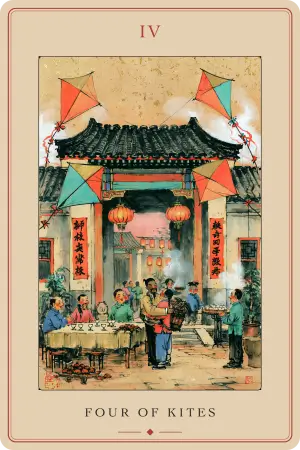


Minor Arcana · Wands (Fire)
Five of Kites
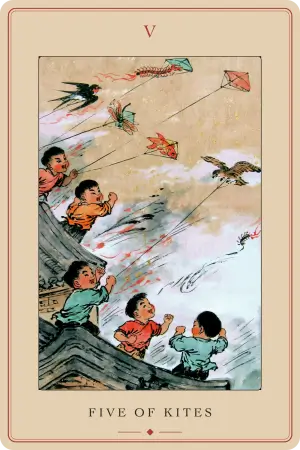
Rivalry as noisy apprenticeship: five boys fly kites over one hutong sky, crossing strings without hatred.
Read the complete guide: The Five of Wands Tarot Card: A Comprehensive Guide to Its Symbolism and Meaning
Card at a glance
- Numerology
- 5
- Element
- Fire
- Astrology
- Saturn in Leo (first decan) · July 22 to August 1
- Kabbalistic path
- Geburah (Severity)
- Timing
- Late July · Leo season · high summer wind
- Yes / No
- Maybe; no clear winner yet
Upright
rivalry
friendly contest
competition
creative friction
sparring
crossed interests
learning through struggle
jostling for room
Reversed
reconciliation
untangling
conflict avoidance
exhaustion
conceding
end of rivalry
passive aggression
withdrawal
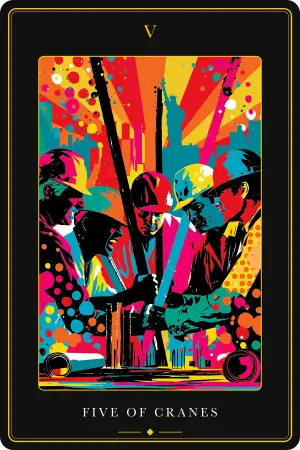
Five of Kites in each deck
Every deck reimagines the same archetype. Compare the art, then open a deck to read its full interpretation.
Imagery and symbolism
Above the grey tiled roofs of a Beijing lane, five boys fight a kite battle. Their glass-coated strings cross, saw, and tangle in one shared sky, and five paper fliers jostle for altitude: a swallow, a goldfish, a butterfly, a hawk, and a centipede-dragon. Nobody is angry, everybody is shouting, and one kite is already spiralling down. The boys' fists are raised in delight rather than threat, because in the hutong the fight and the game are the same gesture. This is the Tarot of Beijing's Five of Wands, and it replaces the deck-agnostic melee of unarmored youths with a rooftop contest that any Beijing child would recognize.
The five kites are five ambitions launched into one wind. That wind is single and impartial: the same gust lifts the hawk and downs the centipede, so circumstances favour skill and not desire. The glass-coated strings, sharp enough to cut each other, stand for the words and tactics of a dispute, real enough to sting but wielded here without malice. The falling kite carries the card's quiet lesson. Every rivalry produces a loser, and in this deck the loser simply climbs down, patches the paper, and returns tomorrow.
The rooftops matter. The boys have climbed above the courtyards, each seizing his own high ground, yet the roofs all belong to one lane, so the competition unfolds inside a community. Tonight these rivals will eat at tables within earshot of each other. A swallow, a real bird among the paper ones, flies through the battle untouched, nature's reminder that mastery looks effortless from inside the struggle. The kites belong to the suit of fire, and their variety of fish, insect, raptor, and myth-beast shows that no two wills are shaped alike. Muted ink washes with bursts of vermilion, a gold-flecked kraft sky, and a small red seal keep the scene warm. This is conflict painted by someone who loves the combatants.
Core meaning
The Five of Kites is Beijing's Five of Wands, and the deck reads it as rivalry that trains rather than wounds. After the anchored celebration of the Four of Kites, with its strings tied to the courtyard gate, the five unties everything and throws it into open sky. Several wills, projects, or opinions have risen at once, and their strings are crossing. This is competition and dispute of the hutong kind: loud, energetic, and without real hatred.
Where the canonical Five of Wands shows a disorganized scramble of strangers, the Beijing card frames the same friction as neighbours testing neighbours. Nobody here is truly an enemy. Everyone is testing everyone, and the friction itself sharpens skill. The card's argument is that strife is a form of apprenticeship you cannot skip. You learn the wind by flying against other kites, not by watching from the courtyard. One kite spiralling down is the small, inevitable loss written into any contest, and the deck treats that loss as tuition rather than defeat.
Upright meaning
Upright, the situation is a crowded sky. Colleagues, rivals, or family members are all pulling in different directions, and lines are sawing against each other. The card's advice is plain: do not take the shouting personally, and do not leave the roof. Join the contest and fly your kite, because this rivalry is training in disguise. Defend your string, but keep the tone of a game. The boy who sulks learns nothing, while the boy who laughs and re-launches learns everything. Watch whose line crosses yours and study their technique instead of resenting it. Keep your temper as light as paper and your grip as firm as bamboo.
In love. The courtyard fills with noisy weather: quarrels, teasing, and sparks. In a couple it shows two strong wills whose strings keep crossing over plans, habits, and in-laws, passionate friction rather than cold distance. The same energy that fuels the arguments fuels the attraction. For those seeking love, it can mean literal rivals, several suitors circling one person, courtship as a kite battle where charm and persistence decide altitude. Quarrel the hutong way: full volume, no cruelty, dinner together afterward.
In career. The office becomes a rooftop, with colleagues competing for one promotion and ideas clashing in meetings. Fly visibly: present your ideas in the contested meeting, put your name on the difficult project, answer challenges rather than absorbing them in silence. Expect your proposals to be argued with and sometimes cut down. The colleagues who push hardest against your line often respect it most, and this period of jostling is how the workplace learns your name.
In finances. A contested wind of competing bids, haggling, and rival claims on a budget or inheritance. Progress comes through active contest: negotiate harder, tender against others, defend your price at the stall. Expect one small loss amid the scramble, a fee undercut or a deal snatched, and treat it as tuition. Do not underprice yourself to avoid the argument. In the lane, the vendor who haggles cheerfully keeps both the coin and the customer.
In health. Pure rooftop energy: the body wants contest, movement, and other bodies to measure itself against. It favours competitive and social exercise over solitary routine, from team sports to races to the morning park. Training with rivals pulls effort out of you that discipline alone cannot. Expect small knocks, the scrapes and bruises of an active season, and channel restlessness into sport before it curdles into irritability.
Reversed meaning
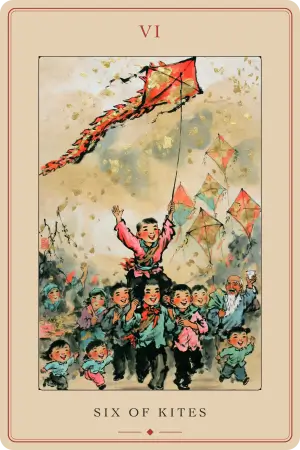
Reversed, the wind has dropped or the flyer has left the roof. Read it honestly as one of two things: healing or hiding. In its healing sense the tangle is resolving. Strings are being patiently unknotted, disputes settled over tea, and the boys who cut each other's kites yesterday are gluing paper together today. This is reconciliation after a noisy quarrel, the cessation of hostilities that clears the way for the earned victory of the Six of Kites. Be the one who climbs down from the roof first.
In its hiding sense the rivalry has stopped teaching and started grinding: the same arguments, the same crossed lines, no altitude gained. It can also point to dodging every contest out of fear of losing, which quietly costs you the skill that only contests build. A kite kept indoors never learns the wind. Decide which it is, and if you are simply avoiding the sky because someone flies better, go back up.
In love. The storm is passing or being suppressed. At best a long argument ends in laughter, or rivals withdraw and the choice grows clear. At worst it warns of conflict avoidance: grievances swallowed to keep a false peace, a couple so afraid of the tangle that nothing true is said aloud. Unflown quarrels gather like kites in a shed. Drop the scorekeeping and remember what the rivalry was for, winning each other rather than winning against each other.
In career. The office battle is winding down or being ducked. Conflicts resolve and feuding teams reconcile, so use the calm to thank rivals and repair strained strings. The shadow reading is avoidance: swallowing your ideas in meetings, declining the open role, letting louder colleagues take uncontested credit. That silence reads as absence, and absence is never promoted. It can also mark burnout from political tangles that consume the day while the actual work gains nothing.
In finances. The contest is either ending or being dodged. Disputes over money settle, an inheritance is divided, and each party walks away with a workable share. The warning is avoidance: refusing to negotiate, accepting the first price, letting competitors take clients because the struggle feels vulgar. Income quietly shrinks when you never defend it. It can also show scattered finances, too many small money battles at once and fees lost in the tangle, so consolidate and fight only the contests that matter.
In health. The contest with the body has gone wrong in one of two directions. Either competition has turned compulsive, training through pain to beat someone and chasing another person's silhouette instead of your own health, or the flyer has quit the sky entirely, with movement stopped and irritability building like unflown wind. Both are tangles. Step out of comparisons that injure, rest the strain properly, and re-enter movement at the level of play.
Historical notes
The oldest scenic ancestor of this card sits in the Sola Busca Tarot, engraved around 1491 in Ferrara, the first known deck to fully illustrate its numbered cards. Its Five of Batons personifies Gaius Lutatius Catulus, the first plebeian to reach the Roman consulship, shown as a wounded soldier in a garland holding a scale, framing conflict as classical duty and endurance rather than sport. The Tarot de Marseille tradition then stripped the scene away, arranging five batons in an abstract geometric crossing, and read the card through numerology, where five universally breaks the stable square of four.
The modern meaning was fixed by the Hermetic Order of the Golden Dawn, which mapped the card to Geburah, the fifth sphere on the Tree of Life, ruled by Mars and named Severity. When the volatile fire of the Wands enters that severe sphere, the result is friction, and the Order titled the card the Lord of Strife. In 1909 Arthur Edward Waite and Pamela Colman Smith turned that abstraction into a scene: five young men in bright, mismatched tunics clashing sprouting staves on a green field, which Waite called a mimic warfare of youths at sport or strife. None of their wands touch the ground, marking the conflict as unrooted, superficial, and free of real malice.
The Tarot of Beijing carries that reframing into a specific culture. It keeps the number, the fire, and the friendly-strife reading, then translates the mimic warfare into a rooftop kite battle over a hutong. The bright tunics become five differently shaped kites, the sprouting staves become glass-coated strings, and the unrooted quality of the original, wands that never reach the earth, survives as paper fliers held aloft on one impartial wind.
Correspondences
Number. Five, the wind that disturbs the stable square of four. Four corners hold a courtyard, so a fifth force has nowhere assigned to stand and must contend for its place, which is why the card carries rivalry, crossed strings, and the jostle of too many kites in one patch of sky. Five is also the number of the hand, five fingers on the spool, and of learning through the body: you cannot be taught a kite battle, you can only fight one.
Astrology. The first decan of Leo, roughly July 22 to August 1, sub-ruled by Saturn. Leo is the sign of self-assertion and display, the joyful demonstration of strength, exactly the spirit of a battle where every flyer wants his dragon or hawk seen riding highest. Saturn is the weight on the string, bringing discipline, limits, and consequence: strings snap, kites fall, and only patient craft survives the tangle. Saturn is why the noisy battle is also a school.
Element. Fire in its most sociable and combative form, energy that seeks other energy to spar with, will that sharpens itself on other wills. Here the fire fights to shine rather than to destroy, and it genuinely enjoys a worthy rival.
Kabbalah. Geburah, the fifth sphere, whose name means Severity or Strength and whose planet is Mars. Geburah is the pruning, restrictive power of the Tree, and the clash of Wands within it gave the Golden Dawn its title for the card, the Lord of Strife.
Psychological perspective
In career and group readings this card maps almost exactly onto the storming phase of Bruce Tuckman's model of team development. A newly formed group pushes against boundaries, personalities clash, and egos vie for room, and while the phase is loud and uncomfortable, a team that refuses it never reaches the harmonious norming that follows. The Five of Kites says the same thing in paper and string: the friction is not a failure of the group but the mechanism by which the group finds its shape.
The people of this card are the boys on the rooftops, spirited and loud and fundamentally good-natured. They love a contest more than a victory and cannot pass a challenge without answering it. They argue passionately, saw their string against yours, and then invite you to dinner, because their aggression is play and their play is training. Reversed, the same spirit sours or drains. Some can no longer tell a game from a war and must win even the argument about the weather. Others have come down from the roof for good, tired of competing, conceding before the challenge is spoken, nursing an old defeat and refusing to launch again. Between those extremes the card asks for the middle skill: fight with full energy and clean technique, and let a loss be information rather than a verdict.
Five of Kites across decks
Rider-Waite-Smith. Five young men in bright tunics clash sprouting staves on a green field, a mimic warfare of youths whose wands never touch the ground. The Beijing card keeps that unrooted, malice-free contest and relocates it to a hutong roof, trading five clashing staves for five crossing kite strings.
Tarot de Marseille. The Marseille Five of Wands is purely geometric, five batons crossing in an abstract pattern with no human figures, read through the numerology of five breaking the square of four. The Tarot of Beijing keeps that numerological core, the fifth force with nowhere to stand, and restores a full scene around it.
Crowley-Thoth. Crowley titled his card Strife and filled it with ritual wands, the Chief Adept's caduceus crossed by Phoenix and Lotus wands against a stark yellow ground, reading the conflict as a purifying fire of magical initiation. Beijing shares the yellow-gold sky and the idea of friction as necessary purification, but keeps its combatants human and its stakes a windowpane rather than the soul.
Modern reframings. Recent decks tend to soften the Five of Wands into healthy competition, brainstorming, and the debate that sharpens ideas. The Tarot of Beijing belongs to that movement, framing rivalry as noisy apprenticeship, competition without malice, because in the hutong the kite battle is how boys learn the wind.
In combination and context
The Five of Kites pulls a spread toward active contest, so its neighbours mostly decide whether that contest is teaching or grinding. Before the Six of Kites it reads at its most hopeful, the tangle resolving into an earned victory carried through the market lane on shoulders. Held next to the Four of Kites it marks the exact moment stability breaks and the strings leave the gate, the settled peace giving way to open sky.
Court and cue cards shift the tone. Beside the steadier fire of the deck's Wands court, the King or Queen of the suit, the card advises rising above the petty scramble without losing your own identity. Drawn with softer cards of love and rest, the strife turns flirtatious, the enemies-to-lovers banter of two people who thrive on friction. Alongside cards of exhaustion or withdrawal it leans reversed, the flyer tired of sparring and ready to wind in the string.
When the Five of Kites keeps returning to your readings, treat it as a standing invitation to enter the tangle rather than watch from the courtyard edge. Launch your kite into the contested air, defend your string with humour, and note exactly which gust took whatever spirals down. That observation, not the fallen kite of a rival, is the prize the card is training you to carry home.
Questions for reflection
- Which contest are you watching from the courtyard edge instead of entering, and what skill is that hesitation quietly costing you?
- When a rival's line crosses yours, do you study their technique or only resent the crossing?
- Is the rivalry in your life still teaching you something, or has it become the same tangle with no altitude gained?
The general meaning follows the Rider-Waite-Smith reading, the reference used across Tarot Academy. Open a specific deck above for its own interpretation.
Frequently asked questions
Explore the Tarot
Latest Posts
Discover the ancient wisdom of tarot cards and unlock the mysteries of your spiritual journey. Our blog is your gateway to understanding the rich symbolism, meanings, and practical applications of tarot reading.




















































