
 EN (English)


Minor Arcana · Wands (Fire)
Five of Cranes
Five contractors bidding the same job: a scrum of egos over crossed steel, building energy that has not yet agreed on a direction.
Read the complete guide: The Five of Wands Tarot Card: A Comprehensive Guide to Its Symbolism and Meaning
Card at a glance
- Numerology
- Five
- Element
- Fire
- Astrology
- Saturn in Leo
- Kabbalistic path
- Geburah (Severity) in Atziluth
- Timing
- Late July, first decan of Leo
- Yes / No
- Upright a struggling maybe · Reversed no
Upright
Competition
Rivalry
The scrum
Undercutting
Friction
Ambition
Contest
Reversed
Burnout
Avoidance
Bid war ending
Compromise
Exhaustion
Surrender
Five of Cranes in each deck
Every deck reimagines the same archetype. Compare the art, then open a deck to read its full interpretation.
Imagery and symbolism
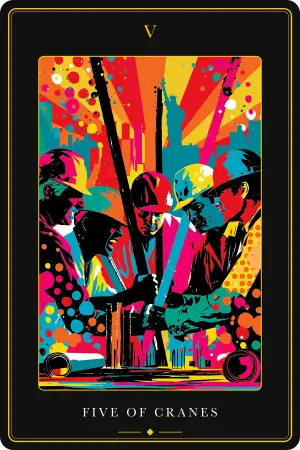
The New York Five of Cranes puts the Rider-Waite-Smith scuffle on a construction site. Five workers in hard hats crowd around a cluster of crossed steel rods and beams, each gripping his own length and shoving it against the others. Mouths are open and jaws are set: they are shouting over one another, and there is no telling who is directing whom. This is the deck's picture of five contractors bidding the same job, a scrum of egos and elbows where everyone pushes and nobody has won yet.
The hard hats come in different colors, red, yellow, blue, and pink, standing for different temperaments and strategies in the fight, some aggressive, some defensive, each man sure his angle is the right one. All five are locked entirely on the contest and ignore everything around them, which is how rivalry narrows a person's vision. The crossed steel deliberately echoes the crossed wands of the Rider-Waite-Smith original, the tools of the build turned for the moment into the instruments of the quarrel.
Behind the figures, rendered in pop-art sunburst rays and halftone dots, stands the skyline, and among the silhouettes the Statue of Liberty raises her torch. The city watches with total indifference, since the skyline exists because a thousand arguments like this one were eventually settled, and it will outlast this one too. The sunburst gives the scene an almost festive charge, echoing the sporting undertone of the RWS card: this reads as a contest as much as a war. At the workers' feet lie rolled blueprints and pipe sections, the actual work waiting on the ground, slightly trampled, until the shouting stops.
Core meaning
Underneath the site scene sits the standard Five of Wands. It is the friction that breaks the stability of the Four, which in this deck was the topping-out ceremony, the milestone marked and toasted. The Golden Dawn titled the card the Lord of Strife, though the strife is rarely malicious. It is the chaotic interplay of competing egos and ideas, the struggle to hold your spot in a crowded field, and the number five disrupts the settled square of four and forces adaptation.
The deck's own emphasis sharpens the point: the steel these five fight with is the same steel the city is made of. Cranes are the suit of fire, ambition, and construction, and the tension here is that the energy is not destructive by nature. It is building energy that has not yet agreed on a direction. If the five ever pointed their beams the same way, a tower would go up. That is the promise and the warning at once, and the task the card sets is to aim the fire rather than waste it on being right.
Upright meaning
Upright, the Five of Cranes is competition and the fight for position: the bid you have to win, the pitch room where every idea has to fight for air, the daily scrap for your corner of the city. It asks you to stand up for your stance without being drowned out, and it rewards knowing exactly what you are bidding for before you start undercutting. Read as yes or no it is a struggling maybe, since the goal is reachable but only through friction and effort. Keep the competition healthy: fight for the job, not against the people, because in this city you meet the same five contractors on the next site.
In love. Ambition and competition inside the couple, two careers colliding in one apartment, a quiet contest over whose work matters more, whose friends, whose name goes on the lease. Handled honestly the friction becomes real dialogue, and the relationship that passes through it comes out sturdier than the one that went in. This is a fire card, so the sparks flying are the same element as the attraction.
In career. The classic storming phase, the promotion several people want, the meeting where five plans are shouted and no beam points the same way. It is uncomfortable, but the friction can sharpen the team's vision and force it to clarify its goals. The advice is to do the careful work and treat the rivalry as sharpening, while keeping one eye on the blueprints lying trampled underfoot, since the job still has to get built while everyone argues about how.
In finances. Competition over resources, several people bidding on the same apartment, client, grant, or shift. It calls for holding your price when everyone around you is undercutting, and for pushing a valuable proposal through a crowded field. At its best it makes you sharpen your offer instead of lowering it.
In health. The racer's card: sports, the push to improve your form, rivalry as fuel. The marathon through the boroughs, the pickup game at the park courts, the training partner who is slightly faster and gets you out of bed at six. It favors channeling the competitive fire into a real contest, including competition with yesterday's version of you.
Reversed meaning
Reversed, the card splits two ways. On one side it is a fight that produced only fatigue, the bid war that dragged on so long the job itself stopped mattering, the drive to compete burned down to exhaustion. On the other it is the welcome moment the shouting stops: the rivals concede, the price stabilizes, and the crew finally agrees and gets to work. Read as yes or no it leans no. The caution is not to confuse peace with avoidance, since refusing every fight in this city has its own price.
In love. Avoidance of the hard conversation, a peace made of silence that slowly turns into distance, or the opposite exhaustion of endless quarrels where both partners have forgotten the prize. Often it signals that a tense period is finally passing and someone has stopped needing to win. End the contest deliberately rather than by attrition, because a relationship is the one job in the city you cannot win by underbidding the other party.
In career. Conflict becoming manageable at last, the meeting quieting, the crew agreeing on a direction. Or the less healthy version: sitting out the contest for the promotion, passivity dressed as professionalism, with missed chances as the cost. Watch too for a real team conflict papered over rather than resolved, still draining energy from underneath. Put the beams down and pick the blueprints up.
In finances. A weakening of the fight over money, walking away from the negotiation or not asking for the raise. Sometimes that is wisdom, often it means opportunities go unused. It can also mark financial chaos, too many small money conflicts at once, the several-gig juggle collapsing into noise. Remember that declining to name your price is itself a price.
In health. The competitive fire burned too hot or gone out entirely: overtraining and chasing records at the expense of the body, or inertia and dropped routines. The prescription is Saturn's, the ruler of this card's decan, structure over intensity. The body goes up in disciplined stages, not in a shouting match with itself.
Historical notes
The card's tone has swung widely across history. The Sola Busca deck of about 1491, the first with fully illustrated pips, personified the Five of Batons as the Roman consul Gaius Lutatius Catulus, a wounded, garlanded soldier holding a scale, framing conflict as classical duty and fatalistic endurance. The Tarot de Marseille dropped the figures for five interwoven batons, read through numerology as disruption breaking the stability of four.
The playful modern version came in 1909 from Arthur Edward Waite and Pamela Colman Smith. Smith took structural cues from photographs of the Sola Busca then held by the British Museum, but changed the mood completely, setting her scuffle of youths in the green hills of Sussex and Kent under bright sun. Crowley's later Thoth deck kept the title Strife and reimagined it as pure magical geometry, five ritual wands where the frustration of Saturn in Leo becomes a purifying fire rather than mere bickering. The New York deck inherits that RWS reading and relocates it to a job site, swapping sprouting staves for crossed steel and tunics for hard hats.
Correspondences
Number. Five, the number of change and instability, the pivot that breaks the settled square of four and forces motion. In this deck the Four of Cranes was the topping-out ceremony; the five is the next morning, when the next contract goes out to bid. Being the first odd number joined to the first even, it carries built-in opposition.
Astrology. Saturn in Leo, the first decan of Leo, roughly July 22 to August 1. Leo is fixed fire at its most radiant and self-asserting, the sign that wants its name on the building, and restrictive Saturn weighs it down and disciplines it. New York is in many ways a Leo city, a stage where visibility is currency, and this card shows several Leos bidding on the same stage at once. The decan also holds the royal star Regulus, which lends a proud, fiercely competitive undercurrent.
Element. Fire, ambition in its most contested form, the drive to raise something colliding with four rivals who want the same lot.
Kabbalah. Geburah, Severity or Strength, the fifth Sephirah, in Atziluth, the world of pure will. Geburah is ruled by martial Mars, the pruning force that removes the weak so the strong can flourish, so fiery Atziluth meeting Geburah produces immense friction.
Elemental dignity. A Fire card that strengthens beside Air and meets tension with Water, so its neighbors decide whether the strife catches or is doused.
Psychological perspective
Psychologically the Five of Cranes is dynamic tension, radiant creative fire pressed down by Saturnian limitation until it feels stuck. Handled well, that pressure is the friction growth actually requires, the essential New York skill of staying lit without burning out. To refuse the fray is to deny yourself the heat you need to evolve.
Its main warning is unchecked ego. The chaos on the card happens precisely because every worker shoves independently, prizing his own angle over any shared plan, and all that building energy is spent on the quarrel instead of the tower. There is a lighter note too, in the festive sunburst and the almost theatrical crowding: much daily strife is low-stakes, petty drama that passes like a summer storm, and today's rival at the bid table is often next month's partner on a bigger job.
The Five of Cranes across decks
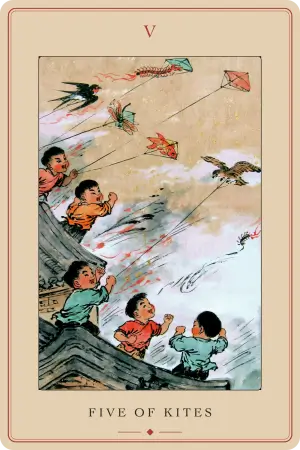
Sola Busca. A lone wounded warrior weighing a scale, conflict read as fatalistic duty.
Tarot de Marseille. Five crossed batons read by number as pure disruption, with no narrative attached.
Rider-Waite-Smith. The bright, boisterous scuffle of youths swinging sprouting staves, strife drained of malice, the image this New York card adapts.
Crowley-Thoth. The title Strife kept, the brawl replaced by a tense arrangement of ritual wands, the clash turned inner and initiatory, a purifying fire rather than a playground fight.
The Tarot of New York City. The same archetype moved to a construction site: five workers shoving crossed steel beams instead of wands, hard hats for tunics, the skyline and the Statue of Liberty watching from behind. The deck's pointed addition is that the steel of the quarrel is the steel of the building, so the whole fight is misdirected construction energy.
In combination and context
The Five is easily confused with the deck's other conflict cards, and the differences are precise. Against the Five of Swords, the Cranes fight is Fire: active, loud, disorganized, and free of real malice, a fair if messy scramble where nobody lies bleeding. The Swords version is Air, the cold aftermath of a win-at-all-costs battle with a clear victor and humiliated losers. Against the Seven of Wands the geometry differs: the Five is a free-for-all among equals, while the Seven is one person defending established high ground against many.
Context shifts it. Beside softer cards the antagonism can read as flirtatious teasing rather than hostility, the sparks of attraction rather than war. As advice it says engage the debate and fight fair. As an outcome it rarely names a clear winner: it points to a stretch of productive friction that, aimed with purpose, resolves into the public success the Six of Wands promises.
Questions for reflection
- In the contest I am in right now, am I fighting to win the job, or just to win the argument?
- Where would stepping into the friction actually sharpen me, and where is it only noise I should walk away from?
- If I have gone quiet to keep the peace, is that real resolution or only avoidance postponing a worse fight?
The general meaning follows the Rider-Waite-Smith reading, the reference used across Tarot Academy. Open a specific deck above for its own interpretation.
Frequently asked questions
Explore the Tarot
Latest Posts
Discover the ancient wisdom of tarot cards and unlock the mysteries of your spiritual journey. Our blog is your gateway to understanding the rich symbolism, meanings, and practical applications of tarot reading.




















































