
 EN (English)

Palmistry Library
The world's traditions of hand-reading
Three thousand years of reading character, fate and health in the palm, gathered in one library. From the Vedic Samudrika Shastra and the Chinese Bagua hand to Islamic and Kabbalistic mysticism, the Romani tradition, the modern Western schools and the medical science of dermatoglyphics, study each tradition's history, methods and meaning, fully translated into 52 languages.
- traditions
- 8
- languages
- 52
- years of history
- 3,000
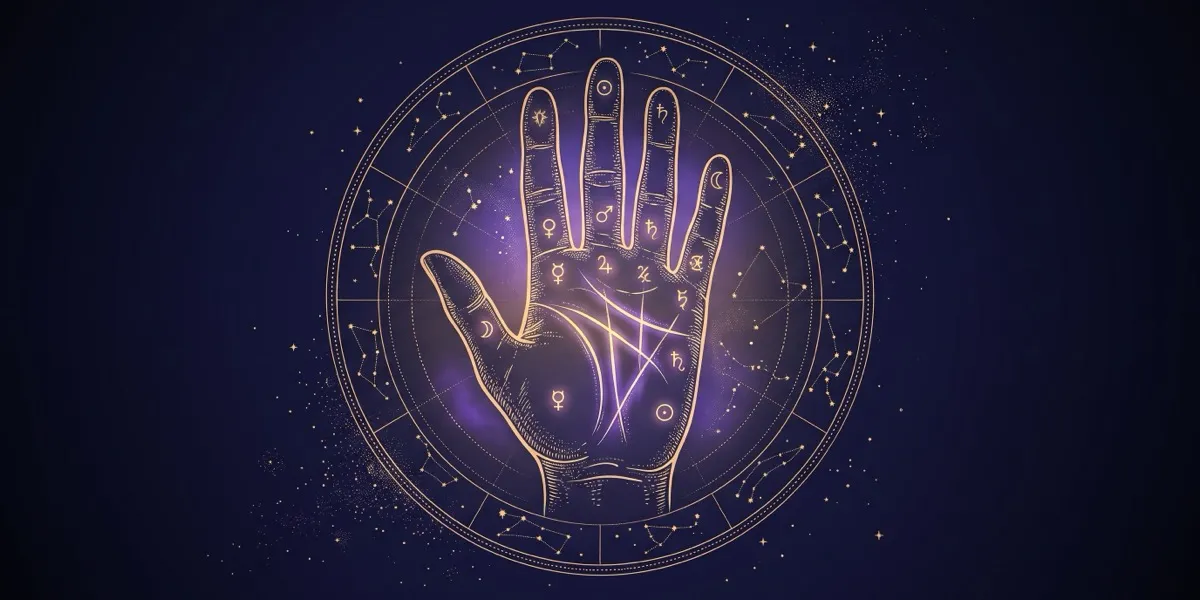
Browse by tradition
Each culture read the hand through its own cosmology, medicine and theology. Start with the one that speaks to you.
🕉️
Samudrika Shastra
India
over 3,000 years
The oldest codified hand-reading, a branch of the wider science of body signs drawn from the Puranas. It maps the palm's lines and planetary mounts as a record of karma, and reads the two hands as inherited potential against the results of free will.
☯️
Chinese Shou Xiang
China
from the Zhou dynasty
Hand analysis woven into Chinese medicine. Rather than Greco-Roman mounts it lays the eight trigrams of the I Ching across the palm, with a bright central 'courtyard' at its heart, and uses the hand to diagnose the body as much as to read fortune.
🖐️
'Ilm al-Kaff
Islamic world
medieval Sufism
The science of the palm, walking carefully around the ban on claiming the unseen. Sufi readers saw the creases forming the numbers that sum to the 99 Names of God and the fingers spelling His name, binding the hand to theology.
✡️
Kabbalistic chiromancy
Jewish mysticism
from late antiquity
Hand-reading as soul-mapping and a call to repentance. Rooted in the Merkabah mystics and the Zohar, which links the palm to the letter Kaf, it treats the lines not as fixed fate but as a changing ledger of deeds and free will.
🔮
Romani dukkeripen
European diaspora
15th century on
The art the Roma carried west from India and made famous across Europe. Blending real cold-reading with theatrical mystery, dukkeripen was both a living and a boundary between the Roma and outsiders, and it fixed the fortune-teller in the Western imagination.
📐
Western chirognomy
Europe
19th century
The rational revival led by Captain D'Arpentigny in 1839, who moved attention from the lines to the shape of the hand and set out seven hand types still used today, dividing the hand into intellectual, practical and instinctive 'worlds'.
🧠
Psycho-chirology
Europe
1930s
The hand read as psychology, not prophecy. Julius Spier, a student of Jung, and Charlotte Wolff stripped away fortune-telling and used the hand's form as a diagnostic tool for character, complexes and mental life.
🧬
Dermatoglyphics
worldwide
20th century
The empirical science that grew out of the old observation. Named in 1926, it studies the permanent ridge patterns set in the womb, and reads the atd angle and the single palmar crease as real markers of chromosomal conditions.
Browse by method
Hand-readers look at different features of the palm. Find the method built for what you want to know.
➿
The major lines
the creases
The heart, head and life lines that anchor almost every tradition, joined by fate, sun and marriage lines. Classical readers insist the life line shows vitality, not the length of a life.
⛰️
The mounts
planetary pads
The fleshy pads beneath the fingers, named for planets in the West and for trigrams in China. Their fullness and markings are read as the strength of what they govern, from ambition to love.
✋
Hand shapes & elements
hand shape
The reading of the hand's overall form, sorted by the classical elements into earth, air, fire and water hands, or by D'Arpentigny's seven types, each tied to a temperament.
🤲
The two hands
left & right
The comparison of dominant and non-dominant hands, one read as inherited potential and the other as the life made from it. Which hand means what varies by tradition.
✖️
Special markings
the marks
The small signs that modify a reading: the draining grille, the protective square, the ill-omened cross, and the mystic cross of occult gift set between the head and heart lines.
➖
The Simian line
fused lines
The single crease formed when the head and heart lines merge. Vedic readers see an intense union of thought and feeling; medicine knows it as the single transverse palmar crease.
🌀
Fingerprints & ridges
the ridges
The whorls, loops and arches first classified by Purkinje and Galton. Fixed for life from the seventh week in the womb, they carry the reading from folklore into genetics.
⚕️
Medical diagnosis
the body
The hand as a health map, from Chinese bio-holographic diagnosis and the pediatric 'tiger's mouth' method to the dermatoglyphic screening of chromosomal disorders.
🔢
Sacred geometry & number
hidden numbers
The systems that read the hand as sacred script: the Islamic creases summing to the 99 Names, the Bagua laid across the palm, and the Kabbalah's letters written on the body.
🧭
Fate & free will
destiny & choice
The question every tradition faces. Vedic, Islamic and Kabbalistic readers alike treat the lines as warnings and potentials to be worked with, not sentences fixed in advance.
The hand as a map
Across the ancient world the hand became a surface on which cultures wrote their ideas about fate, health and the divine. Palmistry, also called chiromancy or chirology, rests on the old hermetic idea that the small world of the body mirrors the large world of the cosmos. By reading the creases, ridges, proportions and fleshy pads of the palm, practitioners set out to judge character, foresee the future and even spot illness. The practice seems to have arisen on its own in several places, in India, China, Mesopotamia and Greece, where Aristotle is said to have found a treatise on the subject on an altar to Hermes and passed it to Alexander. Modern science treats its predictive claims as folklore, but the frameworks it built are a rich record of how people have imagined destiny, and its careful observation of the hand eventually seeded a real medical science.
Reading the hand
Beneath the many traditions lies a shared vocabulary. Most read three major lines, of the heart, the head and the life, along with minor lines for fate, fame and marriage, and they warn against the common error of taking the life line as a measure of lifespan rather than of vitality. They read the mounts, the fleshy pads beneath the fingers, named for planets in the West and for trigrams in China, whose fullness signals the strength of what they govern. They weigh the overall shape of the hand, often sorted by the four elements, and they compare the two hands, one for inherited nature and one for the life made from it. Small marks refine the picture: a grille that drains, a square that protects, a cross that warns, and the mystic cross of occult gift. When the head and heart lines fuse into one, the Simian line, it is read as an unusually intense union of thought and feeling.
India: Samudrika Shastra
The oldest written hand-reading comes from India, where it forms a branch of Samudrika Shastra, the wider science of bodily signs drawn from the Puranas and fixed in manuscripts like the Samudrika-tilaka of 1160. Hand-reading proper, Hasta Samudrika Shastra, treats every line and mount as a record of the mind and of accumulated karma. It sorts hands by the five elements and reads the two hands together: the non-dominant hand for the potential a person is born with, the dominant hand for what their choices have made of it. Because the reading is about growth rather than doom, a weak mount or troubled line is met not with a grim prophecy but with a remedy, often a gemstone chosen to strengthen the planet involved.
China: Shou Xiang and the Bagua
Chinese hand-reading, Shou Xiang, grew up inside traditional medicine rather than apart from it, tied to Yin and Yang, the five phases and the trigrams of the I Ching. Instead of Greco-Roman mounts it lays the eight trigrams across the palm, with a bright central courtyard, the Ming Tang, that should sit like a valley among the hills of the raised mounts; a sunken or dull center was read as a warning of misfortune or ill health. The eight surrounding zones each carry a vector of fortune, from wealth and fame to family and career. Because Chinese thought held that inner conditions must show on the surface, the hand also served as a diagnostic tool, including a pediatric method that reads the veins on an infant's index finger.
Islam: the science of the palm
In the Islamic world, hand-reading, 'Ilm al-Kaff, had to work around a strict ban on claiming knowledge of the unseen, which belongs to God alone. Sufi esotericists answered by treating it as a mystical science of the soul rather than a fortune-telling trick. They noticed that the creases of the two palms trace the numbers eighty-one and eighteen, which sum to ninety-nine, the number of the Names of God, and read the fingers as spelling His name, one reason the hand became a protective symbol, the Hamsa. The tradition linked regions of the hand to seven heavens, each under a prophet, and read the left hand for innate nature and the right for acquired traits, revisited every four months to follow a person through a full cycle of the elements.
Jewish Kabbalah
Jewish tradition held palmistry at arm's length and yet developed it deeply. Against the biblical ban on soothsaying, Kabbalists treated the hand as a map of the soul and a spur to repentance, tracing the practice to the Merkabah mystics and finding scriptural warrant in the verse that God 'sealeth up the hand of every man'. The Zohar ties the body to the Hebrew letters and the palm itself to the letter Kaf. Later texts gave the lines Hebrew names and moral meanings, but always under the rule, from the Talmud, that free will comes first: the lines are a record of deeds and a warning to change, not a fixed decree, with one hand read for unrealized potential and the other for what has been lived.
The Romani road
If the esoteric schools kept palmistry within their theologies, it was the Romani who carried it to ordinary Europe. Leaving northern India in the medieval period, they brought Hindu fortune-telling west, and after reaching Europe in the fifteenth century palm reading, dukkeripen, became a means of survival for Romani women on the margins of society. It was also a boundary, a controlled exchange between the Roma and outsiders that traded on European fascination with the exotic. Practitioners blended sharp cold-reading of a client's dress and reactions with theatrical mystery, and the trade occasionally shaded into outright grift, like the 'great trick' in which money wrapped up and slept on was promised to double and instead vanished by morning. For all that, the Romani reader stamped palmistry permanently onto the Western imagination.
Europe rebuilds the art
In sixteenth-century Europe palmistry was condemned as a forbidden art and suppressed by papal edict, and inquisitors read marks on the skin as signs of a pact with the devil. The nineteenth century rebuilt it on rational lines. Captain D'Arpentigny's book of 1839 moved the focus from the lines to the shape of the hand, dividing it into intellectual, practical and instinctive worlds and setting out seven hand types that still anchor Western practice. William Benham then tried to ground the lines in a bodily reflex theory, arguing that the hand was an extension of the brain, while the celebrity reader Cheiro carried an Indian-trained chiromancy to the famous, from Mark Twain to Oscar Wilde. By the 1930s Julius Spier and Charlotte Wolff had turned the whole thing into psycho-chirology, a diagnostic reading of character with the fortune-telling removed.
From palm lines to genes: dermatoglyphics
The same close attention to the hand that occupied the psycho-chirologists gave anatomists a genuine science. Named in 1926 and set out fully in 1943, dermatoglyphics studies the epidermal ridge patterns of the fingers, palms and soles. It built on the work of Purkinje, who classified ridge patterns in 1823, and of Galton and Henry, whose systems underpin fingerprinting. Unlike the shifting creases of palmistry, these ridges are fixed in the womb by the seventh week and never change. Researchers found that certain patterns are reliable markers of chromosomal conditions: in Down syndrome the axial triradius shifts toward the center of the palm, widening the atd angle well beyond the neurotypical range, and the single transverse crease that Vedic readers call the Simian line appears far more often. What began as divination ended, in this branch, as a tool of clinical screening.
How to use this library
Browse by tradition to follow one culture's hand-reading from its roots, whether that is Vedic Samudrika Shastra, the Chinese Bagua palm, Islamic and Kabbalistic mysticism or the modern Western schools, or browse by method to compare how the lines, mounts, shapes and ridges are read across them all. Every tradition, its history and its vocabulary are available in the fifty-two languages of the Tarot Academy ecosystem, so you can study the hand in the language you think in.
Frequently asked questions
Does the length of the life line predict how long I will live?
No, and the serious traditions say so explicitly. Classical Vedic texts hold that the life line shows the quality of a person's vital energy and major physiological shifts, not the length of their life, and Kabbalistic readers treat a broken line as a warning to change habits rather than a death sentence. The idea that a short life line means a short life is a popular misconception, not a claim of the older systems.
What is the difference between chiromancy and chirognomy?
Chiromancy is the reading of the lines and creases of the palm, the popular image of palmistry. Chirognomy, a term coined by Captain D'Arpentigny in 1839, is the study of the shape of the hand instead: the proportions of the palm and fingers, the flexibility, the mounts and the overall type. Modern Western palmistry usually combines the two, reading both the form of the hand and its lines.
Which hand should be read, the left or the right?
Most traditions read both and compare them. The common approach treats the non-dominant hand as inherited potential and the dominant hand as what a person has made of their life through their choices. Some traditions instead assign hands by gender or by innate versus acquired traits. The point of comparing them is to see the gap between potential and reality, which keeps the reading focused on growth rather than fixed fate.
Is palmistry scientifically valid?
Its predictive and personality claims are not supported by evidence and are considered a pseudoscience. However, the careful observation of the hand did give rise to a real science, dermatoglyphics, which studies the permanent ridge patterns of the palms and fingers. There, features such as a widened atd angle and a single transverse palmar crease are used as genuine markers in screening for chromosomal conditions like Down syndrome.
What is the Simian line?
The Simian line is a single crease that runs across the palm where the head and heart lines would normally be separate, formed when the two fuse into one. In Vedic palmistry it is read as an intense concentration of thought and emotion that can make a person act impulsively. In medicine it is called the single transverse palmar crease and appears far more often in some chromosomal conditions, though many people who have it are perfectly healthy.
What are the mounts of the hand?
The mounts are the fleshy pads on the palm, mainly at the base of each finger and around the thumb and outer edge. In the Western tradition they are named for planets, such as the mounts of Jupiter, Saturn and Venus, and in China the same regions are mapped to the eight trigrams. A reader judges how full, firm and well-marked each mount is to gauge the strength of the qualities it is said to govern.
Are these traditions available in my language?
Yes. Every tradition, its history and its methods are translated into all 52 languages supported by Tarot Academy, so you can study the hand in the language you know best.
Latest Posts
Discover the ancient wisdom of tarot cards and unlock the mysteries of your spiritual journey. Our blog is your gateway to understanding the rich symbolism, meanings, and practical applications of tarot reading.

















