
 EN (English)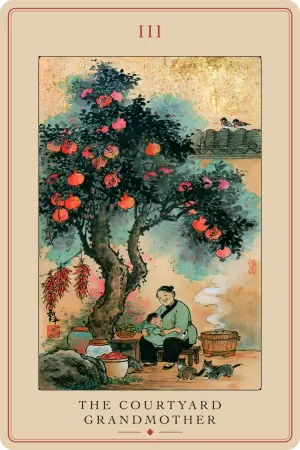


Major Arcana · 5
The Old Man on Jingshan
Order held as posture: an old man on Jingshan aligns his whole world to the city's Central Axis.
Card at a glance
- Numerology
- IV
- Element
- Fire
- Astrology
- Aries in old age · ruled by Mars
- Kabbalistic path
- Heh (Chokmah → Tiphereth)
- Timing
- Dawn · spring · Aries season
- Yes / No
- Yes
Upright
order
authority
stewardship
stability
structure
protection
the view from above
endurance
Reversed
rigidity
control without care
hollow authority
stubbornness
coldness
micromanagement
refusal to descend
The Old Man on Jingshan in each deck
Every deck reimagines the same archetype. Compare the art, then open a deck to read its full interpretation.
Imagery and symbolism
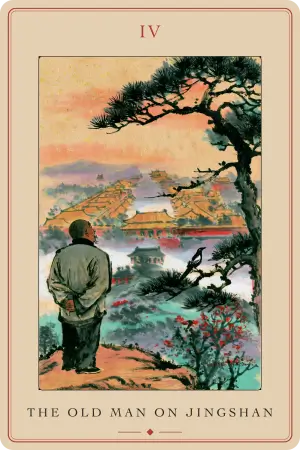
In the Tarot of Beijing the Emperor holds no scepter and sits on no throne. He is an old man in a plain padded jacket who has climbed Jingshan Hill before dawn, as he does every day, and stands exactly on the Central Axis (中轴线), the invisible line that has ordered the city for centuries. He was never an emperor. The posture is ten dynasties old, and that is the card's argument: order is a way of standing.
His hands are clasped behind his back, the deck's replacement for orb and scepter. Power here holds nothing and simply refrains from fidgeting. Below him the golden roofs of the Forbidden City rise out of the morning mist, laid out like his own chessboard, so the palace of real emperors has become the view of an ordinary man. He stands slightly turned, gazing along the axis that runs straight through the card and the whole city, the deck's image of unbending principle.
An old pine leans over him, black-needled and vertical as the axis, the Chinese emblem of longevity and uprightness through hard winters. A magpie perches at his shoulder, herald of good news and his only courtier. Red autumn leaves burn in the lower corner, the single vermilion accent of an ink sketch, passion kept in its proper place. The mist below swallows the lower halls, because even the widest view does not reveal everything, and the wise ruler knows where his sight ends.
Core meaning
The Old Man on Jingshan is Beijing's Emperor, and the deck states his whole meaning in one line: order is a way of standing. Authority is not a throne or a title but a posture held every dawn until the city aligns to it. Where the canonical Emperor rules by force of will over conquered ground, this old man maintains an order already agreed, carried in the spine rather than enforced by decree.
He is the Father of the deck, the civilizing principle who knows where the axis runs and so keeps a million rooftops from becoming chaos. If the Courtyard Grandmother (the Empress) feeds everyone within reach, the Old Man holds the frame in which her table can stand: the walls, the calendar, the rules of the lane. The Hero's lesson here is that authority is assumed, not granted. No one appointed him to stand on the axis. He took up the post the way one takes up a duty nobody else remembered, and the city quietly accepted the arrangement.
Upright meaning
Upright, the card says the situation asks for structure, oversight, and calm command. You are, or must become, the one who sees the whole city rather than one lane of it. Climb your own Jingshan: step back until the pattern is visible, then set it in order deliberately, roof by roof, from the high ground rather than from inside the noise of the hutong. You need no throne. The old man never had one.
In love. The padded jacket, not the fireworks: warmth shown as reliability. A partner who is where they said, when they said, for decades if needed, or a bond entering its settled phase of shared household and sober plans. Reserved people love deeply; they simply love in ink rather than in neon.
In career. The moment you are looked to rather than looked after. It favors promotion into oversight and owning a structure, a team or a process or a standard whose steadiness others calibrate against. Arrive early, keep the frame, say little, and plan in seasons rather than sprints. A senior, old-school superior may open the way.
In finances. The economics of the old courtyard: solid walls first, decoration later. It favors long-held assets, property above all, steady accumulation, and strict oversight of what you already own. Support may come from a parent, patron, or established institution, and inherited or family resources are well aspected.
In health. Exactly what the card depicts, the daily dawn climb. Health is built from small permanent structures: the same walk each morning, the same early hour, the slow aligned repetition of tai chi. Straighten the spine and carry the head as if looking along an axis, and favor endurance over intensity.
Reversed meaning
Reversed, the old man is still on the hill, but the dawn has passed and he has not moved. The card warns of order hardened into rigidity: rules kept for their own sake, control exercised over a city that has already changed below. Sometimes it shows the opposite failure, the axis abandoned and no one standing on it, structure quietly collapsing because nobody takes responsibility. Ask honestly whether your order still serves anyone, or whether you are guarding golden roofs that have become a museum.
In love. The relationship has hardened into administration. One partner stands permanently on the hill, supervising and correcting, while the other lives as a rooftop in the view below. Control has replaced protection, the schedule has replaced the touch. Come down from the hill, because the lanes are where people are.
In career. Bad hierarchy: either a micromanaging superior who rules by rigidity and calls it standards, or a leadership vacuum where the axis is lost and every department drifts. Beware the trap of the hill, monitoring everything and touching nothing. Take real responsibility with its weight, or step aside cleanly.
In finances. Order that is either despotic or decorative. Despotic means hoarding and over-control, refusing every expense until the household economy suffocates. Decorative means accounts that look orderly from the hill but hide mist below, where the actual halls are crumbling. Watch for money conflicts with father figures and for rigid attachment to declining assets.
In health. A regime out of balance. Either discipline has turned punitive, the body ruled like a garrison, or structure has collapsed entirely into late nights and skipped mornings. Watch the spine, the posture, and the knees that carry you uphill, then restore one small daily order rather than launching a dramatic campaign.
Historical notes
The Emperor began as a literal monarch. The fifteenth-century Visconti-Sforza card shows a bearded king with orb and scepter, the imperial eagle on his shield a loaded political device adopted by the Visconti only after Gian Galeazzo bought the ducal title in 1395. The Tarot de Marseille fixed his most famous pose, seated in profile with his legs crossed into the shape of a four, a posture that marked the highest-ranking man in a room and his right to pass legal judgment. During the French Revolution printers were forced to strip the royal symbols from their woodblocks, turning his crown into a Phrygian liberty cap and his scepter into a harmless flower.
The modern card arrived with the 1909 Rider-Waite-Smith deck, which cut the European monarchy loose. Waite and Pamela Colman Smith set the Emperor on a stone throne of four ram heads, dressed him in armor, and placed him in a barren red mountain landscape, recasting a political ruler as a figure of cosmic, Aries-driven authority.
The Tarot of Beijing takes that reframing further. It removes the throne, the armor, the scepter, and the crown, and keeps only the function. What remains is an ordinary old man on a hill above the Forbidden City, holding the same authority with nothing in his hands. The palace of real emperors survives as scenery, and the ruling has passed to whoever is willing to rise at dawn and take responsibility for looking.
Correspondences
Number. IV, and in this deck the number of the courtyard. A siheyuan has four sides, a city gate faces four directions, and the year turns through four seasons the old man has watched from this hill perhaps eighty times. Chinese cosmology makes the pairing exact: heaven is round and earth is square, 天圆地方. The Emperor is the square, the bounded and buildable order inside which life can safely happen, though the Central Axis passes through the square and points beyond it.
Astrology. Aries, the cardinal fire sign ruled by Mars, shown here as Aries in old age, the rarest and strongest form of the sign. The ram's fire has been banked like a stove kept all winter on a few coals. Aries rules the head, and the card is literally a raised head, chin up and gaze along the axis. Where a young Aries conquers, this old ram maintains, and maintaining takes the greater courage.
Element. Fire, surviving as discipline rather than assault: the daily, voluntary campaign of dawn and the protective instinct of the ram who no longer fights for territory because everyone knows whose hill it is.
Kabbalah. His Hebrew letter is Heh, the window, on the path from Chokmah to Tiphereth. Crowley later swapped this letter with The Star, giving the Emperor Tzaddi, the fish hook, though most readers keep the older Heh.
Psychological perspective
The person of this arcana has converted willpower into habit and habit into identity. Their strength no longer feels like effort. It feels like the only way to stand. They are early risers in every sense, first to see problems, first to take positions, first to accept blame for what is theirs, and the whole environment calibrates itself against them the way the city aligns to the axis.
At their best they think structurally, seeing systems where others see incidents, and they protect without smothering, holding the frame and letting others move inside it. The shadow is fossilization. Having found the one right way to stand, they may deny that other ways exist and mistake their own habits for natural law. Their reserve, one vermilion accent per lifetime, can read as coldness to those who need more color, and they risk becoming spectators of their own domain, so committed to the view from the hill that they rule a remembered city rather than the real one below.
The Old Man on Jingshan across decks
Rider-Waite-Smith. The canonical Emperor grips scepter and globe from an armored throne of ram heads, ruling by martial will over a conquered red landscape. The Old Man on Jingshan keeps that Aries authority but empties his hands and steps off the throne, trading conquest for maintenance.
Tarot de Marseille. The classic Emperor sits in profile, legs crossed into a four, the eagle shield at his side, entitled to judge. Beijing keeps the number four but moves it from the crossed legs to the four-sided courtyard and the four directions of the city gate.
Crowley-Thoth. Crowley reassigned the Emperor's Hebrew letter from Heh to Tzaddi, the fish hook, in his famous switch with The Star, and painted the shadow of the archetype as rational despotism. The Beijing reversed card meets the same shadow as the courtyard despot who rearranges the family like furniture.
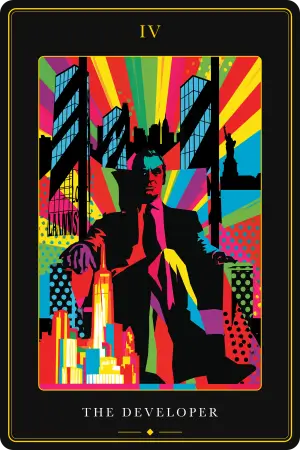
Modern reframings. Recent decks work to save the card's protection and structure from its monarchical baggage, rendering the Emperor as an ordered field of poppies or a chess player thinking several moves ahead. The Tarot of Beijing belongs to that movement, its old man on the axis a ruler who governs by posture and memory rather than by the threat of force.
In combination and context
The Old Man on Jingshan anchors whatever spread he lands in and pulls it toward order, oversight, and responsibility. Beside the Courtyard Grandmother (the Empress) he completes a whole, his frame giving her table a place to stand. With the Hierophant he stacks worldly authority on institutional tradition, a sign to work within established structure or formal teaching.
His banked fire compounds with drive and momentum. Alongside the Chariot he becomes an almost unstoppable will, the strategist's blueprint married to sheer motion, and with the Ace of Pentacles he points to the solid start of a well-built, lucrative venture. In love spreads the neighbors reveal whether the boundary is a home or a museum: with cards of rest and departure he reads as a mature figure holding a line, while with cards of nostalgia he is an elder looking back fondly but keeping restraint in charge.
When he keeps appearing in a reading, treat him not as an outside authority pressing on you but as an invitation to climb your own hill, set the day's structure in the first hour, and let the rest align to it like rooftops to the axis.
Questions for reflection
- Where has your order stopped serving anyone, and which golden roofs are you guarding only because they are expected?
- Do you hold the frame so others can move inside it, or do you supervise a city you no longer walk?
- What duty could you take up the way the old man took the hill, standing at your post whether or not anyone is watching?
The general meaning follows the Rider-Waite-Smith reading — the reference used across Tarot Academy. Open a specific deck above for its own interpretation.
Frequently asked questions
Explore the Tarot
Latest Posts
Discover the ancient wisdom of tarot cards and unlock the mysteries of your spiritual journey. Our blog is your gateway to understanding the rich symbolism, meanings, and practical applications of tarot reading.




















































