
 EN (English)



Major Arcana · VI
The Lovers
Pamela Colman Smith's Eden, where naked honesty and a genuine choice set the path ahead.
Card at a glance
- Numerology
- VI
- Element
- Air
- Astrology
- Gemini · ruled by Mercury
- Kabbalistic path
- Zain (Binah → Tiphereth)
- Timing
- Late spring · Gemini season
- Yes / No
- Yes, if values align
Upright
love
union
choice
values alignment
honesty
partnership
vulnerability
equality
Reversed
misalignment
indecision
disharmony
broken trust
temptation
avoidance
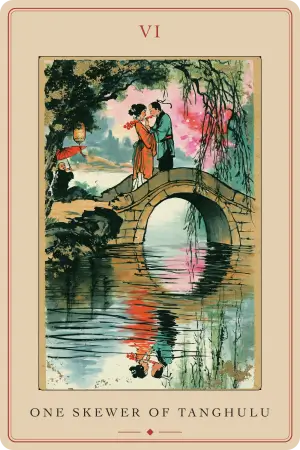
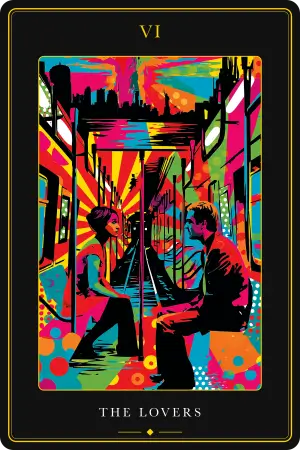
The Lovers in each deck
Every deck reimagines the same archetype. Compare the art, then open a deck to read its full interpretation.
Imagery and symbolism
Pamela Colman Smith's Lovers is the image most people now picture when they think of the card, and it looks nothing like the deck it replaced. Where the Marseille card crowded a torn man between two women, Smith drew just two figures: Adam and Eve, naked in the Garden of Eden, each rooted in front of their own tree. The deck reads that nakedness as plain sincerity. The couple hide nothing, so there is room only for trust and openness, and standing side by side rather than one above the other, they read as equals in the bond.
Above them the Archangel Raphael spreads his wings in blessing. His name means "God heals," and in the Golden Dawn system he rules the element of Air, which ties the whole scene to Gemini. Behind him a great sun blazes, and this deck leans on that light as the divine masculine principle, warmth and strength presiding over the union. The angel's gaze downward marks the meeting below as sanctioned from above.
Smith split the greenery into two deliberate halves. Behind Adam grows the Tree of Life, its twelve fruits drawn as tongues of flame for the signs of the zodiac and the active life force. Behind Eve stands the Tree of Knowledge with the serpent coiled up its trunk, the receptive principle and the entry of duality and moral choice. The gazes finish the diagram: Adam looks across at Eve, Eve looks up at Raphael. The rational mind reaches the divine only by way of the intuitive, feeling mind.
Core meaning
This deck's Lovers is a card of choice before it is a card of romance. It marks the sixth step of the Fool's Journey, the point where the traveler stops taking orders from the Emperor's law and the Hierophant's dogma and first chooses a path of his own. The deck frames it as the Hero's moment of deciding whether to stay under the parental roof or strike out alone, a wholehearted choice made from values rather than outside pressure.
The harmony Smith painted is real, but it is conditional. It arrives when outward actions line up with inner belief, when what you do finally matches what you hold true. The card also carries the union of masculine and feminine, mind with emotion, the search for wholeness that this deck names outright, so the choice it hands you is rarely settled by logic alone. Whatever you pick reshapes the road ahead.
Upright meaning
Upright, this Lovers speaks of love, union, and harmony, though it weights choice and honest alignment above passing feeling. The naked couple set the tone: a bond deep enough to lay you bare, a partner who works as an honest mirror.
In love. A connection built on the openness the artwork insists on, two people showing each other everything and growing through what they see. It can mark passionate romance, but the lasting version arrives when values genuinely align.
In career. A synergistic partnership whose result outstrips what either side could manage alone. The card also raises the harder choice between a safe, well-paid path and a passion-driven one, and asks you to follow your deepest values, since money cannot soothe a misaligned spirit.
In finances. A decision that turns on what you truly value rather than on the spreadsheet alone. Shared ventures and aligned priorities prosper; choices that betray your ethics rarely do.
In health. A nudge toward choices that actually serve you and toward integrating mind and body. Wellbeing here follows from honoring what you already know you need.
Reversed meaning
Reversed, this Lovers warns of misalignment. Your actions and your values have drifted apart, or a choice you keep dodging has left you stuck, letting outside forces set your direction. Refusing to choose is still a choice, and it usually ends in stagnation.
In love. Broken trust, disharmony, or temptation. The energy of the older Marseille card, the choice between competing partners, still sits under Smith's two figures, so reversed it can hint that a gaze has wandered and someone is quietly weighing an outside interest. It needs supporting cards before it accuses anyone.
In career. Being trapped in work that feels meaningless and cut off from your real self, or a partnership hiding misaligned priorities and eroded trust beneath a polite surface.
In finances. Chasing security at the cost of your spirit, or money decisions made against what you actually believe.
In health. An inner conflict left unresolved, ignoring what your body and mind are asking for, a balance that has slipped.
Historical notes
The Rider-Waite-Smith Lovers was the deck's clean break with everything before it. The earliest Lovers, on cards like the Visconti di Modrone of roughly 1441, were about marriage as a contract: figures in family heraldry, a white dog for fidelity, clasped hands that in fifteenth-century Italy sealed the union more firmly than any ring. The Tarot de Marseille then renamed the card L'Amoureux and turned it into a moral test, a young man at a crossroads between a modest woman and an alluring one under a blindfolded Cupid, the Choice of Hercules made visible.
Arthur Edward Waite discarded that torn man entirely. Working with the artist Pamela Colman Smith, both members of the Hermetic Order of the Golden Dawn, he returned the card to two figures as Adam and Eve, which reinforced the Gemini link of the Twins and let him load the garden with Eden's Qabalistic symbolism. Smith painted the deck's 78 images in 1909, and William Rider & Son published it in London the following year. For decades the deck was known as "Rider-Waite"; the now-common "Rider-Waite-Smith" and "Smith-Waite" names restore the illustrator whose hand shaped every card here.
Correspondences
Number. He is VI, a number of harmony and balance, and of the duality that harmony has to reconcile. In this deck his shadow twin is The Devil at XV, whose digits reduce back to six.
Astrology. Gemini rules the card, the mutable air sign of the Twins, governed by quick, communicative Mercury. The pairing suits a card about two poles in dialogue and the choices that pass between them.
Element. Air, the realm of mind, language, and analysis, the same element as the suit of Swords.
Kabbalah. He holds the 17th path, from Binah (Understanding) down to Tiphereth (Beauty). His Hebrew letter is Zain, the sword, an engine of division. In the wider tradition Crowley set the whole card beneath an Arch of Swords for that reason and paired it with Art, or Temperance, as the two halves of Solve et Coagula: the Lovers separates the world into opposites, Art reunites them.
Elemental dignity. Beside Swords the card's decision-making edge sharpens, turning the reading toward the analysis a real choice demands.
Psychological perspective
The deck names the anima and animus directly, and Jung's reading fits Smith's balanced pair under Raphael's wings. Each psyche carries a contrasexual counterpart, the inner feminine in a man and the inner masculine in a woman, and the two figures joined beneath the angel stand for integrating that hidden half into a whole self. This deck's own text frames the same idea as exploring the divine through the feminine by way of the logical masculine, a search for wholeness rather than a picture of two separate people.
The trouble is that until we do the work consciously, we project that inner figure onto real people, and what culture calls falling for a soulmate is often falling for our own unintegrated half reflected back. Disillusionment is built in. Sooner or later the projection cracks against the ordinary reality of the other person. The immature response is to walk off and find a fresh screen to project onto; the mature one is compassion, choosing a grounded companionship that accepts both partners as flawed and real. Read this way the card outgrows romance: ace and aro readers take it as a choice about values and self-acceptance, and queer readers use its two figures for the work of making peace with one's own body and identity.
The Lovers across decks
Smith's Eden is now the reference point other Lovers are measured against, so it helps to see what it kept and what it dropped.
Tarot de Marseille. L'Amoureux keeps the young man at his crossroads between a modest woman and an alluring one, the blindfolded Cupid overhead. Waite took the moral-choice charge from this card but threw out its three-figure staging.
Crowley-Thoth. Crowley builds Atu VI beneath an Arch of Swords for the letter Zain and stages the Chymical Marriage of a Black King and a White Queen, their consummation held back for the later Art card. A winged Orphic egg waits at the base, and faint background figures preserve his darker reading of the card as "The Brothers," the story of Cain and the first blood sacrifice, with a Cupid whose quiver reads Thelema. Where Smith painted innocence, Crowley painted alchemy.
Modern decks. Contemporary and queer artists untether the card from Adam and Eve entirely, reading its union as chosen family, self-acceptance, or the fluid energies inside a single body, and re-centering it on choice and values rather than a man-and-woman pairing.
In combination and context
In this deck's own architecture the Lovers is built as the bright half of a pair. Its dark twin is The Devil, and Waite and Smith made the link visible on purpose: the same naked man and woman, now horned and chained to a black altar under Baphomet instead of standing free under Raphael. Where the Lovers is free choice and reciprocal bonding, The Devil is attachment driven by fear, its chains loose enough to slip off yet worn by choice. Drawn together the two can signal trauma bonding or addictive chemistry mistaken for destiny.
The Lovers is also often set against the Two of Cups, and the difference matters. The Two of Cups is minor and everyday, the sweet romance of dates and first "I love you"s kept alive by daily effort. The Lovers is major and archetypal, a karmic collision between near-opposites drawn together to complete each other's lessons. One is an invitation to share a life; the other is a mandate to transform the soul.
On questions of fidelity the card leans on its neighbors before it says anything harsh. Flanked by the Seven of Swords it suggests sneaking and deception, by the Three of Swords a love triangle and heartbreak, by The Moon hidden secrets, and by the Knight of Wands a restless player chasing thrills. Alone it accuses no one; in that company it becomes a test of loyalty.
Questions for reflection
- What choice are you avoiding, and what does refusing to decide cost you?
- Where do your daily actions fail to match what you say matters most?
- In the person you are drawn to, what part of yourself are you really seeing?
The general meaning follows the Rider-Waite-Smith reading — the reference used across Tarot Academy. Open a specific deck above for its own interpretation.
Frequently asked questions
Explore the Tarot
Latest Posts
Discover the ancient wisdom of tarot cards and unlock the mysteries of your spiritual journey. Our blog is your gateway to understanding the rich symbolism, meanings, and practical applications of tarot reading.




















































