
 EN (English)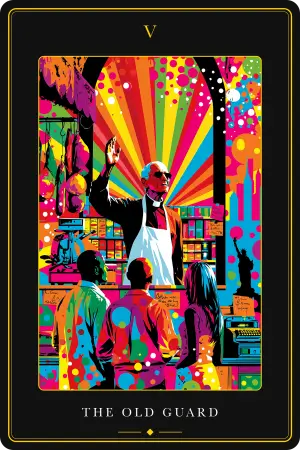


Major Arcana · 7
The Lovers
A stalled L train under the East River, two strangers who finally look, and a choice that counts only because no one made it for them.
Read the complete guide: The Lovers Card VI in Tarot: A Complete Guide to Symbolism and Meaning
Card at a glance
- Numerology
- VI
- Element
- Air
- Astrology
- Gemini · ruled by Mercury
- Kabbalistic path
- Zain (Binah → Tiphereth)
- Timing
- Late spring · Gemini season
- Yes / No
- Yes, if the choice is truly yours
Upright
Choice
Connection
Love
Values alignment
Union
Attraction
Harmony
Commitment
Reversed
Missed connection
Indecision
Imbalance
Misaligned values
Breakup
Avoidance
One-sided attachment
The Lovers in each deck
Every deck reimagines the same archetype. Compare the art, then open a deck to read its full interpretation.
Imagery and symbolism
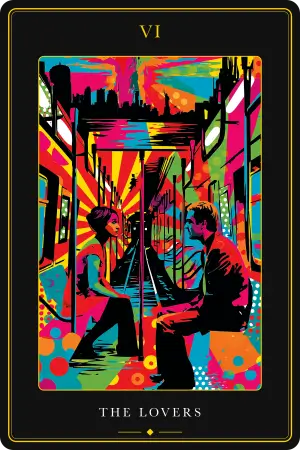
In the Tarot of New York City the Lovers keeps its old name and loses its garden. The card shows the inside of an L train stalled in the tunnel under the East River, drawn in the deck's pop-art language of halftone dots, saturated color blocks, and hard black silhouette. A woman and a man sit facing each other across the aisle, knees almost touching, caught at the exact second they stop pretending not to look. Neither has spoken. The picture freezes the breath before the choice.
The stalled train is the card's central symbol and its sharpest break from Eden. Here the moment of love and choice does not arrive in paradise. It arrives when the machinery of an ordinary commute breaks down. The train stops, the schedule dissolves, and only then do two people actually see each other. The delay every rider curses is the opening the card is built on.
Placing the meeting in the tunnel under the river sets it below the water, and water is the element of Cups and feeling. The whole scene is submerged in emotion neither passenger has admitted. At the top of the card the skyline and harbor spread out in silhouette with the Statue of Liberty raised among the towers. She stands in for the angel of the classic card, a colossal guardian blessing the meeting from above while insisting the choice stay free. Liberty presides over the Lovers because in this deck love is read as the freest decision a person makes.
The sunburst rays behind the woman's head carry the fire of attraction, the divine light that used to pour from Raphael. Now it radiates from the human being herself, since illumination in this city comes through people. The halftone dots scattered across the car read as the crowd dissolving into pattern. When a real connection appears, everyone else turns to background.
The vertical poles between and around the two figures are the card's honest note of difficulty. They stand where the mountain stood between Adam and Eve, holding all the boundaries and all the reasons New Yorkers give for not talking to strangers, and the lovers will have to reach past them. The empty seats running down the car in both directions are every other life each of them could choose instead. The perspective lines converge in the dark tunnel ahead, an unknown future that opens only if someone speaks. The flickering lights, rendered as the deck's rapid alternation of color blocks, mark the threshold: between one flash and the next, the ordinary rules are suspended. Two facing silhouettes, an open aisle, a city goddess overhead with a torch, and one question the Rider-Waite angel also asked. Now that you have seen each other, what will you choose?
Core meaning
The archetypal Lovers you already know from the canonical card holds underneath: duality, the weight of a choice that logic cannot settle, and the first real act of individuation on the Fool's Journey. This deck takes that baseline and gives it two subway seats. The Lovers here is a card of connection and conscious choice, where deciding is a form of self-definition and love and freedom turn out to be the same subject.
Something real is passing between you and another person, an idea, or a path, and the card asks you to choose it on purpose rather than drift past. The choice usually cannot be resolved by calculation or outside advice, and whatever you pick reshapes the route ahead. Its harmony is earned only when your outward actions match your inner values, when what you do finally agrees with what you believe.
Inside this deck's street-level journey the Lovers marks the first decision the city cannot make for the Newcomer. The Hustler showed what could be gotten and the Old Guard showed how it had always been done, yet each of them handed over a ready-made map. The Lovers is where the borrowed maps run out. The train stalls in the dark under the river, and the hero has to choose from the inside: this person, this life, this version of myself, chosen with the whole heart and answered for afterward.
Upright meaning
Upright, the Lovers describes people and moments that lean across the aisle. The general reading is connection freely chosen and a decision made with the heart consulted and checked against your values. A choice made to please others or made from fear will not hold. If the connection is real, the card's counsel is to speak before the doors open again, because windows in this city close fast.
In love. This is the card's home voltage: deep mutual attraction, the current running between two people before a word is spoken, and the nerve to act on it. For someone meeting new people it can mark the literal encounter, the stranger who suddenly stops being a stranger. For an established couple it marks a deepening, the passage from circumstance into commitment chosen again with open eyes. The love it describes is between equals, two facing seats and balanced desire, and it sometimes poses a concrete step: moving in, the ring from the Diamond District on 47th Street, or the vow at the City Clerk's office.
In career. A working partnership with genuine chemistry and shared values, the colleague you click with or the mentor who shifts your trajectory. It also raises the classic fork: two offers, or the safe job against the one you could love. A career chosen purely on paper terms is a lease on someone else's life, so the card asks you to decide with your values in the room and pick the work you could defend at both ends of the line.
In finances. A fork in the financial track that must run through what you value, not the math alone. It often marks joint money, the moment two people merge accounts the way they merged lives, and it favors shared ventures where both sides carry equal weight. Sometimes it poses the New York dilemma directly: the option that pays more against the one you could stand behind wholeheartedly.
In health. Harmony between the inner person and the outer body, with the body read as the place attraction lives. It marks a stretch of feeling at ease in your own skin and favors care taken as self-respect, movement and rest kept in fair proportion. Attractiveness here follows alignment. When what you feel, what you value, and how you carry yourself agree, people notice.
Reversed meaning
Reversed, the card is the same subway car after the moment passes. The lights come back on, both passengers look away, and the train rolls into the station carrying two people who chose nothing. It points to indecision, a stalled relationship, a wrong choice, or the quiet damage of a decision endlessly postponed. Not choosing is still a choice, usually the worst one on offer. Name the fork you are avoiding.
In love. The missed connection and the stalled couple: one person leaning across the aisle while the other studies the subway map, mismatched values that attraction papered over, a breakup or the long flickering half-light before one. Old as the card's Marseille roots, it can also hint that a partner's gaze has wandered toward an outside interest, though it needs supporting cards before it accuses anyone. Turn the lights on and have the direct conversation.
In career. The professional stall: two offers weighed until both windows close, a job accepted against your values that now costs you daily, or a working partnership out of balance where one person carries the load. Stop treating the fork in the track as scenery, name the choice, and weigh it with head and heart together.
In finances. Money decisions made half-heartedly or not at all, imbalance in shared finances where one partner carries the lease while the other drifts, or the discovery that your financial life and your actual values quietly separated. Impulsive spending to soothe relationship trouble is a classic version. Put the numbers and the feelings on the same table.
In health. A broken treaty between self and body: harsh self-criticism, standards imported from outside rather than chosen, or a swing between neglect and obsessive correction. The two facing seats, self and body, have tipped out of balance. Care resumed from acceptance succeeds where campaigns launched from dislike fail.
Historical notes
The Lovers changed shape many times before New York put it on a train. The earliest versions were about marriage as a contract. The Visconti di Modrone card of roughly 1441 celebrates the union of Bianca Maria Visconti and Francesco Sforza, its figures dressed in both families' heraldry beneath an "Amor" canopy with a white dog at their feet for fidelity. The clasped hands mattered more than any ring, since in fifteenth-century Italy the handclasp sealed the binding marriage. Later Italian cards such as the Charles VI widened the scene to several couples strolling under aiming Cupids.
The Tarot de Marseille renamed it L'Amoureux, the singular Lover, and turned celebration into conflict. A young man stands at a crossroads between two women, one stern and modest and one young and alluring, a blindfolded Cupid poised overhead. This is the Choice of Hercules, virtue against pleasure, and it recast the card as a hard moral decision where taking one road means giving up the other.
The modern image arrived with the Rider-Waite-Smith deck in 1910. Waite and Pamela Colman Smith dropped the torn man and his two women, returned to two figures as Adam and Eve under the Archangel Raphael, and reinforced the Gemini link of the Twins with Eden's Qabalistic symbolism.
The Tarot of New York City carries that long movement one step further. Each earlier version answered a local question about where a binding choice of the heart could plausibly happen: a dynastic court, a country crossroads, a mythic garden. This deck moves it underground, because in this city the place two strangers are most likely to finally see each other is a train that has stopped between stations. Eden becomes a stalled L, the mountain becomes a row of subway poles, and the angel becomes the statue in the harbor holding up her torch.
Correspondences
Number. The Lovers carries six, a number of harmony, love, and responsibility, the balance point where separate parts settle into one working whole. In the geometry of the card it appears as the equilibrium between two figures who face each other with the aisle level between them, neither seat above the other. Six also follows five, the number of conflict, and answers that friction with a peace two willing people choose and keep. Its shadow twin is The Devil at fifteen, whose digits reduce back to six.
Astrology. Gemini rules the card, the mutable air sign of the Twins governed by quick, communicative Mercury, and no correspondence sits more naturally in New York. Gemini is two minds meeting and the current of conversation that runs the city, and its gift is opening a channel with someone met ninety seconds ago on a subway car. Its shadow is the card's shadow too: keeping both options alive forever, riding the line back and forth without ever getting off.
Element. Air, the realm of mind, language, and analysis, the same element as the suit this deck calls Subways. Even the deepest attraction here has to become language eventually, a question asked and a choice spoken out loud.
Kabbalah. The card holds the 17th path, from Binah (Understanding) down to Tiphereth (Beauty). Its Hebrew letter is Zain, the sword, an engine of division, so Crowley set the whole Thoth card beneath an Arch of Swords and paired it with Art, or Temperance, as the two halves of Solve et Coagula: the Lovers separates the world into opposites and Art reunites them.
Elemental dignity. Beside the deck's Subways, the mental, decision-making edge sharpens, turning the reading toward the analysis a genuine choice demands.
Psychological perspective
Jung read the Lovers as a picture of inner union. Each psyche carries a contrasexual counterpart, the Anima in a man and the Animus in a woman, and the balanced pair stands for integrating that hidden half into a whole self. This deck stages the idea literally: the stranger across the aisle is also, in the dream-logic of the tarot, the unlived half of the person looking. What the hero falls for in another is often a quality waiting to be claimed within, which is why the choice can never be handed to anyone else. To lean across the aisle is to say out loud, in front of a witness, what you actually want.
The projection is built to crack. Sooner or later the fantasy meets the ordinary, frustrating reality of the other person. The immature response is to get off at the next stop and look for a fresh face to project onto; the mature one is compassion, a grounded companionship that accepts both people as flawed and real. Read this way the card outgrows romance entirely. Ace and aro readers take it as a choice about values and self-acceptance, coming out or building chosen family, and queer readers use its two figures for the work of making peace with one's own body and identity.
As a personality the Lovers type leads with the heart and knows it, reads a room or a subway car instantly, and chooses people deliberately over convenient company. The healthy version keeps its own outline inside the union and occupies two facing seats rather than one merged silhouette. Under stress the same wiring splits, heart pulling one way and head the other, and the result is paralysis dressed up as deliberation, every option kept warm and every commitment left provisional. The developmental task is teaching heart and mind to ride in the same car, so that when the lights flicker the whole person decides.
The Lovers across decks
Tarot de Marseille. L'Amoureux keeps the young man at his crossroads between a modest woman and an alluring one, the blindfolded Cupid overhead, the Choice of Hercules made visible.
Crowley-Thoth. Crowley builds Atu VI beneath an Arch of Swords for the letter Zain and stages the Chymical Marriage of a Black King and a White Queen, their consummation held back for the later Art card. A winged Orphic egg waits at the base, and faint background figures preserve his darker reading of the card as "The Brothers," the story of Cain and the first blood sacrifice, with a Cupid whose quiver reads Thelema.
Modern decks. Contemporary readers and queer artists untether the card from Adam and Eve, reading its union as chosen family, self-acceptance, or the fluid energies inside a single body, and re-centering it on choice and values rather than heteronormative coupling.
The Tarot of New York City. This deck keeps the name The Lovers and swaps the garden for a subway car. Adam and Eve become two strangers facing each other across the aisle, the Tree of Life and the Tree of Knowledge become the vertical poles between them, the Archangel Raphael becomes the Statue of Liberty raised over the skyline, and Raphael's divine light becomes the sunburst behind the woman's head. Where the classic card sets the choice in Eden, this one sets it in a stalled L under the East River, the one place a distracted city ever slows down enough to let two people look.
In combination and context
The Lovers is often set against the Two of Cups, and the difference matters. The Two of Cups is minor and everyday, the sustainable romance of dates and first "I love you"s kept alive by daily effort. The Lovers is major and archetypal, a near-collision between opposites drawn together to complete each other's lessons, closer to Romeo and Juliet than to a cozy courtship. One is an invitation to share a life; the other is a mandate to transform the soul.
Its dark twin is The Devil, the same charged pair now bound instead of free. The Lovers is a choice made in freedom; The Devil is attachment driven by fear and obsession, its chains loose enough to slip yet worn on purpose. Drawn together they can signal trauma bonding or addictive chemistry mistaken for destiny, all intensity and no peace.
On questions of fidelity the card leans on its neighbors before it says anything harsh. Flanked by the Seven of Subways it suggests sneaking and deception, by the Three of Subways a love triangle and heartbreak, by The Moon hidden secrets, and by the Knight of Cranes a restless player chasing thrills. Alone it accuses no one.
Inside this deck the Lovers also reads against its own cast. It stands one step past the Old Guard, the deck's Hierophant, so where he blesses the community-approved bond, the Lovers hands the choice back to the individual on the stalled train. Applied to the building suits of Tokens and Cranes it becomes the co-founder or partner you actually choose to build with. As advice it says consult the heart, check it against your values, and speak while the lights still flicker. As the obstacle it is the choice endlessly deferred. As the outcome it promises a connection or a decision made freely and answered for at both ends of the line.
Questions for reflection
- What choice are you avoiding on the stalled train, and what does refusing to decide cost you?
- Do your daily actions actually match what you say you value most?
- In the person across the aisle, what part of yourself are you really seeing?
The general meaning follows the Rider-Waite-Smith reading, the reference used across Tarot Academy. Open a specific deck above for its own interpretation.
Frequently asked questions
Explore the Tarot
Latest Posts
Discover the ancient wisdom of tarot cards and unlock the mysteries of your spiritual journey. Our blog is your gateway to understanding the rich symbolism, meanings, and practical applications of tarot reading.




















































