
 RO (română)

Tarot
Arcana Majoră
22 cărți
Cele 22 de cărți de atu, numerotate de la 0 la 21. Coloana vertebrală arhetipală a pachetului — fiecare reprezentând o temă majoră din viață, de la inițiere la desăvârșire.
Răsfoiește cărțile
Arcana Majoră în fiecare pachet
The same 22 trumps, reimagined by each deck in our library. Open the Major Arcana in the deck you want to read.
The Major Arcana: the 22 trumps at the heart of the Tarot
The Major Arcana are the 22 trump cards that give the Tarot its reputation as more than a card game. Numbered 0 to 21, from The Fool to The World, they carry the deck's largest themes, the forces and turning points that shape a life rather than fill an afternoon. Here is what they are, where they came from, and how six centuries of card players, occultists and analysts have learned to read them.
Definition and role in the deck
A full Tarot deck holds 78 cards in two unequal halves. The smaller half by count, but the larger by weight, is the Major Arcana: 22 cards numbered 0 to 21, beginning with The Fool and ending with The World. The other 56 cards, the Minor Arcana, run in four suits and look much like an ordinary pack of playing cards. The Minor Arcana handle the texture of daily life, its work, money, feeling and conflict. The Major Arcana deal with something wider, the archetypal forces and structural turning points that sit underneath a whole situation.
That difference in scope is why the word major is not just a label. In most reading traditions a trump carries more force than a suited card. When several Major Arcana turn up in one spread, readers take it as a sign that the question touches something larger than routine, a matter of fate or character or a genuine crossroads rather than a passing detail. A reading crowded with trumps is read as a reading about forces largely outside the querent's day-to-day control.
Historical origins and evolution
The Major Arcana began as a game. In the courts of northern Italy between roughly 1440 and 1450, in Milan, Ferrara, Florence and Bologna, cardmakers added a fifth suit of illustrated trionfi, or triumphs, to the existing four-suit pack. These trumps outranked the suits in a trick-taking game. The oldest survivors, the hand-painted Visconti-Sforza decks, were luxury objects finished in gold leaf for the rulers of Milan, and every sign points to their use in play rather than prophecy. Their imagery came straight from the world the players knew: civic triumph parades, the Christian virtues, and the politics of the day, such as the imperial eagle that sits on early versions of The Emperor.
Print changed the deck. As the game spread into France and Switzerland, woodcut production replaced hand-painting and pared the art down to a bold, primary-colour style that settled into the Tarot de Marseille. The Marseille fixed the number, order and iconography of the 22 trumps and became the baseline for everything after it.
The turn from game to oracle came late, in 1780s France. In 1781 the Freemason and scholar Antoine Court de Gébelin argued that the cards were a surviving fragment of ancient Egyptian wisdom, a lost Book of Thoth. The theory was wrong, but it arrived during a European craze for Egyptian antiquity and it held. Two years later Jean-Baptiste Alliette, writing as Etteilla, published the first practical manual for reading the cards, fixing a meaning for each one and popularising the practice. In the mid-1800s Éliphas Lévi tied the trumps to the Hebrew alphabet and the Kabbalah, and the Hermetic Order of the Golden Dawn, founded in London in 1888, built that hint into a full system of correspondences. From the Golden Dawn came the two decks that define modern practice: the Rider-Waite-Smith deck of 1909 and Aleister Crowley's Thoth deck, painted by Lady Frieda Harris between 1938 and 1942.
The Fool's Journey
Read in order, the 22 trumps tell one continuous story. The author Eden Gray gave it its popular name in the 1970s: the Fool's Journey. The Fool, numbered 0, is the unformed self, curious and untested, stepping off a cliff-edge into experience. The 21 cards that follow trace what happens next, and they fall into three acts.
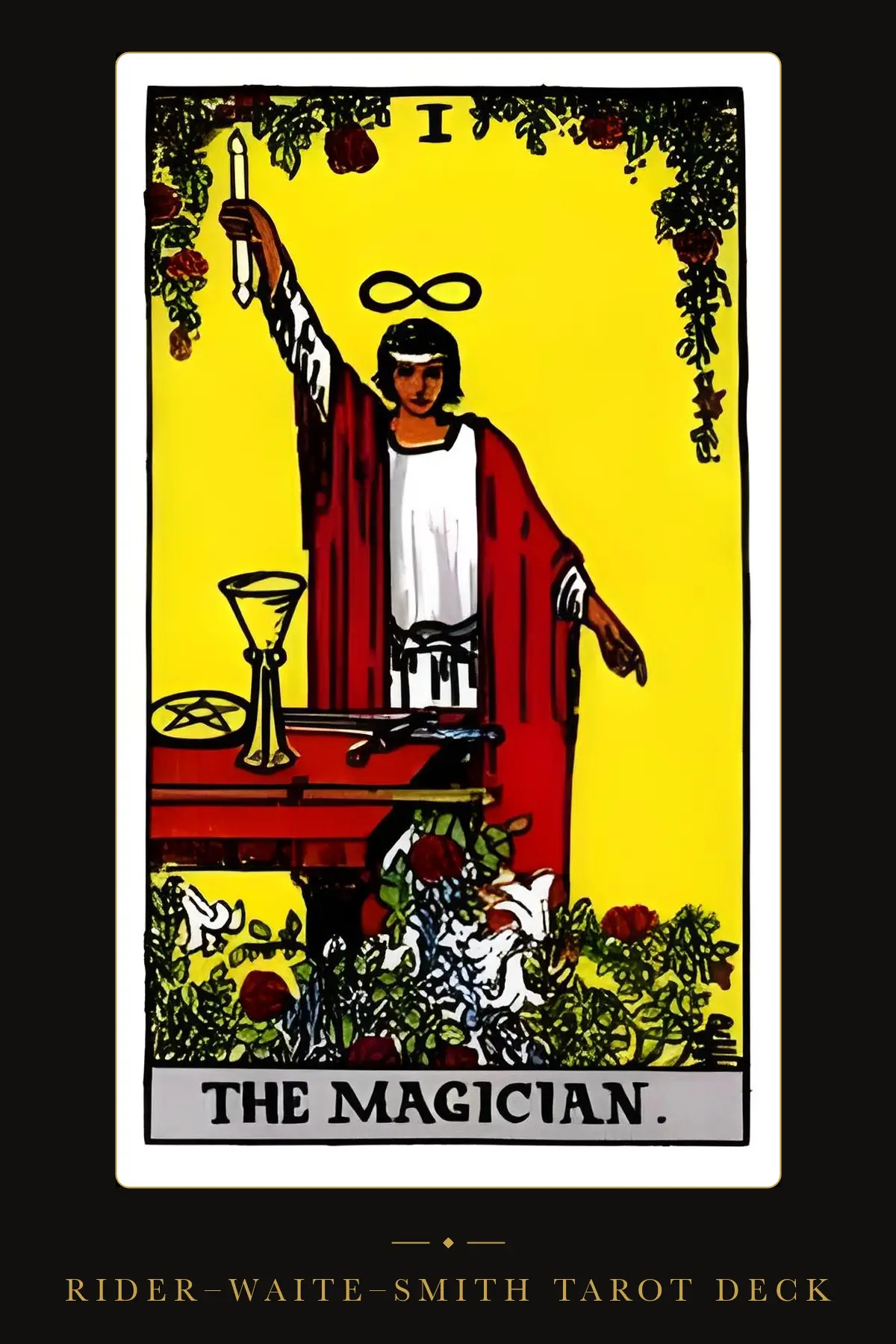
The first act is initiation. Cards I to VII, from The Magician to The Chariot, build the personality and its footing in the world: the will to act, the inner voice of the High Priestess, the mother and father figures of the Empress and Emperor, the teaching of the Hierophant, a first real choice at The Lovers, and an early mastery at The Chariot.
The second act is trial. Cards VIII to XIV, from Strength to Temperance, turn inward once outward success proves thin. The journey passes through moral reckoning, the withdrawal of The Hermit, the turning Wheel, the ego-death of Death, and a hard-won balance at Temperance.
The third act is transcendence. Cards XV to XXI, from The Devil to The World, face the largest forces of all: bondage at The Devil, sudden collapse at The Tower, then renewal through The Star, The Moon and The Sun, ending in the wholeness of The World. Joseph Campbell recognised the same three-part shape in world mythology and called it the Hero's Journey.
Philosophical and archetypal foundations
The trumps have carried heavier philosophical freight than a game ever needed, and later readers found ready-made frameworks waiting for them. The oldest is the Neoplatonic and Hermetic image of a ladder of being, a graded ascent from the material world up toward the divine. A sequence of 21 numbered pictures climbing toward The World reads easily as that ascent, which is part of why eighteenth and nineteenth-century occultists were so quick to treat the deck as a hidden cosmology. Hermeticism gave them the governing phrase, 'as above, so below', in which each card mirrors a level of reality from the stars down to the self.
In the twentieth century Carl Jung translated the same intuition into psychology. He read the trumps as archetypes, the recurring figures of the collective unconscious that surface across the myths and dreams of every culture. The Empress is the Great Mother; The Devil is the Shadow. For Jung the value of such images was individuation, the long work of integrating the conscious and unconscious parts of the psyche into a single self. That reading let the Major Arcana be taken seriously with no claim to magic at all. The cards worked because the human mind already thinks in archetypes, and the deck simply lays 22 of them out on the table.
Psychological reading
Building on Jung, the analyst Sallie Nichols set out the fullest psychological reading of the trumps in her 1980 book Jung and Tarot: An Archetypal Journey. Nichols treated the 22 cards as a map of individuation and the Fool's Journey as its route. Along the way the cards act as projection holders: the psyche casts its own contents onto their open, resonant images, which is what makes a reading feel personal.
Read this way, the Major Arcana become stages of inner development rather than forecasts. The Devil names the complex that has quietly taken control, the habit or self-deception a person will not look at directly. The Tower is the crisis that follows, the collapse of something built on a false foundation, and its lightning is read as insight rather than punishment. Modern therapeutic practice uses the deck in exactly this spirit. A counsellor may lay out cards not to predict anything but to hand a client a vivid external image to talk around, a way to name a feeling and hold it at a workable distance. The value sits with the person reading, not with the card.
Structural correspondences
Beneath the imagery the Major Arcana carry a dense grid of correspondences, most of it fixed by the Golden Dawn in the late 1800s. Four systems overlap.
Numerology. The trumps run 0 to 21, and the numbers read as a progression: 0 the open potential of The Fool, the low numbers the building of a self, the teens the encounters that test it, 21 the completion of The World. Some readers reduce the two-digit trumps to a root digit to link them, pairing The Wheel of Fortune (X, ten) with The Magician (I) through their shared 1.
Astrology. Following the Sepher Yetzirah, the Book of Formation, the Hebrew alphabet splits into three 'mother' letters for the elements, seven 'double' letters for the classical planets, and twelve 'simple' letters for the zodiac signs. The Golden Dawn mapped the 22 trumps straight onto that scheme. Ten cards took the elements and planets, among them The Fool to Air, The Magician to Mercury, The High Priestess to the Moon and The Sun to the Sun. The remaining twelve took the zodiac in calendar order from Aries: The Emperor to Aries, The Hierophant to Taurus, The Lovers to Gemini, on around the wheel to The Moon at Pisces.
Element and Kabbalah. The three mother letters give three trumps an elemental core: The Fool to Air, The Hanged Man to Water, Judgement to Fire. More broadly, the full set of 22 was laid along the 22 paths that connect the ten sefirot on the Kabbalistic Tree of Life, turning the deck into a diagram of how divine energy descends into the world. Held together, these mappings let one trump be read at once as a number, a planet or sign, an element and a path. That layering is where the Major Arcana's depth actually comes from.
Variations across traditions
The 22 trumps are stable in number but not in every detail, and the differences between systems change how a card reads.
The best known is the swap of Strength and Justice. In the Marseille, Justice is VIII and Strength is XI. To line the trumps up with the zodiac, so that Leo (Strength) falls before Libra (Justice) in sequence, Waite moved Strength to VIII and Justice to XI in the Rider-Waite-Smith deck. Most modern decks follow him, but Marseille decks keep the older order, so the same number can point to a different card depending on the tradition in front of you.
Crowley's Thoth deck varies more than its numbering lets on. He kept the traditional Marseille placement of Strength and Justice but renamed a run of cards to fit his system, Thelema: The Magician became The Magus, Strength became Lust, Justice became Adjustment, Temperance became Art, and Judgement became The Aeon. He also switched the Hebrew-letter and zodiac links of The Emperor and The Star, obeying a line from his Book of the Law, to give the zodiacal mapping a symmetry he called a 'double loop'.
Renaming has since become common. Many contemporary decks recast the older titles, turning The Hierophant into a Teacher or a High Priest, or softening Death into a gentler image of transition, and some reword or reorder cards to suit a theme. The underlying 22 archetypes hold steady. What each deck calls them, and where it numbers them, is where the traditions part.
The Majors in practice today
At the table, the Major Arcana still carry extra weight. A trump in a spread reads as a stronger, more fated signal than a suited card, and a spread thick with trumps is taken to mean the question runs deep and lies largely beyond the querent's daily control. Some readers use this on purpose, pulling the 22 trumps out as a Majors-only deck for questions about direction and meaning, where the fine grain of the suits would only get in the way.
Reversals stay an open argument. Plenty of readers give a card a distinct meaning when it lands upside down, whether a blockage, a weakening, or an inward turn of its usual sense. Others never read reversals at all, on the grounds that every card already holds its own shadow and that the neighbouring cards, not the orientation, should shade the meaning. Neither side has won, so most readers pick a rule and keep to it.
The larger shift is in tone. Online communities have pushed hard against fatalism and rebranded the deck's most feared cards as agents of growth. A 'Tower moment' is now framed as necessary upheaval that clears away what was already unstable, and Death is read almost everywhere as transformation rather than literal loss. Six centuries on, the 22 trumps work less as an oracle of fixed outcomes than as a shared language for thinking about change, which is close to how the psychologists, if not the fortune-tellers, always hoped they would be used.
Frequently asked questions
Explorează Tarotul
- Arcana Majoră
- Arcana Minoră
- Bâte
- Cupe
- Spade
- Monede
Ultimele Postări
Descoperă înțelepciunea antică a cărților de tarot și deblochează misterele călătoriei tale spirituale. Blogul nostru este poarta ta de acces pentru a înțelege simbolismul bogat, semnificațiile și aplicațiile practice ale citirii tarotului.




















































