
 HI (हिन्दी)

टैरो
माइनर आर्काना
56 कार्ड
चार तत्वों में बँटे सूट वाले 56 कार्ड। जहाँ मेजर आर्काना मूलरूपों में बोलते हैं, वहाँ माइनर आर्काना रोज़मर्रा के जीवन का वर्णन करते हैं: परिस्थितियाँ, भावनाएँ, चुनाव और परिणाम।
चार सूट
हर डेक में माइनर आर्काना
The same 56 cards, reimagined by each deck in our library. Open the Minor Arcana in the deck you want to read.
The Minor Arcana: the 56 cards that map everyday life
If the Major Arcana are the Tarot's headline archetypes, the Minor Arcana are its working vocabulary: 56 cards, in four suits, that describe the ordinary texture of a life rather than its turning points. They are also the older half of the deck, and the half that still looks most like an ordinary pack of playing cards. Here is how the Minor Arcana are built, where they came from, and how readers use them today.
Definition and structure
A full Tarot deck holds 78 cards. Take away the 22 trumps of the Major Arcana and the 56 that remain are the Minor Arcana. They divide into four suits, usually Wands, Cups, Swords and Pentacles, of 14 cards each. Ten of those are the pips, numbered Ace through Ten, and the other four are the court cards: Page, Knight, Queen and King.
That is almost the structure of a modern playing-card deck, and for good reason. The two share an ancestor. A standard 52-card pack is the Minor Arcana with one court rank dropped, its four suits of hearts, diamonds, clubs and spades descended from the same medieval suits as cups, coins, batons and swords. Where the Major Arcana were a later European addition, the Minor Arcana are the historical core of the deck, the part that reached Europe already whole.
Historical development
The Minor Arcana travelled a long way before it reached a card table in Europe. Its four-suit skeleton goes back to Chinese money-suited cards, which moved west through Persia to the Mamluk Sultanate of Egypt. The key survivor is the Mamluk deck found in Istanbul's Topkapi Palace in 1931 and dated to the 15th century: four suits of 14 cards, ten pips and three court ranks, already the shape of the modern Minors. Because Islamic art avoided figural portraits, its courts were panels of calligraphy rather than kings and queens.
The cards reached Europe around 1370 through the trade ports of Venice, Florence and Barcelona. Europeans kept coins and cups, straightened the curved Islamic swords into broadswords, turned the unfamiliar polo stick into a plain baton or wand, and replaced the abstract court panels with figures of royalty. The Arabic word for those courts, na'ib, survives in the Spanish naipes and the Italian naibi, both still meaning playing cards.
For most of the next four centuries the pips stayed plain. A numbered card showed only a tidy arrangement of its suit symbols, five swords or eight cups, exactly as a modern playing card does. The first deck to break that habit was the Sola-Busca of about 1491, the earliest surviving 78-card Tarot and the first to give all 56 Minor cards a full illustrated scene.
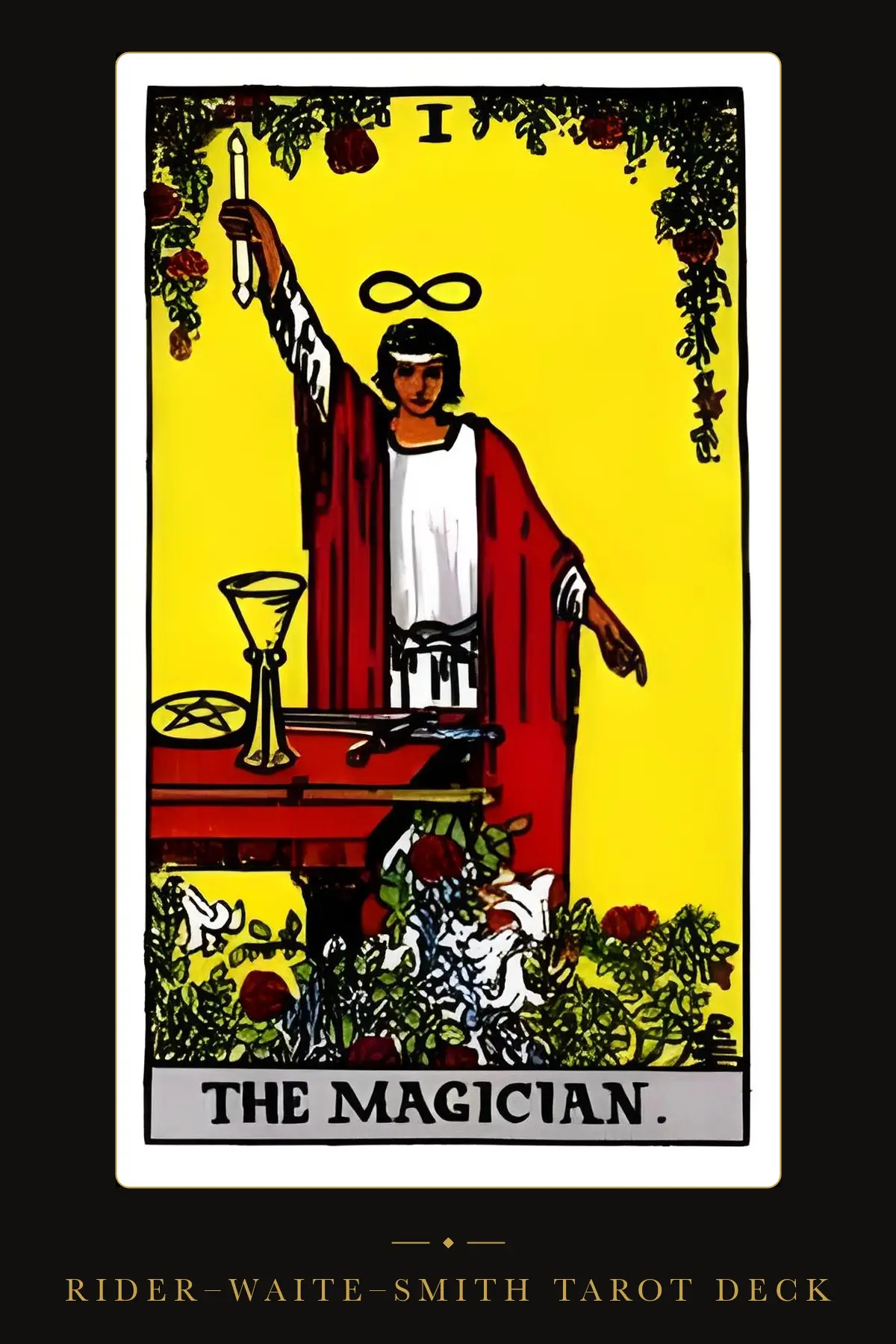
The change that stuck came in 1909. When Arthur Edward Waite and the artist Pamela Colman Smith built the Rider-Waite-Smith deck, Waite dictated the symbolism of the trumps but left Smith largely to herself on the Minors. She had studied photographs of the Sola-Busca, donated to the British Museum in 1907, and borrowed its idea of a scene on every card, echoing its pierced heart in her Three of Swords and its burdened figure in her Ten of Wands. Drawing on years of work at the Lyceum Theatre, she staged each pip as a small human drama. That one decision, a picture on every card instead of a bare count of symbols, is why a beginner can read a Minor Arcana card at a glance, and it is the reason most decks since have followed her lead.
The four-suit system
The four suits are not just labels. Each maps onto one of the four classical elements, a scheme Éliphas Lévi set out in the 1850s and the Golden Dawn later fixed as standard. Wands are Fire, Cups are Water, Swords are Air, and Pentacles are Earth. Each element in turn stands for one domain of ordinary life.
Wands (Fire) cover drive, creativity and will, the spark of an idea and the push to act on it. Cups (Water) cover emotion, relationship and intuition, the inner life and matters of the heart. Swords (Air) cover thought, communication and conflict, the mind at work for better and worse. Pentacles (Earth), sometimes called Coins or Disks, cover work, money, the body and the material world, what gets built and made real. Between them the four suits parcel out the whole of daily experience.
The mapping is settled for Cups and Pentacles but not beyond dispute. Pairing Wands with Fire and Swords with Air is the orthodox arrangement after 1909, yet a strand of Wiccan and neo-Pagan practice reverses the two, reading swords as forged in fire and wands as waved through air. The disagreement is a useful reminder that these correspondences are a chosen framework, not a fixed law.
The number spine
Read down any one suit, Ace to Ten, and the numbers tell the same story four times over, each in its own medium. The Ace is the pure seed of the element, its root and unspent potential. The middle numbers develop and complicate it, and the Ten carries it to its fullest expression, which can mean completion or the point where the energy has run its course.
The esotericists gave this arc a precise skeleton. The Golden Dawn mapped the ten numbers of each suit onto the ten sefirot of the Kabbalistic Tree of Life, so a number carries a fixed character wherever it lands. The Aces are the root of their element; the Fives, tied to Geburah (severity), bring strife and disruption; the Sixes, tied to Tiphareth (beauty), restore a balanced success; the Tens, tied to Malkuth (the kingdom), mark a fixed ending. This is why the four Fives feel related across the suits, the Five of Pentacles as material hardship next to the Five of Swords as defeat, and why the number of a card often tells you as much as its suit. The suit says which part of life; the number says where in the cycle it sits.
The court cards
The 16 court cards, four ranks in each suit, are widely admitted to be the hardest part of the deck to read, because a single court can mean several different things at once. The classic European ranks are Page, Knight, Queen and King, usually taken as a rough ladder of maturity from student to master.
Most of the difficulty comes down to three interpretive habits, and experienced readers move between them by context. A court card can be a person, someone in the querent's life whose age, role or temperament the card describes. It can be an energy, a quality active in the situation whoever happens to carry it, such as the King of Cups' disciplined warmth. Or it can be an approach, a way of handling things the querent is being invited to adopt, reading the Knight of Swords as 'act decisively and argue your case'. The same card supports all three; the reader picks the one that fits the question.
Underneath sits a tidy piece of structure. Each rank is given its own element on top of the suit's element, so the courts become an 'element of an element'. In the Rider-Waite-Smith scheme the Kings are Fire, Queens Water, Knights Air and Pages Earth, which makes the Queen of Swords the watery part of air, intuition wielded through unforgiving logic. Many modern readers reach the same 16 personalities through Carl Jung's four functions instead, matching Swords to Thinking, Cups to Feeling, Pentacles to Sensing and Wands to Intuition, turning the courts from little portraits into a map of how a person is processing the world.
Philosophy and psychology
The clearest way to hold the two halves of the deck apart is by altitude. The Major Arcana speak in the language of fate and archetype, the large impersonal forces that shape a whole life. The Minor Arcana speak in the language of everyday consciousness, the choices, moods and tasks a person moves through day to day. A trump says this is a turning point; a Minor says this is what the week feels like. Read together, the Majors set the theme and the Minors fill in the detail.
That everyday register is exactly what makes the Minors so useful to modern psychological reading. Stripped of any claim to predict the future, a card such as the Five of Pentacles becomes a picture to think with, a way to ask where someone is shutting themselves out of help they could accept. Secular readers use the harder Minor cards this way as a matter of course, treating the Seven of Swords as a question about boundaries rather than a warning of theft, or the Ten of Swords as the mind's own catastrophising rather than literal disaster. The card names a feeling and holds it at a distance where it can be examined.
Variations across decks
The 56-card frame is fixed, but almost every label on it has been changed by someone. The Earth suit alone goes by three names: Coins in the older Italian and Marseille decks, Pentacles in the Rider-Waite-Smith tradition, and Disks in Crowley's Thoth deck. Wands turn up elsewhere as Batons, Staves or Rods, and Coins is the oldest form of the fourth suit.
The courts have been reshuffled even more. To line the four ranks up with the four letters of the Hebrew name of God, the Golden Dawn renamed the Kings as Princes, the Knights as Kings and the Pages as Princesses. Crowley's Thoth deck kept a version of that and reads Knight, Queen, Prince and Princess in place of the familiar Page, Knight, Queen and King. A reader crossing between traditions has to check which system a deck uses, because the same title can sit at a different rank.
The deepest split is visual. Decks in the Marseille lineage keep the Minor pips unillustrated, showing only arranged suit symbols and asking the reader to lean on number and element. Decks in the Rider-Waite-Smith lineage give every pip a full scene. Neither is wrong. A pip-only deck rewards knowledge of the system, while a scenic deck hands you a picture to read straight off, so choosing between them is choosing how much of the meaning you want carried by the art.
Reading the Minors today
In a working reading the Minor Arcana do most of the practical labour. Where the trumps flag the large themes, the Minors answer the specific, grounded questions: what to do about a job, a conversation, a bill, a strained friendship. A spread made up mostly of Minor cards usually signals that a situation is workable and within the querent's own hands, rather than a matter of fate.
Two habits give the Minors extra reach. The first is timing. Because the older esoteric system ties the numbered Minors to the astrological calendar, many readers use suit and number as a rough clock, taking Wands as fast-moving and Pentacles as slow, or leaning on a card's seasonal associations to estimate when something will arrive. The second is suit dominance, noticing which element floods a spread. A reading crowded with Cups points to an emotional matter, one heavy with Swords to a mental or conflict-driven one, one full of Pentacles to work and money, one dense with Wands to drive and momentum. Before interpreting a single card, an experienced reader often reads the balance of suits first, because that alone says which part of life the whole question belongs to.
Frequently asked questions
टैरो एक्सप्लोर करें
- मेजर आर्काना
- माइनर आर्काना
- वैंड्स
- कप्स
- तलवारें
- पेंटाकल्स
नवीनतम पोस्ट
टैरो कार्ड्स की प्राचीन ज्ञान की खोज करें और अपनी आध्यात्मिक यात्रा के रहस्यों को अनलॉक करें। हमारा ब्लॉग टैरो रीडिंग के समृद्ध प्रतीकवाद, अर्थ और व्यावहारिक अनुप्रयोगों को समझने का आपका द्वार है.




















































