
 EN (English)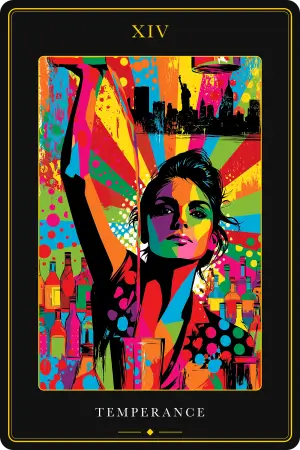


Major Arcana · 16
The Devil
The best-dressed man in the club, and the loose gold chain you keep choosing to wear.
Card at a glance
- Numerology
- XV
- Element
- Earth
- Astrology
- Saturn · Capricorn
- Kabbalistic path
- Ayin (Hod → Tiphereth)
- Timing
- Winter · Capricorn season · 3am
- Yes / No
- Usually no · a warning to examine what binds you
Upright
gilded trap
addiction
materialism
temptation
golden handcuffs
lifestyle debt
power and control
self-deception
Reversed
slipping the chain
sobriety
clarity
reclaiming choice
boundaries
leaving the scene
self-determination
The Devil in each deck
Every deck reimagines the same archetype. Compare the art, then open a deck to read its full interpretation.
Imagery and symbolism
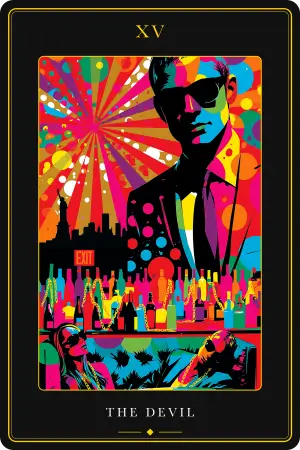
In the Tarot of New York City the Devil is not a horned beast on a black throne. He is the best-dressed man in the club, and that is the whole point. The deck's pop-art panel sets a huge figure in a sharp suit, tie, and black sunglasses over a nightclub, drawn in ecstatic halftone dots and sunburst rays of red, pink, gold, and green. The colors shout joy while the composition builds a cage.
The man in sunglasses stands in for Baphomet. Because his eyes are hidden you cannot meet his gaze or read his intent, so shades worn at night become this card's inverted pentagram, image pulled over truth. Where the old Devil's throne sat, a wall of glowing bottles rises like an altar, and gold chains hang draped across the glass, loose and unlocked. Those chains are the deck's version of the loose collars on Adam and Eve, here turned into jewelry and brand.
Below the bar two figures lounge on a couch in sunglasses of their own, gold chains at their necks, looking not tortured but fabulous. Over their heads a red EXIT sign burns, the single most important symbol on the card. New York fire code posts a lit exit in every room by law, and no one in the picture is looking at it. Behind everything the downtown skyline and the Statue of Liberty stand as black silhouettes against the sunburst, Liberty reduced to unlit décor in the Devil's room.
Core meaning
Strip away the glamour and the New York Devil says one plain sentence: nobody is holding you here, you keep choosing it at 2am and calling it freedom. The archetype underneath is the human shadow, not a monster in the dark. It reflects earthly materialism, carnal desire, addiction, and self-imposed bondage, the latent power of the unconscious turned against you.
Everything hangs on those draped chains. Bondage in the modern city is voluntary and self-renewing. There is no dungeon, only a subscription, a tab that stays open, a habit that reschedules itself. The card names the great human paradox, that people pursue what holds them back because instant relief is easier than the slow work of healing. It never calls the seeker evil. It hands them a diagnosis and, under the fear, a way out the moment they decide to take it.
Upright meaning
Upright, and despite the imagery, the New York Devil is an empowering advice card. It describes the gilded trap: the table you cannot afford but keep booking, the habit that structures your nights, the lease signed without reading, the paycheck just big enough to keep you from leaving. It refuses to judge you and instead makes you own your part, pressing two hard questions. What are you getting from staying, and what do you fear losing if you leave. In money and work it can flip to permission, a license to be fiercely ambitious and boundaried, to stop letting people trample your good nature and give the devil his due.
In love. A relationship built on passion but thin on emotional substance, or one partner dominating, manipulating, or gaslighting the other. Read in a healthy, consensual bond it turns into raw magnetism and the delightful sense of being fated and stuck to each other.
In career. Feeling ensnared in a job that compromises your ethics, or a fixation on status that leaves you hollow. As advice it can authorize real ambition and firm boundaries.
In finances. Compulsive spending, gambling, lifestyle debt, and the golden handcuffs of pay structured so you cannot afford to walk.
In health. Addiction and numbing, the sleepless nightlife metabolism, the destructive habit used to avoid a feeling rather than face it.
Reversed meaning
Reversed, the heavy energy lifts and the chain slips. The card shows the first sober month, the deleted contact, the resignation letter, the broken lease, the decision to stop performing a lifestyle you can no longer afford in any currency. The seeker has recognized the self-imposed limit, reclaimed their power, and started sliding the loose collar off. It also warns of the harder face of liberation: withdrawal, the social circle that vanishes when you stop buying rounds, the identity crisis of no longer being the person at the table.
In love. Recognizing the toxic pattern at last, ending a codependent or controlling bond, setting firm boundaries, and walking away from what no longer serves you.
In career. Growing honesty about your own role in the dissatisfaction, breaking the golden handcuffs, and refusing to stay held hostage by a paycheck.
In finances. Paying down the lifestyle debt, cutting up the card, and getting out from under crushing terms, though the reversal warns against declaring victory while the automatic payments still run.
In health. A return to sobriety, the breaking of a physical addiction, or release from the anxiety bred by a permanent 2am.
Historical notes
Long before the neon and the halftone dots, the Devil began with a strange fact: it is missing. The foundational Visconti-Sforza decks of mid-fifteenth-century Milan survive without the Devil or the Tower, and historians read the gap as deliberate rather than lost to time. In the mid-1400s there was no standardized image of the Christian devil, and the codified figure that would anchor the fifteenth trump did not settle into Italian card-making until nearly a century later, so it probably was not part of the earliest trump sequences at all. One irony sits under the New York setting: thirty-five of the surviving Visconti-Sforza cards now live at the Morgan Library in the very city this deck reimagines.
Once the card acquired a face it drew the attention of folk magic. Records from the Venetian Inquisition describe the Devil used in coercive love and lust rites, women turning to the deck's most transgressive figure for desires that orthodox prayer would not serve, which cemented its long tie to earthly passion and the subversion of the moral order. When Waite and Pamela Colman Smith fixed the modern image in 1910, they built their Devil straight from Éliphas Lévi's 1855 Baphomet, the half-goat form the New York club figure now translates into a suit and sunglasses.
Correspondences
Number. XV, the fifteen. In this deck the 1 is the self, the will that walks in believing it runs the evening, and the 5 is appetite and sensation turned all the way up through the sunburst and the bottles. Together they make willpower placed in service of hunger, the ego financing its own appetites. Reduced, one plus five is six, which ties the Devil to the Lovers as its dense mirror, the same couple seen chained on a couch instead of choosing across a subway aisle.
Astrology. Saturn and Capricorn, the cardinal earth sign of discipline, ambition, and material drive, and the operating system of Manhattan. The Devil works the shadow of those traits, where ambition rots into greed, discipline hardens into control of others, and the wish for security curdles into crushing materialism. Every chain on the card is a Saturnian instrument: a lease, a loan, a tab, a guest list, each one a contract somebody signed.
Element. Earth, grounding the card in the body, money, appetite, and the plain fact that we are bound to the flesh.
Kabbalah. The Hebrew letter is Ayin, 'Eye,' on the twenty-sixth path from Hod up to Tiphereth, a stretch often called the Dark Night of the Soul, where the seeker's self-deceptions are dragged into the sun's glare.
Mythology and yes/no. Behind the Christian devil stand Pan, Dionysus, and the Celtic Cernunnos, older gods for whom raw desire was natural rather than sinful and simply needed balance. As a yes or no the card usually reads as a cautionary no, a prompt to examine what is really binding you before you act.
Psychological perspective
In therapeutic practice the Devil is the engine of shadow work, the Jungian labor of facing and integrating what you have repressed. In the New York deck the mechanism is drawn right on the card. The sunglasses are image management worn as a full-time defense, kept on indoors and at night so that neither others nor the self can check what the eyes are doing. Take them off in front of one other person and the work begins.
Its sharpest question is why anyone would choose the cage on purpose. The answer is the payoff, the secondary gain that keeps a person bound. The known reality feels neurologically safer than the unknown even while it suffocates. Identities get built around the wound, the martyr or the eternal helper or the good daughter, so dropping the chains threatens a real ego death. Staying bound also means never risking the judgment that comes with walking away. The brain registers whatever you avoid as dangerous, which quietly feeds the very thing you fear. Underneath the glitter, almost always, sits an unmet need the noise is anesthetizing: loneliness and the terror of being ordinary in a city of eight million.
The Devil across decks
New York's contribution to the Devil's long visual history is to swap the horned beast for the best-dressed man in the club and to make the loose chains literal jewelry, but the archetype has worn many faces.
Tarot of Marseille. The oldest of the classic three is the strangest, a blue-skinned, hermaphroditic beast fragmented into semi-conscious parts, with a second face staring from its belly and eyes set into its knees. It holds a flaming wand while two small horned imps stand chained at its pedestal. This Devil is the chaotic unconscious itself, a blind force of nature at home in the dark.
Crowley-Thoth. Crowley and Lady Frieda Harris throw out the moral frame. Their Devil is a goat with a third eye and a bough of blue flowers before a great phallus, and the human souls appear as sperm held within the testes, potential awaiting birth, with no chains anywhere. Following the maxim that 'the word of Sin is Restriction,' the card exalts the animal drive rather than punishing it.
Modern decks. Contemporary versions update the cage in a direction the New York club already points toward. The Sci-Fi Tarot draws the Devil as a wall-sized vintage computer with two unchained figures stepping toward it, a picture of chainless digital dependency, while the Mythical Mystic Tarot shows emaciated figures bound to a chair with enough slack to burn it free, choosing familiar suffering over the unknown.
In combination and context
The New York Devil is bound to the Lovers by more than numerology. Fifteen reduces to six, and this deck stages the pair as opposites of the same number. The Lovers are two strangers on a stalled L train who lean across the aisle and choose each other, while the Devil is two figures on a couch who long ago stopped choosing anything. When both cards turn up together they usually signal a twin-flame or intensely karmic relationship, a magnetic pull that also forces each person to mirror the other's deepest unhealed shadow, and the work is telling a love that elevates from a lust that binds.
Temperance, its neighbour in the sequence, acts as the antidote, arguing that the chains are loose and can be slipped through boundaries and patient healing. Read for a genuinely abusive individual, experienced readers often reach past the Devil to the Five of Swords, since the Devil's nature is dual rather than simply evil.
In an advice or outcome position the card keeps its diagnostic edge. It asks the querent to name the payoff that keeps them stuck, points to the lit EXIT sign no one in the picture will look at, and reminds them the collar has always been loose. The terror it offers is not that you are trapped but that you could have walked out at any time.
Questions for reflection
- Name your particular devil in one plain word: the tab, the habit, the person, the title. What is it actually costing you in money, sleep, and years?
- Which chain around your neck is loose enough to slip off today, if you simply stood up from the couch and decided to?
- Where have you mistaken a familiar, suffocating room for stability, and where exactly is its exit sign?
The general meaning follows the Rider-Waite-Smith reading — the reference used across Tarot Academy. Open a specific deck above for its own interpretation.
Frequently asked questions
Explore the Tarot
Latest Posts
Discover the ancient wisdom of tarot cards and unlock the mysteries of your spiritual journey. Our blog is your gateway to understanding the rich symbolism, meanings, and practical applications of tarot reading.




















































