
 EN (English)



Major Arcana · XV
The Devil
Loose iron collars and a loss of freedom you can undo the moment you decide the cage was never locked.
Card at a glance
- Numerology
- XV
- Element
- Earth
- Astrology
- Saturn · Capricorn
- Kabbalistic path
- Ayin (Hod → Tiphereth)
- Timing
- Winter · Capricorn season
- Yes / No
- Usually no · a warning to examine what binds you
Upright
bondage
temptation
materialism
attachment
addiction
sexual energy
control
lost innocence
Reversed
liberation
awareness
breaking free
self-determination
independence
boundaries
awakening
The Devil in each deck
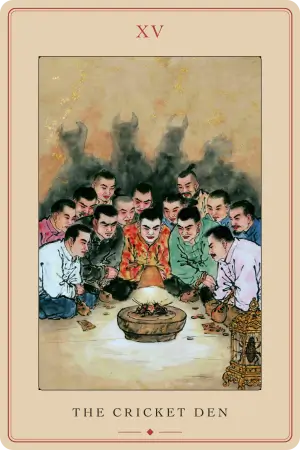
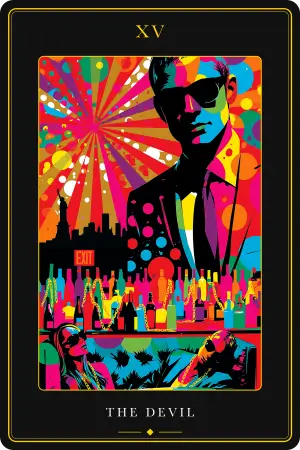
Every deck reimagines the same archetype. Compare the art, then open a deck to read its full interpretation.
Imagery and symbolism
Pamela Colman Smith drew the Rider-Waite Devil straight from Éliphas Lévi's 1855 Baphomet: a half-man, half-goat figure with a bearded, monstrous face, bat wings, shaggy goat legs, and clawed harpy feet, squatting on a square black pedestal. In this deck he is read as the ruler of matter and flesh, half-naked to show a lack of boundaries, gazing down with authority at the two small figures who look like his slaves. The Baphomet reference carries a specific charge here: it stands for the harmony of opposites and for awareness of the personality's shadow side.
Smith loaded the card with symbols this deck decodes precisely. The inverted pentagram on his forehead marks the disregard for spiritual values and the dominance of matter over spirit. The torch in his hand points downward, and the Rider-Waite reading is exact about it: this is anti-light, delusion, a false path. His raised right hand mocks the Hierophant's blessing. The wings belong to a night bird and stand for darkness, ignorance, and the loss of innocence and submission to earthly passion; the curved horns and upturned tails point to the animal instincts that have taken the upper hand.
The two chained figures are Adam and Eve, the couple from The Lovers reappearing as dependencies to be overcome. Eve's tail ends in a cluster of grapes for fertility and earthly ties, Adam's in a flame for energy and desire. Two details are the deck's own emphasis. First, the collars around their necks are loose enough to lift off, so their bondage is a choice to stay rather than a lock. Second, behind them the black background shows glimpses of lighter tones, hinting at an alternative spiritual path that stays unseen because material attachment blocks the view. The black earth and black sky press that point home, giving the whole scene the density of a material world under the Devil's rule.
Core meaning
In the Rider-Waite deck the Devil is the card of fears, attachments, addictions, and unconscious desires, and above all the loss of innocence and freedom. It shows the power of dependency and a superficial way of seeing things: temptation, temporary pleasure, and freedom handed over in exchange for comfort. The card asks you to examine your path, let go of the passions that harm you, and look for deeper values than the ones on offer.
Everything turns on those loose collars. The demons could step away at any moment, and their choice to remain is the bond with lower passions and the failure to choose liberation. So the Rider-Waite Devil is less a monster than a diagnosis of one. It names the dark side of a personality that goes unacknowledged, the potential left unrealized, and it insists that acknowledging a weakness is the first move toward slipping free of it.
Upright meaning
Upright, the Devil points to uncontrolled desires, passions, and attachments, and to the parts of a personality a person refuses to own. It can flag substance dependence, a relationship built on possession, or plain forceful dominance, and it can reveal someone nearby exerting a negative influence. As advice the card is blunt: move toward the fear, be honest about what keeps you trapped, and let go of the attachment that is doing the harm.
In love. Deep attraction and intense passion that shade into dependency. It promises heat but warns of losing self-control, of becoming hostage to your own need for the other person, and it flags manipulation, control, mistrust, and over-attachment to physical pleasure.
In career. An attachment to status, income, or the comfort of a familiar job, and a fear of change that keeps you in a mismatched but profitable role. It can also read as genuine drive and a wish to prove your competence, set in a workplace marked by authority and control.
In finances. A serious dependency on material things, a strong urge to accumulate that tempts dishonest shortcuts, and the sense of being blocked or bound by an agreement that holds you back.
In health and body. Bodily needs placed above everything, physical magnetism and appetite that motivate at their best and spiral into loss of control at their worst, including carnal excess and addiction.
Reversed meaning
Reversed, the heavy energy lifts and the Rider-Waite Devil turns toward liberation: recognizing self-imposed limits, reclaiming freedom, and slipping the loose collars off. It can also warn of weak will, self-deception, and a refusal to take responsibility, so read it in context. At its best it marks the awakening from illusion the upright card was waiting for.
In love. Burdensome ties loosen and a compulsive attraction fades. You may recognize your role as a victim and leave a bond that brought more suffering than joy, returning to your true nature.
In career. Freedom from fear about income, status, or workplace norms, relief from pressure and stress, and a time to explore new options and resolve toxic conflicts instead of staying held hostage by a paycheck.
In finances. Release from debt or from an unhealthy attachment to possessions, a chance to start over, and a caution to avoid rash decisions and hidden pitfalls in contracts.
In health and body. A return to control over physical desire, or its shadow, when appetite still runs unchecked into overeating, exhaustion, and a negative self-image.
Historical notes
The Devil reaches the Rider-Waite deck from a strange gap in the record. The foundational Visconti-Sforza decks of mid-fifteenth-century Milan survive with no Devil and no Tower, and historians mostly read the omission as deliberate. In the mid-1400s there was no standardized image of the Christian devil, and the codified figure that would anchor the fifteenth trump did not settle into Italian card-making until roughly a century later, so it likely was not part of the earliest trump sequences at all. Once the card acquired a face, records from the Venetian Inquisition show it pressed into coercive love and lust rites by women turning to the deck's most transgressive figure, which fixed its long tie to earthly passion and the subversion of the moral order.
Arthur Edward Waite and Pamela Colman Smith gave the card its most recognizable and most morally charged form when their deck appeared in 1910. They built their Devil explicitly on Lévi's 1855 Baphomet and turned the card into a portrait of the chains of materialism, a sharp break from the fragmented chimera of the Marseille tradition. Smith's draftsmanship is what makes the Rider-Waite symbols legible one by one, from the inverted pentagram to the loose collars, and that clarity is why this version became the reference point for how the Devil is read today.
Correspondences
Number. XV, fifteen, which reduces to six (1 + 5) and ties the Devil to The Lovers as its dense, shadow mirror, the same couple seen chained instead of blessed. The six also demands accountability, matching the card's call to answer for your own passions and choices.
Astrology. Capricorn, with Saturn behind it. The card works the shadow of Capricorn's strengths, where ambition curdles into greed, discipline hardens into control, and the drive for security becomes crushing materialism. It shares the sign's stubbornness in overcoming difficulty and its tendency to get stuck and resist change.
Element. Earth, grounding the card in the body, money, appetite, and the plain fact of being bound to the flesh.
Kabbalah. The Hebrew letter is Ayin, 'Eye,' on the path from Hod (Splendor) up to Tiphereth (Beauty), a stretch where self-deceptions get dragged into the light.
Yes or no. Usually a cautionary no, a prompt to examine what is really binding you before you commit.
Psychological perspective
The Rider-Waite Devil is the deck's engine of shadow work: the encounter with the unconscious, with everything the conscious mind has repressed but which keeps operating out of sight. Ignoring that dark side does not erase it. In the Hero's journey the Devil is the stage where the Hero meets their dependencies, fears, and suppressed ambitions and sees how those manifestations block the way forward. Recognizing them is the first step, and it turns the confrontation with the shadow into a catalyst for growth.
As a personality the Devil often carries real magnetism and a zest for life alongside a strong will and desires that are hard to resist. That same force cuts both ways. Used well it fuels transformation and healing, the willpower to conquer fear and forge an original path. Left unchecked it becomes excess and self-deception, a person who denies the problem and slips into addiction or an unhealthy bond because unconscious passions have taken over. The card's sharpest point is that these prisoners built their own cell, and the will that locked it is the same will that can open it.
The Devil across decks
The Rider-Waite Devil is the moral paradigm, the chains of materialism made legible. Set beside its ancestors and rivals, its choices stand out.
Tarot of Marseille. The oldest of the three is the strangest: a blue-skinned, semi-conscious beast fragmented into parts, with a flaming wand and two small horned imps chained at its pedestal. This Devil is the chaotic unconscious itself, a blind force of nature at home in the dark.
Crowley-Thoth. Crowley and Lady Frieda Harris throw out the moral frame entirely. Their Devil is a goat with a third eye before a great phallus, and the human souls appear as potential held within the body, awaiting birth. Following the maxim that 'the word of Sin is Restriction,' the card exalts the animal drive.
Modern decks. Contemporary versions keep updating the cage. Some redraw the Devil as a wall-sized machine with unchained figures stepping toward it of their own accord, a picture of chosen digital dependency, while others show emaciated figures bound with enough slack to free themselves and choosing familiar suffering anyway, the loose-collar logic the Rider-Waite made famous.
In combination and context
The Devil is bound to The Lovers by more than the coincidence of numbers. Fifteen reduces to six, and the two cards read as a light-and-shadow pair, the innocent couple of The Lovers reappearing here in chains as Adam and Eve. When both appear together they usually mark an intensely karmic or twin-flame bond, a magnetic pull that also forces each person to mirror the other's deepest unhealed shadow, and the reading work is telling a love that elevates from a lust that binds.
Temperance, close by in the sequence, acts as the antidote: set beside the Devil it argues that the collars are loose and can be slipped through boundaries and honest healing. For a genuinely abusive individual, experienced readers often reach past the Devil to a harsher card, since the Devil's nature here is dual.
In an advice or outcome position the card keeps its diagnostic edge. It asks you to name the payoff that keeps you stuck, then reminds you that the collar was always loose. The unsettling part is not that you are trapped, but that you could have stepped away at any time.
Questions for reflection
- Which of the collars around your neck is loose enough to lift off today, if you simply decided to?
- What are you getting from staying attached to this, and what do you fear losing if you let it go?
- Where have the lighter tones behind you gone unseen because material comfort filled the whole frame?
The general meaning follows the Rider-Waite-Smith reading — the reference used across Tarot Academy. Open a specific deck above for its own interpretation.
Frequently asked questions
Explore the Tarot
Latest Posts
Discover the ancient wisdom of tarot cards and unlock the mysteries of your spiritual journey. Our blog is your gateway to understanding the rich symbolism, meanings, and practical applications of tarot reading.




















































