
 EN (English)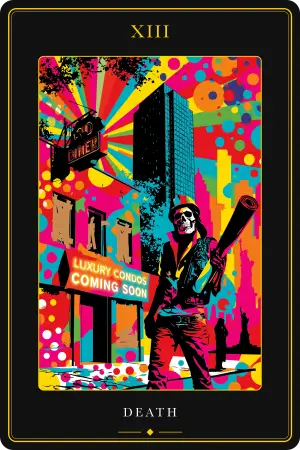


Major Arcana · 15
Temperance
The bartender's patient pour that blends the whole city into one glass that holds.
Card at a glance
- Numerology
- XIV
- Element
- Fire
- Astrology
- Sagittarius · ruled by Jupiter
- Kabbalistic path
- Samekh (Yesod → Tiphereth)
- Timing
- Early winter · Sagittarius season
- Yes / No
- Yes, but slowly · in time
Upright
balance
moderation
patience
healing
blending
the right proportions
steady pour
equilibrium
Reversed
excess
imbalance
impatience
overindulgence
extremes
curdling
burnout
the 2am round
Temperance in each deck
Every deck reimagines the same archetype. Compare the art, then open a deck to read its full interpretation.
Imagery and symbolism
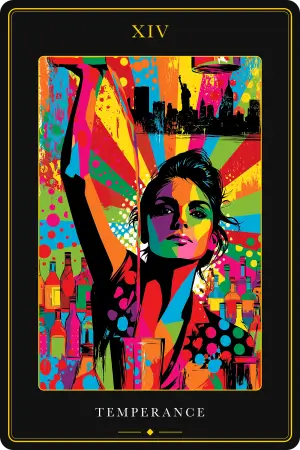
In the Tarot of New York City the angel steps behind the bar. A woman mixes a drink, her face lit in facets of many colors at once, green and orange and violet and rose, so that no single one owns her. Where the classic angel unites spirit and matter, she unites the city: every culture is in the glass, and every color is in her face. Her arm is raised high and she pours a long, thin, unbroken stream from a vessel at the top of the card down into a glass waiting at the bottom, in the reader's own space. That stream is the deck's translation of the water the classic angel pours between two cups, the transfer of living energy and the steady hand it takes to pour from that height without a spill.
Behind her shoulders the deck's sunburst rays fan out in alternating colors, blazing where the angel's wings would root, so passion and calm sit in the same figure. The skyline runs behind her in black silhouette with the Statue of Liberty lifting her torch, and the raised torch rhymes with the bartender's raised arm: Liberty lifts a flame, the bartender lifts a pour, the city's great symbol of welcome and the small nightly act of serving a stranger drawn as one gesture. The skyline sits where the older card puts its distant mountains and shining crown, the far goal made of buildings.
Along the bottom, rows of bottles crowd in every color, no two alike, the many histories the city stocks behind its bar. None of them is the drink; the drink exists only in her proportions. Halftone dots scatter over the scene like carbonation, and the polka dots on her shirt clash in color yet sit together comfortably, moderation worn as a pattern. Amid the loudest palette in the deck her expression is the quietest thing on the card, level and unhurried, the still point exactly as the classic angel stands with one foot on land and one in the water.
Core meaning
Behind the bar the task is proportion, not force and not speed. The city hands the bartender conflicting cultures and demanding schedules, ingredients that are different from each other and sometimes opposed, and the work is to combine them by hand until they hold together. That is this deck's whole reading of Temperance: balance found or within reach, patience producing what rush never could, healing quietly underway.
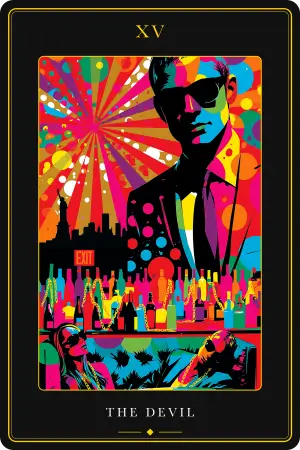
Underneath sits the archetype the reader already knows. Temperance is not the puritan restraint its name suggests but active harmonization, the middle path walked by blending opposites into a steadier third state. In the deck's sequence it comes just after Death, where the diner has gone dark and the old form of life ended without negotiation, and just before the Devil with its loose chains and bottle service. Its formula is the alchemists' solve et coagula, dissolve and recombine: pour the waters of experience back and forth until a more resilient self is forged. Balance here is a verb. Whoever stops performing it loses it.
Upright meaning
Upright, the card says the situation calls for exactly the bartender's skill: measure before you pour, take the long way of small adjustments over the shortcut of the grand gesture, and give the process the time it needs. It favors steady, organic progress and often marks a real stretch of healing, energies that had swung to extremes brought back into ratio. The result is slow and it lasts.
In love. Two ingredients making a drink neither could be alone, often two histories or two boroughs combined patiently until they hold. Asked about reconciliation it rarely means a partner is walking straight back; it asks for genuine healing and reset boundaries first, and for two whole people forming a new dynamic rather than sliding into old patterns. In a healthy bond it is quiet, lasting stability, which can read as boring to anyone hooked on chaotic highs.
In career. The shift that runs smoothly because someone keeps the balance: steady pacing, teamwork over explosive ambition, and the diplomatic mixing of a loud colleague with a quiet one or an old process with a new system. If you are overwhelmed it advises stepping back to recalibrate the ratio the city likes to forget, work to rest.
In finances. The balanced pour applied to a budget. It favors blending several modest income streams and correcting with small, regular adjustments over dramatic overhauls, and where a decision is in question it points to the middle option and the long timeline.
In health. Moderation as the actual method. The card supports recovery, sobriety, and movement you can repeat all year, healing that comes by patient daily measures rather than by force.
Reversed meaning
Reversed, the shaker slips. The mix has gone wrong: too much of one element, unmeasured ingredients, or a stubborn refusal to let anything combine. The reading turns to extremes and instability, the calibration of the upright card lost.
In love. The mixture separates, one partner pouring everything in while the other only drinks, closeness and distance swinging hard, or an excess like jealousy poisoning the glass. It marks codependency and a lack of mutual respect.
In career. The rush has broken the bartender: chronic overtime, burnout dressed as dedication, or clashing styles that were never blended and now curdle into the same conflict on repeat. It can also show so much accommodating that nothing decisive ever ships.
In finances. The glass overflows on one side and runs empty on the other. Spending that outruns income or hoarding so tight that life gets no funding, money leaking into a heavy bar tab or recurring 2am purchases, panic selling or doubling down after a loss.
In health. The body paying for a broken ratio: overtraining, feast-and-famine eating, all-nighters balanced by nothing, or the nightcap that quietly became the routine and the dulled reflexes that follow.
Historical notes
The bartender stands at the end of a long lineage. Temperance began as an earthly virtue: in the fifteenth-century Italian decks, the Visconti-Sforza and the Charles VI, she is a human woman diluting wine with water, one of the cardinal virtues beside Justice and Fortitude. The gesture was practical before it was symbolic, since crude Renaissance wine often had to be cut with water to be drinkable, and it came to stand for the Aristotelian golden mean and the regulation of appetite.
In France the Tarot de Marseille turned the woman into a winged angel. Following directly after Death in the sequence, this angel reads as a psychopomp greeting the soul beyond physical death, and the mixed water and wine took on the weight of the Eucharist. The occult revival then loaded the card with alchemy. Etteilla's 1789 deck, the first built for divination, gave the angel a sun on its brow and feet resting on rocks for salt and sulphur, and Oswald Wirth later poured the vital fluid between a gold and a silver urn to picture solve et coagula, the blending of solar reason and lunar imagination. Waite and Pamela Colman Smith gathered all of it into the 1909 image that became the template this deck now moves behind the bar.
Correspondences
Number. XIV, the fourteenth trump, the restorative pause between Death and the Devil. Reduced, 1 and 4 make 5, the number of change and constant adaptation, which is the secret inside the card: the balance is never static but survives through small corrections.
Astrology. Sagittarius, the mutable fire sign ruled by Jupiter. Novices often expect Temperance under Libra's scales, but the card is the active blending of volatile energies rather than the passive weighing of facts, and Sagittarius the centaur, half human and half beast, mirrors the harmonizing of intellect and instinct. It suits this deck, whose bottles each traveled here from somewhere else and whose long pour is the sign's arrow, aimed from high above and landing where it was meant to. It also governs the ninth house of higher learning.
Element. Fire, the passion and vital energy the card learns to temper rather than smother.
Kabbalah. The Hebrew letter is Samekh, meaning prop or support, on the twenty-fifth path running vertically from Yesod (Foundation, the Moon) up to Tiphereth (Beauty, the Sun). Called the Intelligence of Probation, it is the testing ground where the soul is heated and cooled like steel in a forge, made strong enough to bear the divine yet flexible enough not to shatter.
Timing. The card points to Sagittarius season and to slow, organic timing. As a yes or no it answers yes, but slowly, an outcome that needs time to unfold.
Psychological perspective
This deck reads the psyche as a working bar: many bottles, one glass, and a self whose job is proportion. The Temperance person holds strong feelings without being run by them and keeps their tempo when everything around them speeds up, the inner version of a steady pour through the Friday rush. That equanimity is usually earned through real inner work, the learned capacity to sit with intense feeling without being consumed, which is why such people so often end up cast as the healers of their circle, the ones others leave more level than they arrived.
The gift has a shadow, and it is a subtle one. Upright Temperance can curdle into spiritual bypassing, using the language of peace and balance to dodge a confrontation that actually needs to happen. Its shadow is dilution: watering down your real desires or your necessary boundaries to keep an uneasy peace, then calling that paralysis the high road. True balance is not an automatic split down the middle, and it does not mean flattening every intensity into mediocrity. Sometimes the most tempered act available is to draw one hard, uncompromising line, or to walk away from a situation that no amount of mixing can save, the room that needs a Tower rather than Temperance.
Temperance across decks
The Tarot of New York City. This deck keeps the classic meanings of harmony, moderation, and the blending of opposites, but moves the scene from the angel at the water's edge to a bartender at work, painted in a pop-art register of sunburst rays, halftone dots, and hard black silhouettes. The Statue of Liberty stands in for the distant mountain, and the rows of colored bottles stand in for the elements the angel once balanced between two cups.
Crowley-Thoth. Crowley and Lady Frieda Harris renamed the card Art and pushed it from moderation to full metamorphosis. A dual-faced alchemical androgyne, the fusion of the Emperor and Empress, pours fire and water together into a boiling golden cauldron, the most explosive picture of solve et coagula in any deck. A raven on a skull marks the caput mortuum, the dead residue of purification, and a golden Orphic egg behind the figure carries the acronym V.I.T.R.I.O.L.
The Wild Unknown and goddess decks. Kim Krans strips out the angel entirely: a great blue heron stands with one wing over an orange flame while blue droplets fall toward it, and because of the bird's steady presence neither element destroys the other. The Motherpeace Tarot casts the card as an initiated shaman controlling opposites, and Ellen Lorenzi-Prince's Dark Goddess Tarot names it for Brigid, the Irish goddess of the forge and the sacred well who is fire and water at once.
In combination and context
Temperance sharpens against the cards it meets. Beside the Devil, which sits right after it with its loose chains and bottle service, it acts as the antidote, suggesting the chains that seem to bind the querent are actually loose and can be slipped off through boundaries and healing. Reversed next to the Devil it confirms the opposite, a real addiction or a toxic bond spiraling out, where trauma-bonding is mistaken for passion.
With Justice the two balances split the labor: Justice is the external, objective cut of law and consequence, Temperance the internal blending through intuition and time, and together they ask you to align your outward actions with your emotional truth. With the Fool it makes inspired action, the bold leap taken with patience and a safety net, though reversed the pair warns of violent swings between recklessness and paralysis. With the Magician it supplies the endurance and the exact formula that turn his first spark of will into something that lasts.
Temperance is also a frequent stalker card, turning up again and again to name a life out of balance: a call toward sobriety, a demand to stop rushing and rest before burning out, and sometimes a pointed message to stop obsessively pulling cards and let things unfold on their own.
Questions for reflection
- Which two parts of your life are still standing in separate bottles, when the work in front of you is to pour them into one glass?
- Where are you calling avoidance balance, watering down a boundary to keep an uneasy peace?
- What needs the slow, patient pour right now rather than another all-nighter or grand gesture?
The general meaning follows the Rider-Waite-Smith reading — the reference used across Tarot Academy. Open a specific deck above for its own interpretation.
Frequently asked questions
Explore the Tarot
Latest Posts
Discover the ancient wisdom of tarot cards and unlock the mysteries of your spiritual journey. Our blog is your gateway to understanding the rich symbolism, meanings, and practical applications of tarot reading.




















































