
 EN (English)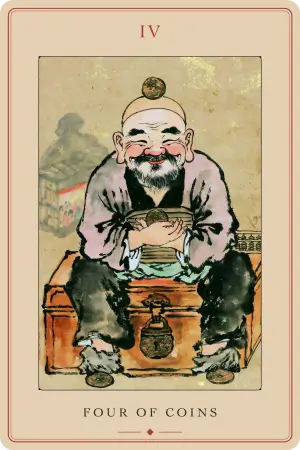


Minor Arcana ·
Five of Coins
Ten thousand blessings hang over the street unread while two figures freeze outside a lit teahouse and never turn the corner to the door.
Card at a glance
- Numerology
- Five
- Element
- Earth
- Astrology
- Mercury in Taurus (1st decan, 0°–9°)
- Kabbalistic path
- Geburah (Severity) in Assiah
- Timing
- Deep winter · late April, Taurus season
- Yes / No
- Upright no · Reversed a cautious yes
Upright
poverty
hardship
exclusion
cold
illness
scarcity mindset
unseen help
pride
Reversed
recovery
thaw
help accepted
reunion
relief
healing
the door found
dignity
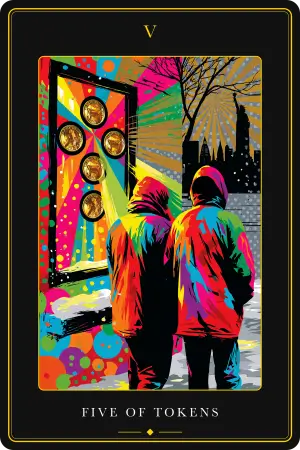
Five of Coins in each deck
Every deck reimagines the same archetype. Compare the art, then open a deck to read its full interpretation.
Imagery and symbolism
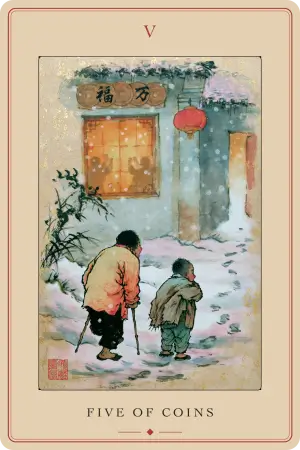
In the Tarot of Beijing the Five of Coins is a winter night outside Qianmen. Two figures stand with their backs to us in the snow: an older man in a thin padded jacket, leaning on crutches with one trouser leg hanging empty of strength, and beside him a boy in a ragged oversized coat, arms wrapped around himself. They are this deck's answer to the two mendicants of the Rider-Waite card, one wounded in body and one wounded in circumstance, companions in misfortune who keep each other alive by keeping each other company.
The card is drawn in the deck's Feng Zikai manner: a handful of calm brush lines, grey and black washes on warm kraft paper flecked with gold, the small red seal in the lower corner. Almost all the warmth is held in two objects, a glowing paper window and a red lantern, and nearly all the grey and black ink belongs to the outside. Warmth in this card is not absent. It is adjacent.
Above the two figures, a teahouse name-board replaces the stained-glass window of the traditional card. It is made of five round copper coins with square holes, the five 'pentacles' of the scene, and it reads 万福, Ten Thousand Blessings. The blessing hangs directly over the beggars' heads and neither of them looks up. That is the card's central irony: abundance is present, named, and nailed to the wall, and it is attention that is missing.
The paper window glows orange, and through it move the shadows of people toasting with raised cups. In this deck the teahouse is the vessel of human connection, since the whole suit of Teacups lives there, so standing outside a teahouse window is the deck's exact image of exclusion. Not exile from wealth in the abstract, but exile from the table. A red lantern burns above the gatepost, hospitality's standing signal that the house receives guests. It shines for these two as much as for anyone; they simply do not read it as meant for them.
At the right edge a door stands ajar, spilling warm color into the snow, and a line of footprints crosses past the figures and curves toward it. Someone has already walked this way and gone in. The path to warmth is printed in the snow, and following it needs only lowered pride and lifted eyes. A bare branch of winter plum leans in at the left, the deck's quiet promise, since in Chinese painting the plum blossoms precisely in snow. Snow falls evenly over the beggars and the lantern alike, which says that fortune's weather is impartial and what differs is who has found shelter.
Core meaning
The Five of Coins is Beijing's Five of Pentacles, and its subject is real material difficulty: loss of income, unexpected expense, illness, cold in the most literal sense. It can mark the loss of a home, a job, or a standing, or simply the feeling that everyone else is inside at the feast while you are out in the lane. The four before it, the pawnshop owner sealed in his shuttered room with a coin under each shoe, hoarded. The five is what happens when fortune's wind changes and throws the household out into the open street.
What makes this card sharper than plain bad luck is its geography. The help exists and it is close. The name-board overhead spells Ten Thousand Blessings, the door is around the corner, the footprints already point the way, and none of it is seen. The crisis is partly one of not looking, not asking, not turning the corner. So the deck's reading is double: the snow is real snow and the cold bites, but the deeper wound is the belief that no help exists when it is hanging half an arm away. The card asks you to separate what you truly lack from what you have merely failed to locate, and it refuses to let you romanticize the trudging. It does not want you to keep walking photogenically through the snow. It wants you to lift your head and read the sign.
Upright meaning
Upright, the Five of Coins signals a lean season and a difficult change of fortune: contraction, the withdrawal of comforts you had relied on, survival mode where the present takes all your energy and the future has to wait. Take honest stock of what you actually lack. Then do the thing the two figures fail to do, which is to look up, ask for help, and walk around the corner to the door that is already there.
In love. Two people crossing a hard winter together, or failing to. Money troubles, illness, exhausting work, or an emotional cold spell presses on the bond, and the lit window they pass may be the memory of their own early days. Hardship does not destroy love; walking through hardship separately does. The pair in the snow survives because the strong one slows for the lame one and the small one warms against the tall one.
In career. A cold stretch: job loss or the fear of it, a search that drags through the snow, or a workplace where you feel like the figure outside the glass, unthanked and passed over while others toast. Effort and reward have come apart. The card points overhead to help that is nearer than despair admits: an internal opening, a former colleague who would vouch for you, a skill you discount because it comes easily.
In finances. Loss of income, debts, the budget stretched thin as the boy's torn coat, money that was counted on failing to arrive. The card also diagnoses the manner of the poverty, attention fixed downward on the lack while resources hang unnoticed above: help not applied for, a skill unmonetized, a relative unasked, a door untried. It warns against letting pride price itself into the budget.
In health. The most physically explicit card of the suit, since one of its figures walks on crutches. It can indicate illness, injury, chronic fatigue, or a body worn down by cold, poor food, and worry, often when self-care was the first budget line cut. Its counsel is the deck's central gesture: look up and read the sign, because the clinic around the corner and the friend who would walk with you are closer than the despair claims.
Reversed meaning
Reversed, the Five of Coins is the moment one figure notices the footprints curving around the corner and follows them to the door. It marks the first thaw after a hard period: work returns, debts ease, health mends, the household begins to warm. Help arrives, or rather help that was always nearby is finally accepted. It can end an isolation too, with readmission to the table and reconciliation with people whom scarcity had estranged.
In love. The couple coming in from the cold. The crisis passes its worst point and the relationship warms from the inside, often because the two finally turn the corner together and have the conversation that should have happened a season ago. What was endured jointly becomes the new foundation. Rebuild the small rituals of warmth deliberately and do not audit the winter for blame.
In career. The thaw of a professional winter: an offer after a long search, reinstatement, a transfer to a warmer room, recognition returning where there had been cold shoulders. The break often comes through the door around the corner, the unglamorous adjacent role or the recommendation from someone you finally asked. Accept the imperfect but warm position over the perfect but imaginary one.
In finances. The worst of the shortage is passing. Income resumes or a new source appears, a debt is restructured, help is accepted at last. This is the stage of applying for what you are owed and taking the modest work that keeps the stove lit. Recover in small, steady, square-holed increments and avoid the gambler's urge to win the winter back in one night.
In health. Convalescence, the fracture knitting and strength returning in the undramatic increments by which strength actually returns. Care resumes: the postponed appointment kept, the treatment begun, the crutch needed less. Rebuild gently and communally, the way elders move through slow tai chi at the Temple of Heaven, and keep one habit from the hard time, which is walking beside someone.
Historical notes
The card began as a plain pip. In the Visconti-Sforza and Cary-Yale decks of around 1450, the Five of Coins was five geometric coins with no narrative of suffering at all, a numerical value for courtly parlor games. The Sola Busca deck of 1491 changed everything by illustrating full scenes on its plain suits, and its narrative pips were the precedent Pamela Colman Smith drew on after she and A.E. Waite studied the deck's photographs at the British Museum.
The Tarot de Marseille kept the geometric pattern, five coins among floral flourishes, and read the number as the first disruption of the stable four. In that tradition the Cinq de Deniers was less a state of ruin than a necessary, uncomfortable urge to spend or move. The Rider-Waite-Smith deck of 1909 fixed the modern image: two ragged mendicants in a snowstorm passing a lit church window, with Waite defining the card as material trouble, destitution, and chaos. A small bell on the man's neck was the medieval leper's bell, marking the meaning as social ostracization and stigma, not only poverty.
Crowley and Lady Frieda Harris took the archetype the other way in the 1944 Thoth deck, renaming the suit Disks and titling this card 'Worry': five cracked disks in an inverted pentagram over crumbling earth, human figures gone. The Tarot of Beijing keeps the Rider-Waite scene but relocates it. The church becomes a teahouse, the stained glass becomes a paper window, and the five pentacles become five copper cash on a name-board reading Ten Thousand Blessings. Waite's dichotomy of physical suffering and unseen sanctuary survives, translated into the geography of a hutong winter.
Correspondences
Number. Five, the number of upheaval and forced change, which breaks the settled square of four and sends its contents rolling down the lane. Four hoards; five is the world correcting the hoard, or simply the wind changing. Five is also the number of the crossroads and the open road, the fresh angle of vision, and the card's composition teaches that redemptive side: the footprints curve, the door stands ajar, the blessing hangs unread. The crisis is real and so is its exit.
Astrology. The first decan of Taurus, roughly April 21 to 30, ruled by Mercury. Taurus is the fixed-earth sign of stability and the well-stocked household, precisely the things the card shows threatened. Mercury is the card's hidden door, the messenger and reader of signs, and the whole predicament is a failure of reading: the name-board says Ten Thousand Blessings and no one looks up. Where Taurus endures the winter, Mercury finds the door.
Element. Earth, carried in this deck by the suit of Coins, the square-holed copper cash: work, body, household, the weight of the material world. The five disturbs that element the way a hard frost disturbs a courtyard. Nothing is destroyed forever, but everything living must prove it can survive the season.
Kabbalah. All fives belong to Geburah, the fifth sphere on the Tree of Life, whose name means Severity and whose planet is martial Mars. The suit of Coins corresponds to Assiah, the dense material world, so the formula is Geburah in Assiah: severity applied directly to resources, finances, and the body. Where the Four sat in Chesed, mercy and benevolent accumulation, the Five is the sudden retraction of that security.
Psychological perspective
This is the psychology of poverty consciousness, and it does not require actual poverty to appear. Its person may be poor in coin, or wealthy in coin and destitute in warmth, but either way their attention is fixed on their own footprints. They genuinely do not see the lit window, the name-board, the help extended half an arm away. They distrust good news, and loneliness follows them even into crowds. Their pride is the particular Beijing kind that would rather walk past the teahouse with a straight back than knock and be seen needing.
Modern practice often reads this as a scarcity mindset that persists past its cause: hoarding, over-analyzing minor expenses, or imposter syndrome that keeps anticipating ruin even when the accounts are sound. Shadow work sharpens the question the figures raise by walking past the open door: why refuse the help that is available? The answer is often the safety of predictability. If an identity is built around being the perpetual outsider or the self-sacrificing endurer, accepting help means dismantling that identity, and that can feel more expensive than the cold. Yet the figures endure, and they rarely walk alone. They hold to one companion with a loyalty the prosperous seldom learn, and that loyalty is where the recovery usually starts.
The Five of Coins across decks
Rider-Waite-Smith. Two crippled beggars trudge through a snowstorm past an illuminated church window of five golden pentacles, one figure barefoot and one on crutches with a leper's bell. Waite read it as destitution and material trouble, the sanctuary present but unseen. Beijing keeps this scene almost intact and only moves it indoors to a Chinese street, church to teahouse.
Tarot de Marseille. The Cinq de Deniers stays geometric, five coins among floral flourishes, read as the disruptive urge that breaks the stable four rather than as literal ruin. Beijing keeps the number's disruptive charge but tells it as narrative rather than pattern.
Crowley-Thoth. Retitled 'Worry' and stripped of people, five cracked disks form an inverted pentagram over fracturing earth, the Tattvas showing the material world itself destabilized. Beijing shares the astrology of Mercury in Taurus but keeps the human warmth Crowley removed, so its worry has a face and a companion.
Modern decks. The Pagan Otherworlds card shows a barren snowy landscape with no figures, elemental harshness alone, while the Light Seer's places a luminous key glowing behind a weeping figure who will not turn to see it. Beijing belongs with these psychological readings: its key is the name-board overhead and the footprints in the snow, help made visible in the picture precisely so the failure to look becomes the lesson.
In combination and context
The Five of Coins colors a spread with lack and the exclusion that follows it, and its neighbors usually reveal whether the winter is ending or entrenching. Beside cards of recovery, thaw, or the suit of Teacups it leans toward the reversed reading, the door found and the table rejoined, since Teacups is this deck's home of connection and its presence answers the card's isolation directly. Beside other hard fives and heavy Coins, it reads as a longer season and warns against endurance mistaken for virtue.
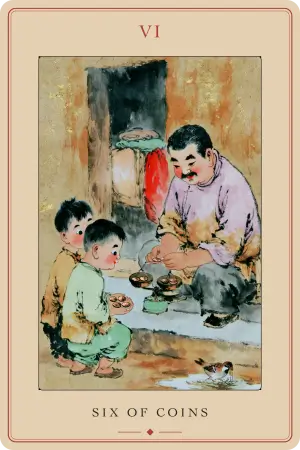
With an Ace it often marks the low point just before a new material start, the door standing ajar at the card's edge. Sixes of the suit, especially the Six of Coins with its charity given and taken, complete the arc the reversed card promises: the beggar of one season becoming the giver of the next. In money and work spreads its counsel is practical rather than fated, since the crisis it shows is partly correctable by reading signs and asking plainly. When it keeps returning to a reading, treat it less as a forecast of ruin than as a stalker pointing at a scarcity story you are telling yourself, and answer it the way the deck does: look up, the blessings are hanging over the street.
Questions for reflection
- What is hanging right over your head that you have not read, the help or blessing that is present, named, and close?
- Where are you walking past a lit window because pride would rather freeze with a straight back than knock and be seen needing?
- What do you truly lack, and what have you merely failed to locate because your eyes stayed on the footprints in the snow?
The general meaning follows the Rider-Waite-Smith reading — the reference used across Tarot Academy. Open a specific deck above for its own interpretation.
Frequently asked questions
Explore the Tarot
Latest Posts
Discover the ancient wisdom of tarot cards and unlock the mysteries of your spiritual journey. Our blog is your gateway to understanding the rich symbolism, meanings, and practical applications of tarot reading.




















































