
 EN (English)



Minor Arcana · Pentacles (Earth)
Five of Pentacles
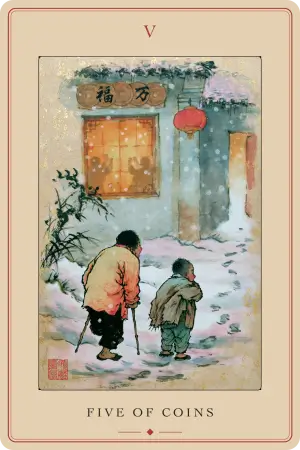
Two beggars in the snow passing a lit church window: real hardship, and help that goes unseen just steps away.
Card at a glance
- Numerology
- Five
- Element
- Earth
- Astrology
- Mercury in Taurus (0°–9°)
- Kabbalistic path
- Geburah (Severity)
- Timing
- Late April, or a cold patch that will pass
- Yes / No
- Upright no · Reversed yes
Upright
Hardship
Loss
Poverty
Isolation
Insecurity
Ill health
Exclusion
Scarcity
Reversed
Recovery
Relief
Hope
Accepting help
Healing
Turning point
Rebuilding
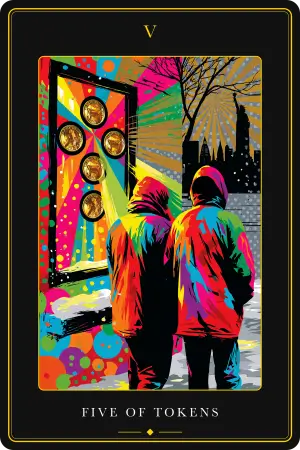
Five of Pentacles in each deck
Every deck reimagines the same archetype. Compare the art, then open a deck to read its full interpretation.
Imagery and symbolism
Pamela Colman Smith illustrates a single, unmistakable scene: two ragged figures trudging through a night blizzard, passing beneath the brightly lit stained-glass window of a church. One, a woman, is barefoot in deep snow with a thin shawl pulled tight; the other walks on wooden crutches, one leg braced, his head bandaged. Waite directed the theme bluntly as material trouble, destitution and disorder, and Smith made it instantly legible to a lay reader without a word of esoteric explanation.
One detail carries most of the card's weight. A small bell hangs at the neck of the figure on crutches, a medieval leper's bell or plague bell. Because disease could damage the larynx, the afflicted were required by law to ring a bell rather than call out, warning the healthy to keep away. That single object lifts the card from mere financial poverty into social ostracism, the stigma of being marked untouchable. The snow is itself a rarity in this deck, appearing only here and on The Hermit, and it enforces isolation, frozen assets and a landscape actively hostile to survival.
Behind the two figures glows the stained-glass window, five golden pentacles worked into a flourishing design that recalls the Tree of Life, set in warm jewel-toned panels against the black church stone. White snow against black stone reads almost as a yin-yang of suffering and sanctuary. The window is warmth, shelter and institutional support standing inches away, and the figures walk past it with their eyes cast down, apparently oblivious. In this deck's own reading the window's help exists close by but goes unnoticed or unclaimed, and the deeper point is that balance and recovery are found within the person rather than in outside circumstance. The card's palette stays dark and cold throughout, holding the heavy atmosphere in place while the one lit window keeps the possibility of relief in view.
Core meaning
In the Rider-Waite-Smith deck the Five of Pentacles is the collapse of the material security the suit had been building. After the Four's tight hold, the Five is the sudden retraction: loss, lack, and the fear that comes with it, felt in money, in the body, and in the sense of belonging. Waite named it material trouble, and Smith gave that trouble a face, two people out in weather that will not let up.
But the image is built around a tension, not just a verdict. The sanctuary is right there, lit and warm, and the figures do not turn to it. That is the card's real question: how much of the suffering is the cold itself, and how much is the downcast head that cannot see the door. This deck reads the hardship as genuine and temporary, a trial that can be risen from, and locates the turning point inside the person, in the willingness to look up and accept what is near.
Upright meaning
Upright, the Five of Pentacles signals a painful contraction: severe lack and the withdrawal of comforts once relied on. It points to survival mode, where the present takes all the energy and the future cannot yet be planned for. The pain is real, and the card's advice is to put pride aside and reach for the help that exists.
In love. A bond strained under external weight, money trouble, unemployment or illness draining the partnership's reserves. It can mark codependency or trauma bonding, two people with only each other, an intensely loyal but potentially toxic dynamic living on starvation rations of affection. For a single querent it points to feelings of inadequacy, rejection, or being shut out in the cold.
In career. A lean stretch: job insecurity, redundancy, a lack of opportunity, the sting of being overlooked while peers advance. The card's counsel is practical, set pride down and seek institutional help, whether grants, renegotiated debt, or the support systems the glowing window stands for.
In finances. Acute hardship, debt, depleted resources, finances stretched dangerously thin. It urges honest assessment of what caused the shortfall and active steps toward help rather than isolation.
In health. One of the deck's most direct warnings of physical breakdown: exhaustion, malnutrition, poor sleep, the toll of prolonged anxiety and the inability to stand on one's own two feet. It flags the isolation that so often shadows chronic illness, and the danger of neglecting the body in pursuit of security.
Reversed meaning
Reversed, the card usually turns toward recovery, though a harder reading exists alongside it. In its dominant sense it marks the end of the harsh winter: work restored, debts easing, health returning, help finally arriving. Symbolically it is the moment the figure lifts their head, sees the lit window at last, and accepts the sanctuary that was always there, along with the inner shift away from a scarcity mindset and the release of shame.
In love. Rebuilding after a strain, a partnership finding its feet again, or the release of an old wound that let alienation set in. The willingness to be helped and to help returns.
In career. A new job, a stabilizing income, the lifting of a lean stretch. Past mistakes become lessons that guide the next steps rather than repeating themselves.
In finances. The first signs of economic recovery, debts renegotiated, a rise beginning from the low point. The counsel is to rebuild while keeping balance, and to value what is already in hand.
In health. Convalescence and returning strength, energy renewing after a period of depletion. The alternative, harder reading is worth naming: the reversal can also mark entrenchment, poverty of spirit rather than of wallet, a stubborn refusal to see solutions and a comfort taken in the familiar role of the victim.
Historical notes
The scenic Five of Pentacles of 1909 has a direct ancestor. In 1907 the Busca-Serbelloni family donated black-and-white photographs of the 15th-century Sola Busca deck, the earliest complete 78-card deck and the first to fully illustrate its pip cards, to the British Museum. Waite and Smith studied those images there, and the narrative pip tradition they took from it made the modern Five of Pentacles possible. Smith rooted the setting in the South East England countryside of Kent and East Sussex that fed the whole deck.
Before that, the card was far quieter. The Visconti-Sforza and Cary-Yale decks showed five plain coins for courtly gaming, with no scene of suffering at all. The Tarot de Marseille kept the coins geometric, ringed with floral work, and read the Five as the disruption of the stable four, an imperative to spend or use rather than an image of ruin. Crowley's later Thoth deck went the other way, dropping human figures for five cracked disks in an inverted pentagram over fractured earth, bluntly titled "Worry." Smith's snowbound beggars are what fixed the card's meaning as destitution and exclusion for the modern reader.
Correspondences
Number. Five: flux, conflict and change that shatters the stable four. Where four is foundation and boundary, five introduces the destabilizing fifth term that unsettles the material order.
Astrology. The card carries Mercury in the first decan of Taurus, 0° to 9°, roughly 20 or 21 to 30 April. Taurus is fixed Earth ruled by Venus, wanting stability and secure resources; Mercury is quick, airy and analytical. Forced into Taurus's rigid ground, Mercury loses its agility and curdles into anxiety over survival, which is why the Golden Dawn titled the card the Lord of Material Trouble and Crowley called it "Worry."
Element. Earth, the element of the body, resources and the material world.
Kabbalah. As a Five it belongs to Geburah, Severity and Judgment, ruled by the martial force of Mars. In the suit of Earth this is Geburah in Assiah, restrictive, destructive severity acting directly on finances, resources and the body, the sharp retraction after the Four's Chesed of mercy and accumulation.
Elemental dignity. The Mars of Geburah clashing against fixed Taurean Earth gives the card its friction, security under sudden, forceful strain.
Psychological perspective
Smith's card doubles as a psychological mirror, which is why modern practice leans on it heavily in shadow work. The figures walking past the warm window stand for the part of a person stubbornly attached to their own suffering, and the card presses an uncomfortable question: why refuse the help that is right there? The answer often lies in the safety of the familiar. If an identity is built around being the perpetual victim or the self-sacrificing martyr, accepting help means dismantling that identity, which can feel more frightening than the cold.
As a recurring card it tends to point at a scarcity mindset rather than a coming crash. Even someone materially stable can hoard, over-analyze small expenses in the way Mercury in Taurus predicts, or live under a constant imposter's dread of ruin. There is a harder-edged reading worth holding alongside the psychological one: the sanctuary is not always benign. Institutional shelters, welfare, healthcare and corporate networks can be exclusionary and conditional, and for many the church is a site of judgment rather than refuge. In that light the card can name real systemic exclusion, and it points toward community and mutual aid rather than reliance on a door that was never open.
The Five of Pentacles across decks
The card's severity is constant while its imagery swings between the literal and the abstract. In the Rider-Waite-Smith deck, the version this page follows, it is the two mendicants in the snow beneath the lit church window, the staging that fixed its meaning as destitution, isolation and unseen sanctuary. The earlier Visconti-Sforza and Tarot de Marseille decks kept the coins geometric, the Marseille reading the Five as the disruption of the stable four rather than as ruin.
Crowley's Thoth deck strips out the human scene entirely, titling the card "Worry": five cracked, unstable disks in an inverted pentagram over crumbling earth, each marked with a Tattva to show the fabric of the material world itself giving way. Contemporary decks push the psychology further, the Light Seer's Tarot placing a luminous key glowing unseen behind a weeping figure, a near-literal image of the help refused. Across all of them the same charge holds, material crisis meeting the human tendency not to look up.
In combination and context
The Five of Pentacles reads against the cards around it. It sits at the low point of a narrative sequence: the Four of Pentacles before it is the tight grip that precipitates this loss, the tighter the hold the more the sand slips through. Beside the Six of Pentacles that follows, it turns toward the arrival of help, charity given or received. With the Tower or other cards of upheaval it deepens into sudden collapse; with recovery cards nearby, the lit window in the image becomes the way out rather than a missed one.
Position shapes the counsel. As advice the card usually says set down pride and ask for help, since no one is built to endure total isolation; read more sternly it can instead command endurance, one foot in front of the other until the season turns. As an obstacle it names scarcity thinking and the refusal to be helped. As an outcome it warns of a lean, cold stretch, though rarely a permanent one, since the winter it depicts is cyclical by nature.
Questions for reflection
- Where in my life is there a lit window I keep walking past, help that is available but I have not let myself turn toward?
- Is my hardship right now the cold itself, or the downcast head that will not look up, and how would I tell the difference?
- What would it cost me to set pride aside and ask for support, and is that cost really higher than staying out in the snow?
The general meaning follows the Rider-Waite-Smith reading — the reference used across Tarot Academy. Open a specific deck above for its own interpretation.
Frequently asked questions
Explore the Tarot
Latest Posts
Discover the ancient wisdom of tarot cards and unlock the mysteries of your spiritual journey. Our blog is your gateway to understanding the rich symbolism, meanings, and practical applications of tarot reading.




















































