
 EN (English)


Minor Arcana ·
Five of Tokens
Two figures in the snow with their backs to a lit doorway, walking past five golden tokens of warmth because shame will not let them look up.
Card at a glance
- Numerology
- 5
- Element
- Earth
- Astrology
- Mercury · Taurus (first decan)
- Kabbalistic path
- Geburah (Severity) in Assiah
- Timing
- Late April · first decan of Taurus
- Yes / No
- Upright no · Reversed yes
Upright
hardship
being priced out
financial loss
locked out in the cold
isolation in the crowd
shame that won't ask for help
survival mode
walking past the open door
Reversed
coming in from the cold
recovery
help accepted at last
financial improvement
relief
rebuilding slowly
community support
Five of Tokens in each deck
Every deck reimagines the same archetype. Compare the art, then open a deck to read its full interpretation.
Imagery and symbolism
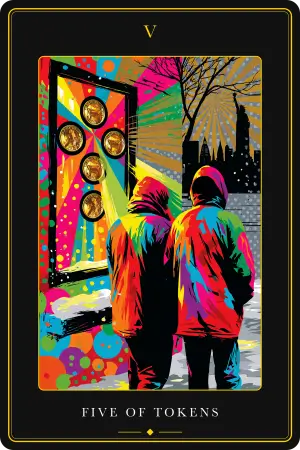
In the Tarot of New York City the Five of Tokens restages the oldest scene of poverty outside the church window as a winter night in the five boroughs, drawn in the deck's pop-art language of halftone dots, sunburst rays, and hard black silhouettes. Two figures stand in the snow with their backs to us, hoods up, hands jammed in their pockets. Their jackets blaze with color, red and pink and green and cyan, a deliberate inversion of the rags in the classical card. In this city even the people who have fallen through every net are vivid and unmistakably alive. Their posture tells the truth the color hides: heads bowed, shoulders closed, bracing against more than weather.
To their left stands a doorway. Not a stained-glass church window but an open door frame, glowing from within. Inside it hang five golden subway tokens, arranged like the pentacles of the old stained glass and radiating beams of yellow, red, and green out into the gray street. The token is this deck's coin. It is fare, rent, and wage, the metal the city runs on. Five of them lit up in an open doorway means the resources exist, warmth and help and a way in, and the door is not painted shut. The tragedy of the card is that the figures are not looking at it. The light falls on their backs.
Everything on the figures' side of the frame is drawn in gray. Silver halftone dots stand in for the falling snow, a bare-branched tree goes black, and the skyline reads as flat silhouette with the Statue of Liberty raising her torch in the far distance. Liberty is present but colorless and remote, the promise of the city visible on the horizon and unreachable from this particular sidewalk. Behind the skyline a golden sunburst spreads across the sky, the deck's recurring sign that energy and possibility saturate New York even at its coldest.
The split palette carries the whole meaning. Riotous color pours out of the doorway while monochrome winter fills everywhere the figures are actually looking. Abundance and lack occupy one frame, separated by nothing but the direction of a gaze. The card does not pretend the hardship is imaginary, because the snow is real and so is the cold. What it says is that the exit sits closer than it feels, and the last barrier between these people and the warm room is not a lock. It is shame, pride, and the habit of walking past.
Core meaning
The Five of Tokens is the city's cold card, the Rider-Waite-Smith Five of Pentacles translated into a lost job, a rent hike you can't cover, and a bank balance thinning toward nothing. In numerology four is the settled square: the topped-out building, the locked accounts, the routine that holds. Five breaks it. Dropped into the most concrete suit in the deck, that shattering lands exactly where people can least afford it, on the paycheck and the lease and the savings account. The card reads as material crisis born of fast, uncontrollable change, and often as the spiritual poverty that rides alongside it, the sense of being locked out of the version of the city that seems to work for everyone else.
What makes the card more than a forecast of ruin is the geometry of the picture. The help is right there. Two people trudge past a lit doorway with their heads down, and the meaning of the whole arcana lives in that gap between where the warmth is and where they are looking. The suffering is genuine, and the deeper wound underneath it is the belief that no help exists, or that they are not the kind of person the warm room is for. The Five of Tokens names a hard season honestly and then asks the one question the figures never ask themselves: why keep walking?
Upright meaning
Upright, the Five of Tokens points to a painful change in fortune, a stretch of genuine lack and the withdrawal of comforts you had learned to rely on. It can be acute: job loss, mounting debt, an unexpected bill, the math of rent and fare and groceries that simply stops working. The counsel written into the image is short. Look up. The door is not locked, and the figures only need to turn toward it. Take honest stock of what you have, understand what caused the trouble, and ask for help before pride talks you out of it. Difficulties of this kind are a season, not a sentence.
In love. The relationship is passing through winter, often with money strain pressing on everything else, the jobs that leave no energy for tenderness and the stress that turns small frictions into fights. The two figures walk side by side yet each stays locked in a private cold, not touching, not looking at each other or at the doorway beside them. It does not say leave. Hard times reveal what a partner is made of, and couples who cross this winter honestly often come out fused rather than fractured. Stop pretending, open the difficult conversation, and turn toward the warmth together.
In career. The grind at its most punishing: layoffs in the air, a toxic run with colleagues or management, effort that outruns reward. You may feel out in the cold while the office windows glow for other people. It can mean job loss or the fear of it, a search that keeps hitting closed doors, or the sense that recognition and pay have both gone missing. Sometimes it flags a skills gap that training could close. Reassess what in this work is genuinely valuable to you and what is only the fear of the cold keeping you in a room that stopped being warm.
In finances. A hard financial season is underway, and personal resources alone may not be enough this time. It can mean loss of income, the shock of city prices, or savings running down while the lit windows of people who seem to afford everything stay bright above you. The central image is help glowing a few feet away, unasked-for. It may be time to seek assistance, from family, a community program, or a debt counselor, rather than freezing quietly out of pride. Treat the hardship as a forcing function to rethink strategy and learn the money management the flush years never demanded.
In health. The body in winter: sleep sacrificed to worry, meals reduced to whatever is cheap and fast, the gym membership cut the same month as everything else. Because Tokens govern the physical body, the card points to exhaustion, the wear of prolonged stress, and the neglect that is really triage, since the body is usually the first bill left unpaid when money and energy run short. The resources here are closer than they look. A walk costs nothing in this city, the clinic exists, and a friend will meet you in the park.
Reversed meaning
Reversed, the thaw begins. The hardest stretch is behind you: work returns, a debt gets restructured, the door you finally knocked on actually opens. The figures on the card have, in effect, turned around, and the light from the five tokens now falls on their faces instead of their backs. It marks the slow rebuilding of income, of a household, of self after a period of real deprivation, and it carries an internal healing too, a shift away from the scarcity mindset and the release of shame. The crisis, painful as it was, taught you what you can survive and who showed up. There is a second, harsher reading worth naming: sometimes the reversal shows the hardship internalized rather than lifted, a chronic entrenchment where the material poverty has hardened into a permanent identity and the figure stubbornly refuses the solutions in plain sight.
In love. The thaw between two people. The relationship went through real trials, money strain and distance and mutual disappointment, and now recovery begins even if it is undramatic at first. Partners who survived the winter compare notes on it and find in the shared hardship a stronger foundation than the easy months ever gave them. The work now is honest budgets and honest feelings and honest asking. For those recovering from a breakup, it promises warmth returning, a wiser new beginning after a hard ending.
In career. The situation is finally improving. An interview turns into an offer, a freelance gig turns into a contract, a bridge you thought was burned turns out to be standing. Problems at work start to fade and finances tied to it begin to stabilize. New openings for growth tend to arrive through people rather than postings, so the lit doorway in work terms is usually someone willing to make an introduction. Make choices now that build long-term footing rather than short-term relief, and keep the network warm.
In finances. Recovery after a hard financial period and the first movement toward stability. The tight constraints loosen, a new income stream appears, a debt gets renegotiated, and help arrives and gets accepted at last. It marks the end of the coldest phase while counseling care, because recovery in this city is slow and celebrating too early is a real temptation. Keep the budget you built in the lean months, avoid impulsive risks, and remember which doors opened and which stayed shut.
In health. Bodily recovery, with energy returning after a depleted stretch. Strength comes back after illness, sleep normalizes as the stress lifts, and appetite recovers alongside the finances. It often marks the start of a new regimen that actually holds because it is grounded in hard-won realism rather than January optimism. Expect visible improvement in shape and vitality and the particular glow of someone who came through a cold season and walked, at last, through the lit door.
Historical notes
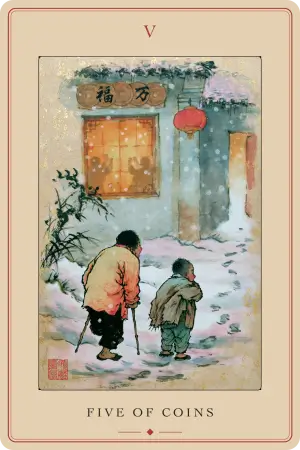
The Five of Tokens inherits its scene from the Rider-Waite-Smith Five of Pentacles, illustrated by Pamela Colman Smith in 1909 under A.E. Waite's direction. That card shows two ragged mendicants struggling through a fierce snowstorm at night, passing beneath a brightly lit stained-glass window set with five golden pentacles. One figure, a barefoot woman, pulls a thin shawl around her head; the other walks on wooden crutches with a bandaged head and a small bell at his neck. That bell was a leper's bell, rung by the afflicted to warn the healthy away, a detail that lifts the card from mere poverty into social ostracization and the stigma of the untouchable. Snow is a rarity in the Rider-Waite-Smith deck, appearing only here and in The Hermit, and Waite defined the card's meaning as material trouble above all, destitution and disorder. This deck keeps every load-bearing element and moves it to New York: the snowstorm becomes a winter night in the boroughs, the church window becomes an open lit doorway, the golden pentacles become subway tokens, and the ragged beggars become hooded figures whose jackets blaze with color.
Older and parallel traditions frame the same disruption in their own keys. In the earliest decks, the Visconti-Sforza and the Tarot de Marseille, the Five of Coins was an unillustrated pip, five coins in geometric arrangement, sometimes wound with floral flourishes, a neutral gaming value that carried none of the later narrative of suffering. Waite and Smith drew their scenic approach from the Sola Busca deck of 1491, the earliest fully illustrated 78-card set, which they studied from photographs in the British Museum. In Crowley and Harris's Thoth deck the card is retitled Worry and abandons human figures entirely for five cracked disks forming an inverted pentagram over fractured earth, the material world itself coming apart. Across all of them the number five does the same work, breaking the settled square of four.
Correspondences
Number. Five, the number of disruption: change, instability, sudden movement, the breaking of a settled pattern. After the square stability of four, in this deck the topping-out ceremony and the locked accounts, five is the transfer announcement that changes everything mid-commute. It delivers freedom and a new perspective the hard way, through conflict and loss. Five also holds a second meaning in reserve, adaptability and the nerve to see a familiar situation from a new angle, which is the same skill a New Yorker uses to reroute the instant the usual train isn't running.
Astrology. Mercury in Taurus, the first decan of Taurus from roughly April 21st to 30th. Taurus is the sign of material comfort and security, the steady job and the pantry that is never empty, and its first decan carries the drive to build exactly that. Mercury's rule sharpens the analytical mind and introduces movement into fixed earth: plans, calculations, and the sudden reversals that news can bring. The friction of a fast planet grounded in slow earth is what the Golden Dawn named the Lord of Material Trouble, and it also supplies the card's way out, the flexibility to change routes and stay open to help that pride would refuse.
Element. Earth, the suit of Tokens, the element of rent and wages and fare and everything else the city weighs and charges for. Tokens govern material welfare and financial stability, and the Five is the point in the suit where that stability breaks and the laws of the material world show their teeth.
Kabbalah. The card sits at Geburah, the fifth sphere, whose name translates as Severity, Judgment, and Strength and which is ruled by the martial energy of Mars. Geburah falls within Assiah, the dense material world. The formula for the card is therefore severity applied directly to physical resources: where the Four of Tokens rested in the mercy and accumulation of Chesed, the Five is the sudden retraction of that security.
Elemental dignity. As a Five in the earth suit it brings loss and instability to its neighbors, draining steadier cards of their footing, while a card of recovery or support beside it points toward the open door and the turn upward.
Psychological perspective
Read as a state of mind, the Five of Tokens is the scarcity mindset made visible, the poverty consciousness that keeps a person outside long after the weather has cleared. In digital tarot communities it is a notorious stalker card, the one that keeps turning up in daily pulls and driving anxious readers to a sense of impending doom. The pattern those readers describe is telling. The card tends to stalk people trapped in a self-fulfilling story of limitation, and even when someone is financially stable they may hoard resources, over-analyze small expenses, or suffer imposter syndrome that anticipates ruin around every corner. That over-analysis is the negative face of Mercury in Taurus, the anxious intellect chewing on the fear of loss.
In shadow work the card acts as a mirror for self-sabotage. The figures walking past the warm door stand for the part of a person that is stubbornly attached to its own suffering, and the question it forces is uncomfortable: why refuse the help that is right there? The answer usually lives in the safety of predictability. If your identity is built around being the one who copes alone, accepting help means dismantling that identity, and pride can feel cheaper than that in the moment even though it costs far more over time. The card's charge is to notice the difference between hardship the world imposed and the exile you keep choosing, and to look up from the snow.
The Five of Tokens across decks
The same winter scene appears in different settings across the tradition, and this deck's contribution is to move it from the medieval churchyard to a New York sidewalk and make the sanctuary a subway-lit doorway. In the Rider-Waite-Smith deck two ragged beggars, one barefoot and one on crutches with a leper's bell, trudge through a snowstorm past an illuminated church window set with five golden pentacles, their eyes cast down, oblivious to the warmth inches away.
The Tarot de Marseille and the earlier Visconti-Sforza keep the card abstract, five coins in geometric arrangement wound with floral flourishes, a neutral numerical value with none of the later drama of suffering. In the Thoth deck Crowley and Harris retitle it Worry and drop the human figures entirely, rendering five cracked disks in an inverted pentagram over crumbling earth, the material world itself coming apart. Modern decks push in either direction: the Pagan Otherworlds shows an empty snowy landscape and the Light Seer's a weeping figure with a glowing key behind her that she refuses to see. The Tarot of New York City keeps the archetype whole and swaps the churchyard for the five boroughs: the church window becomes an open lit doorway, the pentacles become five golden subway tokens, the ragged beggars become hooded figures whose jackets blaze with color, and the Statue of Liberty stands colorless on the horizon. The meaning holds across all of them, help present and unseen, warmth a step away and a gaze pointed the wrong direction.
In combination and context
Numerologically the Five of Tokens is the shattering of the settled four, the moment the earth suit's accumulated stability breaks and the querent is thrown into survival mode. It grounds the number five in the material world, the layoff that arrives without warning and the rent that jumps in the one month there was no cushion, and it holds the instability the way fives always do, as a temporary trial aimed at forcing a return to what actually matters. Surrounding cards shift its weight. Beside cards of illness or isolation it deepens into physical and spiritual exile; beside cards of recovery, community, or the open road it starts to read as the winter already turning, the head already lifting toward the door.
Spread position changes its job. In a yes-or-no reading it leans no upright and yes reversed, since upright it describes lack and a closed posture while reversed it describes relief and the door opening. Asked for timing it points to a cold season rather than a fixed date, a stretch to be walked through until the cycle turns. As a challenge or obstacle it exposes the pride and shame that keep a person outside the warm room, or the scarcity story that outlives the actual shortage. As advice it is unusually direct: look up, take honest stock of your resources, and knock on the lit door, because in this city almost nobody survives the winter entirely alone.
Questions for reflection
- The figures in the snow are walking past an open, lit doorway with their heads down. What warm door are you walking past right now, and what story are you telling yourself about not being allowed inside?
- Separate the two colds on this card. How much of what you are feeling is the genuine hardship of the season, and how much is the belief that no help exists or that you don't deserve it?
- Who is standing a few feet away, holding a door open, that pride has kept you from turning toward? What would it actually cost you to knock?
The general meaning follows the Rider-Waite-Smith reading — the reference used across Tarot Academy. Open a specific deck above for its own interpretation.
Frequently asked questions
Explore the Tarot
Latest Posts
Discover the ancient wisdom of tarot cards and unlock the mysteries of your spiritual journey. Our blog is your gateway to understanding the rich symbolism, meanings, and practical applications of tarot reading.




















































