
 EN (English)


Minor Arcana ·
Four of Coins
Hard-won security on a locked chest, while the temple fair drifts past a shuttered window.
Card at a glance
- Numerology
- 4
- Element
- Earth
- Astrology
- Sun in Capricorn (3rd decan)
- Kabbalistic path
- Chesed (Mercy) in Assiah
- Timing
- Deep winter · Capricorn · Jan 10–19
- Yes / No
- Upright a conditional yes · Reversed no
Upright
stability
security
savings
thrift
stewardship
financial control
prudence
provisioning
Reversed
hoarding
miserliness
fear of loss
isolation
loss of control
clinging
over-caution
closed shutters
Four of Coins in each deck
Every deck reimagines the same archetype. Compare the art, then open a deck to read its full interpretation.
Imagery and symbolism
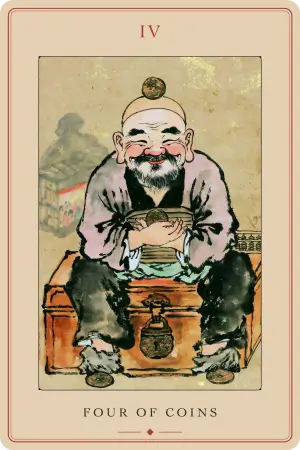
In the Tarot of Beijing the Four of Coins is an old pawnshop owner, drawn in the Feng Zikai manner: a few calm ink lines, gray and black washes, one muted vermilion accent, all on aged kraft paper flecked with gold. He sits squarely on a large wooden chest bound with iron and closed with a heavy padlock. He does not merely own his wealth, he sits on it, and no one opens that chest without moving him first.
He clasps a strongbox to his belly with both arms, a copper coin pressed to its lid, and smiles the deep, contented smile of a man whose accounts balance. The deck does not mock him. His happiness is real, and that is the card's honesty: security is genuinely sweet. The question it asks lies elsewhere.
A coin sits balanced on his round cap, so even his thoughts are crowned by money. Under each cloth shoe lies one square-holed copper cash. In this deck the coin keeps its old cosmology, heaven round and earth square, so the man stands on heaven-and-earth and uses the order of the universe as a doorstop. What was minted to circulate has been turned into flooring. Behind his shoulder waits an abacus, the instrument of perfect accounting, so everything he has is counted and everything counted is kept.
In the upper left, faint as breath, a temple fair drifts past: a bright lantern, an opera stage, small figures in festival colors dissolving into gray wash. It is spring and music and sugar-figures, the world happening. The window between him and it is shuttered. He is safe. That is all he is. Gold flecks scatter across the paper, abundance falling on the whole city like pollen while the man gathers his four coins tighter. A small red seal rests in the corner, the artist's own mark of ownership, and a quiet joke, since even this picture of possession is possessed by someone.
Core meaning
The Four of Coins is the anchor of the material suit, the point where effort solidifies into something you can lock. In the Tarot of Beijing that something is a chest, and the card blesses it plainly: stability, savings, a household in order, control over where every fen goes. This is hard-won security, the fruit of counting twice and locking once.
The generic Four of Pentacles is often dismissed as the miser, but the Beijing deck refuses the sneer. The old man's contentment is earned and his caution is frequently wise, since there are seasons when conserving beats expanding and sitting on the chest a while longer is simply prudent. The whole meaning turns on the shuttered window. The card asks one question and asks it gently: does your security still serve your life, or has your life begun to serve your security? A courtyard has four walls so that life can happen safely inside them, not so that it stops.
Upright meaning
Upright, the Four of Coins describes a situation of solid material footing. The accounts balance, the door is bolted, nothing is leaking and nothing is at risk, and this order is the fruit of your own discipline. It is a period for conserving rather than expanding: protect what you have built, keep the ledger honest, plan long. The card's one counsel is to notice the window, and to remember that generosity of money, time, and attention is also a way of managing wealth.
In love. A relationship with a full pantry and a bolted gate: stable, faithful, provisioned. Partners under this card keep their promises the way the pawnbroker keeps deposits. Passion may have settled into reliable warmth, tea poured for two at the same hour each evening. Keep the gate closable, but do not keep it closed.
In career. A secure, hard-earned position, the seat on the chest. Your competence is proven, your income steady, your standing worth guarding. It favors consolidation: deepen expertise, finish long projects, negotiate from the strength of someone hard to replace. Sit on the position, but do not become it, and spend some earned security on rest and growth.
In finances. One of the deck's most solid money cards. Steady income, real savings, controlled spending, a firm grip on every coin. It favors conservation: build reserves, pay down obligations, choose the long-term and low-risk over the glittering gamble. If you have wondered whether to guard or to gamble, this card sits down on the chest and answers: guard, for now.
In health. A well-provisioned body maintained by routine: regular meals, regular sleep, the morning walk with the birdcage, the same tai chi hour in the same park. Strength laid down through years of regularity, good resistance, the quiet dividends of past discipline. Keep the practices that already work.
Reversed meaning
Reversed, the fair has moved on, the lane is empty, and the old man is still sitting on the chest. The card shows fear of loss grown larger than any loss: excessive frugality, hoarding, reluctance to spend even on necessities. At the other extreme it flags the sprung lock, a panicked loss of control with uncounted expenses, missing coins, and a ledger no one dares open. The remedy is the coin's own law, circulation: loosen the grip one finger at a time and learn to tell saving from hiding.
In love. Affection rationed and tenderness withheld like coins, one partner clutching the other from fear rather than joy. Jealousy, control over shared money, a refusal to invest feeling until guarantees appear. Sometimes it is a couple barricaded in comfort, nothing wrong and nothing alive, their early love passing like gray smoke outside the shutters. Unclench one hand and spend feeling without receipts.
In career. A career locked from the inside. Clinging to a safe but exhausting post out of fear until caution becomes the ceiling, growth stalling because every new project looks like a threat to the existing chair. Sometimes it marks a genuinely insecure situation, with pay withheld or your credit controlled by someone else's padlock. The remedy is deliberate movement: update skills, ask for the overdue conversation, teach rather than guard.
In finances. The relationship with money has tipped out of balance. Either the clenched fist, greed and dread of poverty despite sufficient means, or the sprung lock, impulsive spending and unrecorded debts. The card warns that over-caution loses money as surely as carelessness does, capital idling while opportunity passes the shuttered window. Return to the abacus honestly, without self-punishment, and restore a middle way.
In health. A body locked into its own routine, stiff in the literal and the figurative sense from holding on too tightly: clenched jaw, held breath, the posture of a man hugging a strongbox. Rigidity about diet or regimen so severe it excludes rest and pleasure, or neglect behind a locked door, with check-ups postponed as expenses. Open the shutters: movement, stretching, breath, and permission to spend on the body's comfort.
Historical notes
The crowned miser of the Four of Coins is a relatively late invention. In the 1909 Rider-Waite-Smith deck, Arthur Edward Waite and Pamela Colman Smith drew a crowned figure on a gray stone seat before a distant city, one pentacle balanced on his head, one clutched to his chest, one pinned under each foot. The four coins block the figure's crown, heart, and feet, and his back is turned to the town, so the image reads as material security bought at the price of spiritual and emotional flow. Waite added this minor king where the deck otherwise reserves crowns for its kings and its Emperor, and had him look straight at the viewer, a rare direct gaze in the Minor Arcana.
The Thoth Tarot, painted by Lady Frieda Harris to Aleister Crowley's design, titles the card Lord of Earthly Power and drops the human figure for a fortress of projective geometry. Crowley reads it as power held in reserve, the reward of good work, and warns in the same breath that attachment to that comfort curdles into fear of loss.
The Tarot of Beijing keeps the posture and reworks the setting. The RWS coins on head, chest, and feet survive exactly, but the crowned king becomes an ordinary hutong pawnbroker, the barren city becomes a temple fair behind a shuttered window, and the coins gain the square holes of Chinese copper cash. The warning stays intact while the contempt is removed, since the deck lets the old man be genuinely happy and asks its question without calling him a fool.
Correspondences
Number. Four, and in Beijing four is architecture: the siheyuan with buildings on all four sides, the four corners of a gate, the four legs of the chest the old man sits on. Four is the point where energy stops moving and starts standing, where three is still a conversation and four is a wall. The deck also lets the number's shadow fall gently, since in Chinese 四 (sì, four) sounds close to 死 (sǐ, death), and buildings skip the fourth floor. Four is the number of the strongbox and of the tomb, and the difference between them is a door that still opens.
Astrology. The Sun in the third decan of Capricorn, roughly January 10 to 19, the deepest weeks of the Beijing winter when the lakes freeze for skating and the coal is stacked to the eaves. Capricorn's third decan carries order, self-discipline, and the ambition to control one's circumstances, the pawnbroker's own virtues. The Sun lends vitality and self-worth, yet in the picture its light falls on the fair outside while the man sits with his shutters closed.
Element. Earth, with a specific Beijing texture: brick, coal, copper, and the packed gray dust of a hutong floor. Earth here means persistence and practicality, the patient counting by which a household survives a northern winter.
Kabbalah. Chesed, the sphere of Mercy and stabilizing structure, in Assiah, the dense material world of action. The expansive majesty of Chesed filters into the suit of Earth and hardens into strict discipline, a power grown from peace and security and held defensively in reserve.
Elemental dignity. An earthy four sits well beside other earth and grounding cards and reads there as consolidation, but next to cards of flow and feeling it can stiffen into blockage, the clenched hand refusing what the neighbor offers.
Psychological perspective
The person of this card is a reliable proprietor of the lane: practical, prudent, unhurried, able to name the exact contents of every drawer they own. They count twice, lock once, and sleep well. They value the tested over the new and the long term over the fashionable, and nothing entrusted to them is ever lost. Their winter coal is bought in summer. They may not be generous with surprises, but they are unfailingly generous with reliability, and in the hutong that is a currency of its own.
Modern tarot has moved past the simple miser reading. Rachel Pollack framed the card as the mind imposing necessary structure on chaos, the psychic barrier a person builds to protect a fragile self while it repairs, healthy and even required after a period of trauma. The shadow appears when the salt circle drawn for healing hardens into a prison. Beneath a very tight grip there is usually an old memory of scarcity that was never properly mourned, and such people benefit from small, deliberate acts of generosity, each one loosening the knot a little.
The Four of Coins across decks
Rider-Waite-Smith. A crowned minor king on a gray seat before a distant city, one coin on his head, one at his chest, one under each foot, his back to the town. The image reads as security that blocks the crown, heart, and feet. Beijing keeps this exact arrangement of coins and trades the barren town for a temple fair the man has shut out.
Thoth. Crowley's Lord of Earthly Power drops the human figure for a fortress of projective geometry, power held in reserve and shadowed by the fear of loss. The Beijing card carries the same double reading, blessing the security and naming its risk in the same breath.
The Wild Unknown. Kim Krans strips out the human entirely and binds four pentacles into a rigid diamond, horizontal lines drawn toward it but failing to penetrate its defenses. It asks whether the querent's safety is genuine or a manufactured illusion, the same question the Beijing shutters raise.
Deviant Moon. Patrick Valenza's surreal card presses on the psychological weight of holding tightly, the primal fear of losing what one has gathered.
Tarot of Beijing. The old pawnshop owner in Feng Zikai ink keeps the RWS posture and adds a whole city: the abacus, the square-holed cash, the shuttered fair, the gold flecks of an abundance falling on everyone but him. Where most decks judge the figure, this one lets him be happy and simply points at the window.
In combination and context
The Four of Coins pulls a spread toward conservation, boundaries, and the guarding of what is already held. Next to the deck's Ten of Coins it shifts from stinginess toward prudent saving, a call to build a specific stable future rather than merely to clutch. Beside the Ace of Cups it warns that a guarded heart is blocking the emotional overflow the Ace offers, the clenched hand refusing the poured cup.
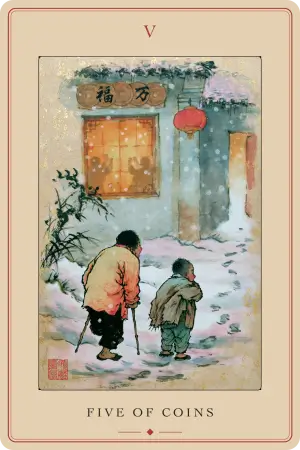
The card's own suit gives it a narrative neighbor in the Five of Coins, which follows it. Practitioners read the move from four to five as causal: the tighter the grip, the more the sand slips through the fingers, and clinging to an obsolete resource precipitates the very loss it feared. The Beijing deck answers that dread inside its own Five, whose shop sign reads Ten Thousand Blessings and whose door, the card insists, is always just around the corner for anyone willing to open it.
When the Four of Coins keeps returning to your readings, treat it as a request to examine your grip. It asks what you have quietly reclassified as not for you, and whether one deliberate unlocking, a friend's tea paid for, a feeling spoken, an hour spent on something that produces nothing, might be the wiser form of wealth management.
Questions for reflection
- What have you quietly filed under 'not for me', the invitation declined by reflex or the small expense refused on principle?
- Is your security still serving your life, or has your life begun to serve your security?
- What is your caution actually protecting, and what is it costing you to keep the shutters closed?
The general meaning follows the Rider-Waite-Smith reading — the reference used across Tarot Academy. Open a specific deck above for its own interpretation.
Frequently asked questions
Explore the Tarot
Latest Posts
Discover the ancient wisdom of tarot cards and unlock the mysteries of your spiritual journey. Our blog is your gateway to understanding the rich symbolism, meanings, and practical applications of tarot reading.




















































