

タロット · 火

ワンド

14 枚

情熱、創造性、意志、行動力。ひらめきと、それをかたちにするエネルギー。

The Suit of Wands: the Tarot's fire of will and creation

The suit of Wands is the Tarot's suit of Fire, the one that deals in energy rather than feeling, thought or matter. It covers will, passion and the creative spark that sets things moving. Here is where the Wands came from, what they stand for, and how readers work with them today.

Element and suit identity

The suit of Wands is the Tarot's suit of Fire. Across the tradition it has gone by many names, Batons, Staves, Rods, Clubs and Scepters among them, but its symbol is always the same simple object: a length of wood held upright. In one line, Wands are the suit of will and creative drive, the spark that sets things in motion. Where the other three suits deal in feeling, thought and matter, Wands deal in energy itself.

Domain of life

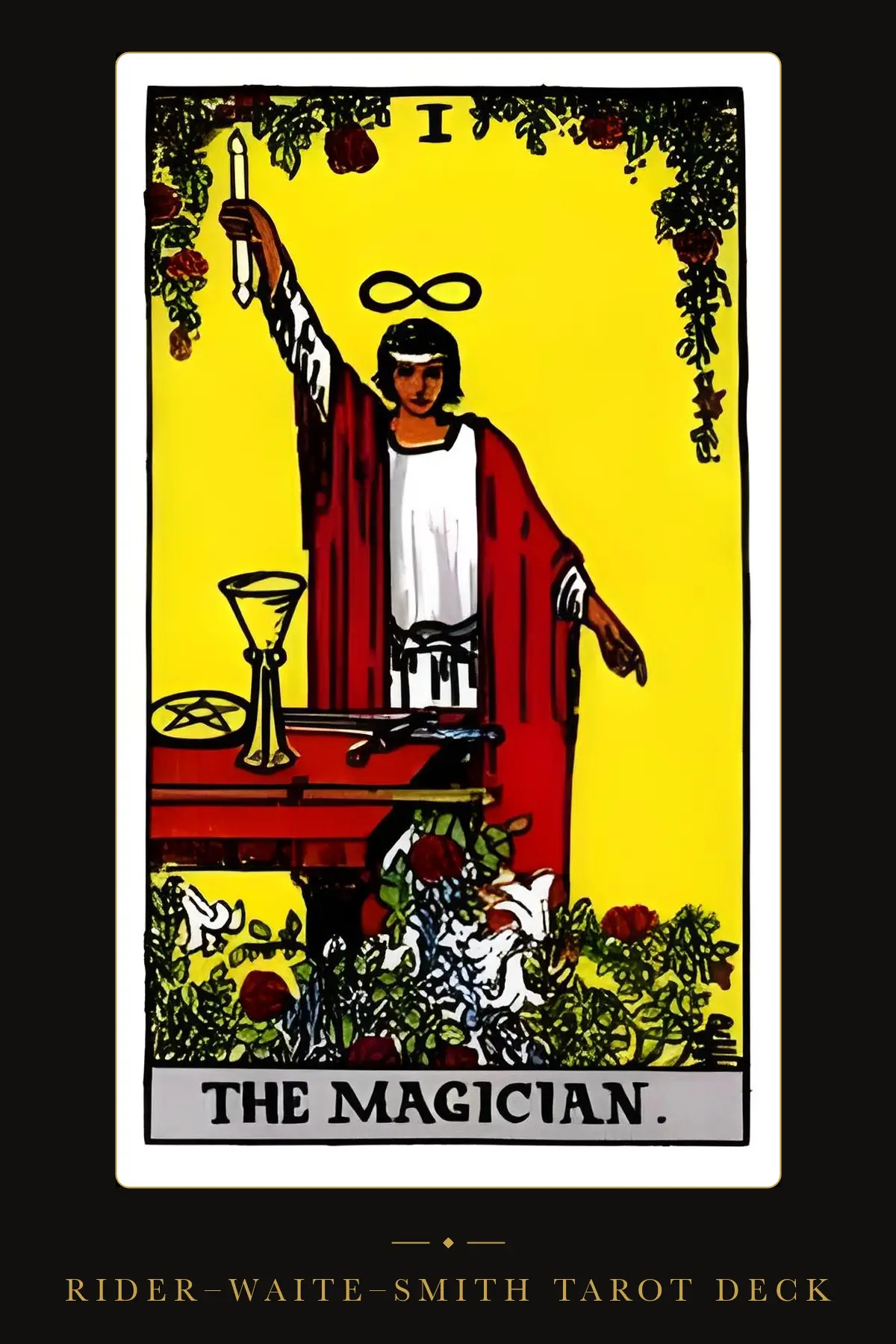
Wands govern the territory of will and action. Their subjects are ambition, passion, creativity, enterprise and the raw push to make something happen. When a question is about drive, whether to start a project, chase a goal, take a risk or follow a calling, it belongs to Wands. Arthur Edward Waite called it the suit of life and animation, and in the Rider-Waite-Smith deck the staffs sprout green leaves to make the point: this is living energy, not dead wood. Wands describe the fuel of a life rather than its comforts or its conclusions.

Historical and cultural roots

The Wands began as sporting equipment. In the Mamluk playing cards of medieval Egypt, the ancestors of the Tarot Minors, the suit was the jawkan, the polo stick, a mark of the mounted warrior elite. Polo reached Europe around the 1370s as an unfamiliar foreign game, so European cardmakers redrew the exotic mallets as plain batons: cudgels, walking staves and farm tools. In the process the suit lost its aristocratic meaning and took on a new one. Mapped onto the feudal classes, Batons became the suit of the peasantry and of agricultural labour, of physical toil and brute force.

Its elevation to Fire came much later. When the French occult revival and then the Golden Dawn reworked the Tarot into an esoteric system across the 18th and 19th centuries, they renamed Batons as Wands and tied the suit to the classical element of Fire. That cut the suit loose from ploughs and firewood and recast it as pure will and creative spark. The idea that the four suits carry the four elements is old, reaching back through Hermetic and Greek philosophy, but the fixed pairing of Wands with Fire is a product of that revival.

Symbolic and esoteric correspondences

Under the Golden Dawn system the suit of Wands sits at the head of a long chain of correspondences. Its element is Fire, and with Fire come the tradition's usual attributions: the direction south, the heat of summer, and the three fire signs of the zodiac, Aries, Leo and Sagittarius, onto which the numbered Wands are mapped through the decans. In the Kabbalah the suit belongs to Atziluth, the Archetypal World, the highest of the four worlds and the plane of pure divine will before any form, thought or feeling shapes it. Its magical tool is the wand of the ritual altar, the instrument of directed intention. Crowley's Thoth deck presses the same idea further, drawing the Wands as the Tibetan vajra, the thunderbolt that stands for indestructible True Will.

Psychological dimension

In the psychological reading of the deck, Wands stand for the faculty of intuition in the sense Carl Jung gave the word: the perception of possibility and pattern, the hunch about where something could go. It is the function that catches the spark of an idea before any evidence for it exists. The suit's shadow is the shadow of Fire itself. Left unchecked, its drive curdles into recklessness, domination and ego, the will to act with no thought for the cost. The suit's late cards name the exhaustion at the far end: the Nine of Wands as battered hyper-vigilance and the Ten as outright burnout, the burden of a fire that has been asked to burn far too long.

The suit's arc, Ace to Ten

Read from Ace to Ten, the Wands trace the whole life of a fire. The Ace is the pure spark, raw creative potential and the pull of a new beginning. The Two and Three turn that spark into a plan and then into movement, the first survey of the ground and the first real step onto it. The Four brings a settled, celebratory stability, and the Five breaks it with friction, the messy clash of competing wills. The Six rises to triumph and public recognition; the Seven defends that hard-won ground against challengers. The Eight is speed, news and momentum arriving all at once. Then the fire starts to cost more than it gives: the Nine stands wary and worn out, and the Ten buckles under a load too heavy to carry, the cycle spent and ready to begin again.

The court of the suit

The four Wands courts are all fire, each crossed with a second element that gives it a distinct temperature. The King of Wands is fire of fire, charismatic and commanding, a natural leader who can tip into domineering. The Queen of Wands is water of fire, warm and magnetic, passionate without scorching the people around her; in the Rider-Waite-Smith image the black cat at her feet has become a favourite emblem of a woman fully at ease with her own shadow. The Knight of Wands is air of fire, all sudden energy and headlong movement, thrilling and impatient by turns. The Page of Wands is earth of fire, the student and the enthusiast, inspiration just beginning to take a practical shape. In the Thoth deck these ranks shift names, the King becoming a mounted Knight and the Page a Princess, which is worth knowing when you move between decks.

Variations and modern interpretations

Because the suit is really an idea rather than an object, decks have felt free to rename it. Older, pip-only decks in the Marseille line keep the plain Batons, drawn as crossed staves with no scene and read through number and element alone. Modern decks range wider. Some drop the object entirely and simply call the suit Fire; others reach for a fresh emblem that carries the same charge, Inspiration in one deck, Acorns or Arrows in another, Engines in a steampunk deck. The through-line holds whatever the label: a Baton, a thunderbolt, an acorn or a brass engine all still stand for passion, action and will. The clearest divide between decks is not the name but the art, whether the pips are bare arrangements of staves or full Pamela Colman Smith scenes of people building, fighting and setting out.

In readings

In a spread, a run of Wands makes a reading about energy and motion. Their dominance points to drive, ambition, creativity and a fast pace, a situation pushed forward by passion and force of will. Their absence can be just as telling: a question about action with no Wands in sight often shows a lack of motivation, direction or spark, plans that will not catch light. Readers frequently weigh Wands against Pentacles, especially in questions of work and money, because Fire supplies the vision and the momentum but neither the patience nor the ground to stand on. Wands promise activity, not stability, and a reading usually wants some earth alongside the fire before the drive can turn into something that lasts.

Frequently asked questions

最新の投稿

タロットカードの意味や象徴、実践的な活用法を解説するブログです。日々のリーディングや学習に役立つ知識をお届けします。

















































