
 EN (English)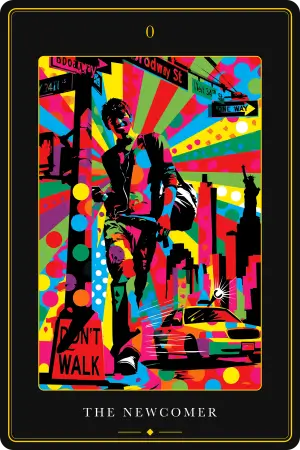


Major Arcana · 2
The Hustler
The man behind the folding table on Canal Street, all four suits laid out, selling the shell game and delivering access.
Card at a glance
- Numerology
- I
- Element
- Air
- Astrology
- Mercury · Gemini & Virgo
- Kabbalistic path
- Beth (Kether → Binah)
- Timing
- Swift · the open window
- Yes / No
- Upright yes · Reversed no
Upright
Hustle
Access
Resourcefulness
Connections
Deal-making
Improvisation
Street smarts
Initiative
Reversed
The con
Overpromising
Empty pitch
Manipulation
Burned bridges
Scattered schemes
Being the mark
The Hustler in each deck
Every deck reimagines the same archetype. Compare the art, then open a deck to read its full interpretation.
Imagery and symbolism
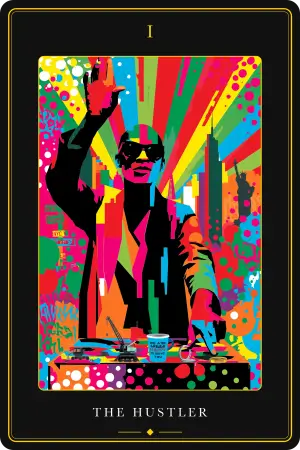
In the Tarot of New York City the Magician becomes the Hustler, and the sacred altar becomes a folding table on Canal Street. The table descends from two ancestors at once: the Rider-Waite-Smith stone altar and the cardboard box of the three-cup shell game. Both readings are correct, which is the whole argument of the card.
Laid out on the table are the four suits of this deck, and each one is a city object. A construction crane stands for Cranes, the deck's fire, ambition, the build. The blue Greek "We Are Happy To Serve You" coffee cup stands for Cups, water, feeling, community. A subway token stands for Subways, the mind, the grind, the ride. A gold coin stands for Tokens, earth, money, rent. He commands all four engines of the city rather than four classical elements on a lawn. The shell game was only ever the advertisement. The real trick is that he can get you anything.
One hand is raised high and the other points down at the table, the old formula "as above, so below" translated into a street address. The skyline is above and the sidewalk is below, and the Hustler is the live wire between the penthouse deal and the handshake on the corner. He moves energy between the two because he belongs to both.
He wears dark sunglasses where the Rider-Waite Magician floats a lemniscate. You cannot see his eyes and he sees everything. The sharp black coat over riotous color replaces the white robe and red mantle, discipline on the surface with appetite underneath.
Behind him the city breaks open in rays and halftone dots. The skyline rises on one side and the Statue of Liberty stands small on the horizon, a reminder of what the hustle is finally for: arrival, and the promise that you can become someone here. Street signs and graffiti tags crowd the edges, the language he speaks natively. The yellow rays carry the traditional meaning of intellect and vital energy, and in this deck they are unmistakably taxi yellow, the city's color for getting somewhere fast.
Core meaning
The Hustler is the claim, made daily on every corner, that reality is negotiable. Where the generic Magician says you already hold the tools, this deck says something narrower and sharper: the highest magic in this city is access, and the truest wand is a phone full of names. He gets the table at the booked restaurant, the apartment before it lists, and the meeting with the person who never takes meetings.
He owns nothing at the start. No building, no title, no inheritance. His entire capital is intangible and consists of quickness, knowledge, relationships, and nerve. The card proposes that this is the truest form of wealth, since it cannot be confiscated, taxed, or lost in a crash. The four suits on the table are not his possessions. They are his fluencies.
Inside this deck the Hustler is the city's first teacher. Where the Newcomer steps off the bus at Port Authority with a duffel bag and no map, the Hustler is the first figure he meets who has cracked the code. He is the proof that the city, which looks like a wall, is a door if you know how to knock. That is the turning point of every New York story: the moment the innocent discovers that everything here is negotiable.
Upright meaning
Upright, the Hustler says the querent already has what the goal requires. All four suits are on the table and this is the moment to move. It marks the start of a venture, an important deal coming together, or the discovery that a problem is solved by knowing who to call. Doors that seemed locked have a side entrance. The advice is direct: use your contacts, call in your favors, work the room, and stop waiting for permission. The window is open briefly. Trust that the resources are within reach even when they don't look like resources yet.
In love. Charm at full wattage. This is the person who gets the impossible reservation, remembers everything you said, and makes the city feel like it is performing for the two of you. For anyone looking, the card says make the move and send the message, because initiative is rewarded now. In an existing relationship it points to renewal through effort, a partner who plans and courts again and refuses to let things run on autopilot. Dates get engineered like small productions and problems get treated as solvable.
In career. The operator every workplace depends on and no org chart captures. This is the colleague who knows which approval can be walked through in person, has a contact in every department, and turns a stalled project into a moving one with three phone calls. Pitch the idea, volunteer for the visible project, negotiate the raise, make the lateral move the cautious will call lucky later. The deck's professions run to work built on quickness and connections: founders, brokers in real estate and talent and finance, salespeople, fixers and concierges, promoters and publicists, agents and managers, street vendors, recruiters, lawyers, actors and comedians, journalists with a source in every borough.
In finances. The card of the earner, money made by quickness and the nerve to ask. The side deal, the flip, the introduction that becomes a commission, the skill sold at street speed. It favors negotiations, sales, and launches, and it indicates strong instincts about what a thing is worth, who wants it, and how to stand between the two. Name your price and manage the money actively.
In health. Taking command of the body with the same resourcefulness you bring to a venture. A training program starts, an image gets rebuilt on purpose, and physical presentation becomes an asset you are willing to work. The Hustler's physicality is agility and quick reflexes, which favors boxing, basketball, dance, anything that rewards improvisation. Move while the energy is high.
Reversed meaning
Reversed, the moves stop landing. The crowd no longer leans in, calls go to voicemail, and angles that always worked fail. Plans stay talk while the effort stays enormous. You may be getting out-hustled by someone running the game on you, and the shortcut you were offered may be the con. This is the shell game with no ball under any cup, and it is also the hustler who ran the same trick once too often until the block noticed. Slow down, look at what is actually under the cups, and rethink the goal underneath the moves, because hustle without direction is noise on the corner.
In love. The charm may be the entire product. A perfect text, a dazzling date, and misdirection underneath, with other games running and promises with nothing behind them. It warns of manipulation, love-bombing, and a person you have never seen with the sunglasses off. Turned inward it says your own performance has become the barrier, because being irresistible is easier than being known. Watch what is done rather than what is said, over time.
In career. Style has outrun substance. This is the colleague everyone learns to double-check, impressive in the meeting and missing at the deadline. Credit gets claimed for other people's work, skills get inflated, the political game gets played so visibly it backfires. Get the agreement in writing and notice who benefits from the version of events you are being sold. In business it warns that the operation is more pitch than product: a beautiful deck and a demo made of smoke, too many deals in the air, a founder's word trading at a discount.
In finances. A warning light over every deal on the table. Read the documents, verify the claims, and distrust anything that must be decided today, since urgency is the grifter's favorite tool. If a deal this good found you, you are probably the mark. Turned inward it means five hustles running and none profitable, money earned quick and spent quicker, commitments made against money that is not real yet. Stop moving long enough to count what is actually there.
In health. The body run on adrenaline and caffeine while its actual needs go ignored. The appearance holds and the engine underneath is failing. Crash diets, dubious supplements, and quick fixes stand in for habits. The body cannot be charmed or negotiated with, and consistency is the one thing this archetype avoids.
Historical notes
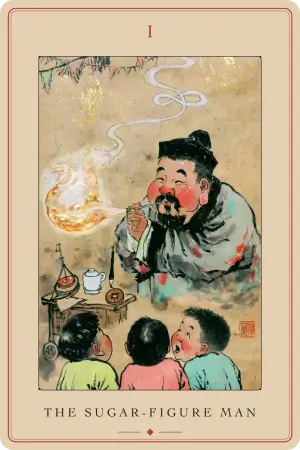
This deck's Hustler is a return as much as an invention. The earliest version of the card was never a temple adept. In the Visconti-Sforza tarocchi of about 1460, attributed to Bonifacio Bembo, the figure sits playing at cups and balls, a sleight-of-hand act meant to entertain and occasionally to swindle. Italian tradition called him Il Bagatto, the juggler or mountebank, and in the game of Tarocchi he was the Pagat, the lowest trump. The Mantegna engravings put the equivalent figure near the bottom of the human ladder as Artixano, the Artisan. The Tarot de Paris of around 1625 sets him among a dog, a monkey, and a small crowd, and the French named him Le Bateleur. His tools then were dice, gambling cups, and knives, the working kit of a fairground con. The card was linked to cheating, boastfulness, and dangerous friendships. Hieronymus Bosch painted the same scene in 1505 as The Conjuror, a table turned into an in-between zone where ordinary judgment is suspended.
The nineteenth-century French occult revival remade him. Eliphas Levi and the writers who followed read the Tarot as encrypted ancient wisdom, and the street conjuror was elevated into an aspect of Hermes-Thoth. The gambling table became a sacred altar and the cheating props became elemental weapons. When Waite and Pamela Colman Smith published their deck in December 1909, the last of the trickster was gone and the solemn adept remained.
The Tarot of New York City puts the cardboard box back under the altar without giving up the altar. Canal Street is the fairground, three-card monte is the cups and balls, and the figure is once again someone whose respectability is unresolved. What the deck keeps from the occult revival is the direction of the will: the same hands run the con and build the empire, and the card refuses to decide for you which one it is.
Correspondences
Number. Trump I, the first move, the first dollar, the first name in the phone. The number of the self-starter, and no figure wears it more literally than a man who by definition made himself. Nobody handed him the table, the crowd, or the network. One is also the number of unity, and he is the only figure in the deck holding all four suits at once: four engines and one operator. As the step after the Newcomer's zero it tells the story of arrival becoming agency. The Newcomer steps off the bus with nothing; the Hustler is what that nothing looks like once it gets organized. The number carries its own warning, since the one who stands alone can fall alone.
Astrology. Mercury, and no planet is more at home in this city. Mercury governs communication, commerce, speed, wit, negotiation, and movement, and the Hustler works all of them at street level: the fast talk, the faster hands, the deal closed between two subway stops. Mercury is the messenger who travels between worlds, and the Hustler carries information and favors between the penthouse and the sidewalk the way Mercury carried messages between gods and mortals. Mercury rules trade, and the Canal Street table is trade in concentrated form. Mercury was also the god of thieves in the old myths, and the card keeps that shadow honestly. Through Mercury the card takes the signs Gemini, which lends persuasion and verbal agility, and Virgo, which lends analysis and method.
Element. Air by attribution, though the point of the imagery is that he commands all four. Crane, Cup, Subway, Token lie on the table as counters he adapts at will.
Kabbalah. The 12th path of the Tree of Life, the bridge from Kether (the Crown) to Binah (Understanding), under the Hebrew letter Beth, whose numerical value is 2 and whose literal meaning is "House." Older texts call the path the Intelligence of Transparency, the adept working as a clear lens so the light passes through undistorted by ego. In this deck the ego is exactly the risk, and the sunglasses are exactly the opacity.
Elemental dignity. Beside Swords the Mercurial air amplifies and the reading turns toward communication, networking, and intellect.
Psychological perspective
Psychologically the Hustler is self-made agency, the conviction that any situation can be worked. Thinking and acting are one motion. The confidence rests on a track record of figuring it out rather than on credentials, and the intelligence is social and situational: reading a room instantly, locating the decision-maker, sensing what each person wants before anyone speaks. Such a person is self-taught in almost everything and proud of it. They tolerate uncertainty well and enjoy improvising, so a plan falling apart interests them more than it frightens them. They experience the city as a partner in an ongoing game rather than an obstacle. Generosity inside the network is common, since the true Hustler moves favors in every direction and the block knows it.
The shadow sits close. The angle can turn compulsive, so they work people even when there is nothing to gain, because working people is the only mode they trust. Self-reliance shades into isolation, and the sunglasses that hide the eyes from the crowd eventually hide them from everyone. Modern readers connect the reversed card to gaslighting and to the narcissist who sees other people as counters on an altar rather than autonomous lives. The other shadow is quieter: because this figure lives on the appearance of competence, the inverted card is the fear of being exposed as a fraud, the juggler watching the crowd for the moment they catch the sleight of hand.
The deepest risk here is identity. Someone who can be anyone for anyone may lose track of who they are when the crowd goes home and the table folds up. Clinical writing on physician burnout has borrowed the archetype for the phase of reclaiming personal and professional agency after institutional harm, which is the same movement this card describes at street level.
The Hustler across decks
Tarot de Marseille. Le Bateleur hides his infinity symbol in the curves of a wide-brimmed hat. He stands at a temporary three-legged table with cups, coins, and knives on it and holds his baton in the left hand. Six fingers are often drawn on that hand, read as power beyond ordinary human reach. The missing fourth leg asks the observer to complete the scene, and a single small plant with a yonic shape grows at his feet.
Rider-Waite-Smith. The 1909 adept in a cultivated garden of red roses and white lilies, lemniscate overhead, ouroboros belt at the waist, wand and pentacle and sword and cup resting on a solid altar.
Crowley-Thoth. Painted by Lady Frieda Harris between 1938 and 1943 and renamed The Magus, Lord of Illusion. The figure is androgynous and juggles the elements through abstract space with no table at all. Near him sits the Cynocephalus, the Ape of Thoth, a reminder that the moment truth becomes language it becomes distortion. Harris found Mercury impossible to pin down and blamed the archetype when her plumbing burst.
The Tarot of New York City. Every function survives and every object changes hands. The altar becomes a folding table with a shell game running on it. The four elemental weapons become a crane, a Greek coffee cup, a subway token, and a coin. The lemniscate becomes sunglasses. The white robe and red mantle become a black coat over loud color. The garden of roses and lilies becomes taxi-yellow rays, halftone dots, and graffiti. Crowley's warning about language survives too, since this is a figure whose whole instrument is talk. The deck keeps the Marseille table's unresolved honesty and the RWS adept's dignity in the same frame, and lets you decide which one is standing there.
Among modern decks the archetype keeps moving. Lisa Sterle's Modern Witch Tarot recasts the adept as a female practitioner and brings back the Renaissance juggler's showmanship, and the Mary-El and William Blake tarots rework the imagery for their own aesthetics.
In combination and context
The Hustler takes his charge from the company he keeps. Beside grounded, material cards the access turns into a signed lease, a closed deal, a business with a product behind it. Beside heavy or deceptive cards the same quickness reads as the grift catching up, and the querent is more likely the mark than the operator. Alongside Swords the Mercurial air amplifies and the reading narrows to communication, networking, and intellect.
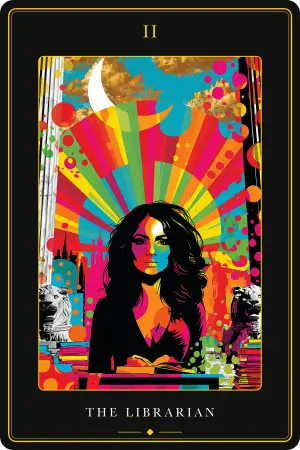
He is the natural counterpart of the High Priestess at II: outer doing against inner knowing, the spoken deal against the guarded silence. A whole practitioner uses her to decide what is worth manifesting and him to work out the how. Set against the Chariot at VII he marks an earlier stage. The Hustler is the spark and the pitch, standing still behind his table while he aligns the elements. The Chariot is the grind that carries the plan through resistance. With relationship cards he usually reads as personal power rather than a shared soul contract, since his energy is individual by nature.
Position sharpens him further. As advice he says make the calls and move inside the window. As the obstacle he is the angle you keep working instead of building the thing. As the outcome he promises a deal that comes together on relationships rather than paperwork. Following the Newcomer he is the education the arrival was waiting for, and the card that first asks the deck's ethical question: the same gifts run the con and build the empire, and only you know what the trick is for.
Questions for reflection
- What is actually on my table right now, and which of the four have I been pretending I don't have?
- Where am I working an angle when I could be building a skill?
- Who in my life have I only ever met with the sunglasses on?
The general meaning follows the Rider-Waite-Smith reading — the reference used across Tarot Academy. Open a specific deck above for its own interpretation.
Frequently asked questions
Explore the Tarot
Latest Posts
Discover the ancient wisdom of tarot cards and unlock the mysteries of your spiritual journey. Our blog is your gateway to understanding the rich symbolism, meanings, and practical applications of tarot reading.




















































