
 IS (íslenska)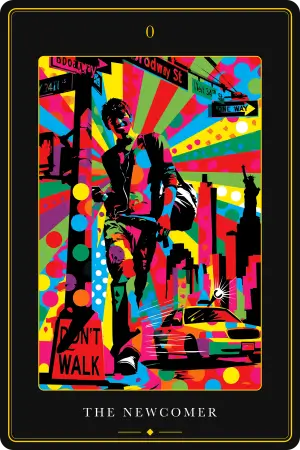


Stóri Arkani · 2
Braskarinn
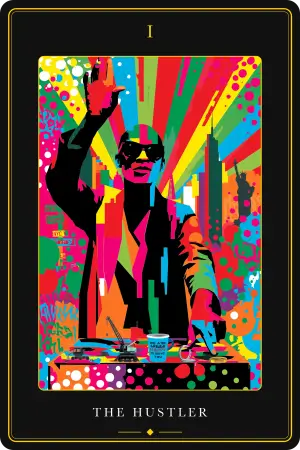
Maðurinn á bak við felliborðið á Canal Street, með allar fjórar sorturnar lagðar fram, selur þriggja skelja leikinn og afhendir aðgengi.
Spilið í hnotskurn
- Talnaspeki
- I
- Frumefni
- Loft
- Stjörnuspeki
- Merkúr · Tvíburinn & Meyjan
- Kabbalísk slóð
- Beth (Kether → Binah)
- Tímasetning
- Snögg · opni glugginn
- Já / Nei
- Upprétt já · Öfugt nei
Rétt
Brask
Aðgengi
Útsjónarsemi
Tengsl
Samningagerð
Spuni
Götuvit
Frumkvæði
Öfugt
Svikamylla
Lofa of miklu
Tóm söluræða
Blekking
Brenndar brýr
Dreifð ráðabrugg
Að vera fórnarlambið
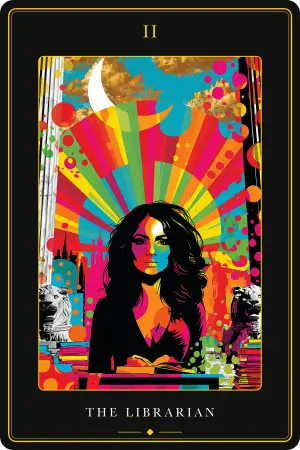
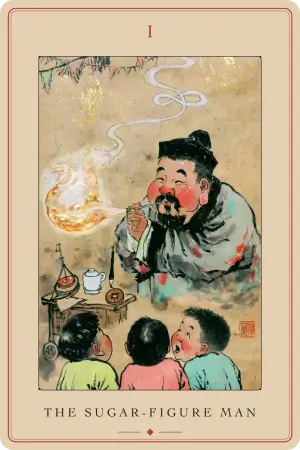
Braskarinn í hverjum stokk
Hver stokkur endurskapar sömu erkitýpu. Berðu saman listina og opnaðu síðan stokk til að lesa túlkun hans til fulls.
Braskarinn
Braskarinn er maðurinn sem getur reddað þér öllu. Hann stendur við felliborð á Canal Street með fjórar drifvélar borgarinnar fyrir framan sig: kranann fyrir metnað, kaffibollann fyrir tilfinningar, neðanjarðarlestarmyntina fyrir amstrið og peninginn fyrir leiguna. Þar sem sögulegi Töframaðurinn notaði helgiathafnir til að breyta veruleikanum nýtir Braskarinn aðgengi. Þriggja skelja leikurinn er einungis auglýsing. Raunverulegu töfrarnir felast í því að þekkja rétta fólkið, vinna út frá réttum sjónarhornum og landa hinum ómögulega samningi áður en tækifærið rennur úr greipum.
Braskarinn í öðrum stokkum
Tarot de Marseille. Le Bateleur felur óendanleikatákn sitt í sveigjum breiðs hatts. Hann stendur við bráðabirgða þriggja fóta borð með bikurum, myntum og hnífum á og heldur á sprota í vinstri hendi. Oft eru teiknaðir sex fingur á þá hönd, sem táknar vald sem nær út fyrir venjuleg mannleg mörk. Fjórði fóturinn sem vantar biður áhorfandann um að fullkomna senuna og ein lítil planta með sköpum stúlku vex við fætur hans.
Rider-Waite-Smith. Meistarinn frá 1909 stendur í ræktuðum garði fullum af rauðum rásum og hvítum liljum, með lemniskötu fyrir ofan höfuðið, úróborus belti um mittið og sproti, mynt, sverð og bikar hvíla á traustu altari.
Crowley-Thoth. Málað af Lady Frieda Harris milli 1938 og 1943 og endurnefnt Töframaðurinn, Drottinn tálsýnarinnar. Fígúran er tvíkynja og geymir elementin á lofti í abstrakt rými án nokkurs borðs. Nálægt honum situr Cynocephalus, api Thoth, sem áminning um að um leið og sannleikur verður að tungumáli verður hann að bjögun. Harris fannst Merkúr vera ómögulegur viðureignar og kenndi arfgerðinni um þegar rörin hjá henni sprungu.
Tarot-spil New York-borgar. Hvert einasta hlutverk lifir af og hver einasti hlutur skiptir um eiganda. Altarið verður að felliborði þar sem þriggja skelja leikur fer fram. Elementavopnin fjögur verða að krana, grískum kaffibolla, neðanjarðarlestarmynt og pening. Óendanleikatáknið verður að sólgleraugum. Hvíti sloppurinn og rauða skikkjan verða að svörtum frakka yfir háværum litum. Garður rósanna og liljanna verður að gulllituðum geislum leigubílsins, hálftóna punktum og veggjakroti. Viðvörun Crowley um tungumálið lifir einnig af þar sem þetta er persóna hvers helsta verkfæri er talið. Stokkurinn heldur bæði óleystum heiðarleika borðsins úr Marseille og virðingu meistara RWS í sama ramma og leyfir þér að ákveða hvor stendur þar.
Meðal nútímastokka er arfgerðin stöðugt á hreyfingu. Modern Witch Tarot eftir Lisa Sterle endurhugsar meistarann sem kvenkyns töframann og kveikir aftur í sýndarmennsku sjónhverfingamannsins úr endurreisninni, og stokkarnir Mary-El og William Blake endurgera myndefnið fyrir eigin fagurfræði.
Í samsetningu og samhengi
Braskarinn mótast af félagsskapnum sem hann er í. Við hlið jarðbundinna, efnislegra spila breytist aðgengið í undirritaðan leigusamning, lokaðan samning eða fyrirtæki með vöru á bak við sig. Við hlið þungra eða blekkjandi spila er sami hraði lesinn sem svikamylla sem er að ná manni, og þá er spyrjandinn líklegri til að vera fórnarlambið heldur en sá sem stjórnar. Við hlið Sverða magnast loftkennt eðli Merkúrs og lesturinn þrengist að samskiptum, tengslaneti og vitsmunum.
Hann er náttúrulegur mótvægisþáttur Æðstuprestynjunnar í II: ytri framkvæmd gegn innri þekkingu, talaði samningurinn gegn vörðuðu þögninni. Heilsteyptur fagmaður notar hana til að ákveða hvað er þess virði að birta og hann til að finna út hvernig. Settur upp á móti Vagninum í VII markar hann fyrra stig. Braskarinn er neistinn og söluræðan, sem stendur kyrr á bak við borðið sitt á meðan hann stillir af elementin. Vagninn er amstrið sem knýr áætlunina áfram í gegnum mótspyrnu. Með spilum sem snúa að samböndum er hann yfirleitt lesinn sem persónulegt vald frekar en sameiginlegur sálarsamningur, þar sem orka hans er einstaklingsbundin í eðli sínu.
Staðsetningin skerpir hann enn frekar. Sem ráðlegging segir hann þér að hringja símtölin og hreyfa þig innan gluggans. Sem hindrun er hann nálgunin sem þú heldur áfram að vinna að í stað þess að byggja upp hlutinn raunverulega. Sem niðurstaða lofar hann samningi sem fæst í gegnum sambönd frekar en pappírsvinnu. Á eftir Nýbúanum er hann menntunin sem komumaðurinn var að bíða eftir, og spilið sem spyr fyrstu siðferðisspurningar stokksins: sömu hæfileikarnir stjórna svikamyllunni og byggja upp heimsveldið, og aðeins þú veist til hvers bragðið er ætlað.
Reversed meaning
Reversed, the moves stop landing. The crowd no longer leans in, calls go to voicemail, and angles that always worked fail. Plans stay talk while the effort stays enormous. You may be getting out-hustled by someone running the game on you, and the shortcut you were offered may be the con. This is the shell game with no ball under any cup, and it is also the hustler who ran the same trick once too often until the block noticed. Slow down, look at what is actually under the cups, and rethink the goal underneath the moves, because hustle without direction is noise on the corner.
In love. The charm may be the entire product. A perfect text, a dazzling date, and misdirection underneath, with other games running and promises with nothing behind them. It warns of manipulation, love-bombing, and a person you have never seen with the sunglasses off. Turned inward it says your own performance has become the barrier, because being irresistible is easier than being known. Watch what is done rather than what is said, over time.
In career. Style has outrun substance. This is the colleague everyone learns to double-check, impressive in the meeting and missing at the deadline. Credit gets claimed for other people's work, skills get inflated, the political game gets played so visibly it backfires. Get the agreement in writing and notice who benefits from the version of events you are being sold. In business it warns that the operation is more pitch than product: a beautiful deck and a demo made of smoke, too many deals in the air, a founder's word trading at a discount.
In finances. A warning light over every deal on the table. Read the documents, verify the claims, and distrust anything that must be decided today, since urgency is the grifter's favorite tool. If a deal this good found you, you are probably the mark. Turned inward it means five hustles running and none profitable, money earned quick and spent quicker, commitments made against money that is not real yet. Stop moving long enough to count what is actually there.
In health. The body run on adrenaline and caffeine while its actual needs go ignored. The appearance holds and the engine underneath is failing. Crash diets, dubious supplements, and quick fixes stand in for habits. The body cannot be charmed or negotiated with, and consistency is the one thing this archetype avoids.
Historical notes
This deck's Hustler is a return as much as an invention. The earliest version of the card was never a temple adept. In the Visconti-Sforza tarocchi of about 1460, attributed to Bonifacio Bembo, the figure sits playing at cups and balls, a sleight-of-hand act meant to entertain and occasionally to swindle. Italian tradition called him Il Bagatto, the juggler or mountebank, and in the game of Tarocchi he was the Pagat, the lowest trump. The Mantegna engravings put the equivalent figure near the bottom of the human ladder as Artixano, the Artisan. The Tarot de Paris of around 1625 sets him among a dog, a monkey, and a small crowd, and the French named him Le Bateleur. His tools then were dice, gambling cups, and knives, the working kit of a fairground con. The card was linked to cheating, boastfulness, and dangerous friendships. Hieronymus Bosch painted the same scene in 1505 as The Conjuror, a table turned into an in-between zone where ordinary judgment is suspended.
The nineteenth-century French occult revival remade him. Eliphas Levi and the writers who followed read the Tarot as encrypted ancient wisdom, and the street conjuror was elevated into an aspect of Hermes-Thoth. The gambling table became a sacred altar and the cheating props became elemental weapons. When Waite and Pamela Colman Smith published their deck in December 1909, the last of the trickster was gone and the solemn adept remained.
The Tarot of New York City puts the cardboard box back under the altar without giving up the altar. Canal Street is the fairground, three-card monte is the cups and balls, and the figure is once again someone whose respectability is unresolved. What the deck keeps from the occult revival is the direction of the will: the same hands run the con and build the empire, and the card refuses to decide for you which one it is.
Correspondences
Number. Trump I, the first move, the first dollar, the first name in the phone. The number of the self-starter, and no figure wears it more literally than a man who by definition made himself. Nobody handed him the table, the crowd, or the network. One is also the number of unity, and he is the only figure in the deck holding all four suits at once: four engines and one operator. As the step after the Newcomer's zero it tells the story of arrival becoming agency. The Newcomer steps off the bus with nothing; the Hustler is what that nothing looks like once it gets organized. The number carries its own warning, since the one who stands alone can fall alone.
Astrology. Mercury, and no planet is more at home in this city. Mercury governs communication, commerce, speed, wit, negotiation, and movement, and the Hustler works all of them at street level: the fast talk, the faster hands, the deal closed between two subway stops. Mercury is the messenger who travels between worlds, and the Hustler carries information and favors between the penthouse and the sidewalk the way Mercury carried messages between gods and mortals. Mercury rules trade, and the Canal Street table is trade in concentrated form. Mercury was also the god of thieves in the old myths, and the card keeps that shadow honestly. Through Mercury the card takes the signs Gemini, which lends persuasion and verbal agility, and Virgo, which lends analysis and method.
Element. Air by attribution, though the point of the imagery is that he commands all four. Crane, Cup, Subway, Token lie on the table as counters he adapts at will.
Kabbalah. The 12th path of the Tree of Life, the bridge from Kether (the Crown) to Binah (Understanding), under the Hebrew letter Beth, whose numerical value is 2 and whose literal meaning is "House." Older texts call the path the Intelligence of Transparency, the adept working as a clear lens so the light passes through undistorted by ego. In this deck the ego is exactly the risk, and the sunglasses are exactly the opacity.
Elemental dignity. Beside Swords the Mercurial air amplifies and the reading turns toward communication, networking, and intellect.
Psychological perspective
Psychologically the Hustler is self-made agency, the conviction that any situation can be worked. Thinking and acting are one motion. The confidence rests on a track record of figuring it out rather than on credentials, and the intelligence is social and situational: reading a room instantly, locating the decision-maker, sensing what each person wants before anyone speaks. Such a person is self-taught in almost everything and proud of it. They tolerate uncertainty well and enjoy improvising, so a plan falling apart interests them more than it frightens them. They experience the city as a partner in an ongoing game rather than an obstacle. Generosity inside the network is common, since the true Hustler moves favors in every direction and the block knows it.
The shadow sits close. The angle can turn compulsive, so they work people even when there is nothing to gain, because working people is the only mode they trust. Self-reliance shades into isolation, and the sunglasses that hide the eyes from the crowd eventually hide them from everyone. Modern readers connect the reversed card to gaslighting and to the narcissist who sees other people as counters on an altar rather than autonomous lives. The other shadow is quieter: because this figure lives on the appearance of competence, the inverted card is the fear of being exposed as a fraud, the juggler watching the crowd for the moment they catch the sleight of hand.
The deepest risk here is identity. Someone who can be anyone for anyone may lose track of who they are when the crowd goes home and the table folds up. Clinical writing on physician burnout has borrowed the archetype for the phase of reclaiming personal and professional agency after institutional harm, which is the same movement this card describes at street level.
The Hustler across decks
Tarot de Marseille. Le Bateleur hides his infinity symbol in the curves of a wide-brimmed hat. He stands at a temporary three-legged table with cups, coins, and knives on it and holds his baton in the left hand. Six fingers are often drawn on that hand, read as power beyond ordinary human reach. The missing fourth leg asks the observer to complete the scene, and a single small plant with a yonic shape grows at his feet.
Rider-Waite-Smith. The 1909 adept in a cultivated garden of red roses and white lilies, lemniscate overhead, ouroboros belt at the waist, wand and pentacle and sword and cup resting on a solid altar.
Crowley-Thoth. Painted by Lady Frieda Harris between 1938 and 1943 and renamed The Magus, Lord of Illusion. The figure is androgynous and juggles the elements through abstract space with no table at all. Near him sits the Cynocephalus, the Ape of Thoth, a reminder that the moment truth becomes language it becomes distortion. Harris found Mercury impossible to pin down and blamed the archetype when her plumbing burst.
The Tarot of New York City. Every function survives and every object changes hands. The altar becomes a folding table with a shell game running on it. The four elemental weapons become a crane, a Greek coffee cup, a subway token, and a coin. The lemniscate becomes sunglasses. The white robe and red mantle become a black coat over loud color. The garden of roses and lilies becomes taxi-yellow rays, halftone dots, and graffiti. Crowley's warning about language survives too, since this is a figure whose whole instrument is talk. The deck keeps the Marseille table's unresolved honesty and the RWS adept's dignity in the same frame, and lets you decide which one is standing there.
Among modern decks the archetype keeps moving. Lisa Sterle's Modern Witch Tarot recasts the adept as a female practitioner and brings back the Renaissance juggler's showmanship, and the Mary-El and William Blake tarots rework the imagery for their own aesthetics.
In combination and context
The Hustler takes his charge from the company he keeps. Beside grounded, material cards the access turns into a signed lease, a closed deal, a business with a product behind it. Beside heavy or deceptive cards the same quickness reads as the grift catching up, and the querent is more likely the mark than the operator. Alongside Swords the Mercurial air amplifies and the reading narrows to communication, networking, and intellect.
He is the natural counterpart of the High Priestess at II: outer doing against inner knowing, the spoken deal against the guarded silence. A whole practitioner uses her to decide what is worth manifesting and him to work out the how. Set against the Chariot at VII he marks an earlier stage. The Hustler is the spark and the pitch, standing still behind his table while he aligns the elements. The Chariot is the grind that carries the plan through resistance. With relationship cards he usually reads as personal power rather than a shared soul contract, since his energy is individual by nature.
Position sharpens him further. As advice he says make the calls and move inside the window. As the obstacle he is the angle you keep working instead of building the thing. As the outcome he promises a deal that comes together on relationships rather than paperwork. Following the Newcomer he is the education the arrival was waiting for, and the card that first asks the deck's ethical question: the same gifts run the con and build the empire, and only you know what the trick is for.
Spurningar til íhugunar
- Hvað er raunverulega á borðinu mínu akkúrat núna, og hvaða af þessu fernu hef ég haldið fram að ég sé ekki með?
- Hvar er ég að reyna að finna glufu þegar ég gæti verið að byggja upp hæfileika?
- Hvern í lífi mínu hef ég aðeins hitt með sólgleraugun á?
Almenna merkingin fylgir túlkun Rider-Waite-Smith, sem er viðmiðið um alla Tarot-akademíuna. Opnaðu ákveðinn stokk hér að ofan til að sjá hans eigin túlkun.
Algengar spurningar
Skoða Tarot
Nýjustu Færslur
Kynntu þér forna visku spádómskorta og opnaðu leyndardóma andlegrar ferðar þinnar. Bloggið okkar er þinn hliður að skilningi á ríkri táknfræði, merkingum og hagnýtum notkun spádómslestrar.




















































