
 EN (English)


Major Arcana · 2
The Sugar-Figure Man
Skill, breath, and timing shaping a situation while the material is still warm.
Card at a glance
- Numerology
- I
- Element
- Air
- Astrology
- Mercury · Gemini & Virgo
- Kabbalistic path
- Beth (Kether → Binah)
- Timing
- Swift · while the sugar is still molten
- Yes / No
- Upright yes · Reversed no
Upright
craft
manifestation
timing
showmanship
resourcefulness
initiative
public skill
self-sufficiency
Reversed
hot air
cooled sugar
performance without craft
poor timing
manipulation
skipped apprenticeship
self-doubt
The Sugar-Figure Man in each deck
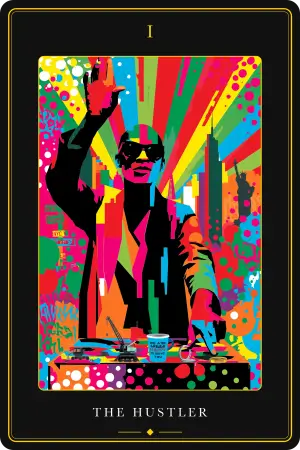
Every deck reimagines the same archetype. Compare the art, then open a deck to read its full interpretation.
Imagery and symbolism
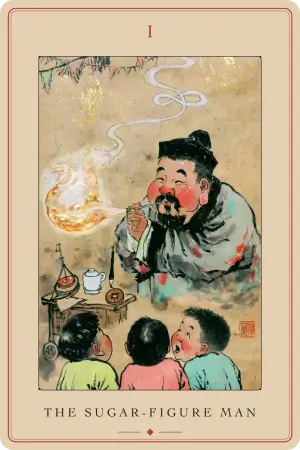
The Tarot of Beijing gives the Magician a trade and a pitch. He is the Sugar-Figure Man, 吹糖人, a street artisan at a temple fair blowing molten sugar into a translucent dragon while children crowd the cart. There is no altar, no ceremonial robe, no raised wand. Magic here is a working trade, performed at eye level and sold for a fen.
The breath is the wand. Where the classical Magician draws heaven's energy down through a lifted hand, this craftsman pushes it out through his own lungs, so creation becomes inspiration in the literal sense: breath entering matter and giving it a body. The line of steam curling from the dragon toward the top of the card does the work the lemniscate does elsewhere. It is not a floating symbol of eternity but the visible track of energy crossing from the unseen into the world.
The dragon itself is caught between formlessness and form. Too weak a breath and it collapses; too strong and it bursts. The card freezes the instant of manifestation, which is the whole teaching: power is timing.
On the little cart lie four instruments, one of only two places in the deck where all four suit emblems appear together (the other is hidden in the corners of The World, where they have become seasons). A kite spool stands for Kites, fire and enterprise. A teacup stands for Teacups, water and bonds. A writing brush stands for Brushes, air and words. A copper coin with a square hole stands for Coins, earth and household. The classical Magician commands the elements from a table. This one wheels them around on a vendor's cart, because in Beijing the elements are used daily rather than summoned.
The children are the audience the classical card has no room for. Their astonishment completes the act, and the composition holds both halves of making at once: the maker's eyes almost shut in concentration, the watching eyes wide open. The copper coin names the price as well as the element. He makes a world out of nothing and sells it for a fen, and the card refuses to rank the sacred act above the commercial one. Heaven round, earth square, and both fit in a palm. Festival pennants overhead, warm kraft paper flecked with gold, muted ink washes with vermilion accents, and a small red seal in the corner place the scene in the deck's Feng Zikai visual language: a handful of calm brush lines, the cosmic shown through the small and human.
Core meaning
This is the card of skill, of beginnings, and of the moment raw material is still workable. The Sugar-Figure Man says that the querent already holds everything needed to reach the goal, and, more urgently, that the situation is still warm. Shape it now. Wait, and it hardens on its own.
He is the first teacher the Newcomer meets after stepping off the train, and what he teaches is self-sufficiency of a very concrete kind: a person with a skill and a cart can make a world. Where the classical Magician pulls power down from higher planes, the Beijing craftsman draws it up from breath, practice, and the body. His will is not cosmic. It is precise and repeatable, which in this deck counts as the higher compliment. The hermetic law reappears in fairground terms: what is in the lungs becomes what is in the hand, and the inner state is legible in the finished figure.
Upright meaning
Upright, the card marks initiation, personal will, and virtuosity that looks effortless because it has been practiced. It can signal the start of an enterprise, an important deal, a public demonstration of skill, or a stretch of active self-development. The advice is to use what is already on the cart: a spool, a cup, a brush, a coin, ordinary tools producing extraordinary results. Do the work in front of people, because skill that hides is skill that stagnates.
In love. A period of active courtship, with small wonders made deliberately for one particular person, the way the craftsman shapes a dragon for one particular child. The card points to a partner who builds affection rather than announcing it: the surprise arranged, the favourite dish learned, the right gift produced as if from nowhere. In an established relationship it asks the two of you to keep making things for each other. Charm is not the opposite of depth when the hands behind it are honest.
In career. Visible mastery, the phase when private practice turns into public reputation and colleagues gather round your bench the way children gather at the cart. Expect a presentation, a launch, a live demonstration, or a difficult task performed under observation. It favours work that rewards dexterity and timing, and it can bring a promotion earned by demonstrated competence or a chance to teach what you know.
In finances. Income earned by skill, active trade, and the smart use of small capital. The whole enterprise is a cart, a flame, and a bag of sugar, and it feeds him because the value sits in the hands rather than the inventory. A good time to monetise a craft, take work public, negotiate, or invest while conditions are still fluid. Taking fair payment for real skill is not beneath the magic in this deck. It is the magic completing its circuit.
In health. The art rests on one long controlled exhalation, so the card points to breathing practice, qigong, swimming, singing, and wind instruments. Physical change comes through technique, timing, and steady rhythm rather than brute force. In matters of appearance it is the artisan's touch: deliberate self-presentation, done with skill and a little theatre.
Reversed meaning
Reversed, the card is breath without shape and heat without timing. The sugar has cooled in the pan, or been blown too hard and burst. It shows unrealised potential, difficulty giving an idea a body, efforts that collapse before they set, and showing off in place of substance. It can also mean deceit and cheap tricks: promises inflated like bubbles and just as hollow, the performance sold instead of the craft.
The remedy is to step back from the crowd and return to the pan. Every master ruined a hundred dragons in a back courtyard where nobody was watching. Acquire the missing skill rather than performing around its absence.
In love. Sweetness without substance. The figure is beautiful, translucent, and empty, and it melts at the first rain. It suggests charm used as technique, a partner dazzling in courtship and absent in difficulty, or charisma deployed to steer and manage rather than to love. It can also describe the querent performing the relationship for family and social feeds instead of living it. Hold the beautiful thing up to the light and see whether anything is inside.
In career. A gap between reputation and craft. Either genuine skill goes unseen, like a master blowing dragons in an empty lane, or presentation has outrun substance and people are starting to notice the figures are hollow. Projects get launched before they set or held until they harden and crack. Go back to apprenticeship without shame; the crowd returns on its own.
In finances. Money that melts like sugar in the rain. The querent may be selling before the skill is ready, underpricing real mastery out of self-doubt, or spending the day's takings on the evening's applause. Capital scatters across half-shaped ventures. At its worst the card warns of fraud and confidence games: glittering translucent promises with nothing inside but breath.
In health. A body run on performance and sugar, sometimes literally. Punishing workouts for show, crash regimens, stimulants and sweets fuelling a rhythm the body cannot hold. The breath is short, the effort gusty, and results collapse like an overblown figure. It can also flag appearance maintained while the underlying health goes unshaped.
Historical notes
The archetype behind this card began as a street performer, which is why the Beijing reading sits closer to its origins than to its occult peak. In the Visconti-Sforza deck of about 1460, attributed to Bonifacio Bembo, the figure is a seated man playing at cups and balls. Italian tradition called him Il Bagatto, the juggler or mountebank, and in the game of Tarocchi he was the Pagat, the lowest trump. The Mantegna engravings name the equivalent figure Artixano, the Artisan, near the bottom of the human hierarchy. The Tarot de Paris of about 1625 surrounds him with a dog, a monkey, and a small crowd, and the French settled on Le Bateleur. His tools then were dice, gambling cups, and knives, the working kit of a fairground swindle.
The nineteenth-century French occult revival, led largely by Eliphas Levi, turned him into something else. The Tarot was recast as encrypted ancient wisdom, and the conjuror was elevated to an aspect of Hermes-Thoth. The gambling table became a sacred altar and the cheating props became elemental weapons. Arthur Edward Waite and Pamela Colman Smith completed the transformation when William Rider & Son published their deck in December 1909, leaving the solemn adept most readers picture today.
The Tarot of Beijing keeps the full Rider-Waite meaning of will, mastery, and manifestation while returning the figure to the fairground the occultists took him out of. The sugar blower is a real trade with a real audience and a real price, and the deck treats that as an upgrade rather than a demotion.
Correspondences
Number. The card is trump I and carries the numerological 1: beginnings, primacy, unity. One lump of amber sugar becomes a dragon, and one breath separates the shapeless from the shaped. The craftsman does not rehearse in private and gets no second attempt at the same figure. Each one is made once, in front of everyone. Its Hebrew letter Beth carries the value 2, which introduces duality: the maker and the material.
Astrology. Mercury rules the card, and through Mercury the signs Gemini and Virgo. Mercury is the god of merchants, messengers, and quick hands, and the Sugar-Figure Man is all three at once: he trades at the fair, his creations carry delight from his hands to the children's, and his fingers move faster than the sugar cools. Gemini supplies persuasion and adaptability, Virgo the precision and step-by-step method. Molten sugar, like a Mercurial mind, does not wait.
Element. Air is literalised here, since the medium of creation is the breath itself. Through the cart he also handles all four: the kite spool is fire, the teacup water, the brush air, the coin earth.
Kabbalah. He holds the 12th path of the Tree of Life, the bridge from Kether, the Crown, to Binah, Understanding. Older texts call it the Intelligence of Transparency, the Sekhel Bahir. The adept works as a clear lens so the light passes through without distortion, and the Hebrew letter Beth means house: the construction of a vessel that formless spirit can safely live in.
Elemental dignity. Beside the suit of Brushes, this deck's airy suit, the Mercurial current amplifies and the reading turns toward words, teaching, and negotiation.
Psychological perspective
Psychologically this is mastery internalised so deeply it looks like play. The profile centres on a strong will expressed through skill rather than force: the drive to turn ideas into things, plus the composure to do it while being watched. Self-discipline accumulates invisibly over years at the pan and gets spent publicly, lightly, with humour. Confidence of this kind has a floor, because it rests on repetition rather than mood.
The strengths are grit on delicate, unforgiving work, the timing to act when the material is ready rather than when the ego is, and a teaching presence that operates without instruction. Others learn by standing nearby. Such people spot opportunity in modest resources and stay adaptable: the same lump of sugar becomes a dragon, a rooster, or a monkey depending on who is standing in front of them.
Unbalanced, the performer eats the craftsman. Confidence turns into showmanship for its own sake and the person starts needing the astonished faces more than the finished work, cutting corners no audience can see and mistaking applause for verification. Extreme self-sufficiency hardens into a refusal to collaborate: one man, one cart, no partners. The trickster's shadow stays available, since hands that skilled can deceive as fluently as they create.
The Sugar-Figure Man across decks
Tarot de Marseille. Le Bateleur hides his infinity symbol in the curves of a wide-brimmed hat instead of floating it overhead. He stands at a temporary three-legged table with cups, coins, and knives, holds his baton in the left hand, and is often drawn with six fingers, which readers take as a sign of powers past ordinary human reach. The missing fourth leg pulls the observer into the scene, and a single small plant with a yonic shape grows at his feet.
Rider-Waite-Smith. Waite and Smith set the adept in a garden of red roses and white lilies, one hand raised with a double-ended wand and one finger pointing down, illustrating "As above, so below." A lemniscate floats over his head, an ouroboros belts his waist, and wand, pentacle, sword, and cup lie on a solid altar.
Crowley-Thoth. Crowley renamed the card The Magus and had Lady Frieda Harris paint it between 1938 and 1943. The figure is androgynous and dynamic, juggling the elements through open space with no table at all, and the Cynocephalus, the Ape of Thoth, mocks him as a reminder that truth distorts the moment it enters language.
Where Beijing sits. Feng Zikai's ink line and a temple fair replace the garden, the altar, and the quantum void alike. The Sugar-Figure Man is the only one of the four with customers. Marseille gives the archetype a table he can fold away, Waite gives him one he cannot lift, Crowley takes the table away entirely, and Beijing puts wheels on it. The four elemental tools survive the move but arrive as merchandise and equipment, which is the point the deck is making about where magic actually lives.
In combination and context
The card takes its shading from the company it keeps. Against The High Priestess it is outer doing, active and verbal, where she is inner knowing, receptive and silent. A complete adept uses her intuition to decide what should be made and his will to execute the how. Against The Chariot the difference is stage rather than kind: the Sugar-Figure Man is the moment of intention and the shaping of the material in one continuous act, while The Chariot is the long grind of momentum that follows.
With the suit of Brushes, the airy Mercurial side amplifies and the reading narrows to communication, teaching, and intellect. With Coins it turns toward the copper coin already on the cart: livelihood, fair payment, and the monetising of a craft. Alongside relationship cards it usually reads as personal power rather than a shared destiny, since its energy is individual by nature. In a challenge position or reversed, expect the fairground shadow: the demonstration dazzling while the delivery melts.
One more thing the neighbours often draw out. The sugar dragon will be eaten before sundown, and the craftsman makes it anyway with total concentration. Mastery in this deck is the perfect execution of the present act, not the production of monuments.
Questions for reflection
- What is going hard in the pan right now, while you wait for a better moment to shape it?
- Everything the craftsman needs fits on one small cart. What is already on yours that you keep treating as insufficient?
- Are you willing to be watched while the work is still half-formed, or do you only show finished dragons?
The general meaning follows the Rider-Waite-Smith reading — the reference used across Tarot Academy. Open a specific deck above for its own interpretation.
Frequently asked questions
Explore the Tarot
Latest Posts
Discover the ancient wisdom of tarot cards and unlock the mysteries of your spiritual journey. Our blog is your gateway to understanding the rich symbolism, meanings, and practical applications of tarot reading.




















































