
 EN (English)


Major Arcana · 1
The Newcomer
The kid off the bus at Port Authority: one duffel bag, a phone at 12%, and the city opening like a door.
Card at a glance
- Numerology
- 0 / XXII
- Element
- Air
- Astrology
- Uranus · Aquarius
- Kabbalistic path
- Aleph (Kether → Chokmah)
- Timing
- New beginnings · the first week
- Yes / No
- Upright yes · Reversed no
Upright
Arrival
Fresh start
Potential
Leap of faith
Spontaneity
Openness
Adventure
Independence
Reversed
Recklessness
No plan
Getting lost
Hesitation
Stagnation
Impulsiveness
Missed opportunities
Loss of control
The Newcomer in each deck
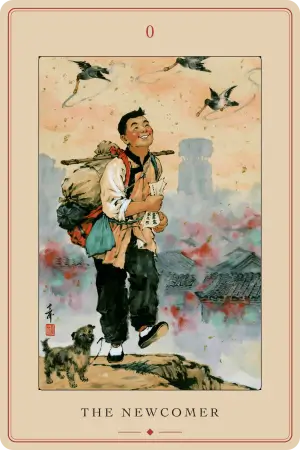
Every deck reimagines the same archetype. Compare the art, then open a deck to read its full interpretation.
Imagery and symbolism
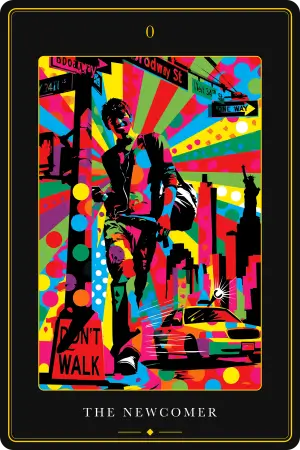
In the Tarot of New York City the Fool becomes the Newcomer, a kid just off the bus at Port Authority, drawn in the deck's pop-art language of halftone dots, sunburst rays, and a black silhouette against saturated color. He strides forward with a duffel bag over one shoulder. The traditional Fool's bindle is rebuilt as the transplant's single bag, light enough to carry anywhere and holding everything he owns.
In his other hand a phone trails its earbuds. This is the deck's white rose, a fragile thread of guidance and connection running at 12% battery: enough to start with, not enough to lean on. Faith covers the rest of the distance.
The cliff edge is a yellow cab braking inches away with its horn blazing, the abyss restaged at a crosswalk. The city's warning could not be more explicit, and he keeps walking and grinning anyway. The near-miss is the initiation.
Above him the street signs read Broadway, West 34th, and ONE WAY, the crossroads of every ambition the city sells. The one-way arrow is the card's quiet joke, since from this corner the only available direction is forward. The traffic signal stands where the Rider–Waite–Smith deck put its white sun, and the sunburst rays behind the figure carry the old card's divine blessing into pop-art form, a whole sky celebrating an arrival nobody else noticed.
On the horizon the black silhouette of the skyline takes the place of the snow-capped mountains: the challenges ahead, beautiful and indifferent. Among the towers the Statue of Liberty raises her torch where the Fool's faithful dog once stood. The dog was instinct, loyalty, and the friend trying to pull him back. Liberty is the guardian who welcomes him in, and the substitution tells you which reading of the animal this deck chose.
Core meaning
The Newcomer is pure potential in the moment before it takes shape, the same zero the Fool has always carried, restaged at the one intersection where the whole world arrives to start over. He stands at day zero of city residency with one bag of experience, no apartment, no job, and no read on which train goes uptown. Nothing is decided, so everything is still available.
His gift is the beginner's mind, the eyes that still look up at the buildings. He acts on instinct rather than information, and because nobody has taught him yet what to ignore, he sees the city as it actually is. He steps off the curb against the light because the light is a convention and he has not signed the convention.
Inside this deck the card carries a second job the generic Fool does not. The Newcomer is the protagonist of all seventy-eight cards, the figure who will ride every train, sign every lease, and finally stand on the observation deck of the World. Every reading that opens with him is a departure story.
Upright meaning
Upright, the Newcomer announces a brand-new chapter stepping off the bus. A move, a project, a relationship, or a new version of yourself is at its very beginning, and the card counsels momentum: keep walking, focus on the present block instead of the whole map, and say yes to the unfamiliar train line. In this city motion is a survival skill. The people who made it kept moving while they figured it out. Let go of the fear of looking like a tourist, because everyone here was new once.
In love it is the beginning before the story has a name, the number exchanged on the platform or the first date that runs six hours. You fall for someone the way you fall for the city, all at once and with total conviction. In an existing relationship it asks the couple to become newcomers together, take the trip with no itinerary, and be surprised by a person they thought they had fully mapped. Say the honest thing early, and do not demand that day one behave like year five.
In career it is the first day: a new job, an industry switch, or the application you are supposedly unqualified for. Being the rookie is the power position, since nobody expects you to know anything yet, every question is free, and every convention is still negotiable. The deck's professions run to work where fresh eyes are the asset, including the actor at an open call, the busker on the platform, the founder with no reputation to protect, the bike messenger learning the grid in real time, the street photographer who notices what the jaded walk past, and the first job off the bus behind somebody's counter. Stay teachable and never fake fluency you don't have.
In finances it is starting capital in its purest form, small and liquid: the first paycheck in the new city, seed money, or the investment in yourself. It promises no outcomes, since the math says 12% and you go anyway. Keep overhead light and treat this phase as the tuition the city charges every arrival in overpriced first apartments and rookie mistakes. Every fortune here started as somebody's duffel bag and bus ticket.
In health it is the body at the start of something, waking to miles walked without noticing and five-floor walkups. Energy rises, and the card favors experiment over regime. Try the class you would never have risked back home, or change the haircut, since nobody here remembers the old one. That anonymity is a cosmetic superpower.
Among friendships it is the open door: new acquaintances, the invitation from people you barely know, and the ease of someone who talks to strangers. The Newcomer connects without hierarchy because he doesn't yet know who's important, so he treats everyone as though they might be. That turns out to be the correct social technology.
Reversed meaning
Reversed, the Newcomer freezes on the curb while the light cycles from WALK to DON'T WALK, and the card splits into two shadows. The first is paralysis dressed as caution: the arriver still gripping the bag at the terminal, unable to take the first step because the city looks too big and everyone else seems to know where they are going. The second is recklessness disguised as courage: the lease signed sight unseen, the savings gone in the first month, the jump taken before anyone checked which side of the tracks the platform was on.
The deck gives the shadow a specific face. This is the perpetual arriver who never lands, five years in and still living out of the duffel bag, emotionally if not literally, signing nothing and ghosting the moment anything asks them to stay. And it is the mark who falls for the three-cup shell game on Canal Street twice, then relocates rather than learn.
In love it is romance without follow-through, thrilling first weeks and vanishing second months from someone who treats hearts like sublets. It equally names the fear-frozen heart declining connection because the last city broke your lease. In work and money it warns against the blind sprint and the standstill alike: the fast guaranteed return that is a shell game, the venture launched on vibes where three others already failed, the resignation letter drafted for years and never sent. In health it is the arrival's toll, sleep skipped and meals improvised from bodega shelves at midnight, burnout wearing the costume of momentum.
In a yes-or-no reading the upright yes turns to no. Charge the phone before you need it, build the minimal plan of a place to sleep, a week of money, one contact, then take one deliberate step.
Historical notes
The Fool is the card that changed the most long before New York restaged it. In the 15th-century Visconti-Sforza tarocchi he was Il Matto, an impoverished outcast in ragged clothes, painted with a goiter and carrying a club to fend off dogs, drawn close to the Vice of Folly that Giotto frescoed in Padua in 1305. He was a warning, not an ideal. The Tarot de Marseille retitled him Le Mat, a vagabond in a belled cap with a spoon and a knapsack and an animal tearing at his trousers. A 1750 Bolognese manuscript gives his divinatory keyword flatly as 'Madness'.
The turn came with the Hermetic Order of the Golden Dawn, which rejected the morally bankrupt vagrant outright and recast Key 0 as the breath of life, the spark before manifestation. The step off the cliff stopped being stupidity and became radical trust, as though invisible hands were waiting to hold him up. That reading, carried into the Rider–Waite–Smith deck of 1909 and Crowley's Thoth, is the innocent seeker the Tarot of New York City inherits and gives an address.
One older thread matters unusually much for this deck. In the card games the tarot was built for, the Fool refused a fixed rank. Piedmontese play treated it as the lowest trump, worth a point or none, while Central European Tarock games call it the Sküs and treat it as the twenty-second trump, nearly unbeatable. That double citizenship is exactly the 0 and 22 the Newcomer carries on his corner: worth nothing on arrival, worth everything at the end of the run. The same rule-breaking wildcard is the direct ancestor of the modern Joker.
Correspondences
Number. Zero and twenty-two, the beginning and the completion of one cycle. Zero is the void, a circle with no start and no end, the value a person enters the world with and takes out of it. In this deck it is the unswiped MetroCard, worth nothing until it moves and able to take you anywhere once it does, the moment before the first turnstile click when every line on the map is still equally yours. Twenty-two is the master number, the grid itself, structure raised to visionary scale (2+2=4, the Emperor's foundation, elevated). It says the kid with the duffel bag already contains the finished city life folded small enough to carry off a bus.
Astrology. Uranus, planet of sudden change, rebellion, and the electric break with the established order. It is the jolt of the third rail, the alternating current that tears people out of hometowns and deposits them on Eighth Avenue. Uranus rules the lightning decision to buy the one-way ticket, and it reads the missed train and the chance encounter on a stalled L as the method rather than an interruption of it. The zodiac link is Aquarius, the airy visionary.
Element. Air, the element of intelligence, breath, and swift uncontainable movement, free of Earth's plodding weight.
Kabbalah. The path of Aleph, the first Hebrew letter, the bridge from Kether (the Crown) to Chokmah (Wisdom) on the Tree of Life.
Elemental dignity. Airy company sharpens him: beside Swords and other Air cards the leap gets quicker and more mental, sometimes to the point of pure nerve with no ground under it. Earth cards weigh him down usefully, turning the arrival into a lease and a job. Water cards flood the beginning with feeling, and Fire cards accelerate it past the point where anyone is steering.
Psychological perspective
Psychologically the Newcomer describes the psyche at the threshold, a personality organized around beginning rather than maintaining. Such a person lives in the present tense of a city that only speaks it. They are open in a way that disarms guarded people, curious past the point of politeness, and they tolerate uncertainty better than most people tolerate boredom. Everything ordinary looks miraculous to them, which is precisely why they spot the opportunities that acclimated New Yorkers have filed under background noise. They form attachments fast, because in a city of strangers speed is how belonging gets built. Their beginner's mind is not a deficit of knowledge but a surplus of attention.
Jung's frame puts him at the opening of individuation, the unformed self stepping off the map, with the whole Major Arcana read as the journey that follows. This deck literalizes it: the trumps are a life in one city, and the Newcomer is the ego before the city has priced it.
Drawn as a warning, that same fluidity curdles into rootlessness. This is the person who resets their life the moment it gathers weight, changing apartments and jobs the way others clear a browser history, avoiding the feedback loops that would teach them anything, mistaking avoidance for adventure and under-commitment for keeping options open. The developmental task is learning that putting the bag down does not end the journey. It is how the journey gets a second act.
The Newcomer across decks
The Newcomer is one deck's answer to a figure every tradition draws differently. In the Tarot de Marseille he is Le Mat, a belled jester with a bundle on a stick and an animal worrying at his leg. In the Rider–Waite–Smith deck he is the innocent seeker at the cliff edge in a floral tunic and yellow boots, a red feather in his cap, a plucked white rose in one hand and a white dog at his heel. In Crowley's Thoth deck he is an androgynous cosmic figure suspended in the rings of the Qabalistic void, ringed by a tiger and a crocodile, spilling zodiac coins to say the cosmos is his loose change.
The Tarot of New York City keeps each of those functions and swaps the objects for the city's own. The bindle becomes a duffel bag, the white rose a phone at 12%, the cliff a braking cab, the white sun a traffic signal, the snow-capped peaks a skyline, and the guardian dog the Statue of Liberty. Crowley's twin threats survive the translation too: the tiger's appetite for the material is the city's own bargain, and the crocodile's paralysis is the reversed card's arriver who never steps off the curb.
The RWS deck also runs the red feather and the white rose forward through Death and The Sun, so that the Fool dies to the world and is reborn into conscious innocence. This deck keeps the continuum in its own scenery: Death is a shuttered diner, the Tower a blackout, and each clearing makes room for another Newcomer. Under every version sits the same zero and the same unwritten beginning.
In combination and context
More than most cards the Newcomer takes its meaning from its neighbours and its position, because it describes potential rather than a fixed outcome. Beside grounded, practical cards it becomes a leap that can actually land. Beside heavy or anxious cards it reads as the naive move that ignores a real risk, the shell game the querent is about to lose.
Position sharpens it. In the past foundation it says the present was built on a recent arrival or an ungrounded stretch of exploration. Crossing the querent as the obstacle it points to wishful thinking, no plan, and rose-coloured glasses in a treacherous environment: someone looking at the rainbows of an idea and not the workload. As advice it says stop overthinking, loosen the grip on the outcome, and get on the train. As the outcome it promises a clean slate and kinetic movement toward a destination that stays unwritten.
Inside this deck it does one more thing. Because the Newcomer is the protagonist of the whole seventy-eight, his appearance frames the entire reading as a departure story: whatever the spread describes is happening at the start of something, where potential is at its maximum and evidence at its minimum. The card rarely answers what will happen. It answers what the situation is asking of your nerve.
Questions for reflection
- If I were arriving today with one bag, what would I put in it, and what would I finally leave behind?
- Where am I frozen on the curb, and is the standstill wise caution or fear wearing its costume?
- What in my routine could I approach with a transplant's eyes, as if I had never done it before?
The general meaning follows the Rider-Waite-Smith reading — the reference used across Tarot Academy. Open a specific deck above for its own interpretation.
Frequently asked questions
Explore the Tarot
Latest Posts
Discover the ancient wisdom of tarot cards and unlock the mysteries of your spiritual journey. Our blog is your gateway to understanding the rich symbolism, meanings, and practical applications of tarot reading.




















































