
 EN (English)



Major Arcana · I
The Magician
In Smith's garden, focused will draws power from above and roots it in the earth below.
Card at a glance
- Numerology
- I
- Element
- Air
- Astrology
- Mercury · Gemini & Virgo
- Kabbalistic path
- Beth (Kether → Binah)
- Timing
- Swift · soon
- Yes / No
- Upright yes · Reversed no
Upright
manifestation
willpower
focused intention
skill
resourcefulness
initiative
self-mastery
communication
Reversed
manipulation
deceit
unrealized potential
self-doubt
incompetence
scattered energy
misuse of power
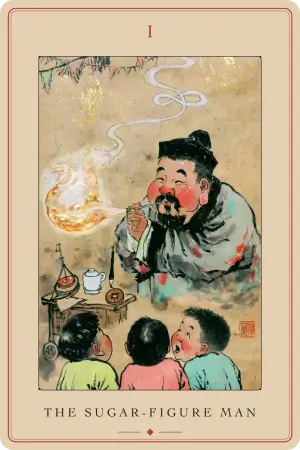
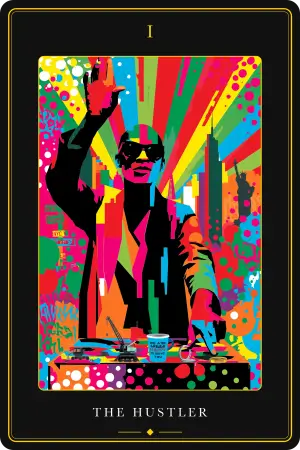
The Magician in each deck
Every deck reimagines the same archetype. Compare the art, then open a deck to read its full interpretation.
Imagery and symbolism
Pamela Colman Smith set her Magician in a cultivated garden against a flat, saturated yellow ground. In this deck that yellow is not a neutral backdrop; it stands for intellect, energetic growth, and prosperity, framing the figure as a mind at the height of its powers. He raises a double-ended white wand toward the sky with his right hand and points to the earth with his left index finger. The gesture makes the Hermetic axiom "as above, so below" visible: heaven and earth joined through his body, energy drawn down from one plane and grounded in the other.
Above his head floats the lemniscate, the sideways figure of infinity, marking limitless energy ready to be channeled into conscious creation. Waite, who wrote The Pictorial Key to the Tarot for the deck, read this symbol through a Gnostic lens, tying it to the number eight and the Ogdoad, a state of spiritual rebirth. Around his waist a serpent bites its own tail, an ouroboros that signals eternal cycles and his grasp of universal mysteries.
On the altar lie the four tools of the Minor Arcana: a cup for water and emotion, a sword for air and intellect, a wand for fire and action, and a pentacle for earth and material wealth. Laid out as counters, they show his command over all four elements, the raw materials he combines to shape reality. His dress carries the card's tension. The white inner tunic reads as purity and innocence; the red cloak over it adds passion and earthly desire, with the risk of ego if that drive turns corrupt. Red roses and white lilies grow around him, the roses standing for courage and passionate desire, the lilies for hope and spiritual purity. Waite called this the culture of aspiration, intent cultivated until it flowers into physical result.
Core meaning
In the Rider-Waite deck the Magician is the beginning of creativity, self-expression, and mastery, the first point where boundless potential takes deliberate shape. Numbered I, he opens the sequence of intentional creation. Where The Fool is unformed possibility, the Magician is the moment that possibility gains a plan and a pair of hands.
Smith's figure turns knowledge and skill into new opportunity. When the card appears, the message is that you already hold every tool the situation demands, and nothing is missing except the decision to use it. He is the conscious link between an idea and its expression, proof that a concept held clearly in the mind can be built into outer reality.
Upright meaning
Upright, the Magician is the deck's premier card of manifestation, willpower, and personal agency. It confirms you have clear perception of the paths ahead and the focus to commit to one. The planning phase is over. This is the signal to take the initiative, step into a leadership role, and create opportunity rather than wait for it. Self-belief is essential.
In love. The card brings charm, high energy, and active communication. It favors deliberately seeking the right partner or bringing fresh life to a current bond, and it points to someone who takes the lead and pursues what they want. In an established relationship, it asks you to steer the partnership toward deeper understanding through effort.
In career. A strong omen of success. The timing suits launching or scaling an enterprise, wielding your talents with confidence, and turning opportunity into concrete revenue. Expect a major assignment to land well, a jump to a higher position, or the chance to bring in new methods.
In finances. Money grows through decisive action and the smart use of capital. The card favors investments, negotiations, and funding a new venture, rewarding resourceful moves over passive waiting. It often predicts a rise in income or an event that steadies your economic footing.
In health. The Magician emphasizes mastery over the body through planning and organization. It is a productive phase for beginning a disciplined regimen and taking decisive charge of a physical goal, with motivation high enough to force real results.
Reversed meaning
Reversed, or in a challenge position, the same mastery curdles into manipulation and illusion. The skill that arranges the four elements can be turned on other people just as easily. This is the manipulator who builds an alternate reality where ordinary judgment is suspended. It can also point inward, to unrealized potential, wasted resources, and a nagging fear of being exposed as a fraud.
In love. A warning of insecurity, manipulation, and dodged accountability. It can mean deception or gaslighting by a partner who turns charm into a weapon, or at its mildest a stalled relationship trapped by indecision.
In career. Confidence outruns competence. Big talk replaces execution, strategy scatters, and skills go underdeveloped, sometimes with a temptation to manipulate colleagues. It flags weak management and stalled growth.
In finances. Poor discipline, uncontrolled spending, and squandered resources. In its darkest form it warns of fraud, scams, or deceit in business dealings.
In health. A chaotic or damaging approach to the body: punishing routines with no result, fad diets, or a collapse of self-control that ignores physical needs entirely. The card asks you to rest and build a saner plan.
Historical notes
The Rider-Waite-Smith Magician is the endpoint of a long transformation. In the mid-fifteenth-century Visconti-Sforza deck attributed to Bonifacio Bembo, he is a seated man playing at cups and balls. Italian tradition called him Il Bagatto, the juggler or mountebank, and in the game of Tarocchi he ranked as the lowest trump. The French later named him Le Bateleur and set him among a dog, a monkey, and a small crowd, his tools the dice, cups, and knives of a fairground con.
The nineteenth-century French occult revival remade him. Eliphas Levi and the writers who followed recast the Tarot as encrypted ancient wisdom, and the street conjuror became an aspect of Hermes-Thoth, the divine communicator; the gambling table turned into a sacred altar. Arthur Edward Waite and Pamela Colman Smith completed that arc when William Rider published their deck in December 1909. Their Magician strips away the last of the trickster and leaves the solemn adept most readers picture today. With an estimated 100 million copies in circulation, this is the version that set the modern standard.
Correspondences
Number. The card is trump I, the singular starting point of the numbered journey and, in numerology, a figure of beginnings, will, and independence. Its Hebrew letter Beth carries the value 2, which introduces duality: the subject who acts and the object acted upon.
Astrology. Mercury governs the Magician, and through Mercury the signs Gemini and Virgo. Gemini lends persuasion and verbal agility; Virgo lends analysis and step-by-step method.
Element. He commands all four. The wand, pentacle, sword, and cup on his altar are fire, earth, air, and water laid out as counters for him to arrange.
Kabbalah. The Magician holds the 12th path of the Tree of Life, the bridge from Kether, the Crown, to Binah, Understanding. Older texts call it the Intelligence of Transparency: the adept works best as a clear lens, letting divine will pass through undistorted by ego.
Elemental dignity. Beside Swords, his airy Mercurial side amplifies and the reading turns toward communication, networking, and intellect.
Psychological perspective
Psychologically, the Magician is the moment of claiming agency: mastery of intellect, passion, emotion, and resource, the point where a person stops reacting to life and begins authoring it. The personality he describes acts with assurance, faces fear directly, and draws on inner strength to set its own course.
The shadow sits close. Because the Magician relies on the appearance of competence, his inverted expression is the fear of being found out, the powerlessness of the juggler who dreads the crowd spotting the trick. Pushed the other way, the drive for control hardens into arrogance and narcissism, self-sufficiency rejecting collaboration until other people read as tools on the altar rather than autonomous lives. Convinced of his own infallibility, he stops listening and discards ethical limits in pursuit of the goal.
The Magician across decks
The Rider-Waite-Smith image is the reference point most readers carry, so its choices stand out most clearly against the decks that diverge from it.
Tarot de Marseille. The older Le Bateleur hides his infinity symbol in the brim of a wide hat rather than floating it overhead. He stands at a temporary three-legged table, holds his baton in the left hand, and is often drawn with six fingers, an anomaly readers take as a sign of powers beyond ordinary reach. The missing fourth leg invites the observer to complete the scene, and a single small plant grows at his feet in place of Smith's garden.
Crowley-Thoth. Aleister Crowley renamed the card The Magus and had Lady Frieda Harris paint it between 1938 and 1943. The figure is androgynous and dynamic, juggling the elements through open space instead of resting them on an altar. Near him sits the Cynocephalus, the Ape of Thoth, a reminder that the instant truth is put into language it becomes distortion.
Modern decks. Lisa Sterle's Modern Witch Tarot reimagines the adept as a female practitioner and brings back the playful showmanship of the Renaissance juggler, while keeping Smith's infinity sign and elemental tools. The Mary-El and William Blake tarots rework the imagery for their own aesthetics, and the message of self-mastery survives each redraw.
In combination and context
The Magician gains definition from the cards around him. He is the natural counterpart of The High Priestess (II): outer doing, active and verbal, where she is inner knowing, receptive and silent. A whole adept uses her intuition to decide what to manifest and his will to carry out the how.
Set against The Chariot (VII), he marks a different stage. The Magician is the spark of intention, the architect drafting the blueprint while standing still behind his altar; the Chariot is the grind of momentum that drives the plan through resistance to completion.
Alongside Swords, the airy Gemini current strengthens and the focus sharpens onto communication and intellect. With relationship cards he usually reads as personal power rather than a shared soul contract, since his energy is individual by nature. In a challenge or reversed position, the shadow of manipulation and illusion takes the foreground.
Questions for reflection
- Where in your life do you already hold every tool you need, and what keeps you from picking them up?
- When you persuade someone, are you channeling clear intention or bending the truth to get your way?
- What idea are you ready to move from planning into action this week?
The general meaning follows the Rider-Waite-Smith reading — the reference used across Tarot Academy. Open a specific deck above for its own interpretation.
Frequently asked questions
Explore the Tarot
Latest Posts
Discover the ancient wisdom of tarot cards and unlock the mysteries of your spiritual journey. Our blog is your gateway to understanding the rich symbolism, meanings, and practical applications of tarot reading.




















































