
 EN (English)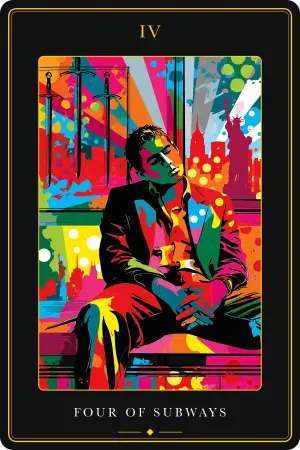


Minor Arcana · Swords (Air)
Five of Subways
The platform argument you won by being crueler, and the quiet car afterward when you feel exactly what the victory cost.
Read the complete guide: Five of Swords in Tarot: A Complete Guide to Symbolism and Meaning
Card at a glance
- Numerology
- 5
- Element
- Air
- Astrology
- Venus · Aquarius (first decan)
- Kabbalistic path
- Geburah (Severity)
- Timing
- Late January · early Aquarius
- Yes / No
- Upright no · Reversed a wary no
Upright
conflict
hollow victory
winning by cruelty
the last word
platform standoff
cutthroat competition
verbal cruelty
the car that empties around you
Reversed
walking away
laying down the fight
changing trains
guilt over how you fought
reconciliation
false peace
lingering resentment
Five of Subways in each deck
Every deck reimagines the same archetype. Compare the art, then open a deck to read its full interpretation.
Imagery and symbolism
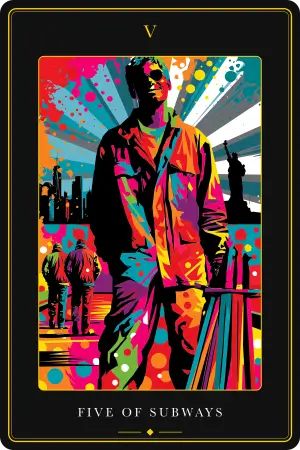
In the Tarot of New York City the Five of Subways is the aftermath of a clash in the city's underground, rendered in the deck's saturated pop-art palette. In the foreground stands the victor: a man in sunglasses, chin up, a satisfied half-smile on his face. He has just won the argument and taken the last word, and he wears the win the way he wears the shades, as armor that also blinds. That detail carries the reading. Behind the glasses he cannot fully see what his victory looks like from the outside, and he never watches the two people leaving.
Behind him, two figures walk away toward the water with their shoulders drawn in and their heads down. They are the defeated, and they are also the ones in motion. Walking away in this deck is never only a loss. It is the Six of Subways already beginning, the quiet ride out of the conflict, and they leave the victor alone with everything he claimed. At his hand stands a cluster of sharp vertical stakes, the deck's echo of the gathered swords. They read at once as collected weapons and as a stripped, skeletal turnstile: trophies that cannot be spent, a barrier he has built at his own hip. He holds them casually, yet they fence him in as much as they arm him.
The background splits in two. On the left the downtown skyline stands in black silhouette against a sunburst of rays, the arena that stages a thousand of these contests a day and forgets each one by evening. On the right the Statue of Liberty rises in silhouette, torch up, out across the harbor toward which the two figures walk. She is the card's conscience, and the liberty here belongs to the people leaving rather than the man who won. Freedom, the card suggests, may lie in refusing the fight. The sunburst behind the victor's head forms a false halo, glory as he feels it, drawn in the language of an advertisement. Halftone dots scatter across the scene and dissolve the moment into newsprint, because today's triumph is tomorrow's fish-wrap. In the upper left corner splashes of hot pink and red bleed across the frame, the residue of the argument itself, the said things still hanging in the air and impossible to retract.
Core meaning
The Five of Subways is the pyrrhic victory told in the city's own key: the argument on the platform that you win by being crueler, and the silence when the train pulls out and you feel how much the win cost. Halfway through the suit of Subways, where fives bring the crisis that shatters the armed peace of the fours, it is intellect turned combative, the sharp tongue that cuts too deep, the unforgivable sentence deployed because it will land. The Golden Dawn titled the underlying card the 'Lord of Defeat', and the defeat it names is not losing the argument. It is standing on the high ground of the platform while the car around you goes quiet, having driven off the people you actually wanted there.
The card puts one blunt question before you board: is this fight worth the fare? In this city there is always another argument available, and you do not have to ride every one. Winning for the sake of winning empties the platform around you, and people remember how you fought long after they forget what the fight was about. The card generally shows a win, but a win with losses folded inside it, one that took more cruelty and cost more goodwill than expected. It can also mark a dispute that still needs real resolution, because the last word is not the same thing as the end of the fight.
Upright meaning
Upright, the Five of Subways is the person trying to dominate the car: talking over, cutting down, taking the last word like a trophy at someone else's expense. It shows open conflict, office knife-fights, and fierce competition for the same seat or the same job. Before you engage, the card asks what the fight is actually worth and reminds you that the unforgivable sentence travels faster than any express train and cannot be recalled. Sometimes the strongest move is to let the doors close, take the loss on this ride, and keep your allies and self-respect for the battles that matter.
In love. The fight where somebody won and the relationship lost: arguments that turn cruel, scorekeeping, and the terrible quiet afterward, two people on the same couch like strangers on the same bench. Often it marks a partner who always has to be right and wins every argument on technique while the connection bleeds out underneath. Force and verbal aggression do not produce love, and the partner who wins the platform argument usually stands there alone.
In career. Competition for the same promotion, elbows out over territory, and the meeting where someone wins by making someone else look small. Victory is available, but this card prints the price on the ticket: a win that leaves the team resentful, a working relationship that never recovers. How you fight is remembered longer than what you won, so keep your conduct cleaner than your competitors keep theirs.
In finances. Conflict and dispute over money: the contested deposit, the roommate who stopped paying their share, the deal that turned into a standoff. Someone may be playing outside the rules, and losses here often come not from the market but from the fight itself, in legal fees and burned bridges. Read the fine print, keep receipts, and do not assume the other party is fighting fair.
In health. The war you are in with yourself, the brutal early weeks of a regimen or the punishing schedule held against a hundred daily temptations. Progress is won through persistence and friction, yet the card carries its suit's warning into the body: victory over yourself achieved through savage self-talk is the same hollow win. Fight for yourself, not against yourself.
Reversed meaning
Reversed, the Five of Subways is the ride home after the fight, when the adrenaline drains and the mind starts replaying every word. It points to a desire for peace after a clash, the long quiet trip out of the conflict over the bridge toward something calmer. It can mark disputes that still smolder, guilt over how you fought, or the slow realization that the victory you took was not worth what it bought. Sometimes it means laying down the fight altogether, giving up a war of attrition with a landlord, a colleague, or your own pride. Retreat is not the same as defeat when it preserves your dignity and stops the bleeding.
In love. Usually the end of the fighting, one way or the other. In the hopeful reading the storm passes, apologies become possible, and two people begin the careful work of forgiving what was said at full volume. In the harder reading the fight ends because one of you steps off, taking the quiet ride out rather than one more battle. Either way, handle words with extreme care, because a relationship at this stage is a track under repair.
In career. The morning after the office war: plans disrupted, a defeat absorbed, or a victory that quietly cost you the room. Sometimes the wise move is to concede the point, take the reassignment, or let a rival have the hill you no longer need. Watch for lingering guilt or resentment over how a past conflict went, because unprocessed, it will board every new project with you.
In finances. The exhausted end of a money fight, the point where you total up what the dispute cost in fees, time, and nerves and realize the fight itself became the biggest expense. It can indicate the decision to settle rather than keep litigating, or the willingness to eat a loss to stop the bleeding. The aim is disengagement on decent terms.
In health. The moment you stop fighting your own body, from exhaustion or from wisdom. It can mark burnout with a regimen that ran on punishment, or a period of recovery when the task is restoration rather than conquest. The sustainable route is the local, not the express.
Historical notes
The card behind the Five of Subways carried loss from early on. In the late 18th century Etteilla gave the upright Five of Swords the keyword Perte, loss, illustrated with the third-century clash between the Roman emperor Aurelian and Queen Zenobia of Palmyra, whom he defeated, captured, and paraded through Rome. The allegory teaches that a victory built on subjugating another is tainted by loss. Reversed, Etteilla and decks like the Tarot Belline read it as Deuil, grief and mourning, with a promise of eventual healing once the fighting stops.
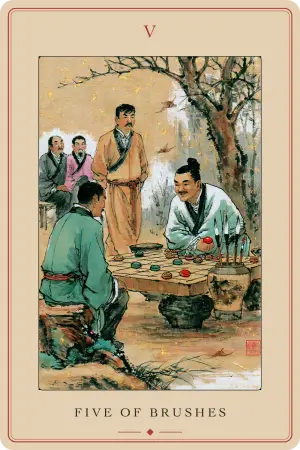
The Hermetic Order of the Golden Dawn mapped all the fives to Geburah, the sphere of severity ruled by Mars, and titled this card the 'Lord of Defeat', the armed peace of the Four shattered by cowardice, treachery, or petty quarrels. A.E. Waite and Pamela Colman Smith fixed the modern image in 1911, the smirking victor and the two retreating men under a torn sky, drawing on Etteilla's meanings of dishonour and loss. In Crowley and Harris's Thoth deck the card is abstract, titled 'Defeat', with a broken central sword and the torn rose petals of Venus scattered by the martial clash. The Tarot of New York City keeps that lineage and moves the coastal skirmish underground, onto the platform. The bleak shore becomes the harbor, the surrendered swords become a skeletal turnstile of stakes, and the two men trudging off become commuters walking toward the water and the next train.
Correspondences
Number. Five, the number of disruption, change, and instability, the rush-hour number where the system runs at maximum friction. It is the place where the settled order of four breaks open and something has to give before six can restore movement. Under the suit of mind and language, its disruption becomes conflict of thought, the argument that breaks out when two people's mental maps of the city refuse to overlap.
Astrology. Venus in Aquarius, the first decan of Aquarius, roughly January 20 to 29, ruled by Venus. Aquarius is the city's own sign, eight million people each certain they know the right way to the airport, and here its independence hardens into loyalty to one's own position at any cost. Venus governs love and connection, the very things spent to buy the victory, which is the card's cruelest irony.
Element. Air, the suit of intellect and communication, the element that in this deck runs underground through the tunnels. Here it shows its cutting edge: the quick word, the devastating comeback, logic deployed to win rather than to understand.
Kabbalah. The card sits at Geburah, Severity, the fifth sphere ruled by Mars, the necessary force that severs what is no longer viable. Airy intellect in this martial sphere turns combustible.
Elemental dignity. As a harsh Air card it sharpens and inflames the cards around it, and it eases only when tempered by watery, compassionate influences nearby.
Psychological perspective
The Five of Subways is a portrait of the unchecked ego, and its meaning turns on who you are in the scene. If you are the man in sunglasses holding the platform, the work is to face your cruelty and pride. If you are one of the figures walking toward the harbor, the work is to grieve the loss and learn to protect yourself. Many of these people learned early that the city rewards whoever hits first. They read weaknesses the way a commuter reads the countdown clock, and they end up alone at the end of the ride because they rarely count the cost their victories impose on others.
More insidiously the card can mark paranoia and self-sabotage, a mind at war with itself that weaponizes 'truths' against its own self-esteem and then projects hostility outward, suspecting a coworker or a partner without evidence. The advice there is to stop fighting the wrong person and recognize that thoughts are battling feelings. The esoteric antidote is Temperance, the other card that reduces to five: lower the swords, self-regulate, and let empathy temper intellect. Discovering that your own strength does not require someone else's humiliation is the last and hardest fight the card asks you to take on.
The Five of Subways across decks
The traditions read the same conflict in different rooms, and this deck's contribution is to stage it on the subway platform. The Rider-Waite-Smith version is the theatrical source: a young man gathers three swords with a self-satisfied smirk after a coastal skirmish while two figures trudge away under a torn sky, the defining image of the hollow win.
In the Tarot de Marseille the card strips out the human drama and arranges five blades into a hard, symmetrical pattern, conflict shown as pure structure. In Crowley and Harris's Thoth deck the card is fiercely abstract and titled 'Defeat': angelic hands grip swords in a clash while a third blade thrusts up to scatter them, the central sword broken to show power lost, with the torn rose petals of Venus falling through the weapons. The Tarot of New York City keeps the archetype whole and swaps the shore for the underground. The smirking victor becomes a man in sunglasses holding the platform, the surrendered swords become a skeletal turnstile of stakes, the choppy sea becomes the harbor, and the Statue of Liberty stands in silhouette as the card's conscience, her freedom belonging to the people walking away.
In combination and context
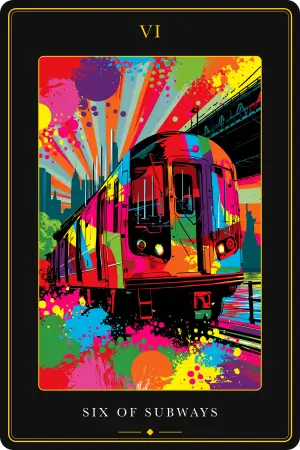
The Five of Subways sits inside a clear arc of the suit. It is the chaotic climax and false victory that follows the rest of the Four, and it is followed by the Six of Subways, the quiet ride toward calmer water, already visible in the two figures leaving toward the harbor. It contrasts sharply with the Five of Cranes, this deck's fiery scuffle among equals, competitive but without deep malice, where the Five of Subways is personal, calculating, and cold, opponents mismatched and communication broken.
Spread position sharpens it. In a yes-or-no reading it is an almost universal no, warning that the current path leads to further hostility or a victory so compromised it feels like a defeat, and in reconciliation questions it says the rift cannot heal while ego drives either party. Read for how someone feels, it shows a person trapped in the adrenaline of the fight, grinning inappropriately in the face of trauma, or the one riding home in silence unable yet to admit the loss. Wherever it lands, the instruction holds: get clear on what you actually want before you engage, and run the check every New Yorker runs eventually, not 'did I win?' but 'can I respect how I rode?'
Questions for reflection
- In this conflict, am I the man in sunglasses holding the platform or one of the figures walking toward the harbor, and what does that change about what I need to do?
- Is this fight worth the fare, or is it only my ego that would lose face by letting the doors close on it?
- When I run the end-of-day check, can I respect how I rode, or only that I got the last word?
The general meaning follows the Rider-Waite-Smith reading, the reference used across Tarot Academy. Open a specific deck above for its own interpretation.
Frequently asked questions
Explore the Tarot
Latest Posts
Discover the ancient wisdom of tarot cards and unlock the mysteries of your spiritual journey. Our blog is your gateway to understanding the rich symbolism, meanings, and practical applications of tarot reading.




















































