
 EN (English)


Minor Arcana · Swords (Air)
Four of Subways
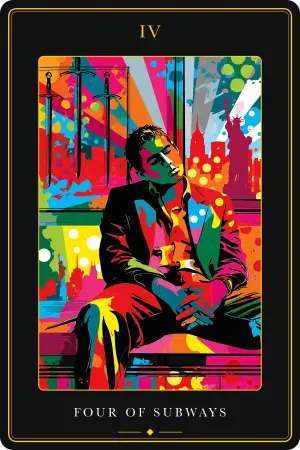
The man asleep upright on the last car home, eyes shut against a blazing skyline, taking half an hour of nothing on purpose.
Read the complete guide: The Tarot Card Four of Swords: A Comprehensive Guide to Its Symbolism and Meaning
Card at a glance
- Numerology
- 4
- Element
- Air
- Astrology
- Jupiter · Libra (third decan)
- Kabbalistic path
- Chesed (Mercy)
- Timing
- Mid-to-late October · close of Libra season
- Yes / No
- Upright not yet · Reversed no
Upright
rest
the ride home
recovery
earned quiet
retreat without defeat
meditation
half an hour of nothing
restoring balance
Reversed
burnout
running on empty
insomnia
riding the loop
forced rest
restlessness
avoidance in motion
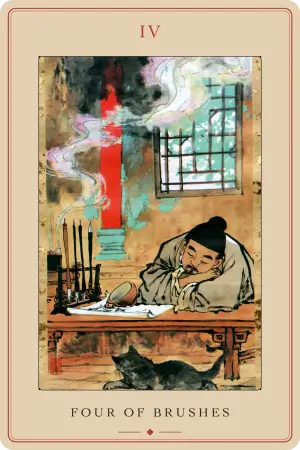
Four of Subways in each deck
Every deck reimagines the same archetype. Compare the art, then open a deck to read its full interpretation.
Imagery and symbolism
In the Tarot of New York City the Four of Subways is a man in a rumpled suit on the bench of the last car home, eyes closed, head tilted, hands folded loosely in his lap. He is not collapsed. He is composed. The struggle is paused rather than lost, and his stillness sits at the dead center of the card's riotous pop-art color. That contrast is the whole message: the city keeps blazing, and he rests anyway.
The swords of the tradition are all here, translated into the train. Three sword-blades hang point-down against the window above him, echoing the three swords on the wall of the ancestral Four of Swords. They are the concerns he has set aside for the length of the ride, the conflicts and deadlines and worries that will still be waiting at his stop. Suspended there, they neither threaten nor vanish. They hold their place and mark a truce, not a victory. The fourth sword lies in the bench and the rails themselves, the horizontal line that carries him home. What supports his rest is the very suit of mind and grind: the same intellect and city that exhaust him are, for this half hour, holding him up and moving him along. The root of the problem and the means of recovery run on the same track.
Through the window behind him the skyline glows in saturated reds, yellows, and magentas under pop-art sunburst rays and halftone dots, with the Statue of Liberty raising her torch twice, near and far, on both sides of the water. Where the Rider-Waite-Smith card set a stained-glass window of blessing above the resting figure, this deck sets the illuminated city. His stained glass is the skyline itself, and Liberty's torch stands in for the saint's halo, a promise that the freedom and hope he came here for stay lit while he sleeps. He sits with his back to all of it, eyes shut, showing that the recovery happens inside and not in the view.
Core meaning
The Four of Subways is the sanctioned pause, the one card in the fast-moving suit of Air that demands stillness. It is the RWS Four of Swords translated into the one place a New Yorker actually sleeps in public: the train home. The card points to a stretch of rest and recovery after the grind, the argument survived, the deadline met, the shift finished. This is a time to relax and replenish rather than push another block forward.
You are not quitting the line, just sitting down on it. The card treats rest as an active strategy, the part of the run most people never master, and its warning is plain: take the pause before the grind takes the choice away. It also names something the city refuses to hand you, which is the protection of your own mental health. Peace here is constructed, not found. Like its ancestor, the Four asks you to lay the blade down before the blade lays you down, on the understanding that the train keeps moving while you rest. Recovery is not the opposite of progress.
Upright meaning
Upright, the Four of Subways is the last car home: asleep upright at last, with no one left to perform for, while the city hums you into a stretch of nothing. It calls for a real period of rest after a hard run, meditation or quiet reflection used to think a situation through and gather strength again. Listen to your body's signals the way a regular listens for their stop. The recharge now is what makes tomorrow's ride in possible.
In love. A quiet season, a stalled train where nothing is wrong and everything is just still. Sort out your feelings, evaluate the relationship in maintenance rather than crisis, and for couples worn down by the pace, stop performing the connection and rest inside it. Sit in the same car in comfortable silence.
In career. Step back to see the project whole. A day of genuine rest will outperform a week of grinding through mental fog, and the card can mark a leave, a slow week, or the stretch between jobs used for reflection instead of panic. Let the three blades hang; you don't have to take them down today.
In finances. Pause major moves. Expect stability rather than growth, the month you don't switch apartments, don't renegotiate, and don't chase the side hustle. Count what you have, guard the reserve, and let it sit while you plan the next stretch of track.
In health. Sleep, silence, and slowness are the treatment. The card favors the gentler disciplines, yoga and stretching and long unhurried walks across the bridge, and it prizes sleep above all as the cheapest beauty treatment in the five boroughs with no waitlist.
Reversed meaning
Reversed, the Four of Subways is the rider who hasn't slept in days and keeps swiping through the turnstile anyway. The rest that is needed isn't happening, because the schedule never allows for it or because stopping feels like failing. Problems and stress stack up like delays along the line, and personal well-being gets quietly neglected, the way you stop hearing the announcements after enough years underground. The card is the alarm clock of burnout: admit the train needs maintenance, or the city will schedule an involuntary stop through illness or collapse.
In love. Constant activity with no pause wears the bond down, two people passing on opposite platforms and waving. Space curdles into avoidance, unresolved issues ride along and never get off, and one partner may simply stop communicating, doors closing with no announcement. A couple that never rests together will eventually rest apart.
In career. Severe burnout from a pause skipped too long: the worker asleep on their feet, mistaking exhaustion for dedication, riding the same route until the stations stop having names. The reverse can also be the opposite fault, using 'rest' as a hiding place while problems pile on the desk. Either way the current pace is unsustainable.
In finances. Worry and money troubles that no longer allow the luxury of a pause, the MetroCard of your finances running on insufficient fare. Rent notices and maxed cards force action that can't be postponed, and anxiety itself starts to degrade your judgment.
In health. Overexertion showing up exactly where you'd rather it didn't, in the skin, the eyes, the posture, and the immune system. Insomnia, chronic stress, and the body's signals ignored like announcements in a language you've stopped hearing.
Historical notes
The Four of Subways inherits its scene from the Rider-Waite-Smith Four of Swords, drawn by Pamela Colman Smith in 1909 under A.E. Waite's direction. In that card a knight in full armor lies still on a stone tomb inside a quiet cathedral, hands pressed in prayer, three swords hung on the wall above him and a fourth carved beneath. The tomb likely comes from real church tombs in Winchelsea, near Rye in England, where Smith spent time with the actress Ellen Terry, and the knight's pose draws on the medieval vigil, a night of solitary prayer before initiation. High in that card a stained-glass window carries the Latin word PAX, peace, marking the rest as sanctioned rather than tragic.
This deck keeps the structure and moves it underground. The cathedral becomes the last car home, the tomb becomes the subway bench, and the PAX window becomes the lit skyline through the glass. Older traditions framed the same pause in their own keys. In the Tarot de Marseille the four swords interlace into a stable, protective pattern, rest shown as a boundary actively built. In Crowley and Harris's Thoth deck the card is titled 'Truce', four swords meeting at their points in a 49-petalled green rose over chaotic lines of mental turmoil, a peace Crowley thought inherently fragile because Air resists the stillness of the number four. The Four of Subways carries that fragility into a city that never quiets down for anyone.
Correspondences
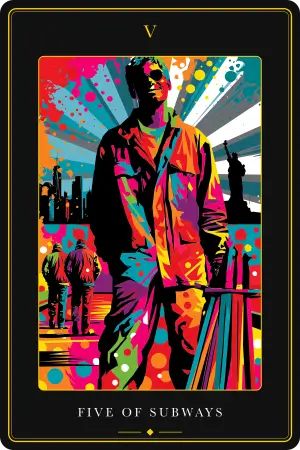
Number. Four, the number of stability, order, and structure, easy to find in this deck: the four corners of the subway car, the frame of the window, the grid of the city itself. Four is the structure that holds while you rest inside it, the pause after the first three steps and before the disruption of the Five of Subways on the opposite platform.
Astrology. Jupiter in Libra, the third decan of Libra, roughly October 13th to 22nd, the same correspondence its ancestor carries. Libra's cardinal air brings restraint and the hard-won balance of simply sitting still, while Jupiter's expansive, benevolent wisdom leads toward the acceptance of inner truths.
Element. Air, the suit of thought and intellect. In this deck the element runs underground, the rush of the tunnels and the current of thought that never fully stops, calling for mental space before the doors open again.
Kabbalah. The card sits at Chesed, Mercy, the fourth sphere and the first stable point below the Abyss, within Yetzirah, the formative world of mind. It is a merciful, structured reprieve granted to an exhausted intellect.
Elemental dignity. As a stabilized Air card it steadies its neighbors, and it sits in tension with fast, forceful cards that would break the truce before the rest is done.
Psychological perspective
The Four of Subways names a specifically modern discomfort with stopping. In a city engineered to measure worth by movement, stillness reads as weakness, and the mind resists the pause even when the body is running on empty. The card's answer is that silence has something to offer, but in New York silence has to be constructed: headphones off, phone face-down, one stop ridden past on purpose. Even a few minutes of genuine quiet, without screens or conversation or performance, can shift something that has felt stuck for weeks.
The card describes the half-dream state of the rider between stations, where the mind sorts the day without being asked and works a problem beneath the surface the way the express runs under the local. There is a genuine shadow to watch, though. Rest can curdle into avoidance, the deliberate pause becoming a way to hide from something that actually needs attention. It is the difference between resting on the train and refusing to get off at your stop. If you are truly resting, it feels restorative. If you are hiding, you already know.
The Four of Subways across decks
The same pause appears in different settings across the tradition, and this deck's contribution is to relocate it to the one place a New Yorker actually rests. In the Rider-Waite-Smith deck the scene is a knight lying on a tomb inside a cathedral, three swords hung above and a fourth beneath, the PAX window promising sanctioned peace and quiet renewal.
The Tarot de Marseille strips out the figure and interlaces the four swords into a calm, symmetrical mandala, rest depicted as a protective boundary against outside demands. In the Thoth deck Crowley and Harris title the card 'Truce' and render it as geometry, four blades meeting at their points in a rose of 49 petals, a compromise negotiated by the intellect and always temporary. The Tarot of New York City keeps the archetype whole and swaps the cathedral for the last car home: the armored knight becomes a tired man in a rumpled suit, the tomb becomes the subway bench, the hung swords become blades against the window, and the stained glass becomes the lit skyline with Liberty's torch standing in for the saint's halo. The promise underneath stays the same. The rest taken now is what lets the mind arrive home in one piece.
In combination and context
Numerologically the Four of Subways is the consolidation between the Three and the Five, the moment the system demands recovery before the next round of conflict. The idea sparked at the Ace, the choice was faced at the Two, and the pain landed at the Three. Now comes the pause, and skipping it is how people crash into the Five of Subways unprepared, waking from too shallow a rest only to walk straight into the conflict waiting on the opposite platform.
Spread position sharpens the message. In a yes-or-no reading it is a soft no, a 'not right now' that says the timing is wrong for forward momentum, unless the question is itself about resting or withdrawing, in which case it turns to a clear yes. Read for how someone feels, it shows a person who has genuinely disconnected to recover, sitting in their own quiet with no immediate intent to act, which is a very different figure from the one anxiously watching from a burner account. As an outcome it favors patience over the quick score: let the decision ride, let the mind work on it below the surface, and the answer arrives more cleanly than it would if you grasped for it. Wherever it lands, the instruction holds. Sit down on the line for a while, and arrive rested.
Questions for reflection
- The city ran you hard this week. What would actually restore you if you rode one stop past on purpose and let it carry you for a while?
- Are the three blades over the window concerns you are resting from, or ones you are hiding from by staying on the train?
- By the end of today, are you more resourced than you were this morning, or less?
The general meaning follows the Rider-Waite-Smith reading, the reference used across Tarot Academy. Open a specific deck above for its own interpretation.
Frequently asked questions
Explore the Tarot
Latest Posts
Discover the ancient wisdom of tarot cards and unlock the mysteries of your spiritual journey. Our blog is your gateway to understanding the rich symbolism, meanings, and practical applications of tarot reading.




















































