
 EN (English)



Major Arcana · XXI
The World
Smith's dancer suspended inside a laurel wreath, a wand in each hand, four living creatures holding the corners of the sky.
Card at a glance
- Numerology
- XXI
- Element
- Earth
- Astrology
- Saturn
- Kabbalistic path
- Tav (Yesod → Malkuth)
- Timing
- Completion · the close of a long cycle
- Yes / No
- A resounding yes
Upright
completion
wholeness
harmony
integration
fulfilment
achievement
unity
freedom
Reversed
incompletion
lack of closure
stagnation
loose ends
imbalance
deferred goals
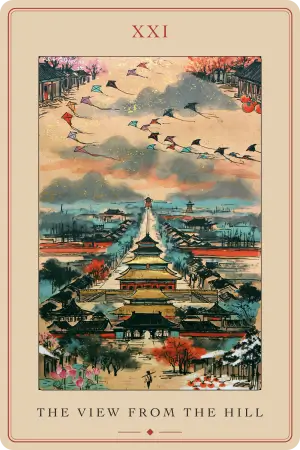
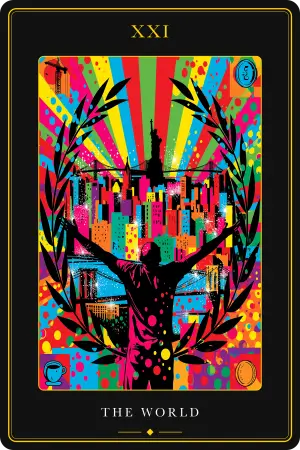
The World in each deck
Every deck reimagines the same archetype. Compare the art, then open a deck to read its full interpretation.
Imagery and symbolism
Waite and Smith kept the Marseille skeleton of this card and rebuilt everything inside it. The Marseille figure stands; Smith's dances. She is suspended in open space, one leg crossed behind the other in mid-step, and the deck reads that suspension as weightlessness and freedom beyond space and time. Nothing holds her up and nothing needs to.
A wand sits in each hand. That doubling is the deliberate detail, because in Arcanum I the Magician holds a single wand raised to draw power down into one ego. By the last trump there are two, and the deck reads them as the masculine and the feminine held in balance, active weighed against passive, heaven joined to earth. The figure herself is a divine androgyne, identified with Hermaphroditus by Juliet Sharman-Burke and Liz Greene in The New Mythic Tarot, which puts the wholeness on the card outside strict sexual identification and locates it as an alchemical marriage inside one person.
She is nude, and in this deck's reading that is truth without adornment, purity and authenticity and self-acceptance rather than exposure. The purple stole winding around her carries high spiritual energy; purple is the colour of transformation, healing, and spiritual awakening. Behind her the background is celestial blue for spiritual ascension, peace, and complete enlightenment.
The wreath is green laurel, victory and the evergreen cycle of nature both, and it is bound at top and bottom by red ribbons knotted into lemniscates. Those knots are the card's argument in miniature: infinity, eternity, and the continuous flow of life, so that the end of one cycle is tied to the beginning of the next. Some readers take the wreath itself as an Ouroboros, the serpent swallowing its own tail.
In the four corners are the bull, the lion, the eagle, and the angel, the tetramorph out of Ezekiel and Revelation, and Christian art's emblems of the four Evangelists. Here they carry the elements: earth, fire, air, and water, and behind them the four fixed signs, Taurus, Leo, Scorpio, Aquarius, and the four suits of the Minor Arcana. The deck reads them as energies she has under control, and as the link between nature and spirit. Robert M. Place describes them as the rigid fourfold frame of the material world, the anchor that keeps the sacred centre from dissolving back into chaos, which makes the dancer the quintessence, the fifth element of spirit at the middle of the four.
Core meaning
This deck names the archetype The Reclaimed Paradise, the fullness of life. The hero has reached the goal, regained wholeness, and found the lost paradise. It is the pinnacle of creation read as a person: someone who has arrived at completeness and the full expression of who they are, standing at the centre of the world around them.
What that integration covers is specific. Light and shadow, masculine and feminine, subconscious and reality are reconciled, and the person comes to live in harmony with themselves while respecting every element in the world. The concluding stage of the journey is also an opening onto a new path, which is why the ribbons are tied as infinity signs rather than a simple bow.
Saturn keeps the joy honest. The card is paired with the planet of structure, stability, and perseverance, and with respect for the laws of the physical world, so the equilibrium here is reached only after a long process of learning. Enlightenment arrived at by working through real difficulty, chaos turned into order through patience and a long view. The number carries the same weight: twenty-one factors as three times seven, material completion multiplied by spiritual completion, and its digits reduce to three, the trinity of body, mind, and spirit.
Upright meaning
Upright, The World marks wholeness, harmony, and inner peace. Goals are achieved, dreams fulfilled, a significant phase brought to a close. A project or course of study wraps up, family matters resolve, and you find yourself at peace with the people around you. Effort pays off and persistence in the pursuit of peace bears fruit. Waite's own Pictorial Key adds recompense, voyage, route, emigration, and a change of place to the card's promise.
The counsel is to keep moving while staying at peace with yourself and others. Personal harmony matters more here than external achievement, so hold onto your comfort without missing chances to grow. Plan ahead, act on the plans, and tie up the loose ends. Aim for agreement and cooperation rather than conflict.
In love. Harmony, mutual understanding, and emotional comfort. Existing bonds grow stronger and new ones begin in mutual respect, with both partners accepted as they are rather than pressured to change. The relationship is mature, stable, and built on shared plans, and big steps like marriage or buying a home are possible now. For someone unattached, it signals an encounter close at hand with a spiritually kindred person. Read as an outcome it can be more sober: a cycle that has gone as far as it can and completes naturally, or the honeymoon phase ending and settled partnership beginning.
In career. A project or career phase successfully wrapped up, with a promotion, a new position, or a step up in standing as the reward. Work you have put in gets recognized and effort invested brings a fair return. In business it points to harmony between partners and employees, well-deserved recognition, and resilience after a stretch of hard work, with the entrepreneur's goals lining up with their own beliefs.
In finances. Financial harmony and stability: a project completed, expected profits arriving, a reliable source of income. Income matches expenses and money worries ease. It can signal an inheritance, a gift, or a bonus, and it is a good moment for major investment.
In health. Body and spirit balanced together, good energy, satisfaction with your own appearance. Regeneration is balanced and systems function steadily. Diligent work on health pays off here, and healthy eating and regular activity settle into a working routine.
Reversed meaning
Reversed, the card points to internal obstacles blocking progress: unfinished business, complicated relationships, stress, insecurity, disorientation, or an inability to embrace positive change. Something holds back forward movement and leaves things incomplete and disarrayed inside. You may be hunting for harmony or meaning in a situation that feels hopeless, while projects stall for lack of resources, time, or information.
The research names the mechanism precisely: Final Mile Syndrome. At the very end of a cycle, with completion visible and imminent, the individual stops, sabotages the effort, or takes a cheap shortcut that prevents real integration. Underneath it is fear of what finishing means. If years have been spent defining yourself by a struggle or an unmet goal, reaching it strips that identity away, so people cling to a chapter past its healthy end rather than face the disorientation of becoming someone new.
The way through is unglamorous. Reassess your fears, stop dwelling on the past, and accept what you cannot control. Reevaluate your attitude, look for solutions, or wait peacefully for the right moment.
In love. Misunderstanding and disharmony between partners, a mismatch of values, a sense of distance, an unwillingness to accept the partner as they are. Decisions get postponed, communication turns difficult, and views on the future stop lining up. The barriers may well be temporary, which makes conflict resolution the work rather than exit.
In career. Unfinished tasks, conflicts, and a sense of stagnation where nothing moves despite the effort spent. It can mean unhealthy competition, reluctance to change when the situation demands a new approach, or an imbalance between work and personal life. In business, internal conflict or a lack of understanding between partners blocks the final goal, and recognition fails to arrive.
In finances. Instability and lost financial harmony. Watch for losses, bad deals, missed opportunities, and wasteful spending, and take a hard look at how you handle money, since careless choices here lead to real losses.
In health. Disharmony and a loss of wholeness, often from poor diet, too little exercise, or a neglectful attitude toward yourself. It can point to trouble absorbing nutrients or irregular eating, and it warns of a disconnect between physical well-being and inner state brought on by stress, fatigue, or high anxiety.
Historical notes
Waite and Smith inherited a card with four and a half centuries behind it. The earliest surviving tarots come from mid-fifteenth-century Italy, where the deck was a set of cards for the trick-taking game Trionfi rather than an occult instrument. The Visconti-Sforza tarot of about 1460, made for the ruling family of Milan, survives only in incomplete sets scattered across museums and private collections, and its version of this card relies on conventional Christian and classical imagery: earthly dominion, or a celestial sphere held up by angelic figures.
By the eighteenth century production and reinterpretation had moved to France, and the Tarot de Marseille became the standard pattern, its foundational printings including Jean Dodal of Lyon between 1701 and 1715 and Pierre Madenie of Dijon in 1709. Titled Le Monde, it codified the arrangement every later deck works from: a semi-nude female figure inside an almond-shaped wreath with the four beasts of the Apocalypse in the corners. That wreath is a mandorla, or Vesica Piscis, the shape formed where two circles of equal radius overlap so that each centre lies on the other's circumference. The Pythagoreans read it as the meeting of heaven and earth, and medieval artists drew it around Christ in Majesty.
The modern reading of the card was fixed at the turn of the twentieth century by the Hermetic Order of the Golden Dawn, which had assembled Kabbalah, astrology, alchemy, and tarot into one curriculum. In 1909 Arthur Edward Waite and Pamela Colman Smith, both members, published their deck through William Rider & Sons Limited. Waite built the esoteric system and Smith drew it. Their card kept the Marseille structure while emphasizing the dancing quality of the central figure and replacing heavy woodcut lines with fluid ones that carry Golden Dawn correspondences directly in the artwork. It remains the most influential tarot deck in the world and the foundation for most modern readings of this card.
Correspondences
Number. Twenty-one, which factors as three times seven: in esoteric numerology seven is spiritual completion and three is material completion, so the number itself reads as flawless integration on both planes. Split into its digits it gives two and one, balance and union alongside new beginnings and creative will. Added together they reduce to three, growth, expansion, and communication, the trinity of body, mind, and spirit, which this deck ties back to divine perfection and awakening.
Astrology. Saturn, the planet of structure, stability, and perseverance, and of respect for the laws of the physical world. Saturn is the furthest visible planet from earth and the old 'ring-pass-not,' the boundary of the known universe, and as Lord of Time it governs limitation, discipline, and unyielding justice. Paired with this card it insists that the equilibrium shown here was reached through a long process of learning rather than granted. On the Tree of Life Saturn also belongs to Binah, the Great Mother, the dark matrix of form, which loops back to the womb-shaped mandorla the wreath descends from.
Element. Earth, grounding the card in Malkuth and the fully manifested physical world, the point where a spiritual blueprint crystallizes into something solid.
Kabbalah. The letter is Tav, the twenty-second and last of the Hebrew alphabet, on the thirty-second path from Yesod (Foundation) to Malkuth (Kingdom). It is the lowest and heaviest bridge on the Tree, the conduit through which astral and psychological energy precipitates into hard reality. Golden Dawn instruction for passing up the Path of Tau warns of a 'confusion of lights' and the reflected coloured rays of the Qesheth, the rainbow spread over the earth, which is to say that walking this path without the wisdom of the previous twenty-one arcana leaves the initiate lost in material illusion.
Timing and yes/no. Completion and the close of a long cycle rather than a season. As a yes or no it is a resounding, unqualified yes, the circle closing in your favour.
Psychological perspective
In Jungian terms the card is individuation concluded. Individuation is the long process by which a self develops out of the undifferentiated collective unconscious and consciously integrates the repressed shadow, the anima and animus, and the fragile ego. In alchemical language it is the Great Work, base lead transmuted into gold, the V.I.T.R.I.O.L. formula that sends the seeker into the interior of the earth to find the hidden stone. Smith's dancer is the squaring of the circle, spirit settled comfortably into matter, a homecoming to the self. What was learned on the road is no longer remembered, it is lived in the body.
The temperament this deck attaches to the card is a deep inner calm. Such a person finds harmony within themselves and their surroundings, shows tolerance and wisdom, and can see the world whole. They value what they have without fearing the release of what is no longer needed, often become mentors, and tend to have a calming effect on people around them.
The shadow is specific and easy to miss because it looks so peaceful. Too much attachment to harmony blocks necessary risk. These people may feel unfulfilled behind an outward calm, and the pursuit of balance can tip into inertia and reluctance to act, drifting toward static behaviour and solitude, unable to take on anything new because they see no need for further development. Fear of change becomes the barrier, and refusing to leave the comfort zone is the quiet form of Final Mile Syndrome.
The World across decks
The Rider-Waite version is the one that made the dancing figure and her two wands the modern default.
Visconti-Sforza. Around 1460 in Milan, the card belongs to Renaissance humanism and courtly allegory. Its subject is earthly dominion in classical Christian terms, with no occult apparatus behind it.
Tarot de Marseille. Le Monde in eighteenth-century France, drawn in flat woodcut colour. Its contribution is the geometry: the semi-nude figure inside the mandorla, the four beasts at the corners. Practitioners came to read these images as an eternal 'Book of Life' holding universal principles outside material time.
Crowley-Thoth. Published in 1944 and renamed The Universe, shifting the focus from earthly completion to macrocosmic manifestation. Lady Frieda Harris used projective synthetic geometry instead of figuration. The card stages the Orphic and Pelasgian myth of Eurynome, who rose naked from Chaos, danced upon the waves, made the serpent Ophion from the winds she stirred, then bruised his head with her heel when he claimed authorship of the universe. The laurel wreath becomes the plane of the ecliptic, the four beasts survive as stylized forms in the swirling background, and at the base sits the early twentieth-century periodic table arranged by atomic weight.
Modern decks. The Motherpeace Tarot of the 1970s, by Karen Vogel and Vicki Noble, renders every card in a circular format for the feminine and celebrates matriarchal and indigenous tradition. The Neuzeit or New Age Tarot of 1982, by Swiss painter Walter Wegmüller, brings psychedelic detail and Escher-style shifts of perspective to the archetype. Navigators of the Mystic Sea by Julia Turk, from 1997, is built on Golden Dawn Hermetic Qabbalah and prints the Tree of Life on the card backs.
In combination and context
The heaviest pairing in the deck is this card with The Fool. One is the alpha, unmanifested potential willing to step off a cliff; the other is the omega, mastery of every lesson. Together they hand the querent a master key: the right to start over has been earned, and the new beginning happens at a far higher level of consciousness, with the completed cycle as its launching pad. In career questions that reads as the serial founder or expert pioneer who has mastered one industry and carries those credentials into virgin territory. In love it describes someone who has done enough shadow work to stay whole and self-sufficient while risking real vulnerability with a new partner. Both reversed, it becomes a purgatory: a chapter refused closure, and that missing closure used as an excuse to dodge the next risk.
Against the Wheel of Fortune the distinction is worth holding, since both deal in cycles. The Wheel is the external turning of fate, the ups and downs of material life largely outside your control, a turning point inside a process still running. This card sits at a higher and more internal level: the lessons of the turning wheel have been integrated and mastery over one's own reality achieved, which makes the resolution earned and durable rather than transient luck.
With The Chariot the narrative moves from aggressive progress to arrival. The Chariot is willpower forcing a way through obstacles; here the armour comes off because the war is won. Sitting directly after Judgment, this card is the integration that the awakening was heading toward.
Combinations can also turn melancholy. Alongside The Hanged Man and the Five of Cups in a relationship question, it describes the difficult stretch after a completion: the wedding and honeymoon are over, daily life resumes, and the couple feels suspended and mildly disappointed that the high has passed even though the goal was genuinely reached.
As a significator the card marks someone harmonious and at ease with life, aware of their own path, able to take success and failure gracefully and see the whole picture. Reversed it describes someone still searching, avoiding final decisions, unwilling to own mistakes or commit to a choice.
Questions for reflection
- Smith's dancer holds two wands where the Magician held one. Which pair of opposites in you is still being carried in a single hand?
- What cycle in your life is genuinely finished, waiting only for you to stop holding the door open?
- If the identity you built inside your longest struggle had to end for the struggle to end, would you still finish it?
The general meaning follows the Rider-Waite-Smith reading — the reference used across Tarot Academy. Open a specific deck above for its own interpretation.
Frequently asked questions
Explore the Tarot
Latest Posts
Discover the ancient wisdom of tarot cards and unlock the mysteries of your spiritual journey. Our blog is your gateway to understanding the rich symbolism, meanings, and practical applications of tarot reading.




















































