
 EN (English)



Minor Arcana · Wands (Fire)
Ace of Wands
A hand out of the cloud holding green wood: in the Rider-Waite-Smith image, the root of Fire caught at the instant before anything is built with it.
Read the complete guide: Ace of Wands in Tarot: A Complete Guide to Symbolism and Meaning
Card at a glance
- Numerology
- Ace
- Element
- Fire
- Astrology
- Root of Fire (Aries, Leo, Sagittarius)
- Kabbalistic path
- Kether (Crown) in Atziluth
- Timing
- Spring, and fast once begun
- Yes / No
- Upright yes · Reversed no
Upright
Inspiration
New venture
Creative spark
Initiative
Passion
Bold action
Potential
Reversed
Delays
False starts
Burnout
Creative block
Lost motivation
Impulsiveness
Fear of risk
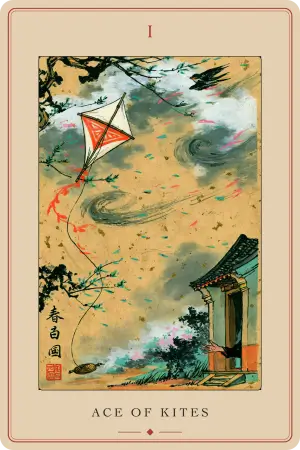
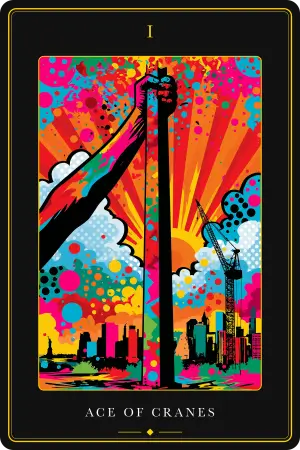
Ace of Wands in each deck
Every deck reimagines the same archetype. Compare the art, then open a deck to read its full interpretation.
Imagery and symbolism
Pamela Colman Smith had a problem to solve that the older pip decks never faced. Waite wanted the Golden Dawn's most abstract idea, Kether in the World of Emanation, drawn as a scene a reader could actually look at. Her answer was to keep the hand and the club that Marseille already had, then load everything else with meaning.
The hand is a luminous right hand, palm turned toward the viewer, coming out of a grey cloud on the right side of the frame. The grey is deliberate: it stands for the unmanifested divine, a neutral haze and the confusion that sits in front of enlightenment. Esoteric readers take the right-hand entry as a nod to the right-to-left spelling of the Hebrew divine name, aligning the card with the outgoing masculine current.
What the hand grips is living wood, not a cut staff. Green leaves and vines run along it, which is why this deck reads the card as creative energy still growing rather than energy already spent. Eighteen leaves hang loose in the air around it, and each is drawn in the shape of the Hebrew letter Yod. The tip of the Yod is said to rest in Kether; through gematria the number 18 spells Chai, "life." Smith's falling leaves are a written statement, not scatter: life-force descending into matter.
The background is the part most often skipped. A river runs through rolling hills toward the largest phantasmal castle anywhere in the deck, standing for Malkuth, the physical world, and the destination the spark has not reached yet. The Rider-Waite reading treats the far heights as the highest goals and the water as feeling and state of mind, with the hills between marking the effort still owed. Sunlight, river, cloud and hills place all four elements in one frame, which is the visual argument that this one spark contains the potential for everything. The wand's upright stance carries stability and continuity, and the green ground it rises over reads as fertility and prosperity.
Core meaning
In this deck the Ace of Wands is motivation and initiative given a body: a beginning built out of an idea, arriving with a surge of passion behind it. The Golden Dawn title is "The Root of the Powers of Fire," and the card sits at Kether in Atziluth, the highest of the four Kabbalistic worlds. It causes a beginning more than it is one.
What the Rider-Waite image adds to that abstraction is the gap between the hand and the castle. The energy is real and the destination is visible, and the whole middle of the picture is unwalked. An Ace is potential, so the fire is volatile and unformed. It gives the push off the starting line and will not carry anyone to the finish without disciplined work. Feed the spark or watch the opening fade back into the ordinary.
Upright meaning
Upright, this is the ultimate green light: a new project, adventure or opportunity landing exactly when energy and passion peak. The Rider-Waite reading is blunt about the timing. It is time to act, take the proposal and run with it, take some risks. Expect a burst of creative inspiration or a real leap in personal growth, with the inner fire available to push it through.
In love. A new spark, passionate attraction, a strong connection forming. Energy runs high and brings romance and the excitement of something new, with a good measure of sensuality and tenderness alongside the heat. For couples who have settled into routine it signals revival: feelings coming back to life, interest renewed. It works on a physical frequency, so it speaks to chemistry more than to the deep emotional intimacy of the Cups. Stay honest about how deep your own feelings run, and respect what the other person is feeling.
In career. A surge of energy and enthusiasm: new projects, a new direction, sometimes a step into leadership. Ideas arrive fast here and have a short shelf life, so they need acting on quickly. The Rider-Waite reading pairs the opportunity with the temperament to use it, and expects a period of intense activity where enthusiasm actually pays.
In finances. Long-delayed financial plans are finally ready to move, or a new venture is ready to launch. The card brings the courage to invest and favours a creative angle on money over a secure ledger: seed capital, a passionate side project, a sudden idea that opens a revenue stream. A short-term rise is likely, possibly an inheritance. Timely action is the condition attached.
In health. Energy and the drive to act, motivating the body toward activity. It reads as the start of a new routine or new habits, taking up sport, yoga or dance, a change of image, a decision to live differently. Vitality rises and sleep needs can drop while the high lasts. Diet is worth attention here too.
Reversed meaning
Turn the card and the fire inverts. The hermetic image is a candle upside down, the flame burning up into its own melting wax until it snuffs itself out through misdirected energy. In this deck the reversal reads as indecision, flagging enthusiasm and obstacles in front of new projects, usually rooted in low motivation, lost direction or fear of failure. New ideas start to feel threatening rather than exciting.
In love. The spark simply is not there: dull feelings, fading passion, doubts about whether the relationship is viable, and a tendency to avoid doing anything about it. Historically the card has been tied to impotence and a loss of biological vitality. For single people it points to a stagnant love life, or an attraction that stays hidden through lack of confidence. Deeper down it can flag pent-up anger or unresolved wounds around desire. Do not make hasty decisions out of desperation; working through this takes time.
In career. Delays, procrastination, wasted effort, or no energy to start at all. It can mean a rejected application or the dawning sense that the enthusiasm a field demands is absent. It also warns against spreading yourself thin across projects that are not realistic. At the other extreme it shows rushed, impulsive action that produces mistakes. Either way, read it as a burnout warning and a case for rest.
In finances. Blocked fire becomes reckless impulse with nothing under it. Inspiration is lost, opportunities get turned down out of fear, or resources run out mid-stretch. The querent is vulnerable to get-rich-quick schemes and to losses from thin due diligence against a high-pressure pitch. Reassess the plan and wait for a better window.
In health. Stagnation and no drive to act: apathy, a sedentary routine, poor nutrition, a temporary loss of strength and vitality. The fiery suit turned inward can also show as inflammatory trouble, skin problems and severe allergies, a life force irritating itself instead of flowing. The standing advice is to begin where you are, breaking the paralysis into the smallest imperfect steps instead of waiting for a grand rush of inspiration. If ideas go uncapitalized the momentum dies and the opportunity reverts to the mundane, much as Cinderella's carriage reverts to a pumpkin.
Historical notes
The Rider-Waite-Smith Ace inherited its two oldest components from the pip tradition. The Tarot de Marseille Ace of Batons is a single sturdy wooden club, sometimes held by a disembodied hand, with no landscape behind it. Marseille readers judged such cards by visual weight, number and size, treating the Ace as the largest concentrated reserve of the suit's resources. A deck like the Conver of 1760 arranges its batons for structural tension and lattice symmetry rather than for psychological narrative.
What changed at the turn of the 20th century was the Hermetic Order of the Golden Dawn, which anchored the Tarot to an interlocking web of Kabbalistic and astrological correspondences and standardized the meanings most readers still use. Waite came out of that order, and the deck he directed, published in 1909 with Smith's illustrations, is the point where the Marseille club acquires sprouting leaves, eighteen Yods, a river, hills and a castle. Crowley's Thoth deck, painted by Lady Frieda Harris, later took the same root back toward abstraction, replacing living wood with a blazing torch of ten Yod-shaped flames.
Correspondences
Number. One, the Ace, seated at Kether, the Crown, the primal source that has no beginning of its own. In numerology 1 carries beginnings, individuality, activity and ambition, and this card is the root of its suit rather than one of the suit's numbered stages.
Astrology. As a root the Ace rules no single decan. It governs the whole fire quadrant of the zodiac: Aries as cardinal fire, Leo as fixed, Sagittarius as mutable, with Mars, the Sun and Jupiter as their rulers. The Golden Dawn phrasing is that it presides over "space, not time," sitting as a throne above the Princess of Wands.
Element. Fire in its purest and least manifested state, corresponding to Atziluth, the World of Emanation. Fire brings initiation, forward motion and energy that spreads fast, and it creates and destroys in equal measure.
Kabbalah. Kether in the world of Atziluth, the first Sephirah of the highest world. Its divine breath is named Eheieh, "I AM," the creative outbreathing that starts the descent through the four worlds toward Malkuth. Kether's symbols include the point, the crown, the point within a circle, the swan and the hawk.
Elemental dignity. As a Fire card it strengthens alongside Air and meets tension with Water, which damps its heat, so the neighbouring cards decide whether the spark catches.
Psychological perspective
Psychologically this is a sudden upwelling of libido in the broad Jungian sense: primitive life force, the drive to exist and to act on one's surroundings. It arrives as dazzling confidence, and the querent can feel as though an earthquake is about to break under them and shake off the complacency.
The Rider-Waite portrait of the person carrying this energy is specific. They run on enthusiasm and ambition, think creatively, look for ways to innovate, and are independent and persistent enough to see an idea through. What defines them is the desire to act rather than the quality of any single idea.
Reversed, the same psychology inverts into disappointment and a lost sense of purpose. Self-doubt breeds indecision, important tasks get postponed, and the person cannot recognize or use potential they demonstrably have. This is the exhaustion of poorly managed ambition and the paralysis of the blank page. The developmental task the card sets is to keep the raw enthusiasm alive while giving it enough structure to survive past the first rush.
The Ace of Wands across decks
Set the Rider-Waite Ace beside its relatives and what stands out is how much narrative Smith added. The Tarot de Marseille Ace of Batons is a bare structural club, read for concentrated force, with no scene to interpret. Crowley's Thoth is a massive fiery torch carrying ten Yod-shaped flames for the ten Sephiroth, described in the Book of Thoth as a lightning bolt of untamed natural force before anything has harnessed it. Crowley classed the Ace of Wands as a natural force arising spontaneously, against the Ace of Swords as an invoked, deliberate one.
Modern decks turn the root inward. Kim Krans' Wild Unknown removes every human figure and shows a single burning match against consuming darkness, reframing the card as an internal wildfire and a symbol for the lonely one holding a personal truth in the dark. The Lost Hollow Tarot paints it as the universe before the Big Bang. The Linestrider works in minimalist line to reach past Waite's symbol set, while the Golden Serpent builds an astrological wand from arrows for Sagittarius, a lion's head for Leo and horns for Aries, with a serpent coiled around the shaft like a Caduceus.
Against all of these the Rider-Waite version is the one that insists on context. It is the only one of the four that shows you where the fire has to travel.
In combination and context
The Ace shifts sharply with its neighbours because it describes a catalyst rather than a result. With The Magician it signals the skilled launch of a business idea by someone with the focus to carry it. With The Chariot the project takes off at speed toward a decisive win. With The Fool it reads as extreme impulsiveness, and if The Empress joins them the group becomes a classic marker of an unplanned pregnancy. With The Devil it warns of a purely sexual attachment stripped of love, and adding The Tower points to sexual trauma or material damage from impulsive action. With the Tower alone it is a disruptive start that overturns a life, or a new project ending before it finds its footing.
Among the pips, the Two of Cups gives the solitary spark a receptive vessel and lust matures into mutual romance. The Two of Wands opens new paths through joining forces; the Three of Wands builds on past success for a bigger return; the Four of Wands can be as small as a road trip. Beside another Ace it shows a wholly new spirit entering the querent's life, pulling on large reserves.
Position sharpens it further. As advice it says stop wishing and start doing. As an obstacle it is impulsive haste with no foundation. In a fertility spread it acts only as the seed and needs maternal cards such as The Empress or the Ace of Cups to confirm anything.
Questions for reflection
- The castle in this card is drawn far away on purpose. What is the distance between the idea I am excited about and the thing I actually want built?
- Where am I waiting for a burst of inspiration when I could begin with one small, imperfect step this week?
- Is the fire I feel a genuine calling, or a passing impulse I would regret feeding?
The general meaning follows the Rider-Waite-Smith reading, the reference used across Tarot Academy. Open a specific deck above for its own interpretation.
Frequently asked questions
Explore the Tarot
Latest Posts
Discover the ancient wisdom of tarot cards and unlock the mysteries of your spiritual journey. Our blog is your gateway to understanding the rich symbolism, meanings, and practical applications of tarot reading.




















































