
 EN (English)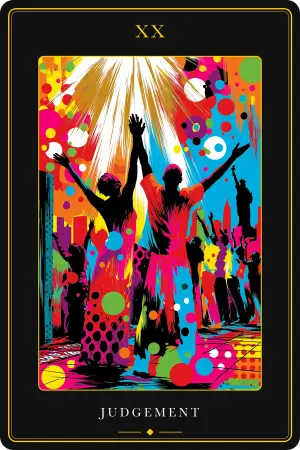


Major Arcana · 22
The World
The observation deck at dusk: the whole city opening below you at once, and for this moment, holding you.
Read the complete guide: The World Arcana in Tarot: A Complete Guide to Its Symbolism and Meaning
Card at a glance
- Numerology
- XXI
- Element
- Earth
- Astrology
- Saturn
- Kabbalistic path
- Tav (Yesod → Malkuth)
- Timing
- Completion · the close of a long cycle
- Yes / No
- A resounding yes
Upright
Completion
Arrival
Wholeness
Integration
Achievement
Homecoming
Belonging
Celebration
Reversed
Incompletion
Lack of closure
Stalled projects
Hollow arrival
Loose ends
Restlessness
Fear of closing
Imbalance
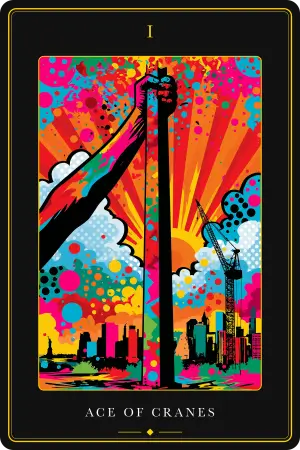
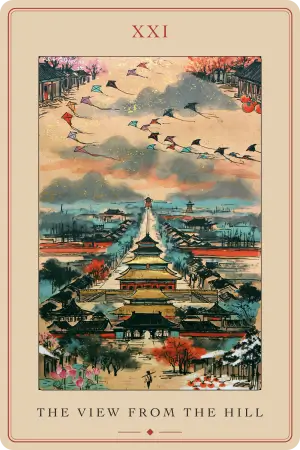
The World in each deck
Every deck reimagines the same archetype. Compare the art, then open a deck to read its full interpretation.
Imagery and symbolism
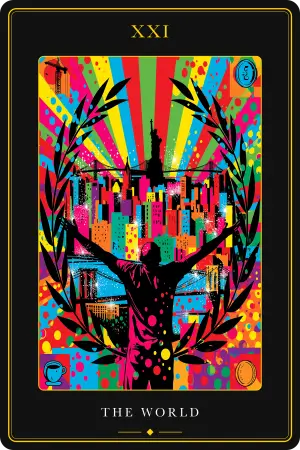
The Tarot of New York City stages The World not as a dancer in the clouds but on a rooftop at dusk, at the center of the five boroughs. A figure stands with arms flung wide toward the skyline, seen from behind. We get the back and not the face because the card wants the reader to step into the pose: this arrival is yours. Where the Rider–Waite–Smith card floats its androgyne in a laurel wreath among clouds, here the same triumph is planted on the city itself, and the dance partner is New York.
The figure is framed by a great laurel wreath of black leaves, the old emblem of victory and the closed circle of a finished cycle. In this deck the wreath doubles as a window. The skyline shows through it, as if the whole city were the medal being handed over.
Behind and above, the skyline rises in pop-art color with no single hue in charge, because the card's meaning is the integration of everything: every neighborhood, every culture, every era of the city pressed into one breathing organism. Rays burst outward from the center like a sunrise or the lights of Times Square at midnight, and scattered white bursts read as fireworks, the city celebrating your arrival.
At top center stands the Statue of Liberty, torch raised, the city's own World-figure and the promise to every newcomer now kept. She crowns the composition the way the wreath crowns the RWS dancer. Bridges span both edges of the card, the great suspension spans that stitch the boroughs together, and they carry the card's message of connection: nothing here is an island, not even the islands.
In the four corners, where the older decks place the angel, eagle, lion, and bull, this deck sets the emblems of its four suits: the construction crane (Cranes, fire and the build), the subway token (Subways, the mind and the grind), the blue Greek coffee cup (Cups, feeling and community), and the golden coin (Tokens, earth and money). Their presence means what the four creatures always meant, mastery and balance of all four elements. The figure at the center has learned the build, the feeling, the mind, and the means, and stands whole among them. The dusk-dark border and golden frame place you on the observation deck at nightfall, the city as one lit, living thing, complete and about to begin again.
Core meaning
The World is the last numbered trump and the end of the journey this whole deck tells. In the Tarot of New York City that journey has an address. It began at Port Authority with one duffel bag and a phone at 12 percent, and it closes on the observation deck with the whole grid laid out below. Whatever started off the bus has come full circle: the project is finished and standing, the degree is earned, the version of you who stepped off the bus can now read the city from above.
Every lesson of the previous twenty cards resolves here into one working whole. The card's promise is completion, arrival, and the integration of every borough of the self into a single organism that finally runs in rhythm. When it appears, a major cycle has genuinely closed and the city that tested you is, for this moment, holding you.
But The World is ruled by Saturn, and that keeps the joy honest. This completion is earned at street level, through decades of winters endured, rent paid, and work rebuilt. The wholeness is real because it cost something. Its number carries the same message, since twenty-one is three times seven, material completion multiplied by spiritual completion.
Upright meaning
Upright, The World is the card of arrival, the observation deck at dusk with the bridges lit and every borough breathing in rhythm. It marks the successful close of a major stage: the topping-out, the closing, the opening night, the citizenship ceremony. A dream that once looked like pure Broadway fantasy can actually arrive now. The counsel inside the card is to stop and take the view before you ride the elevator back down. New York trains people to sprint from finish line to starting line without a breath, and The World asks you not to. Mark the completion, close what is closable, and plan the next cycle from this height while you can still see all five boroughs at once.
In love. A relationship arriving at real wholeness, two complete people choosing to be one city with two centers. It is the mature stage past performance, where acceptance is genuine and no one is renovating anyone, and it marks the defining steps: moving in together, the ring, the shared lease, meeting the whole family on the stoop. As an outcome it can be quieter, a bond that has reached its final form or a phase that completes so the next can begin.
In career. The summit after the long climb, the case won, the show closed to acclaim, the training finished, the probation passed. Recognition is public and the reward matches the effort. You now hold the whole system in your head, how every desk connects, which is the skill that separates the people who run things from the people who do them.
In finances. The closed deal, the cleared check, the mortgage's last payment. Income and expenses find the balance this city rarely allows, and the card marks the shift from surviving the economy to being held by it. Its promise is not riches but enough, fully and finally enough.
In health. The whole system in rhythm, energy steady through long days, sleep restoring, the body carrying you up subway stairs without complaint. It often marks a recovery completing, the treatment finished and the checkup clean.
Reversed meaning
Reversed, The World is the tower stopped one floor short of topping out, the crane idle and the permit expired and the ribbon never cut. Something meaningful stays unfinished: a project stalled for one signature, a relationship left in the tunnel between stations, a move planned every January and cancelled every March. There is a harder version too, the outward arrival without the inward one. You got the apartment and the title and the view, and standing at the window you feel like a tourist in your own achievement.
The circle refuses to close for one of two reasons. Either a piece of the self was left behind at an earlier stop, or you are gripping the finished thing so tightly it cannot become the foundation for the next one. Make an honest punch list. Ask what exactly is unfinished, and whether it is a real obstacle or a fear wearing a hard hat. If the achievement feels hollow, the missing piece is almost never another achievement, so look at which of the four engines you have starved, usually the feeling or the rest.
In love. Real feeling with stalled motion, the next step postponed while one or both partners hover at the doors without stepping through. Old chapters may be blocking this one, the ex not fully grieved or the previous city not fully left.
In career. The promotion perpetually next cycle, the project that will not finish, the sense of riding the same loop past the same stations. Sometimes it is stagnation dressed as stability, a role you completed long ago and never left.
In finances. The almost-closed deal that keeps not closing, funds delayed and contracts stuck in review, or money spent to buy a feeling of arrival it cannot deliver.
In health. Systems out of sync, sleep sacrificed to the grind, the checkup postponed for years, the recovery abandoned at ninety percent.
Historical notes
Long before New York gave it a rooftop, The World was one of the most stable images in the deck. In the fifteenth-century Italian decks like the Visconti-Sforza it was a scene of earthly dominion, a celestial sphere held aloft by angelic figures in the language of Renaissance humanism. The lasting structure was set in France, where the Tarot de Marseille titled it Le Monde and fixed the arrangement that held for centuries: a semi-nude figure inside an almond-shaped wreath, framed at the four corners by the four beasts of the Apocalypse.
That central wreath is a mandorla, or Vesica Piscis, the shape made where two equal circles overlap, which the Pythagoreans read as the meeting of heaven and earth. Arthur Edward Waite and Pamela Colman Smith refined the Marseille design in 1909, turning the figure into a dynamic dancer with two wands and binding the laurel with lemniscate ribbons. Crowley went further in 1944, renaming the card The Universe and pulling its focus out from earthly completion to the whole cosmos.
The Tarot of New York City keeps that inherited meaning of culmination and swaps the objects for the city's own. The almond wreath becomes a wreath of black leaves that doubles as a window, the four beasts become four city emblems, and the clouds become a skyline seen from a roof. The heaven-and-earth meeting the mandorla always drew is restaged as an actual city at dusk.
Correspondences
Number. Twenty-one, the last numbered gate of the Major Arcana, which factors as three times seven, material completion multiplied by spiritual completion. In this deck the digits map the city: the 2 is partnership and duality, the two rivers holding the island and the two library lions named Patience and Fortitude; the 1 is the single newcomer with one duffel bag. Summed, 2 and 1 give 3, the number of growth and synthesis, the third thing born whenever two forces meet. Twenty-one is also the age at which American life opens its doors, a fitting number for the card of arrival.
Astrology. Saturn, and no planet suits New York better. Saturn is structure, discipline, and time, the steel and stone and zoning behind the grid. The skyline exists because of Saturnian patience: permits, foundations, load calculations, and workers showing up at dawn in January. The bridges are Saturn made visible, engineering holding millions of daily crossings. The card can mark a Saturn return, the planet's twenty-nine-year circle that so often coincides with a person's first real arrival into their own life.
Element. Earth, grounding the card in Malkuth and the fully manifested world, the place where the blueprint finally crystallizes into something solid, in this deck into steel and pavement.
Kabbalah. The Hebrew letter is Tav, the twenty-second and final letter, on the thirty-second path from Yesod (Foundation) down to Malkuth (Kingdom). It is the lowest and heaviest bridge on the Tree, the conduit through which astral energies precipitate into hard reality, which is exactly what a city is.
Timing and yes/no. The card marks completion and the close of a long cycle rather than a season. As a yes or no it is a resounding yes, the circle closing in your favor.
Psychological perspective
The World describes the psyche at the end of a long integration, the personality that has stopped being a collection of warring neighborhoods and become one city. The ambitious self, the tender self, the analytical self, and the practical self, the deck's four suits, no longer compete for the same block. They run on a shared grid. Such people show a distinctive calm that is completed motion rather than passivity, like a train arrived at its terminal. They tend to have lived several lives in one, careers changed and neighborhoods survived and earlier selves outgrown, and rather than repressing those selves they have kept them all on the payroll.
They know exactly where they came from and are at peace with where they stand. That makes them the natural integrators of any room, the friend who can seat the artist and the banker at the same dinner and make it work, and their tolerance is earned the honest way, by having been broke and flush and new and established at different stops along the line.
The shadow of the card is precise. Completion can calcify. The integrated self may resist the next disruption exactly because the current arrangement took so much to build, becoming the psychological version of the neighborhood that fights every new building. There is a risk of retiring the spirit too early, mistaking the observation deck for a residence. The view from the top is for orientation, not for living. A World personality gone static becomes a beautiful skyline photo of a person, framed and no longer changing. The work of the card is to let the finished self become the foundation for the next journey.
The World across decks
Tarot de Marseille. Titled Le Monde, the card centers a semi-nude figure inside a mandorla, the Vesica Piscis read as a cosmic womb and a portal between heaven and earth, with the four apocalyptic beasts anchoring the corners. This is the geometry every later deck inherited.
Rider–Waite–Smith. The 1909 refinement makes the figure a dancing androgyne wreathed in green laurel, two wands in hand, the ribbons tied into lemniscates so the card reads as a closed loop. The Tarot of New York City keeps that dancer's open-armed pose but turns the body away from us and sets it on a rooftop, so the reader can step into the arrival.
Crowley-Thoth. Crowley renamed it The Universe and Lady Frieda Harris abandoned flat allegory for sweeping lines of cosmic force, staging the Orphic creation myth of Eurynome and setting the early periodic table at the base, matter born from the divine dance.
Tarot of New York City. The green laurel becomes black laurel doubling as a window onto the skyline, the four beasts become the crane, subway token, coffee cup, and coin, and the mandorla's meeting of heaven and earth becomes an actual city seen from an actual roof at dusk. The victory wreath turns to the black leaves of a night skyline, and the function holds: culmination and the harmonizing of opposites.
In combination and context
The most charged pairing is The World with the Newcomer, this deck's Fool, the end of the journey meeting its start. The Newcomer is the kid off the bus at Port Authority with everything still ahead; The World is that same person on the deck with the whole grid mastered. Together they hand the querent a master key: you have earned the right to begin again at a far higher level, using one completed cycle as the launchpad for the next. In this city that reads as the founder after the sale starting the next venture, or the person who did the shadow work and can now risk real vulnerability again. Both reversed, it is a purgatory between stations, refusing to close the old chapter and using that as an excuse to dodge the new leap.
Against the Wheel of Fortune the difference is instructive. The Wheel is the external turning of fate, luck outside your control, while The World is the internalized mastery of those same cycles, an earned and far more permanent resolution. Paired with the Chariot it is the destination after the drive, the point where the armor comes off because the ride is over. Sitting right after Judgment, it is the final integration the awakening was pointing toward.
Because this deck ends where it began, at midnight with a countdown, The World read as an outcome always carries the next arrival inside it. The ball drops, the crowd reaches zero, and the same second becomes a beginning. You arrived, and the city held you, and now it begins again.
Questions for reflection
- What cycle in your life has genuinely closed, waiting only for you to stop and take the view before the elevator down?
- Which of the four engines, the build, the feeling, the mind, or the means, have you starved on the way to this arrival?
- If you measured the distance from your own Port Authority moment to where you stand now, what would that number actually be?
The general meaning follows the Rider-Waite-Smith reading, the reference used across Tarot Academy. Open a specific deck above for its own interpretation.
Frequently asked questions
Explore the Tarot
Latest Posts
Discover the ancient wisdom of tarot cards and unlock the mysteries of your spiritual journey. Our blog is your gateway to understanding the rich symbolism, meanings, and practical applications of tarot reading.




















































