
 EN (English)



Major Arcana · V
The Hierophant
Pamela Colman Smith's blessing elder, sacred tradition rendered as the bridge from divine wisdom to shared doctrine.
Card at a glance
- Numerology
- V
- Element
- Earth
- Astrology
- Taurus · ruled by Venus
- Kabbalistic path
- Vau (Chokmah → Chesed)
- Timing
- Spring · Taurus season
- Yes / No
- Neutral · seek counsel
Upright
tradition
institution
education
conformity
spiritual guidance
mentorship
orthodoxy
belonging
Reversed
unconventionality
rebellion
dogma
restriction
hypocrisy
breaking free
personal beliefs
The Hierophant in each deck
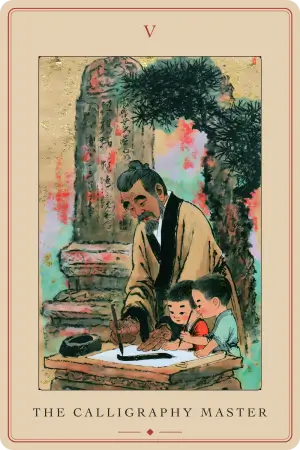
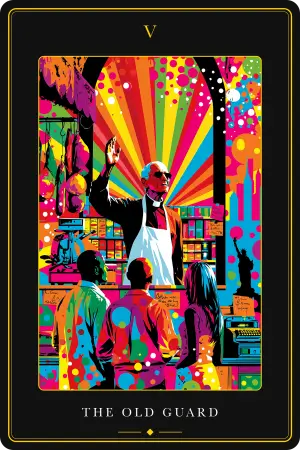
Every deck reimagines the same archetype. Compare the art, then open a deck to read its full interpretation.
Imagery and symbolism
Pamela Colman Smith drew the Hierophant in 1909 as a blessing elder enthroned between two grey stone pillars. Where she framed the High Priestess with the stark black and white columns of Boaz and Jachin, here the pillars are a matched grey: the balance of light and shadow, earth and sky, the material and the spiritual settled into the fixed architecture of institutional law. A plain temple wall closes the scene behind him, holding the eye on the seated figure and the ritual in front of him.
He wears the three-tiered papal tiara. Read outwardly it is the Holy Trinity or the three worlds of earth, heaven, and hell; read inwardly it is dominion over the physical, mental, and spiritual levels of existence. Smith shaped its crest into a form occultists read as the Hebrew letter Vav, the letter that names his Kabbalistic path, and set three small nails projecting from it for the crucifixion.
His right hand rises in benediction, index and middle fingers lifted, ring and little fingers folded, the same 'As above, so below' sign the Magician makes. It marks him a pontifex, a bridge-builder between the divine and the human, and says plainly that some of his knowledge is shown openly and some kept back. His left hand holds a golden triple cross, a staff of three bars for the ordered handing-down of sacred teaching; the gold reads as the purity of that authority.
Smith robed him in red and white, a red outer mantle for active spiritual service over a white vestment for purity, his white hair and beard signaling age, wisdom, and earned authority. Two crossed keys lie on the floor at his feet in the shape of an X, one gold and one silver, the solar conscious mind and the lunar subconscious that together open and close the deeper mysteries. Kneeling before him are two tonsured monks, one robed in red roses for passion and desire, the other in white lilies for purity and clear thought. They make this the first Major Arcanum to show a community, an elder passing structured knowledge to willing students.
Core meaning
The Hierophant is orthodox tradition, institutional teaching, and the hierarchy that carries belief from one generation to the next. His deeper office is translation: he takes the blinding force of divine wisdom and renders it into doctrine an ordinary mind can hold and use safely. In the Rider-Waite reading he is the mentor who helps a person set their private beliefs inside a larger religious framework, a keeper of sacred knowledge tied to the foundations of society.
He sits between The Emperor, who rules the secular world by law, and The Lovers, who make their own autonomous choice. His developmental task is to teach belonging: the traditions, morals, and conventions that let a person operate inside a community. To draw him is to be pointed toward established structure, a mentor, a faith, or an institution, and asked what you still need to learn from those who came before.
Upright meaning
Upright, the Rider-Waite Hierophant favors tradition, shared values, and learning inside an established system. He counsels respect for recognized rules, a qualified teacher, and the accumulated wisdom of an institution over improvising alone. There is real comfort in his structure and ritual, the safety of proven ways, and often a call to undergo training or take on a formal role.
In love. A relationship built on shared beliefs and cultural or religious compatibility, weighted toward long-term stability over fleeting passion. It shows mutual respect and a willingness to accept serious responsibilities, and can signal a formal milestone such as an engagement or wedding.
In career. Work within the system. Align with the company's culture, follow proven procedures, find a mentor, and use established networks; the card often points to formal education or certification as the route to advancement.
In finances. Conservative and long-range. It favors traditional banking, steady accumulation handled as a strategy passed down through the family, and careful planning, and it warns against high-risk ventures.
In health. Discipline and traditional care. This is the card of the trainer, nutritionist, or coach, of a steady regimen and formal practices like yoga or meditation, treating the body as a temple to be protected from careless living.
Reversed meaning
Reversed, the Hierophant turns toward the unconventional. It can mark a healthy rebellion against inherited scripts, a decision to follow your own conscience, or a life that rejects the standard template. Its harder face is dogma and hypocrisy, tradition weaponized to control or exclude, and a stubborn refusal to adapt.
In love. A bond outside the conventional mold, whether polyamorous, queer, or simply uninterested in marriage and the nuclear family. In darker readings it warns of hypocrisy, infidelity, or a partner using rigid gender roles to dominate, or a routine grown so stifling it constricts both people.
In career. Feeling stifled by red tape, bureaucracy, or an inflexible workplace. The card can nudge you toward self-employment or toward challenging outdated policy, though it also warns when clinging to obsolete methods is what stalls your progress.
In finances. A move away from the conservative playbook, into independent contracting or alternative assets. The caution is that instability here often comes from rash rule-breaking or from a stubbornness that refuses any new source of income.
In health. Questioning a standard prescription in favor of a less conventional approach, or the opposite trap of an obsession with fitness or an ideal physique that hardens into over-exercising, severe dieting, or self-punishing control.
Historical notes
He reached Smith's drawing board as Le Pape, the Pope, the fifth trump of the older French decks. In the Visconti-Sforza cards of around 1450 he sits in full papal regalia with the triple tiara and the keys, an image drawn straight from a Church that then ruled the Papal States as a political power. Standardized in the Tarot de Marseille, he became a bearded elder in red and blue blessing two tonsured acolytes, and censors often balked at him: Protestant regions swapped him for Jupiter in the Besançon deck and for Bacchus in the Vandenborre.
The rename came with the French occult revival. In 1781 Court de Gébelin recast the Pope as Le Grand-Prêtre, and in 1856 Eliphas Levi dubbed him the Grand Hierophant, borrowing the title of the chief priest of the Eleusinian Mysteries; the Greek hierophantēs was the one who showed the sacred things to initiates. Arthur Edward Waite took that reframing and, guided by the Hermetic Order of the Golden Dawn, had Smith render the figure as a universal revealer of mysteries rather than the Roman pontiff, keeping the papal shape while loading it with Kabbalistic and astrological meaning.
Smith's 1909 plate then became the template almost every later deck copies. Collectors trace its printings from the prized 'Pam A' of 1910-1920 through the recut editions of the 1920s and 1930s, and after U.S. Games Systems acquired the rights in 1971 the recolored versions multiplied: the vivid Albano-Waite of 1968, the soft Universal Waite of 1990, the luminous Radiant Rider-Waite of 2003, and the Smith-Waite Centennial of 2009, which restores the muted 1909 palette and puts the artist's name first. Through every repainting the Hierophant's pose, tiara, keys, and kneeling monks stay fixed; only the color and line weight change.
Correspondences
Number. He is V, the quintessence that rises above the four elements, and also the number of instability and the friction of bridging matter and spirit. The struggling minor fives, of Wands, Cups, Swords, and Pentacles, are the disruptions his structure exists to contain: the grieving figure of the Five of Cups seeks his counsel, the outcasts of the Five of Pentacles seek shelter in his church.
Astrology. Taurus rules him, the fixed earth sign of endurance, patience, and resistance to sudden change. Its ruler Venus softens the authority, tying his laws and rituals to shared values, comfort, and social harmony, which is why he governs marriage and brick-and-mortar institutions alike.
Element. Earth. His is the stable, unmoving ground that preserves systems and outlasts trends.
Kabbalah. He holds the 16th path, from Chokmah (Wisdom) to Chesed (Mercy). His Hebrew letter is Vau, the nail, and like a nail joining two boards he fixes ethereal truth to the material plane, translating raw divine wisdom into merciful, usable doctrine.
Elemental dignity. Beside Pentacles his earthy stability roots further into money and institutions; beside The Lovers he points toward formal, sanctioned commitment.
Psychological perspective
On the Fool's Journey, the Hierophant is the step out of the childhood home and into society. Having met the nurturing Empress and the rule-setting Emperor as archetypal parents, the Fool now faces formal education, cultural conditioning, and the belief systems of the wider group. Here he learns to belong, to sublimate his own chaotic wants to a shared code, before he is ready for the independent choice of The Lovers that follows. The move from this card to the next is the shift from adopting external values to defining internal ones.
Jung casts him as the Wise Old Man, the mentor who distills experience into teachable lessons, though the same figure also carries the Persona and the machinery of institutional belief. He is the exoteric, outward path to the sacred, offering ritual, scripture, and a congregation, where the High Priestess is the inward, intuitive route. His central danger is getting stuck: outsourcing your moral compass to an authority forever instead of doing the lonely work of thinking for yourself.
The Hierophant across decks
Tarot de Marseille. Le Pape is Smith's direct ancestor, a bearded elder in red and blue raising his hand over two kneeling acolytes, the Church rendered plainly as a trump. Smith kept his posture and his two students and traded the overt Catholic reading for Golden Dawn symbolism.
Crowley-Thoth. Painted by Lady Frieda Harris between 1938 and 1943, this Hierophant breaks sharply from Smith's. Crowley plants him in Taurus, backed by a bull and an elephant and ringed by the four cherubs of the Powers of the Sphinx. His wand carries three interlaced rings for the Aeons of Isis, Osiris, and Horus, the child Horus rides in a pentagram over his heart, and a sword-bearing woman, his Babalon, stands before him.
Modern decks. Kim Krans's Wild Unknown reduces him to a crow perched on a key as a jagged current charges it from above. Motherpeace makes him a female crone and teacher, while the Hierophanies and Queer Witch decks recast him as a non-binary elder initiating others into chosen family, a reminder that even rebel communities build their own traditions. Each departs from a shape Smith's plate fixed in 1909.
In combination and context
The Hierophant's fixed, earthen weight colors every card near it. Set beside The Emperor he doubles into pure systemic control, moral authority fused with legal power, the face of church and state together. Paired with The High Priestess he balances his outward tradition against her inward mystery, the exoteric and esoteric completing each other.
With The Lovers he reads as formal marriage or a bond rooted in shared morals and social approval. With Death he is the painful, necessary tearing-down of an old tradition, and with The Tower he becomes the collapse of a trusted institution or a full crisis of faith. Beside The Fool he flips into a wilder lesson: learn the rules thoroughly so you can break them well.
As a straight yes or no he stays neutral and sends you to counsel first. Consult the lawyer, doctor, or mentor and check the action against the established rules; if it fits the system the answer leans yes, and if it breaks the system the answer leans no.
Questions for reflection
- Which traditions or teachings still serve you, and which have you outgrown?
- Where are you handing your judgment to an authority instead of deciding for yourself?
- What rules do you need to learn well before you earn the right to break them?
The general meaning follows the Rider-Waite-Smith reading — the reference used across Tarot Academy. Open a specific deck above for its own interpretation.
Frequently asked questions
Explore the Tarot
Latest Posts
Discover the ancient wisdom of tarot cards and unlock the mysteries of your spiritual journey. Our blog is your gateway to understanding the rich symbolism, meanings, and practical applications of tarot reading.




















































