
 EN (English)



Major Arcana · XIV
Temperance
The Rider-Waite angel who pours the soul back and forth until its opposites settle into one current.
Card at a glance
- Numerology
- XIV
- Element
- Fire
- Astrology
- Sagittarius · ruled by Jupiter
- Kabbalistic path
- Samekh (Yesod → Tiphereth)
- Timing
- Early winter · Sagittarius season
- Yes / No
- Yes, but slowly · in time
Upright
balance
moderation
healing
reconciliation
adaptation
purposefulness
patience
inner peace
Reversed
excess
imbalance
impatience
stagnation
avoidance
indecision
self-indulgence
Temperance in each deck
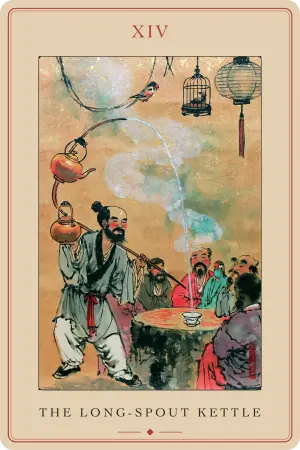
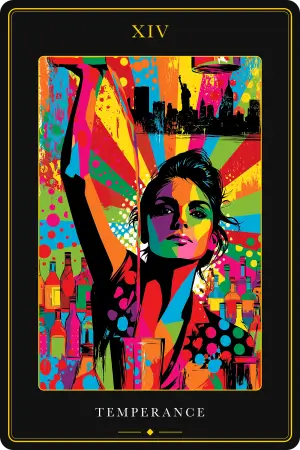
Every deck reimagines the same archetype. Compare the art, then open a deck to read its full interpretation.
Imagery and symbolism
Pamela Colman Smith's 1909 rendering is the version most readers picture when they hear the card's name, and it repays a close look. A winged angel stands with one foot planted on the bank and the other set into a flowing pool, straddling the material world and the emotional depths and managing the current between them. Red wings rise behind the figure and green grass spreads at its feet, and the deck reads the pair together: red for passion, desire, and action, green for growth, fertility, and healing, the two colors asking for balance between an active and a passive life.
The angel holds two cups and pours water between them in an unbroken stream, the transfer of life energy and the endless cycle that keeps change and adaptation moving. On its chest a triangle sits inside a square, the union of spirit and matter, the old 'as above, so below.' A sun blazes on the angel's brow for enlightenment, intuition, and wisdom, the meeting of the divine and the earthly, and a halo marks the figure's sacred origin.
The background carries the journey. Yellow irises crowd the bank, flowers of communication and the exchange of ideas and feeling that keep a relationship in tune, their yellow standing for intellect and inspiration. A bright star behind the angel is spiritual guidance and hope. A path runs back toward two mountain peaks, the long walk toward self-knowledge, the peaks reading as the masculine and feminine principles a person has to reconcile and the challenges that inner balance lets you climb.
Core meaning
In the Rider-Waite deck this card is built on moderation and the ability to unite opposites into wholeness. It carries understanding, purposefulness, inner peace, and reconciliation: the pursuit of balance between opposing forces, patience, adaptation, and fairness, the art of moderation across every part of life.
The deck frames it as a stage in the Hero's journey. After the ego death of the card before it and a deep transformation, the Hero turns from outward growth to inner growth, and Temperance is where that turn happens. Its archetype is the Angel, the Soul Guide, the Healer, the one who knows the sure path to a wholeness that was lost. The work is not to defeat the opposites inside you but to blend them, complete renunciation and absolute excess measured against each other until they meet in the middle. Balance here is a flow of energy between spirit and body, conscious and subconscious, and the card's healing power is exactly this: restoring the connection between the fragmented parts of a person.
Upright meaning
Upright, the card counsels moderation, patience, and the middle way. It favors steady, organic progress over force and often marks a real stretch of healing, energies that had swung to extremes brought back into calibration. A person under this card finds balance where others lose it and makes thoughtful decisions from a place of composure.
In love. Equal give-and-take built on trust, mutual respect, and attraction, and development that unfolds at its own pace. The yellow irises are the reminder here: a bond stays harmonious through the honest exchange of ideas and feeling.
In career. Diplomacy and the careful management of competing interests, progress earned through patience and teamwork rather than a single explosive push. If you are stretched thin, the card advises stepping back to recalibrate the balance between work and rest.
In finances. The middle way against high-risk bets and impulse. It asks for a measured, unhurried approach where income and expense are kept in proportion.
In health. Recalibration and recovery. The card supports rest, sobriety, and the slow integration of recent strain, moderation in eating or exercise rather than any lurch to an extreme.
Reversed meaning
Reversed, the alchemy fails. The two cups no longer feed each other and the current stalls or spills, so the reading turns to imbalance, excess, and the loss of the composure the upright card holds.
In love. A lopsided dynamic where one partner drains the other, sharp emotional swings, and a shortage of the mutual respect the upright bond rests on.
In career. Impatience and rushing an outcome that needs organic time, or the opposite trap the deck warns of: a pursuit of harmony so cautious it becomes stagnation and a refusal to take on new challenges.
In finances. Overspending and high-risk gambles, a swing to extremes instead of the balanced, proportioned approach the card wants.
In health. Overindulgence pushed to a destructive edge, or a physical imbalance that a real return to rest and moderation would settle. At its subtlest the reversal is avoidance, using the language of peace to dodge a decision or a conflict that has to be faced, and calling that paralysis balance.
Historical notes
Temperance began as an earthly virtue. In the fifteenth-century Italian decks, the Visconti-Sforza and the Charles VI, she is a human woman diluting wine with water, one of the cardinal virtues beside Justice and Fortitude. The gesture was practical before it was symbolic, since crude Renaissance wine often had to be cut with water to be drinkable, and it came to stand for the Aristotelian golden mean and the regulation of appetite.
In France the Tarot de Marseille turned the woman into a winged angel. Following directly after Death in the sequence, this angel reads as a psychopomp greeting the soul beyond physical death, and the mixed water and wine took on the weight of the Eucharist. The occult revival then loaded the card with alchemy. Etteilla's 1789 deck, the first built for divination, gave the angel a sun on its brow and feet resting on rocks for salt and sulphur, and Oswald Wirth later poured the 'vital fluid' between a gold and a silver urn to picture solve et coagula, the blending of solar reason and lunar imagination. Waite and Pamela Colman Smith gathered all of it into the 1909 image, keeping the sun on the brow, the water between two cups, and the angel astride land and pool, and it became the template every later deck answers to.
Correspondences
Number. XIV, the fourteenth trump, the restorative pause set between Death and The Devil.
Astrology. Sagittarius, the mutable fire sign ruled by Jupiter. Novices often expect Temperance to fall under Libra's scales, but the card is the active blending of volatile energies, not the passive weighing of facts, and Sagittarius the centaur, half human and half beast, mirrors the harmonizing of intellect and instinct. The sign's reach toward distant horizons, new knowledge, and the search for truth gives the card its themes of growth, tolerance, and a philosophical read on life, the balance between social adaptation and personal aspiration.
Element. Fire, the passion and vital energy the card learns to temper rather than smother.
Kabbalah. The Hebrew letter is Samekh, meaning 'prop' or 'support,' on the twenty-fifth path that runs vertically from Yesod (Foundation, the Moon) up to Tiphereth (Beauty, the Sun). Called the Intelligence of Probation, it is the testing ground where the soul is heated and cooled like steel in a forge, made strong enough to bear the divine yet flexible enough not to shatter.
Timing. The card points to Sagittarius season and to slow, organic timing. As a yes or no it answers yes but slowly, an outcome that needs time to unfold.
Psychological perspective
The Rider-Waite meaning reads this card as a mature personality, someone who can balance their own emotions and hold stability on the emotional, physical, and spiritual levels at once. They seek harmony and step around destructive situations, they manage their feelings rather than being run by them, and their composure and thoughtful decisions are exactly what makes them attractive to others. They find balance where other people lose it, which is why the deck ties the figure to healing.
The card carries a real shadow, and the deck names it plainly. The same pursuit of harmony can limit the appetite for risk and new challenges, tipping into stagnation and a stalled life. It can show up as an inability to decide or a fear of transformation, and the quest for balance can quietly become a way to avoid reality: someone so set on dodging conflict and hard choices that a fear of disturbing the peace leads them to ignore problems, which only breeds more problems. True balance, the card insists, is not the flattening of every intensity into a cautious middle.
Temperance across decks
The Rider-Waite-Smith angel is the reference point later decks push against, so its choices stand out most in comparison.
Tarot de Marseille. The winged angel Smith inherited, following straight after Death and pouring liquid between two vessels. Waite kept the psychopomp's posture and the mixed waters but foregrounded the alchemical reading over the funerary one.
Crowley-Thoth. Crowley and Lady Frieda Harris renamed the card 'Art' and pushed it from moderation to full metamorphosis. A dual-faced alchemical androgyne, the fusion of the Emperor and Empress, pours fire and water together into a boiling golden cauldron, the most explosive picture of solve et coagula in any deck, where the Rider-Waite version keeps the same operation calm and continuous.
The Wild Unknown. Kim Krans strips out the angel entirely. A great blue heron stands with one wing over a bright orange flame while blue droplets fall toward it, and because of the bird's steady presence neither element destroys the other, a naturalistic echo of the balance Smith's angel holds between land and pool.
Goddess and modern decks. The Motherpeace Tarot casts the card as an initiated shaman controlling opposites, and Ellen Lorenzi-Prince's Dark Goddess Tarot names it for Brigid, the Irish goddess of the forge and the sacred well who is fire and water at once, shifting the card from the angelic rescue Rider-Waite pictures toward innate, earth-based healing.
In combination and context
Temperance sharpens against the cards it meets. Beside The Devil, which sits right after it in the sequence, it acts as the antidote, suggesting the chains that seem to bind the querent are actually loose and can be slipped off through boundaries and healing. Reversed next to The Devil, though, it confirms the opposite, a genuine addiction or a toxic bond spiraling out, where intense trauma-bonding is being mistaken for passion.
With Justice the two balances divide the labor: Justice is the external, objective cut of law and consequence, Temperance the internal, subjective blending through intuition and time, and together they ask you to align your outward actions with your emotional truth. With The Fool it makes 'inspired action,' the bold leap taken with patience and a safety net, though reversed the pair warns of violent swings between recklessness and paralysis. With The Magician it supplies the endurance and exact formula that turn his initial spark of will into something that lasts.
Temperance is also a frequent 'stalker' card, turning up again and again to name a lifestyle out of balance: a call toward sobriety, a demand to stop rushing and rest before burning out, and sometimes a pointed message to stop obsessively pulling cards and let things unfold.
Questions for reflection
- Which two opposing parts of yourself are you trying to make one side win, when the real work is letting them coexist?
- Where has your pursuit of harmony quietly become avoidance, ignoring a problem to keep the peace intact?
- What in your life needs slow, patient tempering right now rather than another push forward?
The general meaning follows the Rider-Waite-Smith reading — the reference used across Tarot Academy. Open a specific deck above for its own interpretation.
Frequently asked questions
Explore the Tarot
Latest Posts
Discover the ancient wisdom of tarot cards and unlock the mysteries of your spiritual journey. Our blog is your gateway to understanding the rich symbolism, meanings, and practical applications of tarot reading.




















































