
 EN (English)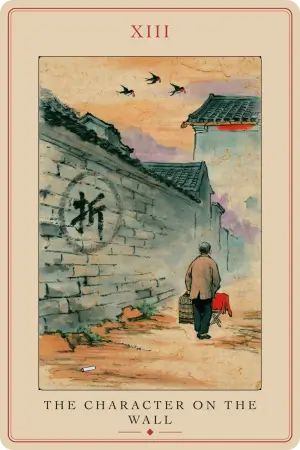


Major Arcana · 15
The Long-Spout Kettle
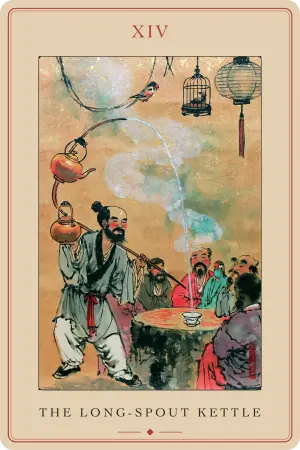
Balance as craft: a teahouse master pours boiling water down a metre-long spout into one small cup, not a drop lost.
Card at a glance
- Numerology
- XIV
- Element
- Fire
- Astrology
- Sagittarius · ruled by Jupiter
- Kabbalistic path
- Samekh (Yesod → Tiphareth)
- Timing
- Late autumn · Sagittarius season
- Yes / No
- Yes, with patience
Upright
balance
moderation
mastery
patience
healing
precision
harmony
the perfect pour
Reversed
imbalance
spillage
showing off
haste
excess
burnout
stagnation
the broken arc
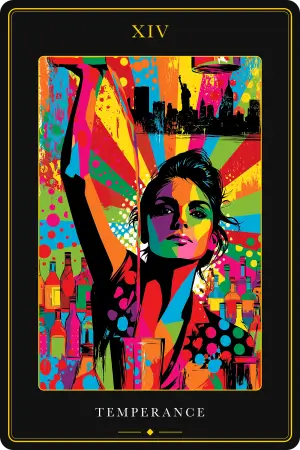
The Long-Spout Kettle in each deck
Every deck reimagines the same archetype. Compare the art, then open a deck to read its full interpretation.
Imagery and symbolism
In the Tarot of Beijing there is no angel on the riverbank. Temperance has walked into a teahouse, and the balancing of opposites is performed nightly, for a few coins, by a man in a plain grey robe with a red sash. He is the Long-Spout Kettle: a teahouse master who pours boiling water from a metre-long copper spout in a single arc over his own shoulder, across the table, into a small gaiwan. Not one drop is lost, not one leaf disturbed. The whole theology of the card sits in that substitution. Where Rider-Waite shows a miracle, Beijing shows a skill.
The spout is the card's central symbol, standing in for the angel's two golden cups. Water travels the entire width of the card as one silver arc, the transfer of life energy made visible. The length of the copper is the length of trust: between effort and result there is distance, and the master has made peace with it. Two kettles do the work of the angel's two vessels, one raised high on the spout and one held low, heaven and earth and the pour that joins them.
He pours the scalding water inches past his own neck and keeps smiling, because balancing opposites is not done from a safe distance. Steam rises through the middle of the card, tinged with teal, the soft twin of the hard silver line, and where the angel had wings the water has them here. A caged bird and a free bird hang side by side in the same warm air, discipline and freedom at rest together. A round paper lantern with a red tassel replaces the RWS crown on the horizon: guidance is a lamp already over the table, not a light to travel toward. The customers watch and do not applaud. They breathe out.
Core meaning
The Long-Spout Kettle is Beijing's Temperance, and the deck's whole claim is that equilibrium is a craft rather than a visitation. The card keeps every meaning of the older Temperance, moderation, harmony, the pouring of one vessel into another, the reconciling of fire and water, but insists that such balance is learnable and human. No angel arrives to mix the waters. A man who has repeated one gesture ten thousand times does it instead, and the sacred is whatever survives that much practice.
Harmony here is active, not the absence of force. The master neither puts out the fire under the kettle nor fears the water inside it. He arranges their meeting so exactly that the result is neither scald nor cold, only tea. This is balance as delivery: force carried precisely, opposites poured through one another, the enormous flourish spent entirely on filling a tiny cup. In the deck's story of the Newcomer, this is the stage after loss, the card that follows the chalked demolition notice of arcanum 13. After something has been torn down, the Long-Spout Kettle is the first hot cup, the daily gesture that recombines a broken week into something whole.
Upright meaning
Upright, the card asks for exactly the gesture it depicts. You are being asked to combine forces that seem incompatible, heat and calm, speed and precision, ambition and patience, and it promises you can, because the skill is already in your hands. This is equilibrium found through practice rather than luck: things land where they are aimed. It is also a time of quiet healing, since the water poured here restores. Do the thing you know how to do, completely and without hurry. Trust the distance between your effort and its result, and refuse spectacle to serve the cup.
In love. The relationship as a shared pour: two different elements meeting daily in a gesture that has grown graceful with practice. Passion has not cooled, it has learned aim, so feeling arrives at the right moment in the right cup and neither partner is scalded. Care is expressed through measure, the remembered preference, the tea poured just as the story gets hard to tell. Balance in love is re-poured every day, and that is its beauty rather than its burden.
In career. A professional in command of the gesture, a stretch where skill honed by long repetition begins to look like ease. Tasks land where aimed, deadlines are met without visible strain, and colleagues start bringing you the scalding matters because in your hands they arrive manageable. The card favours craftsmanship over hustle and rewards work done calmly under observation. It is a strong time to teach your gesture to an apprentice, or to apprentice yourself to a longer spout than your own.
In finances. The perfectly measured pour, income and expense meeting in a steady, unspilled stream. It favours budgets kept, instalments paid on time, and earnings that come from craft, from skill practised until it pays. Money decided now, calmly and at the right distance from emotion, lands where aimed. Patience is profitable, so let long-term arrangements complete their arc, and pay masters what mastery costs.
In health. What the card depicts: measure, warmth, and the mastered gesture. Health is built the teahouse way, through exact and modest daily practice rather than heroic campaigns. It favours disciplines of stillness in motion, tai chi at dawn, qigong, swimming, walking the long lane, and it prescribes the right temperature and the right amount, warm food, regular hours, nothing to excess and nothing to zero.
Reversed meaning
Reversed, the arc breaks and the kettle spills. Boiling water lands on the table, on a hand, anywhere but the cup. The card points to a gesture attempted beyond current skill, or a real skill corrupted by the wish to impress. Fire and water quarrel instead of cooperating. Sometimes it is overload, too many cups promised to one kettle, and sometimes the opposite, tea gone cold from endless hesitation, patience turned to stagnation. Something is being poured from too far away, with too much flourish and too little aim. Shorten the spout, come closer to the task, drop the performance, and restore measure in small daily corrections rather than one grand adjustment.
In love. The pour is off. One partner boils while the other has gone cold, so feeling arrives as scald or not at all. It can show grand gestures over empty cups, anniversaries performed for an audience while the daily attention stands dry, or the metre of distance turned pathological, one partner serving the other impeccably from far away with all courtesy and no closeness. Come close, be imprecise, hand your partner the kettle sometimes.
In career. Something is spilling. The card indicates overload or its twin, burnout, the master pouring on autopilot, precise and absent, the craft gone joyless. It can show a workplace that prizes performance over delivery, theatrical meetings and empty cups, with the fire burning all night and the water running cold at home. Return to close, exact, unglamorous tasks and finish them, decline the next spectacular commitment, and treat rest as part of the gesture.
In finances. The kettle spills money. It warns of finances handled with flourish instead of aim, impressive spending and spectacular commitments over a wet table, or the reverse, resources left to go cold in indecision while opportunities steep too long and turn bitter. Everything may be pouring toward one glamorous project while the ordinary cups of rent and savings stand empty. Bring your money close, count it plainly, and postpone every grand gesture until the hand is steady.
In health. Balance lost at one extreme or the other, overtraining or total stillness, scalding regimes or cold neglect, sleep boiled away by late fire and mornings gone lukewarm. Stress may express itself in the body exactly where a pourer would feel it, tension held in the shoulders and hands. Crash diets and spectacular fitness challenges are the grand arcs this card distrusts. Rebuild from close range, regular meals, warm water, one modest practice repeated daily.
Historical notes
Temperance began as an earthly virtue, not an angel. In the hand-painted Visconti-Sforza deck of about 1450 she is a human woman, possibly a serving maid with braided hair and rolled stockings, diluting wine with water between two identical Majolica pots. Fifteenth-century wine was often undrinkable until tempered, so the act carried a plain domestic sense before it carried any esoteric one, the Aristotelian golden mean, the regulation of appetite. As the Tarot moved to France and settled into the Marseille pattern, a winged angel replaced the woman, working as a psychopomp who greets the soul after the Death card, and the mixing of water and wine was reread as the Christian Eucharist.
The occult revival added the alchemy. Etteilla's 1789 deck was the first to link the card to alchemical work, giving the angel a sun motif and feet resting on rocks for salt and sulphur, and Oswald Wirth later described the pour as vital fluid passing between a gold solar urn and a silver lunar one, the formula solve et coagula. The 1909 Rider-Waite-Smith card gathered all of this into one image, an androgynous angel with one foot on land and one in water, pouring between two golden cups beneath the Tetragrammaton, a winding path leading to a crowned mountain.
The Tarot of Beijing takes the reframing one step further and removes the angel entirely. The one figure between fire and water is now a teahouse master in a grey robe, and the cosmic operation is performed for customers who pay in small coins. The card keeps the RWS grammar, two vessels, the crossing stream, the union of elements, but relocates it from heaven to a round table, arguing that the miracle was always a skill.
Correspondences
Number. XIV, and in this deck the number is poured rather than written. The 1 is the arc, a single unbroken stream, one gesture and one continuous line of water that cannot be corrected once begun, like a brushstroke. The 4 is the table, the square stability of the teahouse, the years of daily practice that make one second of grace possible. Together 1 plus 4 reduce to 5, the water while it is in the air, belonging to no vessel for the length of the arc: individual skill grounded in structure, released into confident motion, and landed.
Astrology. Sagittarius, the mutable fire sign ruled by Jupiter, and the deck makes the link literal. The metre-long spout is the archer's bow, the arc of boiling water is the arrow's flight, and the gaiwan is the target struck dead-centre across the table. The sign's fire is present in the boiling kettle and the red sash, but its higher gift is the mastery of that fire, the turning of raw heat into trajectory. Sagittarius also rules the long view, domesticated here into the perfectly travelled metre between kettle and cup, and it governs the 9th House of higher learning, the philosopher-sign teaching by gesture instead of lecture.
Element. Fire, but fire delivered rather than unleashed. The heat under the kettle is real and inches from the master's neck, and the whole art is arranging its meeting with water so the result is tea rather than scald or cold.
Kabbalah. The path of Samekh, the 25th path, whose name means prop or support. It rises vertically from Yesod, the sphere of the Moon and the subconscious, to Tiphareth, the sphere of the Sun and the Higher Self, and tradition calls it the Intelligence of Probation, the testing ground where the soul is heated and cooled like steel in a forge until it is strong enough to withstand the divine yet flexible enough not to shatter.
Psychological perspective
The Long-Spout Kettle describes a psyche in which strong drives and strong discipline have stopped fighting and started collaborating. This is integrated fire: the person has plenty of heat, ambition, feeling, temper, but has built through long practice a channel exact enough to deliver it without scalding anyone, including themselves. They regulate emotion the way the master regulates water, not by refusing to boil but by choosing the moment, the distance, and the cup. Their calm is contagious, and rooms tend to settle when they enter.
The strengths are mature self-regulation, the capacity to act boldly while staying fully controlled, and a steadiness that holds up precisely when everyone is watching, because the skill no longer depends on nerves. The shadow is what happens when mastery calcifies into ritual, the same perfect pour every night and no new gesture risked. Identity can fuse with competence until any spilled drop feels like annihilation, so small public errors become devastating. Measured feeling can shade into rationed feeling, partners and friends receiving exactly enough and never one drop more. The long spout is itself a temptation, keeping everyone at a graceful professional distance so intimacy is quietly replaced by impeccable service. The growth task is to sometimes hand another person the kettle, to be close-range and unrehearsed, and to survive it.
The Long-Spout Kettle across decks
Rider-Waite-Smith. The 1909 card sets an androgynous angel between land and water, pouring a gravity-defying stream between two golden cups, the Tetragrammaton on its breast and a path climbing to a crowned peak. The Long-Spout Kettle keeps that structure of two vessels and a crossing arc but trades the angel for a man and heaven for a teahouse.
Tarot de Marseille. The Marseille Temperance is a winged angel pouring between two vessels, positioned after Death as a psychopomp for the soul. Beijing keeps the pour and the reconciling of opposites while returning the figure to the human, ordinary world the Marseille angel had left behind.
Crowley-Thoth. Crowley renamed the card Art and painted a dual-faced hermaphrodite pouring fire and water into a boiling cauldron, the alchemical marriage carried to explosive synthesis. Beijing shares the alchemy of blended opposites but strips the halo, replacing the cosmic laboratory with a copper kettle and a smiling master paid in coins.
Modern reframings. Kim Krans's Wild Unknown drops the human figure for a blue heron sheltering a flame from falling water so neither destroys the other, and decks such as Motherpeace and the Dark Goddess Tarot recast the card as earth-based shamanic healing. The Tarot of Beijing belongs to that naturalizing movement, but its healer is a working craftsman whose remedy is measure itself.
In combination and context
The Long-Spout Kettle pulls a spread toward patience, healing, and the exact management of opposites. Its neighbours tell you whether the arc is landing or breaking. Beside the Devil, the two sit next to each other in the majors as opposite approaches to desire, and Temperance acts as the antidote, suggesting the chains are looser than they feel and can be slipped through boundary-setting and slow healing. Reversed alongside the Devil it confirms the opposite, an addiction or a toxic bond spiralling, trauma-bonding mistaken for passion.
With Justice, the two balance cards work by different mechanisms, Justice as the sharp external cut of law and consequence, the kettle as the fluid internal blending of elements through time, so together they ask you to align outward action with inner truth. With the Fool, calculated patience meets the leap of faith and the pair reads as inspired action, a bold move executed with a safety net. With the Magician, willpower gains endurance, the spark of creation joined to the exact formula that makes a manifestation last.
When the card keeps returning, read it as the deck asking you to slow down. It stalks people who are burning out, rushing, or over-pulling the cards themselves, and its message is steady: stop forcing the outcome, aim well, let go, and do not chase the water through the air.
Questions for reflection
- Name one fire in you and one water: a drive and a calm, an anger and a patience. Where in your life are you being asked to pour them through one another rather than choose between them?
- Where are you overextended or withholding, pouring from too far with too much flourish? What would it mean to shorten the spout and come close to the task?
- Are you filling cups, or showing the room your arc? What difficult thing could you deliver today in one calm, exact gesture?
The general meaning follows the Rider-Waite-Smith reading — the reference used across Tarot Academy. Open a specific deck above for its own interpretation.
Frequently asked questions
Explore the Tarot
Latest Posts
Discover the ancient wisdom of tarot cards and unlock the mysteries of your spiritual journey. Our blog is your gateway to understanding the rich symbolism, meanings, and practical applications of tarot reading.




















































