
 EN (English)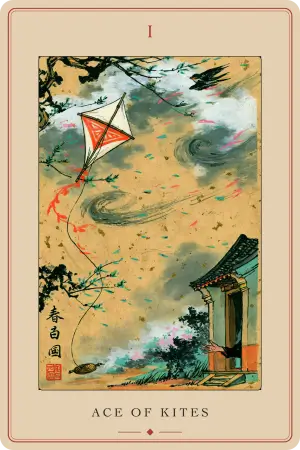


Minor Arcana ·
Two of Kites
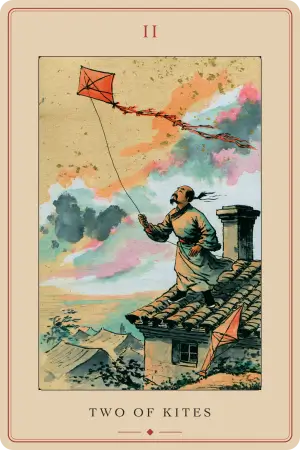
Planning made visible: a flyer on his own roof weighs how much string to give a kite already pulling toward the horizon.
Card at a glance
- Numerology
- 2
- Element
- Fire
- Astrology
- Mars in Aries · first decan (0°–10°, March 21–30)
- Kabbalistic path
- Chokmah (Wisdom) in Atziluth
- Timing
- Spring · Aries season · the first kite-wind
- Yes / No
- Upright conditional yes · Reversed no
Upright
planning
foresight
vision
choice
expansion
strategy
ambition under control
the pull of the horizon
Reversed
indecision
fear of the unknown
stagnation
postponed plans
missed wind
clinging to comfort
no strategy
lost direction
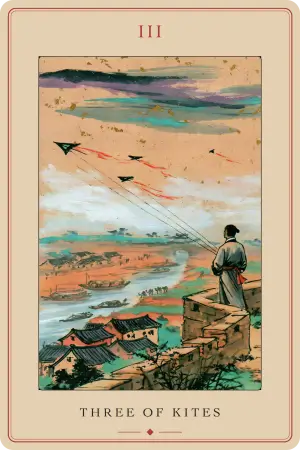
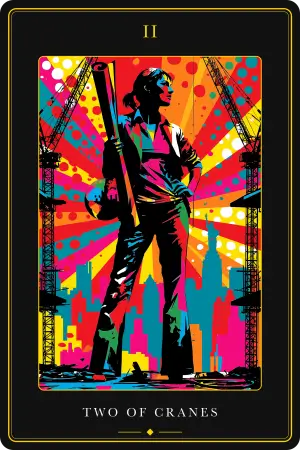
Two of Kites in each deck
Every deck reimagines the same archetype. Compare the art, then open a deck to read its full interpretation.
Imagery and symbolism
In the Tarot of Beijing the Two of Wands becomes the Two of Kites, and the merchant with his globe is replaced by a man on the ridge of his own roof. His footing on the grey tiles is settled and sure: this is his house, his lane, the world he has already earned. His whole body leans upward. In his raised hand he holds the taut string of a vermilion kite flying high above the rooftops, its long tail streaming toward the open horizon beyond the city wall. The kite is will and ambition made visible. The string is the intellect that ties that ambition to the hand, desire kept on a line.
A second kite, identical but furled, rests against the lower slope of the roof by the window. It is the past launch, the venture already flown and brought safely home, proof that his successes are real. It is also a quiet reminder that a kite on the tiles, however well made, moves nothing. Two kites, one choice: keep what is landed, or feed the one that flies. Beside him a massive chimney stands for the hearth of the household, the warmth and stability that make the roof hard to leave. He stands between that chimney and the open sky, which is the whole question of the card.
Below him the grey sea of hutong rooftops and courtyard trees stretches to a pale horizon, the world he already knows laid out like a map. The evening sky is ink-grey cloud washed with pink and teal, flecked with gold on warm kraft paper, the field of possibility itself, turbulent and undecided. Those gold flecks are opportunities riding the same wind, visible only to a flyer who looks up. The vermilion of the kite is the deck's colour of fire and will, the one saturated red in an otherwise muted scene: everything he owns is painted in ink, and only what he wants burns.
Core meaning
The Two of Kites is Beijing's Two of Wands, and it holds the moment between owning a world and wanting a larger one. The Ace was the raw spark of fire. This card is that spark taking its first structured form: vision, planning, and the conscious choice to point one's ambition somewhere. The kite is already aloft and pulling hard, so the question is never whether to have ambition. The question is how much string to let out, and in which direction.
Where the canonical Two of Wands shows a lord who has conquered his ground and grown restless holding the whole known world in a small globe, the Beijing flyer changes one thing that changes everything. He does not command the wind. He alone decides how much line to give it. That is the deck's argument about power at this stage: you cannot control the conditions, only your own hand on the spool. The card connects ambition to strategy, since the flight is real but its distance is still yours to set. It speaks of broadening horizons, travel beyond familiar walls, and the deliberate expansion of one's reach, all suspended in the pause before the choice is made.
Upright meaning
Upright, the Two of Kites is planning and foresight. New opportunities have caught the wind, and a decision must be made about how much string to release. Listen to the pull of the line, which is intuition telling you where the wind is going. Do not launch in a panic, and do not cling to the tiles. Pause on the ridge, weigh both kites, the one aloft and the one at rest, and then commit. The wind can be read and the string can be measured, and the flyer who studies the sky before letting out the spool rarely loses the kite.
In love. A moment of choice and shared direction: two flyers deciding whether their kites will ride the same wind. It favours joint plans, travel beyond the familiar lanes, and a common view of the horizon, often marking the transition from infatuation to something long term, when the flight stops being a stunt and becomes a route. It also reminds partners to respect each other's line, since two kites can share a sky without sharing a string.
In career. A period of planning and analysis with your career kite already aloft and new heights visible from the roof. It favours a considered choice of path, whether to deepen mastery on the current rooftop or launch toward a different sky, and it promises real growth potential when the decision is made deliberately. Improve your skills, set new goals, and read the office wind before you commit the line.
In finances. The impulse to send resources beyond the wall, to make money that is sitting on the roof start flying. It points to investments, new earning opportunities, and strategic decisions about which kite to fund and how much string each one deserves. Study all the currents and choose the most promising, because money rises on managed tension rather than on hope.
In health. The planning stage of a physical change: the body's kite is built, and you are choosing its sky. A new discipline, a better diet, or a change of routine is taking definite shape. Examine your current habits honestly, then plan the improvement the way a flyer plans a launch, reading the conditions and measuring the string before you begin.
Reversed meaning
Reversed, the Two of Kites shows the second kite, the one lying furled against the tiles while the wind passes overhead unused. It points to delays and obstacles on the path to a goal, usually because a decision has not been made. The choice between the known courtyard and the open horizon feels too hard, and reluctance to leave the comfort of the roof hardens into stagnation. The wind is there, but the hand will not open the spool. The correction is plain and difficult: overcome the fear, climb back onto the ridge, and give the wind something to work with. A kite kept indoors is safe and useless.
In love. The bond hovers, neither climbing nor landing, because an important decision keeps being postponed. It can show conflicting directions, two kites pulling opposite ways on one string, or the opposite fault of racing ahead and letting out all the line at once without agreeing where the flight is meant to go. Pause on the ridge together, speak honestly about the end goal, and stay flexible, because a rigid line snaps in the first strong gust.
In career. Uncertainty, fear of decisions, and apprehension about commitment. The promotion, the project, or the move waits furled while you study the tiles under your feet, and indecision quietly loses the opening, since the wind does not wait. Avoid major reckless risks for now, but recognise that permanent caution is its own failure. Step off the comfortable slope and choose.
In finances. A lack of financial plans, missed wind, and stalled opportunities. Capital stays furled under the eaves while the season passes, decisions about money are avoided, and it becomes hard to forecast a future no line has been committed to. Take the spool back into your own hands and make a decision despite the fear, while keeping the string measured rather than gambling the whole line on one gust.
In health. Indecision and the absence of a plan. Doubts about starting a routine or changing habits leave the new regimen furled by the window, and neglect follows, caused not by laziness but by an unmade decision. The obstacle is hesitation, not circumstance. Choose one small change and act on it.
Historical notes
The Two of Wands has an unusually mixed lineage. The Sola Busca deck of about 1491, engraved in Ferrara and the oldest complete seventy-eight-card tarot known, was the first to fully illustrate the Minor Arcana, yet its Two of Batons shows a naked figure oblivious to his surroundings, with none of the dominion or planning that later defined the card. In the Tarot de Marseille the card was an unillustrated pip: two crossed wooden batons woven with floral motifs, its meaning read from the suit of labour and energy and the number's sense of duality and crossroads.
The modern image was set in 1909 by Arthur Edward Waite and Pamela Colman Smith. Their card shows a tall man on a fortified roof looking out over sea and shore, a small globe in his right hand and one staff bolted to the battlement while the other rests free. Waite paired opposite meanings for it, riches and magnificence against physical suffering and sadness, and tied the image to Alexander the Great, who wept when there were no more worlds to conquer. That melancholy of dominion, the restlessness of a man who holds the known world and wonders what remains, is the emotional core the RWS card added.
The Tarot of Beijing keeps the composition of a figure high above a landscape choosing whether to venture out, and swaps its props for local ones. The globe and the two staffs become two kites, one flying and one furled. The parapet over the sea becomes a tiled roof over a grey field of hutong rooftops. The Alexander melancholy softens into a quieter civic question, since this flyer never conquered anything and simply wants to know how far to send his line.
Correspondences
Number. Two, the number of duality and the tension between two poles: here the kite aloft and the kite at rest, the horizon and the hearth, what is wanted and what is owned, held together by a single string. The number puts the flyer exactly at the balance point, one hand on the pull of the future and his feet on the weight of the present, and it frames the card as a choice that has not yet been resolved.
Astrology. Mars in Aries, the first decan of the sign, roughly 0° to 10° and the dates of about March 21 to 30, the first true kite-wind of spring. Mars is the natural ruler of Aries, so the planet of drive sits in its home sign of cardinal fire, a placement of pure and combative ambition. A secondary tension runs underneath: the number two is traditionally linked to the receptive, reflective Moon, so the forward fire of Mars is made to inhabit a contemplative Two. That friction is why the card so often reads as planning rather than doing, ambition held in a strategic holding pattern.
Element. Fire, the element of the Kites suit, standing for primal energy, willpower, and creative drive. Here it is drive on a string, passion that has learned to be steered rather than spent.
Kabbalah. Chokmah, the second Sephirah and the sphere of Wisdom, in Atziluth, the Archetypal World of pure divine Fire. The Twos sit at Chokmah, the first active outpouring of energy from the unmanifest source of Kether, so the Two of Wands is Chokmah in Atziluth: the root force of fire in its highest and most harmonious form, the blueprint of power before it descends into denser worlds.
Elemental dignity. A fire card that strengthens beside other Kites and drive cards, and reads with more friction against the water of Cups. In a love reading that contrast matters, since the Kites bring individual ambition and aligned vision where the Cups bring emotional bonding.
Psychological perspective
The person of this card carries a spool in one hand and a plan in the other. They stand comfortably on what they have built, the roof, the household, the position, while feeling through the string everything happening in the wider sky. They read the currents in a situation and choose the one worth riding, and they hold real potential for positive change: a move, a new venture, a path that crosses the old city wall. Their ambition is not loud. It is a steady pull on a well-kept line.
The shadow is the kite that has been ready for years and never left the courtyard. Here the plan is beautifully built, every bamboo joint glued, but the flyer cannot choose a launch day and watches other kites cross the wall while his gathers dust under the eaves. Online readers argue endlessly over whether this card means action or inaction, and the honest answer is that it is the agonising pause between them, the analysis paralysis of sitting on the fence and fearing the consequences of a choice. The fiery drive is genuine. What is missing is the courage to open the hand and let the string run.
The Two of Kites across decks
Rider-Waite-Smith. The canonical Two of Wands shows a wealthy lord on a fortified parapet, a small globe in one hand and two staffs, one bolted and one free, gazing over sea and mountains with the melancholy of a man who has run out of worlds to conquer. The Beijing flyer keeps that pose of surveying a landscape from a height while poised to venture out, and trades the globe of dominion for a kite he is still deciding how far to fly.
Tarot de Marseille. The Marseille Two of Batons is an unillustrated pip, two crossed wooden staves among floral motifs, read through numerology and the meeting of energies rather than through a human scene. Its crossed lines survive in Beijing as the crossing of two intentions, the kite that flies and the kite at rest.
Crowley-Thoth. Crowley titled his Two of Wands "Dominion" and dropped the human figure entirely, showing two crossed Tibetan dorjes with six flames erupting from them. He leaned into the Mars in Aries force and called destruction the first step in the creative process, a will pure enough to annihilate obstacles by presence, with none of the Waite melancholy. Beijing sits between the two poles, keeping the Marseille and RWS sense of a choice while giving the Martian fire a visible restraint in the taut, measured string.
Modern reframings. Recent decks update the imagery in their own ways. Lisa Sterle's Modern Witch Tarot replaces the merchant with a contemporary woman and lets readers see the globe as a smartphone, the whole world held in one hand. The Wild Unknown strips out the figure and lets two wands intersect over bands of colour to convey raw, undirected potential. The Tarot of Beijing belongs to that reworking, keeping the card's theme of latent potential and turning the burden of ambition into the wind, the string, and the flyer's own hand on the spool.
In combination and context
The Two of Kites pulls a spread toward planning, appraisal, and the moment before a decision. Its most useful contrast is with the Three of Kites that follows it in the suit: if the Two is the blueprint, the world-building and the character lists, the Three is opening the document and writing the draft. The Two asks what you want to do, and the Three asks how you will do it. When the Two appears, the querent is still on the roof deciding whether to stay or seek a higher peak.
Beside cards of grief and endings the card turns the tide. In a line with Death and the Five of Cups, where an ending is unavoidable and old losses still ache, the Two of Kites arriving last signals that the mourning has done its work and its energy is now fuel for a bold new course. In love spreads its neighbours reveal whether the flight is shared or solitary: near cups it can warn that one flyer is gazing at the horizon rather than at the person beside them, while near other kites it reads as two paths genuinely aligning.
When the Two of Kites keeps returning in a reading, treat it as a prompt rather than a verdict. Climb your own roof, weigh both kites honestly, and measure out the next length of string, because the line you release now sets the flight path of much that follows.
Questions for reflection
- You are holding two kites, the one aloft and the one at rest. Which are you actually feeding with your attention, and which are you keeping furled out of comfort?
- The wind will change whether you fly or not. If that is true, what is the fear that keeps your hand closed on the spool really protecting?
- Look past the airspace above your own courtyard. Where is the horizon your line is straining toward, and what is the first length of string you could let out toward it this week?
The general meaning follows the Rider-Waite-Smith reading — the reference used across Tarot Academy. Open a specific deck above for its own interpretation.
Frequently asked questions
Explore the Tarot
Latest Posts
Discover the ancient wisdom of tarot cards and unlock the mysteries of your spiritual journey. Our blog is your gateway to understanding the rich symbolism, meanings, and practical applications of tarot reading.




















































