
 EN (English)


Minor Arcana ·
Two of Cranes
The developer on the high floor of a half-built tower, blueprints rolled in one hand, two cranes waiting, the whole skyline below asking which way.
Card at a glance
- Numerology
- 2
- Element
- Fire
- Astrology
- Mars in Aries
- Kabbalistic path
- Chokmah (Wisdom) in Atziluth
- Timing
- Late March, first decan of Aries
- Yes / No
- Upright conditional yes · Reversed no
Upright
Planning
Vision
Choice
Strategy
Ambition
Foresight
Expansion
Partnership
Reversed
Stalled plans
Indecision
Fear of risk
Stagnation
Missed windows
Comfort zone
Two of Cranes in each deck
Every deck reimagines the same archetype. Compare the art, then open a deck to read its full interpretation.
Imagery and symbolism
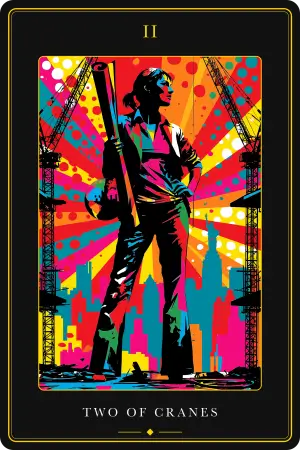
In the Tarot of New York City the Two of Wands becomes the Two of Cranes, and the lord on his castle wall becomes a developer on the raw floor of a building rising over the city. The deck renders her in its pop-art language: a black silhouette figure standing at full height against sunburst rays and fields of halftone dots in saturated red, pink, orange, teal, and yellow. She dominates the frame the way the Rider-Waite-Smith figure dominates his battlement, except her fortress wall is the half-built project itself.
In one hand she holds a tall roll of blueprints, gripped upright like a staff. This is the deck's answer to the wand, will and intellect made into a working tool. The plans are the next tower, already drawn and waiting on her decision. Her other hand rests on her hip, a posture of command rather than hesitation.
At her side hangs a hard hat painted as a globe, the sphere of the RWS card turned into builder's equipment. The world she means to shape is carried onto the site like any other piece of gear. It is not a dream she gazes at from a distance. She brought it to work.
Two tower cranes flank the composition, one on each side. They are the two wands of the original card and the two paths of the choice itself, each marking a direction the future could take. They stand ready but motionless, power on the table that has not been spent, and which one swings first belongs to her.
Behind and below spreads the skyline in flat color blocks, the sprawling landscape of the RWS card become the city. The silhouette of the Statue of Liberty stands among the towers on the horizon, a reminder of what ambition in this city has promised its newcomers. The sunburst rays read as dawn over the site and as the raw energy of the fire suit. The halftone dots scatter across the sky like windows not yet built. At the base lies rubble and debris, the cleared lot, since every act of building here begins with a clearing.
Core meaning
The Two of Cranes is the moment between vision and construction: the master plan held in one hand, the world in the other, two cranes waiting, and the whole skyline below asking a single question, which way. It carries the Two of Wands meaning of planning and foresight, restaged as the pause on the high floor before the steel starts moving.
The number two brings duality and a choice between competing directions, and the deck draws that duality straight into the picture. Two cranes, two lots where the next tower could go, two futures held in one pair of hands. The first beam is already up, and the question is no longer whether to build but where. This is the strategic pause between conception and execution, the developer surveying the grid from a floor higher than she has stood on before, deciding which corner of the city wakes up next.
Beneath the ambition the card asks for real judgment. The vision is huge and the decision is now, and power that sits on the table too long is power spent on nothing. The Two of Cranes rewards the builder who drew the skyline first on paper, then committed the steel.
Upright meaning
Upright, the Two of Cranes is a card of planning, foresight, and belief in one's own vision. The developer stands at the open edge of the floor with the blueprints in hand and new opportunities rising all around her. The advice is to weigh the options honestly before the cranes start swinging, trust the instinct that tells a builder which lot will work, and then choose a direction and commit to it. Timing matters here, since permits expire and windows close, and the card holds that reaching a goal takes strategy as much as ambition. Read as yes or no it is a conditional yes, favorable as long as the querent actually makes the choice.
In love. A moment of shared planning, two people at the edge of something half-built looking out at what it could become. In this deck the building is nearly literal: the apartment hunted together, the move discussed, the city chosen as a pair. It marks the turn from the infatuation stage toward a serious, long-term relationship, and it asks partners to align their visions while still respecting each other's autonomy, the way two cranes work the same site without colliding.
In career. The card of strategy and expansion. The querent has mastered the current role and can feel the stagnation of it, and the Two of Cranes points to a bigger move: a promotion, a pivot, a project with her name on the plans, a choice between two professional directions. It favors the blueprint before the build, improving skills and setting a strategy for growth rather than forcing an uninspired step now.
In finances. A time to plan and to weigh a known, comfortable position against a riskier one with greater reward. The first project is already renting, and there is capital and nerve enough to plan the second. It supports mapping the long game and choosing the most promising of several paths, since two cranes stand ready and only one can swing first.
In health. The body treated as a long-term project rather than a weekend fix. This is the planning phase, when a decision brews about changing a routine, a diet, or a style, and the same energy that raises towers gets aimed at the self. The card favors an honest look at current condition and a concrete plan to improve it, then the commitment to start.
Reversed meaning
Reversed, the Two of Cranes is the project stalled at the drawing stage, the site fenced off and silent, the decision that keeps getting rescheduled. Often a choice has not been made, or it feels too hard: two directions, and the fear of picking the wrong one drowns out the desire to build either. It can show a reluctance to leave the small, known project because the big one is frightening, and a creeping sense that the towers in the blueprint will never actually stand. Read as yes or no it leans no, a sign the timing is off or indecision has the upper hand.
In love. A relationship delayed by an unmade decision, the move that keeps not happening, the question neither person will ask first. It can mean two sets of plans for the same future that do not line up, or a bond tied too tightly to external circumstances, the bigger apartment or the better jobs, rather than to the connection itself.
In career. Uncertainty and fear of commitment: turning down the larger project because the current desk is safe, or watching an initiative slide to next quarter. It warns that indecision costs opportunities, since in this city the next candidate is already in the lobby. The steady advice is to reassess, step out of the comfort zone, and make a choice despite the fear.
In finances. Delay, indecision, and missed windows, the deal that expired while the querent deliberated, the lot someone else bought. It can mean building the same small thing over and over because the bigger bet feels too exposed. The card advises caution with risky, poorly examined investments while still pressing for a decision to be made.
In health. Doubt and lack of a plan, memberships researched and never bought, routines made and never started. It can point to neglecting the body out of an inability to decide, or to a fear of change dressed up as a comfortable habit. The first step is a decision, since no project improves while it stays on paper.
Historical notes
The card began as a plain pip. In the Tarot de Marseille the Deux de Batons shows only two crossed wooden staves woven with floral motifs and no human scene, its meaning drawn from the suit of labor and energy joined to the number of duality and balance. The rare Sola Busca deck of about 1491, the oldest complete seventy-eight-card tarot and the first with fully illustrated minors, gave its Two an unrelated dreamlike figure that carries none of the later themes of planning or dominion.
The scene most readers picture was fixed in 1909, when Arthur Edward Waite and Pamela Colman Smith published the Rider-Waite-Smith deck through William Rider and Son. Waite listed a striking split of meanings, from riches and fortune to physical suffering and sadness, and his note in The Pictorial Key to the Tarot of 1911 tied the figure to the melancholy of Alexander the Great, said to have wept when he saw no more worlds left to conquer. Smith's original watercolor was rediscovered in 1964 during renovations at the Cornwall house where she had lived.
The Tarot of New York City keeps Waite's figure on her high wall and moves the wall to a construction site. The lord surveying sea and shore becomes a developer surveying the grid, the small globe becomes a hard hat, and the two staves become two tower cranes. What survives the change is the theme, the restless vantage of someone who has built enough to see how much is left to build.
Correspondences
Number. Two, duality and the first tension after the Ace, a single spark split into a choice between competing directions. The deck doubles it in the image, two cranes and two lots, and reads the number's partnership side literally: no tower in this city rises alone, and behind every set of blueprints stand partners, investors, and crews.
Astrology. Mars in Aries, the first decan of Aries at 0 to 10 degrees, roughly 21 to 30 March. Mars rules Aries, so the planet of drive sits in its home sign, a placement of raw and combative ambition. Here that fire burns at a construction site at dawn, held inside a reflective Two, which is why the card so often reads as planning rather than charging ahead.
Element. Fire, the element of the Cranes suit in this deck, the suit of ambition and the build. In the Kabbalistic scheme it belongs to Atziluth, the world of pure will and emanation.
Kabbalah. Chokmah, Wisdom, the second Sephirah, in Atziluth. Chokmah is the first active outpouring of energy from the unmanifest Kether, so the card is the spiritual blueprint of power before it descends into denser worlds.
Elemental dignity. A Fire card that strengthens beside Air and meets tension with Water, so its neighbors decide whether the ambition catches or is dampened.
Psychological perspective
Psychologically the Two of Cranes is the friction between two inner drives, the push to act and the pull to weigh and wait. That paradox is the whole card. The builder has the power to break ground and stands instead on the high floor, blueprints in hand, considering the next move. Readers argue over whether the card means action or inaction, and the honest answer is that it holds both, the fire of ambition kept for a moment in a strategic pause.
Its shadow is analysis paralysis, the agony of standing at the edge and fearing the consequences of a real choice, staying on the safe ground floor rather than risking the climb. The growth it points to is using a stable moment deliberately, to draw the plan for what comes next instead of hiding from the decision. The number two also brings the theme of partnership, the vision shared and weighed between two people before it is committed, so the work here is often collaborative rather than solitary.
The Two of Cranes across decks
The archetype stays constant while the imagery changes. In the Tarot de Marseille it is the Deux de Batons, two crossed staves and floral seeds of potential read by pattern and number rather than narrative. In Crowley's Thoth deck it is titled Dominion and drops the human figure for two crossed Tibetan dorjes throwing six flames, leaning into the combative Mars in Aries and calling destruction the first step in the creative process.
Modern decks reframe it again. Lisa Sterle's Modern Witch Tarot swaps the male merchant for a contemporary woman, and readers often see the globe in her hand as a smartphone, the whole world held in the palm. The Wild Unknown strips out the figure and leaves two wands crossing over horizontal bands of color, raw energy waiting for the will to direct it.
The Tarot of New York City carries the restaging furthest. The parapet becomes the raw floor of a half-built tower, the merchant becomes a developer, the globe becomes a hard hat, and the two staves become two tower cranes on the skyline. The RWS melancholy of dominion gives way to the specific tension of this city, where the window you hesitate at is the window someone else climbs through.
In combination and context
The Two of Cranes takes its color from the cards around it, since it describes a decision rather than a settled outcome. Following heavy or grieving cards it becomes the pivot out of them, the moment mourning turns into fuel and the querent charts a bold new course. Beside grounded, material cards the plan hardens into a signed lease or a broken ground. Beside deceptive or stalling cards it reads as the site going quiet, all vision and no permit.
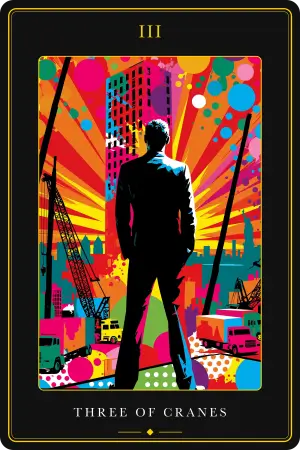
It is most useful read against its own suit. Where the Two of Cranes is the blueprint, the deciding of what to build, the Three of Cranes is the foundation being laid, the first real step with the work already moving. Position sharpens it further. As advice it says do the planning, weigh the risk against the safety, and then commit the steel. As an obstacle it is the comfort zone and the fear of leaving it. As an outcome it promises a genuine choice with real reward attached, claimable only by the builder bold enough to unbolt the plan and start.
Questions for reflection
- What have I already built that feels safe, and what larger skyline am I quietly staring at from its edge?
- Am I in a real planning pause, or have I let the blueprints become an excuse never to break ground?
- If I chose one crane and let it swing, what is the first move I would actually make?
The general meaning follows the Rider-Waite-Smith reading — the reference used across Tarot Academy. Open a specific deck above for its own interpretation.
Frequently asked questions
Explore the Tarot
Latest Posts
Discover the ancient wisdom of tarot cards and unlock the mysteries of your spiritual journey. Our blog is your gateway to understanding the rich symbolism, meanings, and practical applications of tarot reading.




















































