
 EN (English)



Minor Arcana · Wands (Fire)
Two of Wands
A man on his own battlement with the world in his palm: in the Rider-Waite-Smith image, the pause where one wand is bolted to the wall and the other is still free to move.
Card at a glance
- Numerology
- Two
- Element
- Fire
- Astrology
- Mars in Aries, first decan (March 21-30)
- Kabbalistic path
- Chokmah (Wisdom) in Atziluth
- Timing
- Late March, first decan of Aries
- Yes / No
- Upright conditional yes · Reversed no
Upright
Planning
Foresight
Long-term vision
Dominion
Choice of path
Expansion
Self-confidence
Reversed
Fear of the unknown
Playing safe
Indecision
Stagnation
No strategy
Missed opportunity
Analysis paralysis
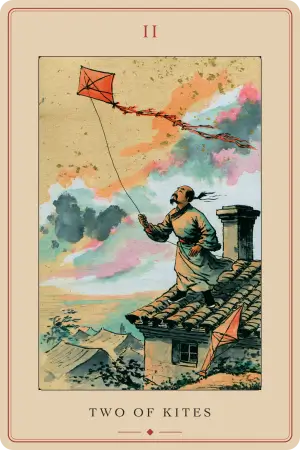
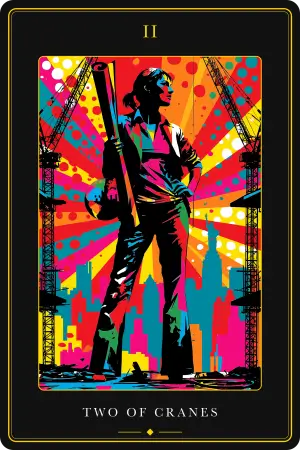
Two of Wands in each deck
Every deck reimagines the same archetype. Compare the art, then open a deck to read its full interpretation.
Imagery and symbolism
Waite's own description in The Pictorial Key to the Tarot is unusually precise, and worth holding beside the card: "A tall man looks out from a fortified roof over the sea and shore. He holds a globe in his right hand, while a staff in his left hand rests on the battlement, and another staff is fixed in a ring. The Rose and Cross and Lily symbols are visible on the left side." Almost every argument about this card comes back to those four objects.
The globe is the piece that does the most work. Esoterically it is the macrocosm held inside the microcosm, worldly ambition and realized potential. Smith drew it small on purpose. The figure has conquered his own ground while the world itself stays vast, and the smallness is what carries Waite's reference to "the malady, the mortification, the sadness of Alexander amidst the grandeur of this world's wealth." This deck's own reading takes the sphere more hopefully: a world waiting to be explored and conquered, and a mark of confidence in one's abilities, with the wand beneath it standing for will and intellect.
The two staffs are the card's engine. One rests loosely in the left hand on the stone battlement, free to be lifted, and it stands for the open future and the willingness to venture out. The other is bolted to the wall behind him by an iron ring. That fixed wand is past achievement and the boundary of the comfort zone, a reminder in this deck's reading that good results come from will and intellect applied over time. The man stands suspended between them.
Colour carries the rest. He wears a red cloak for the fervent desire to discover a new world over a yellow blouse for intellect and energy, a pairing this deck reads as fire under the direction of a working mind. Other readings of the same figure describe a red robe for active will over a brown tunic for grounding and practicality. The stone castle wall he stands on is stability and permanence, and the search for safety and protection, so his elevation buys him clarity and dominion at the price of direct contact with the world below.
The landscape sets the terms of the journey. Calm sea and blue sky speak to the scale of the decision and to room to manoeuvre, while jagged mountains mark real obstacles still to be crossed and fertile valleys promise the payoff. Green vegetation in front of the castle reads as growth, realization and prosperity, green being tied to health, peace and harmony. His feet are planted on stone while his head is silhouetted against open sky, which is the picture's blunt joke: his thoughts are already out there and his body is not.
In the lower-left corner Smith set a red rose crossed with a white lily. In Golden Dawn and Victorian symbolism the rose is passion, desire and the active masculine principle, the lily purity, abstract thought and the receptive feminine. Their crossing mirrors the crossing of the wands. Ambition has to be balanced against disciplined reflection before the choice is made.
Core meaning
In this deck the Two of Wands is decision-making and planning ahead of a new beginning, tied to gaining control over one's own life despite obstacles. It is the desire to steer your own destiny through knowledge and intellect, and the readiness for a journey that has not started.
What the Rider-Waite image adds to the bare archetype is the cost. The figure already has authority over his life. He has the vantage point, the globe, the wall he built. The picture says that dominion of that kind is isolating and restless, and that the clarity of the high parapet is the same thing as distance from the world. He has climbed one mountain and now has to decide whether to stay on it or go looking for a higher one.
Astrologically the card is Mars in Aries, the most direct fire in the zodiac, held inside the reflective, dualistic sphere of a Two. That friction is why the card so consistently reads as planning rather than doing. The power to conquer is fully present and is being spent, for now, on considering the next move.
Upright meaning
Upright, this card signals planning and foresight, and belief in your own abilities. New opportunities arrive and they demand decisions about direction. It favours thoughtful, strategic choice over impulse, and it points toward major future plans and broadening horizons, whether through travel or through new ideas. Listen to your intuition and inner wisdom, weigh the options, then build confidence in your actions before putting anything into motion. Read as yes or no it is a conditional yes: the potential is highly favourable, but only if you actually make a choice and commit.
In love. A moment of choice and shared planning. Harmony between partners and shared prospects matter here, along with a desire to plan the future jointly and build on shared values. New projects, travel or shared hobbies bring fresh energy, and respecting each other's autonomy matters when the important questions come up. It can mark the transition from infatuation into something serious and long-term. Because Wands run on individual trajectory, the card is more pragmatic than the emotional blending of the Cups: it asks whether two long-term paths lead to the same destination. For singles it advises widening the search radius, since the right person is likely outside the current circle, neighbourhood or country. For couples it often surfaces around long-distance situations or a joint decision about relocating.
In career. A period of planning and analysis, with new prospects opening. The card of corporate strategy and international expansion: the querent has mastered their current role and is feeling the stagnation of it, and the Two pushes toward looking abroad or pivoting to a new path entirely. Expect discussions about expansion plans, important projects or new partnerships, and a choice between two professional directions. Improve your skills and pick a strategy for growth. Tied to Fire, it represents potential still waiting to be realized.
In finances. Strategic decision-making around money and resources, with new earning opportunities and offers that strengthen your position. This is the weighing phase: investment options, income sources, branching paths that need a decision. In one forum discussion about buying a house, readers took the card as advice to weigh greater profitability against the safety of a known, comfortable situation. Consider all the paths, then choose the most promising one.
In health. A planning phase for the body. Thoughts about changing your lifestyle, picking up physical skills or changing your style start to take shape, and this is the time to look seriously at your current health and design what comes next. Begin new routines: join a gym, start a diet, take up a training regimen. The same advice applies to creative block, where the card points back to the planning stage, to sketchbook practice and drawing what is in front of you rather than forcing uninspired output.
Reversed meaning
Reversed, the dignified energy of Mars in Aries gets blocked or scattered. Most often it is the fear of the unknown: the querent feels the urge to explore and cannot bear to leave the fortress, so they cling to the bolted wand of past security, enjoy being a big fish in a small pond and watch their world quietly shrink. The reversal can also run the other way, when impulsive Aries fire overruns the strategic restraint of the Two and someone launches with no map, no resources and no clear vision. The advice in either case is to retreat, recalibrate and formulate a concrete plan before acting further. Read as yes or no it leans no: the timing is wrong, the plan is flawed, or indecision has the upper hand.
In love. Uncertainty about the chosen path and delays in the relationship's development because an important decision is not being made. It signifies a partner who is holding back or keeping one foot out the door. It can bring disappointment, unfulfilled hopes and conflicts of interest, or the relationship feels stuck and stops evolving, which calls its value into question. The opposite failure also appears: things moving too fast without any real discussion of the end goal. Revisit your plans, reflect on what you actually want, and stay flexible.
In career. Fear of decisions and apprehension about commitments. Planned projects stall, and indecision costs real opportunities. This is not the moment to take on large responsibilities or risks, but avoiding the essential decisions produces missed chances and professional stagnation. In business it shows as inadequate readiness for expansion or poorly thought-out strategy, frustration from stalled projects, and a business that misses its chance to grow out of fear of the unknown.
In finances. No plan, missed opportunities, stagnation in financial matters. Unsuccessful investments or rash decisions lead to losses, and important money conversations get postponed out of fear of choosing between financial paths. Be cautious, avoid risky investments, and make the decision despite the doubt rather than letting indecision make it for you.
In health. Indecision and no plan. Doubts about starting body care routines or changing your appearance, uncertainty about how to reach physical goals, and neglect of the body because no decision gets made. That neglect chips away at self-esteem. Behind it can sit a fear of a new life stage or an unwillingness to change long-standing habits. Naming the obstacles is the step that starts the change.
Historical notes
The scene Smith drew has almost no ancestor. In the Tarot de Marseille, which spread through the seventeenth and eighteenth centuries, the Deux de Bâtons is an unillustrated pip: two crossed wooden batons woven with abstract floral motifs, four leaves emerging from the centre and two uprooted flowers framing top and bottom. Its meaning came from the suit of labour and energy joined to the number of duality and the crossroads, and Marseille readers such as Alejandro Jodorowsky and Yoav Ben-Dov work it through visual pattern and numerology rather than human narrative. The rare Sola Busca, engraved in Ferrara around 1491 and the oldest complete seventy-eight-card deck, was the first with fully illustrated minors, but its Two of Wands shows a naked male figure oblivious to his surroundings and carries none of the later themes of planning or dominion.
The modern card was codified in 1909 by Arthur Edward Waite and Pamela Colman Smith, both of the Hermetic Order of the Golden Dawn, and published by William Rider and Son in London. Waite wanted to rescue the Tarot from what he considered the stock-in-trade of fortune-tellers and turn it into a vehicle for mystical and psychological initiation. His divinatory meanings for this card split sharply: "riches, fortune, magnificence" on one side, "physical suffering, disease, chagrin, sadness, mortification" on the other. The Alexander note in The Pictorial Key to the Tarot of 1911 is what reconciles them, since the man holding the world is also the man with nothing left to want.
Smith's original artwork, signed and dated 1909, turned up in 1964 during wood panelling renovations at Parc Garland, the house on Cornwall's Lizard peninsula where she lived until 1938.
Correspondences
Number. Two, the number of balance, harmony and dualism: two opposing sides, ascending and descending energies, active and passive principles. It splits the single spark of the Ace into a choice and calls for plans to be aligned with goals. It also carries partnership and diplomacy, and it is linked to intuition and sensitivity, so the inner voice has weight here.
Astrology. Mars in Aries, the first decan of Aries at 0 to 10 degrees, roughly March 21-30. The Golden Dawn assigned the pips 2 through 10 to the 36 decans using the Chaldean order of the planets, and the wheel opens with this one. Mars rules Aries, so the planet of struggle and drive sits in its home sign of cardinal fire: bold, fiercely independent and combative. Numerologically, though, the number Two answers to the Moon, and that friction between Martian thrust and lunar reflection is the card's whole tension.
Element. Fire, in Atziluth, the Archetypal World of Emanation and pure divine Fire.
Kabbalah. Chokmah, Wisdom, the second Sephirah, in Atziluth. Chokmah is the first active outpouring of energy from the unknowable Kether, so this card is the root force of the suit in its purest form and the spiritual blueprint of power before it descends into Briah, Yetzirah and Assiah. The Golden Dawn taught that the number two unites the positive and negative forces of the suit, the King and the Queen, producing reflection and spiritual initiation.
Decanic magic. The first decan of Aries is described in older sources such as the Picatrix and the Liber Hermetis as a restless two-headed figure, or a distinguished man with an axe or sword for the duality of looking to past and future at once. The sixth-century Brihat Jataka gives it a one-legged woman in red or green, tied to spring planting and the hunt. In modern practice the decan is governed by the Shem HaMephorash angels Vehuiah (0 to 5 degrees) and Jeliel (5 to 10 degrees).
Elemental dignity. A Fire card that strengthens beside Air and meets tension with Water, so the neighbours decide whether the ambition catches.
Psychological perspective
The inner state here is the friction between two drives: the Martian urge to conquer and the reflective pull of a Two that wants to weigh and wait. The person has the power to take the world and is standing on the parapet considering the move instead of charging the field.
The Rider-Waite portrait of the person carrying this energy is specific. They have a sense of balance and control, see all the possibilities in a situation and choose strategically. They act with confidence and stay committed once they have chosen. Often they are in transition, already knowing where they want to go, pushing their horizons outward and taking paths of real change such as switching careers or moving somewhere new.
Reversed, the same psychology inverts. The person has plans but cannot choose among the options in front of them, hits obstacles and gets stuck, and finds the move into a new life stage too complex to face. Doubt chips away at drive until they doubt their own abilities enough to fear deciding at all. Online readers argue endlessly over whether this card means action or inaction, and the useful answer is that it is the dialectic between them: the shadow is analysis paralysis, sometimes called the terrible twos, and the growth is using a stable moment deliberately to draft the plan for what comes next.
The Two of Wands across decks
Set the Rider-Waite version beside its relatives and what stands out is that Smith kept a human being in it. The Tarot de Marseille Deux de Bâtons is two crossed batons and floral seeds of latent potential, read by pattern and number, with the crossing taken as a meeting point of energies before they expand into the later cards of the suit. Modern Marseille decks such as the Squid Cake read those intersecting lines as a gathering of work-related or creative force.
Crowley and Lady Frieda Harris's Thoth deck of 1944 titles the card "Dominion" and drops the figure entirely for two crossed Tibetan dorjes throwing six flames. The dorje is thunderbolt and diamond, unstoppable force and indestructibility. Crowley calls it a symbol of destruction and then insists that "destruction may be regarded as the first step in the creative process," so his Two is pure will annihilating obstacles by presence, with none of the Waite melancholy.
Modern decks reframe the figure rather than remove him. Lisa Sterle's Modern Witch Tarot swaps the male merchant for a contemporary woman, and readers on Reddit often see the globe in her hand as a smartphone, the world literally held in the palm, with the warning that a person can spend their life searching online for a destination instead of going to one. The Wild Unknown strips the human out completely and leaves two wands crossing over horizontal bands of colour, raw energy waiting for a will to direct it. The Disney Villains Tarot demotes the card to a simple pip so the focus stays on the trumps and courts.
Against all of these the Rider-Waite Two is the one that insists on the psychological cost. It is the only version that shows you a man who already won.
In combination and context
This card takes its colour from its neighbours, since it describes a decision rather than a settled outcome. After heavy cards it becomes the pivot out of them. In a spread with Death and the Five of Cups, the grief of the Five and the ending of Death give way when the Two arrives last: mourning is over and the querent is using it as fuel to chart a bold new course.
Its most useful comparison is with the card next to it in the suit. Where the Two is the blueprint, the Three of Wands is the foundation being laid. In the Two the figure is confined to his own castle wall holding the globe; in the Three the wands are planted in open ground and he watches ships sail in and out of port. One reader's analogy is that the Two is deciding to write a novel and doing the world-building and character lists, and the Three is opening the document and writing the draft. The Two asks "what do I want to do?" and the Three asks "how will I do it?"
Against the Two of Cups the contrast is elemental. The Cups Two is emotional harmony and the blending of two souls; the Wands Two is individual passion and personal trajectory, so in a love reading it is about aligning visions rather than bonding.
Position sharpens it further. As advice it says do the planning, weigh the risk against the safety, then commit. As an obstacle it is the comfort zone and the fear of leaving it. As an outcome it promises a real choice with a real reward attached, claimable only by someone willing to unbolt the second wand and walk out the door.
Questions for reflection
- One of the two wands in this picture is bolted to the wall. What have I fixed in place with an iron ring, and is it holding me up or holding me back?
- The globe in his hand is small on purpose. How much of the world have I actually seen, and how much am I judging from the parapet?
- Am I in a genuine planning pause, or has planning become the thing I do instead of choosing?
The general meaning follows the Rider-Waite-Smith reading — the reference used across Tarot Academy. Open a specific deck above for its own interpretation.
Frequently asked questions
Explore the Tarot
Latest Posts
Discover the ancient wisdom of tarot cards and unlock the mysteries of your spiritual journey. Our blog is your gateway to understanding the rich symbolism, meanings, and practical applications of tarot reading.




















































