
 EN (English)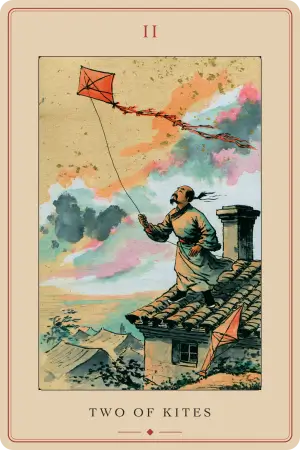


Minor Arcana ·
Three of Kites
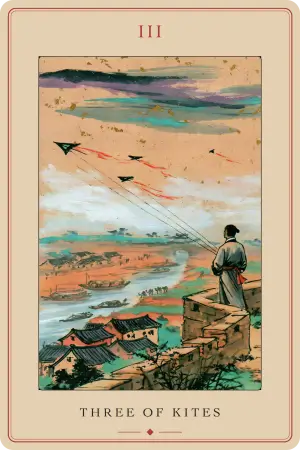
Three ventures aloft on one wind: a Beijing merchant on the city wall holds three kite strings and watches the horizon.
Card at a glance
- Numerology
- Three of Kites
- Element
- Fire
- Astrology
- Sun in Aries, second decan
- Kabbalistic path
- Binah (Understanding)
- Timing
- Late spring, Aries season, dusk
- Yes / No
- Upright yes, reversed not yet
Upright
expansion
foresight
active waiting
launched ventures
perspective
confidence
trade beyond the wall
long plans
Reversed
delays
slack string
fear of expansion
thin planning
stalled ventures
impatience
loss of direction
inflated expectations
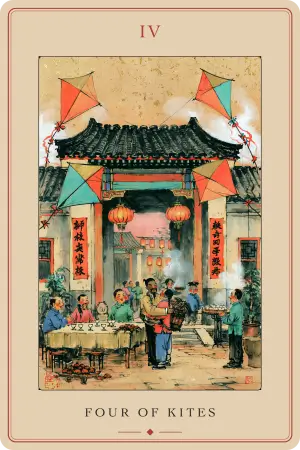
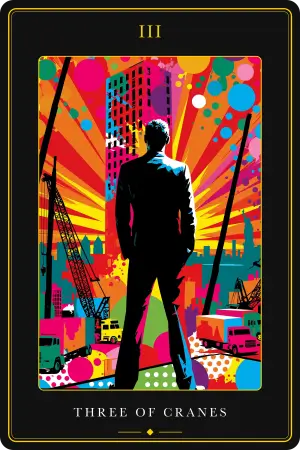
Three of Kites in each deck
Every deck reimagines the same archetype. Compare the art, then open a deck to read its full interpretation.
Imagery and symbolism
In the Tarot of Beijing the Three of Wands becomes the Three of Kites, and its cliff-top merchant moves to the old city wall of Beijing at dusk. He stands with his back to the viewer, holding the strings of three swallow kites. The card is drawn in the deck's Feng Zikai ink style: a few calm brush lines, muted gray washes, one accent of vermilion, on warm kraft paper flecked with gold. Where the Rider-Waite-Smith merchant sends ships to sea, this one sends kites into the wind, and the string replaces the horizon of water as the card's central thread.
The three strings run from his hand clear across the card, taut and unbroken. They are his connection to everything he has set in motion. One kite flies over the market quarter, one over the canal, and one has already passed beyond the gate toward the open horizon. He neither pulls them back nor lets them go. Having launched is not the finish of the work. Holding steady is.
Below the wall the canal carries laden boats, and a camel caravan files along the bank toward the gate. These are the old trade roads of the capital, water and land together, carrying goods he will not see again until they return as profit. Commerce is drawn here as patience in motion. His red sash is the only vermilion on a gray robe, passion worn quietly at the waist. In this deck fire is carried, not waved.
The kites trail vermilion tails across a sky of warm kraft and teal flecked with gold, sparks of intention crossing air that is half sunset and half promise. The height of the wall is the height of perspective. From the lane one sees only the lane. From the wall one sees the market, the water, the gate, and the road beyond, all at once. The card sets the reader at exactly that height.
Core meaning
The Three of Kites is the card of a plan already launched. The unbridled spark of the Ace of Kites, offered on the wind, and the rooftop choice of the Two have resolved into three kites aloft at once. Ideas have taken root in the material world and are generating real growth, just out of reach on the edge of the horizon. This is the threshold between visualizing a thing and watching it happen.
The deck states the teaching in the merchant's stillness. Everything that could be done today is already in the air. What remains is to watch the sky with expectation rather than anxiety, and to trust the wind he chose. He chose it for a reason. The card's core discipline is active waiting: the heavy lifting of the launch is over, but the cliff is not a couch and the wall is not a bed. The flyer stays alert, scanning for the next current, poised to act the moment a kite dips or the boats round the bend.
Because three is expressive and collaborative, this card leans on partnership and social structure. One wind can carry many kites. Ventures here rarely rise on a single pair of hands, so the Three of Kites often points to teamwork, diplomacy, and the ability to inspire others to lift a shared plan.
Upright meaning
Upright, the Three of Kites marks a period of expansion earned by good planning. Your world is widening and you are outgrowing the courtyard you started in. Prospects are opening through travel beyond the wall, a new venture in the market lane, or fresh alliances along the canal. If you are waiting on responses to pitches, applications, or news, the answer is coming and is likely favorable. Look past your own gate and set long-term goals. Your string reaches further than you realize.
In love. A relationship moving forward and widening its horizon. Established couples look ahead together, setting concrete shared goals such as moving in, marriage, or a journey planned as a pair, two flyers on the same wall watching the same sky. Because the card carries travel and distance, it favors long-distance bonds, love met while traveling, or a partnership that blends two backgrounds. Single seekers should look outside their usual type and immediate lane.
In career. One of the most auspicious signals in the deck for work. It is the card of the visionary trader and the project manager whose efforts are gaining measurable traction. A new phase begins, or a large project launches with the third kite already past the gate. It favors distant markets, foreign partnerships, and expansion along new routes. The hardest part, the launch, is done. Hold the strings and let the results climb.
In finances. Planning and foresight for the financial future: resources invested now into ventures that pay later, like goods loaded on the boats or a caravan already through the gate. It points to sound investments and scalable growth, provided you keep one steady hand on three directions. This is a time for new proposals and long horizons, not for spending what the kites have not yet returned.
In health. A readiness to step out of the courtyard and onto the wall. It encourages widening your practice, whether through more movement, a new technique, or a fresh approach to food and rest. Positive change is anticipated when you take daily responsibility for your own condition, because the string of the body answers only to the hand that holds it every day.
Reversed meaning
Reversed, the fiery energy is obstructed and the kite was launched into a wind that was never tested, or never launched at all. Progress stalls, expected returns arrive late or fall short of what rose, and a project sags like a slack string because the planning beneath it was too thin. The reversal often points to a fear of expansion: a real opportunity appears and the seeker shrinks back, choosing to think small because the new horizon feels too large. It asks an honest question. Are you holding your ambitions back because it is prudent, or because success itself is what frightens you?
In love. Delays in a relationship that will not commit to one direction, a hand that cannot choose which kite to fly. Promises go unmet, enthusiasm drains, and disagreements surface about a shared future. The bond can feel becalmed, hanging in still air. Do not despair or force it. Even the best kite waits for its wind, and some relationships simply need time to reach the next height.
In career. Stagnation, postponed plans, and obstacles to expansion. Strings are held with no clear idea where the kites should fly, and fear of a new venture breeds hesitation while good winds pass over the wall unused. Ambitions may outrun the means to lift them, a kite built beautifully but too heavy for the air at hand. Reassess the plan, find the real obstacle, and do not force the weather.
In finances. Delays in trade, thwarted investments, and unrealized projects: boats held up on the canal, a kite down in someone else's courtyard. Poorly considered decisions or money launched into an untested wind lead to instability. Slow down, analyze carefully, and manage what you have rather than chasing returns that have not landed.
In health. Postponement and resistance to changes you know are needed, rooted in a wish to stay inside the familiar courtyard. A chosen routine may not yield the hoped-for results and cause disappointment. Treat the setback as a reason to revisit the plan, not to abandon it. Quick fixes are kites without tails: they spin and fall. The body rewards patience and a steady daily hand.
Historical notes
The card the Three of Kites reinterprets has a long lineage under the suit of Wands. In the Tarot de Marseille it is the Trois de Bâton, a geometric arrangement rather than a scene: two batons crossed in a saltire with a third bisecting them, foliage bursting from the dead wood to signal enthusiasm and the organic growth of an idea. The Marseille tradition read it as the passage from theory to practice, the outward projection of desire, and success appearing on the horizon once proper foundations were laid.
The scenic version arrived with the 1909 Rider-Waite-Smith deck, drawn by Pamela Colman Smith to Arthur Edward Waite's direction: a richly dressed merchant on a cliff, three planted staves sprouting green leaves, three ships at sea below. Waite framed him as a merchant prince who has dispatched his goods abroad and stands on the threshold of adventure, awaiting the return of his fleet. Aleister Crowley's Thoth deck titled the same card Virtue, stripping the narrative to pure geometry and reading it as the fire of the Ace brought under the structuring understanding of the number three.
The Tarot of Beijing keeps that arc of launched enterprise and moves it into the capital. The cliff becomes the old city wall, the ships become swallow kites, and the open sea becomes the canal and the caravan road. The green-leafed staves that proved the plan had taken root become three strings paid out into a spring wind, the same message rendered in the deck's own vocabulary of trade, wall, and sky.
Correspondences
Number. Three, the triad that joins beginning, development, and completion: the offered kite of the Ace, the rooftop choice of the Two, and now three kites aloft at once. Three is expressive and collaborative, which is why this card leans toward partnership, project management, and inspiring others to lift a shared plan.
Astrology. The Sun in the second decan of Aries, roughly March 31 to April 10. Aries is the cardinal fire sign of initiation and pioneering confidence, and the Sun is exalted there, at its most honored and radiant. The pairing explains the card's steady optimism: the flyer watches the horizon with expectation because exalted solar fire assures him his labor will bear fruit.
Element. Fire, the energy of will and action, shown here as fire held on a string. In this deck the suit of Kites is will made visible in the sky, ambition that has learned direction rather than merely burning.
Kabbalah. The Threes belong to Binah, the third sphere on the Tree of Life, whose name means Understanding. Binah is the structuring mother who takes raw energy and gives it form. With the fire of Wands, the mathematical result is Crowley's Virtue: elemental force that is no longer scattered but purposeful and directed.
Elemental dignity. As a fire card it is strengthened beside airy Swords and other Wands, and cooled beside watery Cups, which can dampen the wind the kites depend on.
Psychological perspective
The Three of Kites is a study in the psychology of the launched project. It arrives at the exact moment when action is complete and outcome is not, the interval that tests a person's relationship with control. The healthy stance is strategic patience: having done the preparation, the flyer trusts the wind and refuses to micromanage variables now beyond reach. The kites are working the current even when the hand cannot feel the pull.
Online tarot communities know this card as a persistent visitor, the one that returns when a reader is frustrated with the slow pacing of life. It tends to carry one of two mirror messages. To the person frantically trying to command the wind and the ocean, it says stop pressuring yourself and let external events unfold. To the person who mistakes standing on the wall for taking action, dreaming of the horizon while clinging to a familiar pattern, it says the visualizing is over, so step onto the ship and take the leap. The reversal names the same fault directly, as a fear of outgrowing the courtyard dressed up as prudence.
One caution belongs to relationship readings. Because three sits in the name, anxious seekers sometimes read infidelity into it. The card points to distraction rather than betrayal: a partner absorbed in their own future, their own kites, stretched thin by real ambition rather than by another person.
Three of Kites across decks
Rider-Waite-Smith. The canonical Three of Wands sets a merchant prince on a cliff with three planted, leafing staves and three ships at sea, awaiting the return of a fleet he has sent abroad. The Three of Kites keeps that posture of active waiting and swaps the sea for Beijing's canal and caravan road, the ships for kites, and the staves for strings held taut in one hand.
Tarot de Marseille. The Trois de Bâton shows no figure at all, only three batons crossed in a saltire with foliage sprouting from the wood, a geometric emblem of theory passing into practice. Beijing restores the human scene the pips lack, but keeps the same idea of dead material breaking into new life, now as kites catching a living spring wind.
Crowley-Thoth. Crowley titled the card Virtue and read it as the fire of the Ace disciplined by the understanding of Binah, energy made purposeful. The Beijing card carries the same lesson in its merchant's stillness, fire worn quietly at the waist and held steady on three lines rather than brandished.
Modern reframings. Later illustrated decks tend to emphasize the entrepreneur's horizon and the anxiety of waiting for returns. The Tarot of Beijing belongs to that lineage while grounding it in the specific commerce of the old capital, where expansion means trade past the wall, foreign partnerships, and the long routes of water and land.
In combination and context
The Three of Kites colors whatever spread it lands in with expansion and the discipline of waiting. Read against its own suit it gains precision. Beside the Two of Kites it marks the shift from choosing a direction to committing to it, the rooftop decision becoming three kites already in the air. Beside the Ace of Kites it returns to first sparks, a reminder of the intention now paid out on the string.
With cards of fate and upheaval its message sharpens. Alongside the Wheel of Fortune it says that fated changes will widen your world, and that you hold the foresight to plan for whatever the turning brings. Beside the Tower it reframes destruction as ground cleared, the collapse of an old structure freeing you to launch the plan you have been holding in reserve. Set against the Eight of Cups, both figures leave a place, but the departure here is a joyful expansion, not a grief-struck walk away from what failed.
When the Three of Kites keeps appearing, treat it as a question about patience and control. Climb to your own stretch of wall, confirm the kites are aloft, and then watch the sky with expectation rather than tugging every string. Some days the wisest flyer keeps the spool wound and waits for a truer wind.
Questions for reflection
- Which of your ventures are already aloft, and are you still trying to command winds that have long passed out of your hands?
- When a plan sags like a slack string, do you walk with it and review the pull, or yank until the line breaks?
- What horizon beyond your own gate have you been calling imprudent when the truer word is frightening?
The general meaning follows the Rider-Waite-Smith reading — the reference used across Tarot Academy. Open a specific deck above for its own interpretation.
Frequently asked questions
Explore the Tarot
Latest Posts
Discover the ancient wisdom of tarot cards and unlock the mysteries of your spiritual journey. Our blog is your gateway to understanding the rich symbolism, meanings, and practical applications of tarot reading.




















































