
 EN (English)


Major Arcana · 1
The Newcomer
Arrival at the capital: the first stride off the station curb, before the maze is walked.
Card at a glance
- Numerology
- 0 / XXII
- Element
- Air
- Astrology
- Uranus · Aquarius
- Kabbalistic path
- Aleph (Kether → Chokmah)
- Timing
- New beginnings · spring
- Yes / No
- Upright yes · Reversed no
Upright
Arrival
New beginnings
Potential
Freedom
Openness
Innocence
Spontaneity
Trust
Reversed
Recklessness
Disorientation
Lost in the maze
No plan
Hesitation
Missed departure
Stagnation
Thoughtless risk
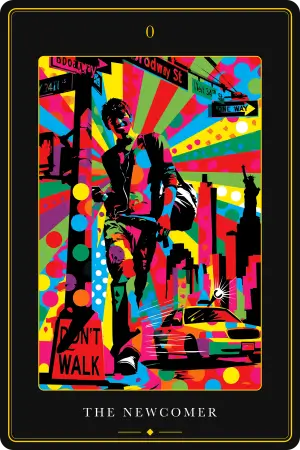
The Newcomer in each deck
Every deck reimagines the same archetype. Compare the art, then open a deck to read its full interpretation.
Imagery and symbolism
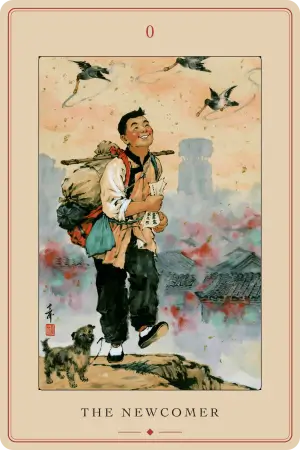
In the Tarot of Beijing the Fool is renamed the Newcomer, 进京的人, "the one who comes to the capital." The cliff edge of the classical card becomes the curb of Beijing Railway Station: one stride ahead of the young man the pavement ends and the maze of hutongs begins, and he does not look down at it. His face is turned up in delight at the sky, and the whole meaning of the card compresses into that single unfinished stride.
Every classical symbol is translated into the migrant's world. He carries a bedroll on a bamboo shoulder pole, the light baggage of the old Fool made into everything he owns and nothing he does not need; the pole rides his shoulder like a scale that has not yet weighed anything. In his fist he clutches a paper with an address on it, this deck's replacement for the white rose: not purity in the abstract but one honest intention, one destination, one thread of trust connecting a stranger to a city of millions. The paper is creased and already fragile, the way faith is.
Above him circle pigeons with bamboo whistles tied to their tails, old Beijing's singing birds, whose flutes moan and laugh over the rooftops. They are the city's own voice, a warning and a greeting and a joke at his expense all at once, which he hears and does not understand. Where the Rider-Waite sun blessed the Fool from behind, here the sky itself whistles. A small dog tugs at his trouser leg for instinct and loyalty; it may be warning him off the curb or urging him on, and the card does not say, because at the start of a journey instinct's warnings and its encouragements feel the same. Behind him a grey watchtower and the layered roofs of the hutongs rise in ink, teal, and vermilion mist, the mountains of the classical card become the vast unknown city. Gold flecks drift through the aged paper like luck scattered in advance, and a small red seal in the corner marks the hand that painted this moment long after the newcomer stopped being new.
Core meaning
The Newcomer is pure potential in the moment before it takes shape, the same beginner's mind the classical Fool carries, here given a face and a city. He arrives with no plan and no map, only curiosity and the trust that the ground will hold when he steps off the curb. Numbered zero, he stands outside the sequence of the Major Arcana as both its first step and the empty space the journey unfolds from.
What this deck adds is that arrival itself is the card's subject. The Newcomer names the fundamental human act of walking into a world you cannot yet read: a new love, a new trade, a new self. His gift is that he has not learned what is supposed to be impossible, so he questions norms nobody has taught him yet, and that innocence carries him past gates that stop more careful people.
Upright meaning
Upright, the Newcomer marks the moment of arrival. A new phase is beginning, a project, an acquaintance, a move, or a role you have never played, and it is full of uncertainty and full of doors. The card favors travelling light: one aim, one address, one honest intention, and leaving the rest at home. Do not wait for a map of every hutong, because none exists and the maze is learned only by walking it. The first stride off the curb is the whole card.
In love it is the first morning of romance in an unfamiliar city, a fast-blooming attraction often with someone from a different world than yours, adventure rather than settled commitment. In career it is a new job, team, or trade, a green light for the outsider whose fresh eyes are their credential and who is not ashamed to ask beginner's questions. In finances it points to new earning opportunities and first ventures, the season to take initiative even when the outcome cannot be calculated, so long as a budget sits under the leap. In health it is renewal and fresh energy, taking up walking or a new discipline, and the willingness to show up new and awkward rather than fear being a beginner.
Reversed meaning
Reversed, the Newcomer stands frozen on the station steps. The city is right there, but he is not walking into it: the paper address is sweated illegible in his fist and the crowd's noise reads as threat instead of welcome. This is stagnation, the departure postponed until some imaginary readiness arrives. The opposite failure is just as reversed, charging into the maze without listening to a single warning, ignoring the pigeons' whistles and stepping off the curb straight into trouble, careless with money and with trust in a place where a newcomer's naivety is a commodity.
In love it is the arrival who never unpacks, chasing the thrill of a beginning and leaving at the first sign of residence, or standing frozen at the threshold unable to knock. In work and money it warns against blind, ungrounded moves and against the easy-money schemes that find the visibly new first. In a yes-or-no reading the Newcomer upright is a clear yes; reversed it turns to no, a call to reread the address, ask directions, and build firmer footing before walking again.
Historical notes
The Fool is the card that has changed the most, and the Newcomer inherits that long history. In the earliest Italian decks, such as the 15th-century Visconti-Sforza, he was Il Matto, the madman: a ragged outcast close to the medieval Vice of Folly, a warning rather than an ideal. The Tarot de Marseille softened him into Le Mat, a wandering jester or beggar in a belled cap with a knapsack and an animal worrying at his leg, and early cartomancers kept madness as his keyword.
The turn came with the 19th and 20th-century occult revival, when the Hermetic Order of the Golden Dawn recast Key 0 as the breath of life, the spark before manifestation, and reread his step off the cliff as an act of radical trust. That reading, carried into the Rider-Waite-Smith and Thoth decks, is the innocent seeker most people picture today. The Tarot of Beijing keeps that seeker and gives him a specific errand: the provincial arriving in the capital with a bedroll and a paper address, the drifting madman of the old cards turned into the migrant every great city is remade by.
Correspondences
Number. Zero: the void, the circle with no beginning or end, the value a person is born with and dies with. It sits outside the numbered sequence, which is why the Newcomer can be both the beginning of the journey and the space around it. This deck also reads him through 22, the master number of completion: the finished city he sees only as haze on his first morning, an amplified 4 (2+2) carrying the structure of a capital that has absorbed newcomers for centuries.
Astrology. The card is linked to Uranus, planet of sudden change, rebellion, and innovation, the force that walks in from outside a city laid on a Central Axis by ten dynasties. Its sign is airy Aquarius, the visionary free spirit.
Element. Air, the element of mind, breath, and swift movement.
Kabbalah. On the Tree of Life the Fool holds the path of Aleph, the first Hebrew letter, the bridge from Kether (the Crown) to Chokmah (Wisdom).
Psychological perspective
Psychologically the Newcomer names the moment the self steps off the map, the unformed ego at the start of what Jungians call individuation. In this deck the Fool's Journey is literal: the young man from the provinces walks through the whole deck learning the city card by card, until he reappears on The World, tiny and complete, inside the panorama seen from Jingshan Hill.
Drawn well he is the beginner's psychology at its best: open and naive yet often resourceful, living in the present, seeing opportunity in walls other people have stopped looking at, and disarming a suspicious city with genuine wonder. Drawn as a warning he is the shadow of that same openness. Excessive spontaneity and the absence of a plan turn the maze from an adventure into a trap; his trust makes him a target and his optimism edits out warnings, including the one tugging at his trouser leg. Someone who is all first steps walks in circles.
The Newcomer across decks
The three foundational decks read the same figure very differently, and the Tarot of Beijing answers each of them. In the Tarot de Marseille he is Le Mat, a belled jester with a bundle on a stick and an animal worrying at his leg, close to the old drifting madman. In the Rider-Waite-Smith deck he is the innocent seeker at the cliff edge, white rose in hand and dog at his heel. In Crowley's Thoth deck he is an androgynous cosmic figure suspended in the rings of the Qabalistic void, ringed by a tiger and a crocodile, spilling zodiac coins to say that all of creation is his loose change.
Beijing translates every one of those symbols into one city. The cliff becomes the station curb, the white rose becomes a creased paper address, the blessing sun becomes whistling pigeons, and the far mountains become the hutong maze in the haze. Under each version sits the same zero, the same open, unwritten beginning.
In combination and context
More than most cards the Newcomer takes its meaning from its neighbours and its position, because it describes potential rather than a fixed outcome. Beside grounded, practical cards it becomes a leap that can actually land; beside anxious or heavy cards it reads as the naive move that ignores real risk.
Position sharpens it. In a past slot it says the present was built on a recent arrival or a recent leap. As an obstacle it points to wishful thinking and a lack of planning, the traveller who sees only the gold flecks and not the pickpocket. As advice it says stop overthinking and step off the curb. As an outcome it promises a clean slate and movement into something unwritten. The Newcomer rarely answers what will happen; it answers what this situation asks of your nerve.
Questions for reflection
- Where in my life am I standing on a curb I have not yet stepped off, and what would it take to trust the stride?
- What is written on my paper address right now: what single intention am I actually walking toward?
- What am I carrying in my bedroll out of habit rather than need, and what could I set down before I begin?
The general meaning follows the Rider-Waite-Smith reading — the reference used across Tarot Academy. Open a specific deck above for its own interpretation.
Frequently asked questions
Explore the Tarot
Latest Posts
Discover the ancient wisdom of tarot cards and unlock the mysteries of your spiritual journey. Our blog is your gateway to understanding the rich symbolism, meanings, and practical applications of tarot reading.




















































