
 EN (English)



Major Arcana · II
The High Priestess
Pamela Colman Smith's veiled guardian of Solomon's Temple, holding light and dark in silent balance.
Card at a glance
- Numerology
- II
- Element
- Water
- Astrology
- The Moon · Cancer
- Kabbalistic path
- Gimel (Kether → Tiphereth)
- Timing
- Cycles · about a month
- Yes / No
- Maybe · not yet time to know
Upright
intuition
quiet strength
subconscious
inner voice
hidden knowledge
patience
solitude
spiritual insight
Reversed
blocked intuition
secrecy
self-doubt
manipulation
superficiality
detachment
ignored inner voice
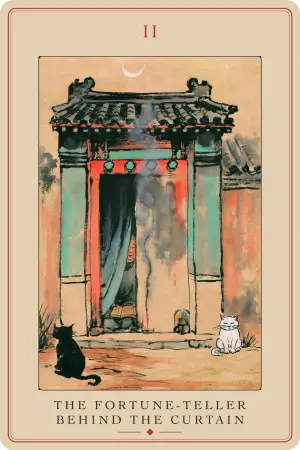
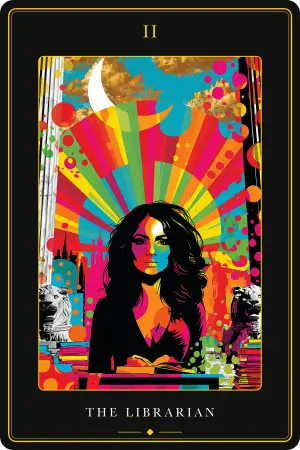
The High Priestess in each deck
Every deck reimagines the same archetype. Compare the art, then open a deck to read its full interpretation.
Imagery and symbolism
This is the card Pamela Colman Smith drew for A.E. Waite in 1909, and her composition set the template most later decks answer to. She seats the Priestess in absolute stillness, guardian of secrets and spiritual truths, at the threshold between the conscious and subconscious. Every object on the card is a key to that role, and the Rider-Waite reading treats her as passive feminine energy in quiet, contemplative command of it.
She sits between two pillars, one white and one black, the twin columns of King Solomon's Temple. In this deck they read as binary opposites held in balance: light and darkness, the known and the unknown, the conscious and the unconscious. She does not resolve the pair, she keeps her place between them. Strung across the pillars is a veil of pomegranates and palms that guards the mysteries behind her. Here the pomegranate carries fertility, wealth, and the cycles of life, and the palm carries victory, peaceful dominion, and spiritual rebirth.
In her lap she holds a partly hidden scroll lettered TORA, a book of ancient knowledge that marks her as keeper of divine wisdom. Its concealment says that this knowing is felt rather than studied. On her head sits a crown of the three lunar phases, waxing, full, and waning, for the fullness of feminine experience and a bridge across past, present, and future. A crescent moon rests at her feet for changeability and the cycles of time, and her blue robe falls like flowing water, the natural course of events and her link to the subconscious. The cross on her breast unites the spiritual and material realms, and the blue field behind her stands for the sacred knowledge she carries.
Core meaning
In the Rider-Waite reading she is inner wisdom, hidden knowledge, and deep intuition: a meditative observer who gathers by perception rather than direct action. She is the receptive counterpart to The Magician before her, taking in and completing the active energy he sends out. Where he acts and manifests, she waits, listens, and lets knowledge arrive.
Her message in a spread is steady. The answer you are after is reached through inner exploration, not outside instruction, and the situation asks for patience and insight rather than spontaneous moves. She points you toward quiet strength: observe carefully, weigh logic alongside feeling, and trust the instinct that surfaces once the mind goes still.
Upright meaning
Upright, the Priestess favors intuition over intellect and observation over force. This is a time for self-knowledge, for noting dreams and subconscious signs, and for letting an unobvious detail resolve the matter. Put a straight yes-or-no question to her and the honest answer is usually "not yet."
In love. She reads as intuition in choosing a partner and quiet, attentive care. For an existing couple she shows a bond developing thoughtfully, spiritual unity valued over surface infatuation, with communication reaching past physical attraction into genuine empathy. She can also mark a valuable stretch of solitude spent understanding your own desires first.
In career. At work she is quiet authority and specialized knowledge. Growth comes from a nuanced grasp of workplace dynamics rather than aggressive networking, and critical information is often still hidden and will take focused effort to uncover. She can point to a female mentor or an influential woman in the office. Plan, research, and observe before you act.
In finances. Intuition matters as much as logic with money. She is the ability to read between the lines of a contract and catch nuances others miss, perhaps uncovering a new source of income by trusting a gut feeling. Understand your accounts in detail and analyze your position thoroughly before you commit.
In health. She reflects inner harmony and gentle, deliberate attention to the body. Meditation, yoga, and mindful relaxation serve you well, as does adjusting your lifestyle to your natural rhythms and studying your own needs through diet, biorhythms, or medical advice.
Reversed meaning
Reversed, the Priestess signals neglected intuition and a loss of inner balance. You may be immersed in illusions, driven by emotion over sense, or listening to everyone except yourself. She becomes the symbol of the unspoken and the deliberately concealed, and she asks you to reconnect with your inner experience and look at the situation objectively.
In love. A refusal to face the reality of the partnership. It may look fine on the surface while lacking real depth, with one partner withdrawn and withholding trust. Ignoring these intuitive red flags only widens the alienation.
In career. Damaging passivity, scattered focus, and hidden agendas that create friction. Watch for conflict with a female colleague, thin boundaries between job and personal life, and a mentor whose guidance feels self-serving. Missing information can easily breed misunderstanding.
In finances. A dangerous lack of interest in the details. Rushed decisions and ignored instincts invite loss, and the card is a strong warning about deception or fraud. Verify every claim and document before signing anything.
In health. A disconnect from the body: ignored symptoms, poor eating, or a superficial fixation on beauty standards at the expense of actual health. She calls for a realistic, respectful routine and honest attention to what the body is telling you.
Historical notes
The figure Waite renamed The High Priestess reached him through three centuries of a very different card. She began as La Papessa, the Popess, one of the more provocative images in early Tarot. Medieval folklore of Pope Joan, a learned ninth-century woman said to have disguised herself as a man and risen to the papacy, shaped the early versions, and the eighteenth-century Tarot de Marseille shows a woman in the papal tiara with a book.
Italian historians trace a sharper source. In the mid-fifteenth-century Visconti-Sforza deck La Papessa wears the plain habit of an Umiliata nun and is identified as Sister Manfreda, a Visconti relative in the Guglielmite sect, which prophesied a line of female popes. The Inquisition burned her in 1300, and memorializing her in the deck 150 years later read as a quiet anti-papal statement. Later variants softened the sting, and Swiss decks rebranded her as Juno.
The universal archetype arrived in 1909, when Waite dismissed the Pope Joan link, renamed the card, and had Pamela Colman Smith illustrate it under his direction for the deck published by William Rider & Son. He tied the figure to Isis, Astarte, Artemis, and the Kabbalistic Shekhinah, trading Catholic dogma for the Hermetic and pagan symbolism this deck made standard. The version most readers picture today is Smith's.
Correspondences
Number. She is II, the first division of unity into duality: masculine and feminine, day and night, active and passive. Where The Magician is a single point of will, the number two introduces the "other" and the whole idea of relationship, cooperation, and mediation between opposing forces.
Astrology. The Moon rules her, governing the psyche, the subconscious, and the emotional body, its shifting light revealing silhouettes rather than hard outlines. Through the Moon she connects to Cancer, the sign it rules, which carries family, home, ancestry, the past, and a deep instinctive sensitivity. The Moon reaches its exaltation in earthy Taurus.
Element. Water. The blue behind her veil and her cascading robe are the depths of the subconscious from which intuition rises.
Kabbalah. She holds the 13th path, the longest on the Tree of Life, running straight down the Middle Pillar from Kether to Tiphereth and across the Abyss through the hidden Da'ath. Her Hebrew letter is Gimel, the camel, the one beast that crosses the desert on its own stored water, an image for drawing on inner reserves rather than outside help.
Elemental dignity. Beside the watery Cups her intuitive, emotional register deepens; beside airy Swords the reading tilts toward secrets held in the mind.
Psychological perspective
The Rider-Waite Priestess describes a personality with a rich inner world and an intuitive read on its surroundings. This person listens closely, perceives invisible connections, values solitude, and reads between the lines. They observe and analyze rather than push, leaning on the subconscious more than pure logic, and they often predict the course of events with striking accuracy because they watch so carefully.
Her risk is excessive passivity. A wish to avoid active life can isolate this type, close them off, and let opportunities pass, and relying only on intuition can tip into either credulity or suspicion until the connection to reality frays. Modern readers add a brighter counterweight, treating her as an emblem of boundaries and self-possession: the moment you stop explaining yourself, secure that your inner knowing needs no permission or applause. Sitting between the pillars, she declines to be pulled into the outer world's quarrels and processes them in silence.
The High Priestess across decks
The Rider-Waite version is the reference point most other decks are measured against, and comparing them shows what Smith fixed in place.
Tarot de Marseille. The older La Papessa keeps the papal roots Waite discarded, seated in the triregnum with a book in her lap, the heretic pope of Renaissance imagination rather than a cosmic oracle.
Crowley-Thoth. Painted by Lady Frieda Harris, Crowley's Priestess sits behind no cloth veil but a "luminous veil of light," his argument being that for the high initiate even pure brilliance is one last screen over the formless spirit. A bow that doubles as a harp links her to Artemis, and a faint camel names her path.
Modern decks. Kim Krans's Wild Unknown replaces the woman with a white tiger gazing from a starry dark, casting intuition as raw animal instinct. Lisa Sterle's Modern Witch Tarot keeps Smith's pillars and pomegranate veil but hands her an open laptop covered in occult stickers, then has her look away from the screen: the reminder that true wisdom still cannot be Googled.
In combination and context
The High Priestess tends to cast a veil of secrecy over the cards around her and to ask for an intuitive reading of them. She is the receptive Yin to The Magician's projective Yang, and when the two appear together they mark an alignment of doing and knowing, the power to act joined to the wisdom of when.
Against The Empress (III) she is the mystic set beside the mother: spiritual fertility and inward focus rather than physical creation and outward nurture. Against The Hierophant (V) she is personal revelation set beside established dogma, the unorthodox oracle to his orthodox teacher. In the Hero's journey she marks where the Fool turns to inner resources and learns to trust intuition over logic.
Her pairings sharpen the theme. With The Fool she is a leap of faith guided by inner knowing. With The Devil she warns of toxic secrets or manipulation working out of sight. With The Moon the veil thickens into illusion or paranoia, intuition either heightened or misfiring.
Questions for reflection
- What does your gut already know that your logic keeps talking you out of?
- Where might silence and observation serve you better than another explanation?
- Which truth are you seeking outside yourself that can only be found within?
The general meaning follows the Rider-Waite-Smith reading — the reference used across Tarot Academy. Open a specific deck above for its own interpretation.
Frequently asked questions
Explore the Tarot
Latest Posts
Discover the ancient wisdom of tarot cards and unlock the mysteries of your spiritual journey. Our blog is your gateway to understanding the rich symbolism, meanings, and practical applications of tarot reading.




















































