
 EN (English)


Major Arcana · 11
The Pinwheel Seller
The wind is one and the fortunes are many: a fairground pole of paper pinwheels stands in for the turning wheel of fate.
Read the complete guide: Arcana X The Wheel of Fortune in Tarot: A Complete Guide to Symbolism and Meaning
Card at a glance
- Numerology
- X
- Astrology
- Jupiter, the Greater Benefic, with a Uranian affinity for sudden turns
- Kabbalistic path
- Kaph (Chesed to Netzach)
- Timing
- New Year · turning points years in the making
- Yes / No
- Upright yes · Reversed no
Upright
fate
luck
turning point
cycles
opportunity
karma
catching the wind
change for the better
Reversed
delays
obstacles
stagnation
loss of control
bad luck
resistance to change
the windless day
The Pinwheel Seller in each deck
Every deck reimagines the same archetype. Compare the art, then open a deck to read its full interpretation.
Imagery and symbolism
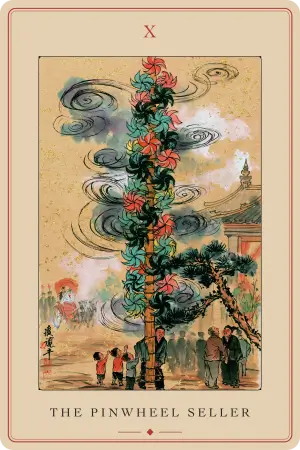
In the Tarot of Beijing there is no golden wheel hanging in the clouds. The Pinwheel Seller replaces it with something you could buy for a copper coin at the Changdian New Year fair: a tall bamboo pole stacked with dozens of paper pinwheels, vermilion and teal and yellow, every one of them spinning a different direction in the same wind. That is the card's whole argument. The cosmic is shown through the small and human, and fate is not one great machine but one weather that each life catches at its own angle.
The pole of pinwheels is the Wheel itself, multiplied. Where the Rider-Waite-Smith card turns all fates on a single rim, this one scatters them across dozens of small wheels. The pinwheels rattle as they spin, and in old Beijing that dry papery rattle was itself considered lucky, the sound of fortune arriving. The wind is drawn as calm ink spirals across a gold-flecked sky, invisible and shown only by what it moves, exactly like fate. The spirals echo the round form of the wheels, so heaven and the toy turn to the same rhythm.
The seller stands where Fortune's blindfolded goddess once stood, but he is neither blind nor a goddess. He is a smiling man doing his rounds, half hidden behind his own pole, who does not command the wind so much as carry his wheels to where the wind can find them. The crowd around him replaces the figures rising and falling on the old wheel's rim. Children in red jackets reach up with their fortunes still ahead of them, old men laugh under the pine with their fortunes made, a pickpocket works the crowd, and a wedding procession with its red canopied cart passes behind. Every position on the wheel is present at once, at eye level, in one lane.
The temple gate on the right is the unchanging law behind the changing luck, and the leaning pine is the classical emblem of endurance, what outlasts every wind. Together they play the part of the RWS card's fixed corner creatures, the stable frame within which everything else turns. Vermilion carries joy and festival, teal carries calm and depth, and the gold flecks in the kraft-paper sky are the scattered, unearned generosity of fortune. The small red seal in the corner is the maker's mark, a reminder that even a picture of chance was placed on purpose.
Core meaning
The Pinwheel Seller is the Tarot of Beijing's Wheel of Fortune, and it states its meaning in a single fairground sentence: the wind is one, the fortunes are many. Causes are universal and outcomes are individual. The same spring gust that delights the children also serves the pickpocket, turns the wedding cart, and rattles the paper luck above them all, yet no two people on the card receive it the same way.
As an archetype the card marks the totality of a life's tasks and the recognition of a higher law, shown here not as hieroglyphs on a golden wheel but as one wind moving through many wheels. It announces the end of one phase and the beginning of another, an unexpected wind of change that sets everything in your life rattling and turning. In the Hero's journey it is the moment he meets significant change caused by forces beyond his control. Nobody at the fair ordered the gust and nobody can cancel it, and the card's lesson is that this is not a defeat. The seller is the archetype resolved: he neither fights the wind nor worships it, having made the wind his trade. Between commanding fate and surrendering to it he keeps a third posture, cooperating with it.
Upright meaning
Upright, the Pinwheel Seller announces dynamics, luck, and a favorable turn in life's cycles. One phase is ending and another opening, and actions that were still yesterday begin to yield results. Sudden coincidences arrive like a gust down the fairground lane. In old Beijing a pinwheel bought at the New Year fair was carried home to catch good luck for the whole year, and the card promises exactly such a season, significant and swift. Its counsel is the seller's own: when the wind rises, do not fold your pinwheel, lift it higher. You cannot choose the weather, but you can always choose which way you hold your pinwheel.
In love. A fateful change or a marked improvement, and the card carries its omen in plain sight, a wedding procession passing behind the pole. It can mean a new romance met in the crowd, or an existing bond resolving old conflicts and entering a happier stage. Both partners' fortunes spin in the same shared wind, though not always at the same speed, and that is the nature of the wheel rather than a flaw.
In career. A fresh wind through your working life: a project completed and a new one begun, a transition, or a promotion that arrives with the suddenness of a gust setting a whole pole rattling. The practical counsel is to carry your skills where the wind can find them. Show your work at the fair, not in the storeroom, because visibility and readiness are half of what this card calls luck.
In finances. Luck, surprises, and change for the better: an unexpected rise in income, an old debt repaid, or a gift of fate that seems to come from nowhere. A new and prosperous phase is opening. Still, the seller knows the fair lasts days and not years, so keep moving through the crowd and set something aside for the windless season.
In health. The wind of renewal reaching the body: a change of style, a shift in diet, or the start of a new practice. The elders of Beijing kept their health by going out into the morning air of the parks and fairs and moving with the day's weather. Like a pinwheel, the body answers to movement and air, so the card favors everything rhythmic and outdoor, exercise that feels less like discipline and more like a fair.
Reversed meaning
Reversed, the wind has dropped over the fairground. The pinwheels hang still on the pole, the rattling falls silent, and the crowd drifts away. Plans stall, external forces hinder progress, and life feels as though it is turning the wrong way or refusing to turn at all. This is a period of obstacles and delay, the sensation of standing in the middle of the fair with a full pole of fortunes and not a breath of wind to sell them. The card's advice is patience with the calm: do not blow on your own pinwheel to convince yourself it is spinning, because that is exhausting and fools no one. Use the lull instead to mend the paper wheels and straighten the pole. In Beijing everyone knows the wind always returns, usually just when you have stopped waiting for it.
In love. Stagnation or a change for the worse: the fair has gone quiet between two people, and the pinwheels of the relationship hang unspinning. Old problems block the wind, and there is a temptation to force a breeze by exhausting yourself. Step back, repair what can be repaired, and be ready to hold the pole up when the wind comes back.
In career. Instability and unpredictability, a stretch when nothing goes to plan: delays, difficulties, possibly the loss of a position. The wind has dropped over your corner of the fair. It is a time to rethink direction rather than force it, and it may signal that your current work is a pinwheel you have outgrown and that a different stall is calling.
In finances. Temporary difficulty, the windless day at the fair: job loss, unexpected expense, or money owed that will not arrive. Trade stands still and it feels as though luck is sold at every stall but yours. Accept that some of this is beyond your control for now, and use the quiet to review your plan so your wheels are the ones ready when the wind returns.
In health. The body in a windless season, processes slowing. Old routines and diets hold on, exercise breaks off, and progress toward physical goals is delayed. The card asks for patience with the body's own cycles, which include periods of inertia that are part of the turning and not failures. Calm is followed by wind here too, so be ready to step outside and meet it.
Historical notes
Long before it entered the Tarot, the central motif was the Rota Fortunae, a foundational idea of medieval European thought. Its most influential statement is in Boethius's sixth-century Consolation of Philosophy, where Lady Philosophy explains that the wheel turns in perpetual, indiscriminate motion, lowering powerful kings into the mud while raising paupers to the throne. To try to stop its spin, she argues, is arrogance, for a wheel that stopped turning would no longer be Fortune's.
The earliest Tarot examples come from mid-fifteenth-century Northern Italy. The Visconti-Sforza deck, made around 1450 to 1460, channels the Boethian allegory directly: human figures climb and fall on a mechanical wheel, matched to the Latin maxim Regnabo, Regno, Regnavi, Sum sine regno, I shall reign, I reign, I have reigned, I am without reign. In the later Tarot de Marseille the human rulers became grotesque animal figures, a crowned creature atop a six-spoked wheel that often rests on water, a nod to the precarious balance of the goddess Tyche.
The paradigm shifted in 1909 with the Rider-Waite-Smith deck. Arthur Edward Waite and Pamela Colman Smith stripped the medieval figures away and built a cosmic mandala: the letters T, A, R, O and the Hebrew YHVH on the outer rim, four alchemical symbols within, an eight-spoked hub, the Sphinx at the zenith with Hermanubis rising and the serpent Typhon descending, and the four winged Tetramorphs reading in the corners. Aleister Crowley's Thoth version pushed further into a ten-spoked wheel in a violet spiral, mapping its three figures to the Hindu Gunas of Sattva, Rajas, and Tamas.
The Tarot of Beijing takes the reframing in the opposite direction, back down to the street. It removes the mandala, the deities, and the golden wheel, and keeps only the function, a picture of many fortunes turning in one wind. The palace of real emperors is nowhere in sight. What remains is a fair, a pole, a smiling vendor, and a crowd.
Correspondences
Number. In this deck the Pinwheel Seller carries the number 10, which unites all the numbers from 1 to 9 and stands for the full cycle, completion, and the transition to a new level. The card draws the number out in the open. The 0 is repeated dozens of times over, in every round pinwheel and every ink spiral of wind, while the 1 is the single upright bamboo pole on which all the turning circles are mounted. One pole, many wheels, the whole number acted out at a temple fair.
Astrology. Jupiter, the Greater Benefic, planet of expansion, abundance, optimism, and good fortune. Jupiter takes twelve years to travel the twelve signs, which makes this a card of macro-cycles: when it appears, the turning point has usually been years in the making. Esoteric astrologers also note an affinity with Uranus, harbinger of sudden and electrifying change, for the moments when fate twists abruptly.
Element. The Wheel is a planetary card rather than one tied to a single element. In the Rider-Waite-Smith design the middle ring shows all four at once through the alchemical symbols for Mercury, Sulphur, Water, and Salt, the building blocks that the turning wheel breaks down and rebuilds.
Kabbalah. The card sits on the twenty-first path of the Tree of Life, joining Chesed, the sphere of Mercy and Jupiterian benevolence, to Netzach, the sphere of Victory. Its Hebrew letter is Kaph, which means the palm or the closed hand. The palm is the site of palmistry, the reading of fortune, and the closed hand is the grasping of one's destiny, so the letter says that vast forces spin the Wheel while a human hand still catches and shapes what is thrown.
Psychological perspective
The person of this arcana adapts to circumstances and stays ready for change. They are confident that everything has its cause, one wind behind all the different spinnings, and they meet events with the seller's working smile rather than the gambler's clenched jaw. They navigate a crowd the way the seller carries his pole through it, without dropping anything and without stopping, and they accept good and bad moments alike, trusting that after a lull the wind returns.
At their best they combine flexible thinking with a mix of optimism and realism, standing calm in the middle of noise and turning the general commotion into their own opportunity. They keep a child's readiness to be delighted, the reaching hands in red sleeves, alongside an adult's craft. The shadow is a pinwheel that spins with every draft, including drafts from slammed doors: constant changes of view, carelessness, and no long-term plan. Relying on luck, such a person neglects responsibility and becomes a spectator at their own fair. Without a planted pole, a foundation of beliefs on which the many spinnings can be mounted, life becomes all wind and no wheel, motion everywhere and direction nowhere.
The Pinwheel Seller across decks
Rider-Waite-Smith. The canonical Wheel is a dense cosmic mandala: TARO and YHVH on the rim, the Sphinx at the top with Hermanubis rising and Typhon falling, and the four Tetramorphs in the corners. The Pinwheel Seller keeps the same idea of one turning fate but empties the sky, scattering the single wheel into a pole of paper ones and lowering the whole scene to a crowded lane at eye level.
Tarot de Marseille. The classic card shows grotesque animal figures rising and falling on a six-spoked wheel that often balances on water, an image of the material world's instability. Beijing replaces those beasts with a real crowd of children, elders, a bride, and a pickpocket, and swaps the unstable water for the wind.
Crowley-Thoth. Crowley's Wheel spins on ten spokes in a violet spiral shot through with lightning, its three figures mapped to the Gunas of Sattva, Rajas, and Tamas, the physics engine of the cosmos. The Beijing card shares the sense of impersonal forces at work but states it as folk wisdom rather than Thelemic machinery: one wind, many fortunes.
Modern reframings. Recent decks reimagine the Wheel as a weaver's web or the thread of the Fates, as a ship's steering wheel amid waves, or even as a womb, each shifting fate toward interconnection, navigation, or fertile chaos. The Tarot of Beijing belongs to that movement of bringing the archetype down to human scale, choosing the most ordinary image of all, a toy sold at a New Year fair.
In combination and context
The Pinwheel Seller acts as a hinge point in any spread, marking sudden change and the initiation of a new karmic cycle. Because it is ruled by Jupiter, the change it brings tends to read as expansive or necessary in the long view, even when the immediate transition feels disorienting. It is a reminder of impermanence in both directions: if the querent is suffering, the wheel will turn toward relief, and if they are prospering, the zenith cannot be held forever.
Beside other cards it colors the reading with timing rather than a fixed verdict. Clarifying the Magician or the Queen of Cups, it can warn of a partner whose feelings are always in motion, passionate one day and distant the next, subject to their own cycles rather than the needs of the bond. In a well-known reading the card fell between Justice and the Four of Wands for someone who had ended a relationship: Justice validated the logic, the Four of Wands promised eventual happiness, and the Wheel in the center mandated patience, insisting that outside timing must align before any reconciliation. In career spreads it can appear as a cosmic stop sign, this is not your time, yet its Jupiterian optimism reframes the closure as a door held shut to clear the path for a better alignment.
When the card keeps returning, treat it as the fair's own counsel. You cannot make the wind blow, but you can make pinwheels, carry them where the crowd is, and hold the pole high. Position yourself where the movement is, keep more than one wheel on your pole, and be ready to turn into the gust when it finally comes.
Questions for reflection
- Which change are you resisting by blowing on a still pinwheel, trying to force a breeze that has not yet arrived?
- Where in your life are you standing in the middle of the moving fair, waiting for luck, instead of carrying your wheels to where the wind is?
- What is the pole you have planted, the foundation of belief that keeps your many spinnings from becoming all wind and no wheel?
The general meaning follows the Rider-Waite-Smith reading, the reference used across Tarot Academy. Open a specific deck above for its own interpretation.
Frequently asked questions
Explore the Tarot
Latest Posts
Discover the ancient wisdom of tarot cards and unlock the mysteries of your spiritual journey. Our blog is your gateway to understanding the rich symbolism, meanings, and practical applications of tarot reading.




















































