
 EN (English)


Major Arcana · 7
One Skewer of Tanghulu
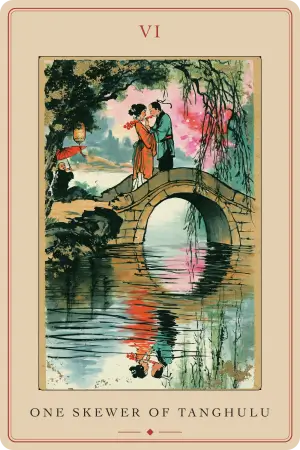
Love as reciprocity: two people share one skewer of candied hawthorn on a Shichahai bridge, a berry each in turn.
Read the complete guide: The Lovers Card VI in Tarot: A Complete Guide to Symbolism and Meaning
Card at a glance
- Numerology
- VI
- Element
- Air
- Astrology
- Gemini · ruled by Mercury
- Kabbalistic path
- Zain, the Sword (Binah → Tiphereth)
- Timing
- Late spring · Gemini season
- Yes / No
- Upright yes · Reversed no
Upright
choice
reciprocity
union
love
partnership
values alignment
taking turns
mutual attraction
Reversed
imbalance
indecision
breakup
one-sided giving
keeping score
wrong choice
fear of commitment
discord
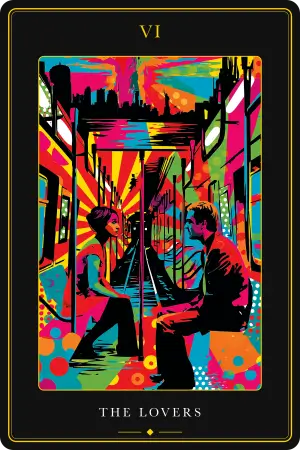
One Skewer of Tanghulu in each deck
Every deck reimagines the same archetype. Compare the art, then open a deck to read its full interpretation.
Imagery and symbolism
The Tarot of Beijing keeps no angel, no garden, and no naked pair. In their place stands a scene any Beijing lane would recognize: a young couple on a stone bridge over Shichahai, sharing a single skewer of candied hawthorn, one berry each in turn. It is drawn in the deck's Feng Zikai manner, a few calm ink lines, gray washes, accents of vermilion and teal on gold-flecked kraft paper, with a small red seal in the corner.
The skewer is the heart of the card. Tanghulu is sour hawthorn dipped in a hard sugar shell, sweetness wrapped around tartness, and that is the deck's honest definition of love: not a paradise but a real fruit made delicious by care. The couple share one skewer, alternating berries, and that alternation is the whole ethics of the arcana. Nobody keeps count; the turns simply happen. Where the Rider-Waite Lovers receive a blessing from above, these two enact their union berry by berry, at street-snack price.
The bridge is the card's structure of choice. It joins two banks, two families, two lives, two possible futures, and the couple stand at its highest point, where crossing is decided. Its arch, completed by the reflection below, closes into a full circle: what is half-built in stone is made whole in water.
On the far bank sits the matchmaker with a red umbrella, pretending not to look. She is tradition, family, and society, present and interested and deliberately not interfering. Her umbrella carries the red of weddings, but she holds it at a distance, so the blessing watches from the shore instead of hovering from a cloud. The choice belongs to the two on the bridge.
The water holds the quietest symbol. Two reflections that the ripples keep joining into one. Still water would show the lovers separate and perfect; it is the disturbance, wind and current and life, that merges them. Around the couple the willow lets down its threads like a matchmaker's knots, pink blossom washes the sky with the color of early undeclared feeling, and a lantern hangs in the tree for an evening that has not yet come. The vermilion of the girl's jacket and of the berries returns in the umbrella and the seal, one red thread of feeling stitched through the whole card.
Core meaning
One Skewer of Tanghulu is Beijing's Lovers, and the deck states its argument plainly: love is a practice, not a state. The canonical card shows union as a condition blessed from above. This card shows it as an activity, two people alternating berries on a bridge, and so it moves the sacred from the sky down into the gesture.
Underneath sits the archetype the reader already knows. The Lovers is a card of choice and values alignment before it is a card of romance. It marks the moment the individual steps away from inherited rules and chooses a path with the whole heart, taking responsibility for a decision that will alter everything after it. Beijing keeps that weight but frames it socially. The matchmaker exists, tradition exists, the red umbrella of collective expectation is fully visible on the bank. The card neither rejects that world nor obeys it. It places the choosing couple above it, on the bridge, and lets society do the one graceful thing it can do at such a moment, which is to look away.
So the card asks two things at once. Choose, with the whole soul, which bank to live on and whose hand to take. Then prove the choice daily, one berry at a time, because the skewer is finite and the taking of turns is the entire vow.
Upright meaning
Upright, the card points to relationships, emotional union, and attraction, but in this deck love is a shared snack rather than a vision from heaven. It can also mark an important decision that must be made wholeheartedly: which bank to live on, whose hand to take, which path to walk. The counsel is small and concrete. Offer the first berry, cross the bridge, say the thing out loud, and do not wait for a grand sign. If you must choose between two paths, choose the one you would be glad to share a skewer on.
In love. The deck's most direct card. Upright, it speaks of a deep mutual bond and the daily practiced reciprocity that keeps sweetness renewable. For a new connection it promises the moment on the bridge, the meeting and the shared treat and the choice about to be made with the whole heart. For an established couple it points to harmony kept the Beijing way, through small gestures rather than grand scenes.
In career. Often a choice between two offers, two roles, or two career banks of the same river. Choose the one your heart would gladly cross toward, not merely the one the industry applauds. The card also blesses working pairs: the colleague with whom tasks alternate smoothly, the mentor and apprentice passing skill back and forth like berries. A collaboration begun now may carry weight for years, the way a stone arch does.
In finances. Shared finances and value-based choices. It favors joint budgets and partnerships where both contribute and both are seen to contribute, the skewer passed openly in daylight. Small, regular, reciprocal money habits build more here than a grand gamble. It is a good card for engagements, household unions, and any agreement two people mean to keep a long time.
In health. Balance kept through small daily portions rather than heroic regimes. The card favors gentle paired activity, walks and dancing and exercise done in company, and the ease that comes from being genuinely comfortable with another person. Care for yourself the way the card loves, regularly and pleasurably, one berry at a time.
Reversed meaning
Reversed, the skewer is held by one hand only. The card points to imbalance, incompatibility, a breakup, or a wrong choice: one partner eats all the berries, or neither dares take the first. It signifies inner conflict and the inability to decide, standing at the foot of the bridge, watching the far bank, going home. The ripples that should join the two reflections now keep them apart, and every disturbance becomes a reason for distance rather than a force of union.
In love. The romance sours under the sugar. One partner always offers and the other always accepts, or the quiet bookkeeping of grievances replaces taking turns. It can mean a breakup, unrequited feeling, a triangle in which someone must finally choose a bank, or a bond kept up for the watcher's sake while the skewer between the couple goes untouched. Fear of commitment shows as the unstepped bridge, endless almost and no crossing.
In career. Imbalance in the team, someone doing the work while someone else collects the sweetness, credit unshared, turns skipped. It can show a decision stalled by fear, standing before two offers until both expire, or one made to please observers and regretted on the far bank. Conflicts here usually trace back to broken reciprocity rather than malice, so the repair is procedural: restore the alternation and name whose turn it is.
In finances. Imbalance in shared money, one partner carrying the whole skewer, hidden spending, or generosity gone quietly into a ledger of resentments. It can point to a wrong financial choice made to please family or appearances rather than one's own judgment. Do not sign anything while standing at the foot of a bridge you have not decided to cross.
In health. Imbalance between indulgence and restraint, all sugar or all sourness, comfort eating or joyless denial. It can indicate appearance anxiety performed for observers rather than for one's own reflection. The corrective is the card's own image, your reflection joined kindly to the life around it: pleasure and rest in turns with effort, meals in company, and a walk over an actual bridge, which this deck counts as legitimate medicine.
Historical notes
The card began as a straightforward celebration of union. In the affluent courts of fifteenth-century Italy it was often titled L'Amore, Love, and painted for dynastic marriages. The Visconti di Modrone tarot of about 1441 shows an arranged aristocratic union sealed by a formal handclasp, with a small white dog for marital fidelity and the word Amor on a ceremonial canopy. Marriage then was a strategic contract more than a matter of romance.
The Tarot de Marseille renamed it L'Amoureux, the Lover, singular, and turned celebration into agonizing choice. A young man stands at a crossroads between two women, one stern and modest, one young and alluring, while a blindfolded Cupid draws his bow above. The scene borrows the classical Choice of Hercules, virtue against pleasure, and fixed the card's enduring lesson that every real choice demands a sacrifice.
The 1910 Rider-Waite-Smith deck moved the scene to Eden. Arthur Edward Waite and Pamela Colman Smith painted Adam and Eve naked beneath the Archangel Raphael, with the Tree of Life behind the man and the Tree of Knowledge, serpent coiled, behind the woman, reinforcing the card's link to Gemini, the Twins. Waite fused physical love with spiritual purity, so that intimacy became a way of experiencing the divine rather than a distraction from it.
The Tarot of Beijing takes the reframing one step further and empties the sky entirely. There is no angel and no garden. The blessing sits on the far bank under a red umbrella, and the divine union is enacted at street price, berry by berry, by two ordinary people on a bridge. The cosmic is shown through the small and human, and nothing is smaller or more human than a shared snack.
Correspondences
Number. 6, and in this deck the number is served on a stick, the short row of hawthorn berries eaten in alternation, the arithmetic of reciprocity. In numerology 6 is the number of harmony, love, home, and responsibility. It balances by pairing, two threes, mirror halves, the two reflections in Shichahai joined by the ripples. Its harmony is never accidental; it is maintained, berry by berry, turn by turn.
Astrology. Gemini, the mutable air sign ruled by Mercury, and the Beijing image makes the pairing unusually literal. Gemini is the sign of the Twins, and the card paints its twins in the water, two reflections the ripples keep joining into one. As an air sign Gemini governs exchange, of words and glances and turns, so the alternating rhythm of the shared skewer is its conversational structure made edible. Mercury, the planet of messengers and matchmakers, appears as the woman with the red umbrella, who carries information between families and then falls silent at the decisive moment.
Element. Air, the element of mind and dialogue. Union here begins as conversation: before two lives can join, two people must learn to take turns speaking, the way these two take turns with the hawthorn.
Kabbalah. The Hebrew letter is Zain, which means Sword, on the 17th path connecting Binah, Understanding, to Tiphareth, Beauty. In esoteric tradition the sword is an engine of division, the analytical separation of a unified world into distinct dualities. That is why the card pairs so often with Art, Temperance, its twin: The Lovers divides so that the later card can reunite.
Psychological perspective
The person of this arcana connects through small concrete acts rather than declarations. They notice which berry you reached for, whose turn it is to speak, when the tea needs refilling. Their empathy is behavioral, expressed in what they do and share and remember. Led by the heart, they still make their great choices soberly, the way one steps onto a stone bridge having looked at both banks first. At their best they hold a rare capacity for sustained, unspectacular devotion, keeping love sweet by renewing it daily rather than defending an initial ideal, and they give others the dignity of choosing, knowing like the matchmaker when to look away.
Depth psychology adds the shadow the card guards against. The classic Lovers warns of projection: until a person integrates their own inner opposite, they fall in love with that unlived part projected onto whoever stands in front of them, mislabeling it a soulmate. The fantasy shatters against the ordinary reality of a real partner, and the immature response is to abandon the bond and seek a fresh canvas. The mature one is the tanghulu answer, compassion for a fallible partner and a fallible self, a companionship grounded in what is actually there. The same sensitivity can sour the other way. When wounded, this personality begins to count berries, converting generosity into a ledger of grievances, or dissolves into the pair and loses their own bank of the lake. Indecision is the classic failure, standing at the foot of the bridge rehearsing the crossing until the lantern is lit and the other person has gone home.
One Skewer of Tanghulu across decks
Rider-Waite-Smith. The canonical Lovers show Adam and Eve beneath the Archangel Raphael, a union blessed from above and tied to Gemini. One Skewer of Tanghulu keeps the Gemini link and the theme of choice but lowers the blessing to the far bank and hands the couple a snack instead of an angel.
Tarot de Marseille. The older L'Amoureux sets a man between two women under a blindfolded Cupid, the Choice of Hercules staged as temptation. Beijing preserves the core of choice while dropping the moralizing triangle; here the decision is which bank to cross to, made in the open and with the whole heart.
Crowley-Thoth. Crowley built his Lovers beneath an Arch of Swords for the letter Zain, staging a Chymical Marriage of a black King and a white Queen and insisting the card must be read with its twin, Art, as the maxim Solve et Coagula, dissolve and coagulate. The Beijing card reaches the same union of opposites in its humblest costume, a girl in vermilion and a young man in teal, sealed by hawthorn rather than by alchemy.
Modern reframings. Recent decks work to free the card from a mandate for heterosexual romance, re-centering it on choice, values, and internal alignment so that it speaks to chosen family and self-acceptance as readily as to marriage. The Tarot of Beijing belongs to that movement, its shared skewer a definition of love broad enough to mean any bond kept alive by taking turns.
In combination and context
One Skewer of Tanghulu colors a spread with union, choice, and the taking of turns, and it often signals that the real question beneath the stated one is whom, or what, do I truly choose. The neighbors decide how sweet or how sour the answer runs. With the deck's Two of Cups the reading is pure earthly affection, the daily practice of love, while The Lovers here adds the heavier note of a choice that reshapes a life; a spread that pairs them can mean a sweet courtship on the surface with a larger decision waiting underneath.
The card darkens beside The Devil, its numerological shadow, since 15 reduces to 6. Together they warn of trauma bonding or a relationship run on addictive chemistry that masquerades as destiny, passion without peace, the loose chains the couple could slip but choose not to. In questions of fidelity the old Marseille triangle can resurface: flanked by the Seven of Swords it suggests sneaking and deception, by the Three of Swords a love triangle and heartbreak, by The Moon something hidden beneath the surface.
When the card keeps returning, treat it as an instruction rather than a forecast. Stand on the bridge and make the decision that has been waiting, with the heart but out loud, then break a stale habit with one concrete gesture, the first berry or the message sent without occasion. And when the day brings ripples, remember what the water does with them: every disturbance is another chance for two reflections to join.
Questions for reflection
- In your closest bond, whose turn was it last, and what would it cost you to offer the first berry now?
- Which choice are you rehearsing at the foot of the bridge, and what are you waiting for before you cross it?
- Where has your giving quietly become a ledger, and how would the relationship change if you stopped counting?
The general meaning follows the Rider-Waite-Smith reading, the reference used across Tarot Academy. Open a specific deck above for its own interpretation.
Frequently asked questions
Explore the Tarot
Latest Posts
Discover the ancient wisdom of tarot cards and unlock the mysteries of your spiritual journey. Our blog is your gateway to understanding the rich symbolism, meanings, and practical applications of tarot reading.




















































