
 EN (English)


Minor Arcana · Cups (Water)
Five of Cups
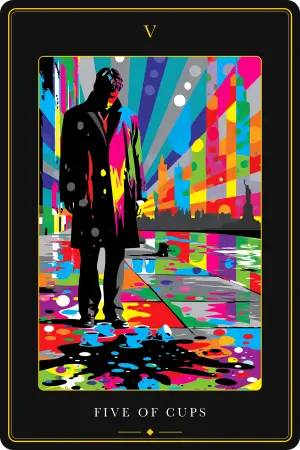
Three coffees spilled dark on a bright sidewalk, two cups still standing behind him: grief that has not yet turned toward the harbor.
Card at a glance
- Numerology
- Five
- Element
- Water
- Astrology
- Mars in Scorpio (1st decan)
- Kabbalistic path
- Geburah (Severity)
- Timing
- Late autumn, the first decan of Scorpio, near Allhallowtide
- Yes / No
- Upright no · Reversed yes
Upright
Grief
Loss
Regret
Disappointment
Mourning
Heartbreak
Dwelling on the past
Pessimism
Reversed
Acceptance
Forgiveness
Moving on
Recovery
Emotional maturity
Release
Hope returning
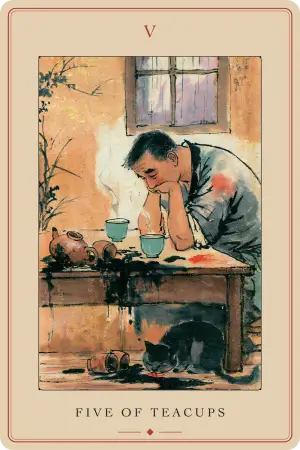
Five of Cups in each deck
Every deck reimagines the same archetype. Compare the art, then open a deck to read its full interpretation.
Imagery and symbolism
The Tarot of New York City keeps the name Five of Cups and moves the whole scene onto a waterfront promenade, drawn in the deck's pop-art language of halftone dots and sunburst rays. The sky above the harbor blazes in saturated reds, pinks, cyans and yellows. The figure at the center is an almost solid black silhouette, head bowed, shoulders dropped, wrapped in a long dark coat that stands in for the old mourning cloak. Splashes of color break across the coat's edges, as if the life around him keeps trying to reach him and keeps sliding off. The card's first statement is that contrast: the city is blazing, and the man cannot see any of it.
At his feet lie the cups, and here they are the deck's signature blue Greek "We Are Happy To Serve You" paper coffee cups. Three are overturned, their coffee spread into a wide black stain across the bright pavement. In this deck a cup carries feeling, community and everyday love, the coffee you bring someone, the cup shared on a stoop. So the spill is wasted warmth, affection that had somewhere to go and never arrived. The black pool swallowing the sidewalk's color shows how grief spreads past its own edges and darkens whatever it touches.
Behind him, upright and untouched, stand the two cups that did not fall. He has not turned around, so he cannot see them: the relationships that held, the chances still open, the warmth still within reach.
Where the Rider-Waite card gives a river, a bridge and a distant castle, this card gives the harbor and the skyline. The water still means the flow of emotion, its surface scattered with reflected color. Across the water rises the silhouette of the city, and at the horizon stands the Statue of Liberty, the deck's fixed emblem of arrival and second chances. The bridge to the castle has become the visible far shore. The future is not hidden here. It is lit up and waiting for him to lift his head. Even the halftone dots drifting through the scene read as the city's background hum, life in motion around a man standing perfectly still.
Core meaning
The Five of Cups is the shattering of emotional equilibrium. Five breaks the settled stability of the four, and in the Qabalah it belongs to Geburah, Severity, ruled by Mars, the force that destroys stagnant form so the soul can move on. In the suit of Water that force overturns the cups and floods the querent with sorrow, regret and disappointment. The archetype is the same one the canonical card carries; this deck just sets it on a New York sidewalk.
Its defining feature is the myopia of grief. Three cups out of five are spilled, and the figure sees only those three. In the deck's own terms he is the person standing over the spill on the pavement, sick about it, unable to look anywhere else, while the whole harbor is lit up at his back. The loss is real. An important person, the end of a relationship, a project that folded, the apartment that fell through, the diner that fed the block going dark. The card does not ask him to pretend otherwise. It warns instead against the distortion that declares everything is ruined when two cups are still standing behind him. The city has not stopped. He has.
Upright meaning
Upright, the Five of Cups is active mourning. The querent is caught replaying a loss, fixed on the spilled coffee and unable to turn around. The card validates that pain rather than rushing past it. Its recommendation in this deck is plain: give the grief its time, do not perform being fine on the platform, and then turn around and take inventory of what did not spill.
In love. Loss and deep disappointment, the breakup you did not choose or the relationship that quietly emptied out while both of you were too busy to notice. Often it shows a person mourning a partner, or an idealized version of one, so completely that the city glitters unnoticed behind him. Around an ex it is a cautionary card. The urge to reach out is usually a fantasy of what was lost rather than the reality, and it tends to lead back into disappointment.
In career and work. A real setback grieved like any loss: a job gone, a promotion handed to someone else, a project killed after months of your nights and weekends. The card can also name burnout's particular grief, mourning the enthusiasm you once had for work that no longer feeds you. The two standing cups remind the querent that skills, allies and transferable experience have not vanished with the job.
In finances. The financial spill: the investment that went sideways, the deposit lost on the apartment that fell through, the deal that died in the last email. The card urges an honest audit, separating what is truly lost from what is merely bruised. Reserves do remain, though grief may hide them for now.
In health. The somatic weight of sorrow, the heavy chest, the fatigue, the mirror becoming another spilled cup to stare at. The card advises letting the emotion flow rather than damming it, and warns against the quiet slide of skipped walks and bad midnight food that this city makes easy.
Reversed meaning
Reversed, the most suffocating phase of mourning has passed and the gridlock breaks. This is the moment the figure finally lifts his head, steps over the stain, and picks up the two cups that survived. It brings acceptance, forgiveness of oneself and others, and the decision to stop reopening the same wound. Handled poorly it warns of the opposite, someone stuck at the site of the spill, unable to accept that the neighborhood has changed, and overcoming that may take real help rather than another late-night walk.
In love. Coming out of a long phase of loss, the first morning you wake up and the breakup is not the first thing you think about. Acknowledging your own part in the old relationship stops being self-punishment and becomes information, which clears the way for something better.
In career and work. Recovery from a professional blow. Attention returns to the parts of the work that bring satisfaction, old expectations and dead plans get released, and room opens for a new role or a whole new line of work.
In finances. The moment you stop staring at the statement and start rebuilding, learning from the bad deal and reallocating what remains. One caution travels with it: do not repeat the mistake, because the city charges interest on the second identical one.
In health. Release from the negative spiral, motivation returning, the first run over the bridge in months. It means accepting your body as it is right now and recognizing that care, not mourning, is what it needs.
Historical notes
The scenic Five of Cups most readers know is a Rider-Waite-Smith invention. Pamela Colman Smith, working under A. E. Waite, turned an old numbered pip into a full narrative of the cloaked mourner, the spilled and standing cups, and the bridge to the distant keep. The Golden Dawn system behind the deck fixed the card's darker machinery: Mars in Scorpio and the fifth sphere Geburah, a triple dose of Martian severity inside the water of feeling.
Crowley and Lady Frieda Harris's Thoth deck names the card "Disappointment," the Golden Dawn's "Lord of Pleasure Lost," the severe force of Geburah overturning the stagnant comfort of the Four. A calendrical reading adds another layer. The first decan of Scorpio falls near late October, around Allhallowtide and the festivals of the dead, which reframes the spilled wine as a deliberate libation poured out for those who have passed. The Tarot of New York City inherits that whole lineage and keeps the suit's original name, then trades the wine for spilled coffee and the bridge for a lit harbor, so the ancient libation becomes an ordinary cup of warmth poured out on a modern sidewalk.
Correspondences
Number. Five, the number of change, conflict and instability. It shatters the settled four, and in this deck's terms it is the transfer station, the crowded in-between place where you have left one train and not yet boarded the next. Nobody lives there; everybody passes through.
Astrology. Mars in Scorpio, and specifically the first decan of Scorpio, roughly October 23 to November 2, sub-ruled again by Mars. Scorpio is the sign of deep transformation and the refusal to look away, a very New York signature, and the first decan brings its rawest, most Mars-driven face, the fresh wound with the fight still in the body.
Element. Water, the suit's own element, feeling and memory. Here it is both the spilled coffee pooling at his feet and the open harbor at his back that reflects every light in the city. Water grieves and water carries at once.
Kabbalah. Geburah, the fifth Sephirah, whose name means Severity, Strength or Judgment, ruled by Mars. It is the cosmic force that breaks down form to prevent stagnation, the swift motion that overturns the cups.
Elemental dignity. As a Water card it flows with Earth and meets tension with Fire, so the neighbouring cards decide whether the grief is contained or inflamed.
Psychological perspective
Read psychologically, the Five of Cups is pure heartbreak: a fresh, visceral emotional loss and the flood of sadness, self-pity and lethargy that follows an ending. Tarot readers often contrast it with the Three of Swords, which is heartache, an older and more mental pain caused by a harsh truth or a betrayal. The Five of Cups is the somatic version, the heavy chest and the tears rather than the punishing thought, and the two cards often arrive together, a new loss triggering an ancient insecurity.
The deck gives that state a face in its mourners, the ones who walk past the shuttered storefront on purpose, who reread the last text, who tell the story of what they lost more fluently than the story of what they have. Their attention lives at the site of the loss, so their pessimism feels to them like realism. They overlook the good standing right behind them, the friends who stayed, the work that survived, the city glittering across the water.
The way out is the hard psychological turn the card keeps pointing at. Loss hurts in proportion to our resistance to it, illustrated in tarot literature by the Zen story of Master Hakuin, who accepts a ruinous false accusation and then, a year later, yields back the child he had raised, taking loss twice without struggle. The more the figure clings to the spilled cups, the more he suffers. Healing begins only when the resistance ends and the loss is accepted as real.
The Five of Cups across decks
The core archetype holds while the imagery shifts. In the Rider-Waite-Smith deck a black-cloaked figure mourns three spilled cups by a river, with two standing behind him and a bridge running to a distant castle. In Crowley's Thoth deck the scene drops away entirely and the card becomes "Disappointment," five cups arranged over a stormy sea under the severe influence of Mars in Scorpio. In the Mystic Mondays deck five cups run vertically along waves, three flowing with orange liquid and two with blue, while the sun stays visible at the right, keeping optimism present through the turbulence. In the Modern Witch Tarot the cups spill on a sandy shore and the liquid seeps into the sand, showing loss being absorbed while the figure looks out to the open ocean.
The Tarot of New York City keeps the name and the meaning and swaps the objects for the city's own. The cloaked mourner becomes a black silhouette in a long coat on a waterfront promenade. The spilled wine becomes spilled coffee in blue paper cups, pooling into a black stain across pop-art pavement. The river becomes the harbor, and the bridge to the castle becomes the visible far shore with the Statue of Liberty at the horizon. Under every version sits the same Mars-in-Scorpio grief and the same two cups the figure has not yet turned to see.
In combination and context
The Five of Cups shifts with its neighbours because it describes a stage of grief rather than a fixed outcome. With The Tower it marks a major, disruptive breakup or loss, destruction that was necessary even though the fallout is severe. With the Two of Wands it becomes a pivot, the querent still grieving but ready to plan ahead and step toward a new path. With The Star it counsels time out to heal, though the hope it promises turns to a pipe dream if it is not paired with real work. With the Four of Swords it reinforces the need for rest and withdrawal instead of short-term distraction. Beside Death it points to the intense grief around a major life transition rather than any literal ending. With the Ten of Swords it signals an absolute ending and betrayal followed by deep sorrow, and also the small mercy that the bottom has been reached and there is nowhere left to go but up.
Position sharpens it further. As advice it says grieve honestly first, then turn around and count what survived. As an obstacle it is the self-imposed blindness itself, attention fixed on the spill while the standing cups go cold. Because it sits at the midpoint of the suit's journey from Ace to Ten, its appearance frames the reading as a crisis caught mid-story, the loss already paid as the toll for a crossing not yet made.
Questions for reflection
- Which three cups am I standing over right now, and what are the two I have not turned around to see?
- Where am I calling my grief realism, when it is really just the direction I happen to be facing?
- If the far shore is already lit up across the water, what is the one small step that would let me start toward it, even if I do not cross today?
The general meaning follows the Rider-Waite-Smith reading — the reference used across Tarot Academy. Open a specific deck above for its own interpretation.
Frequently asked questions
Explore the Tarot
Latest Posts
Discover the ancient wisdom of tarot cards and unlock the mysteries of your spiritual journey. Our blog is your gateway to understanding the rich symbolism, meanings, and practical applications of tarot reading.




















































