
 EN (English)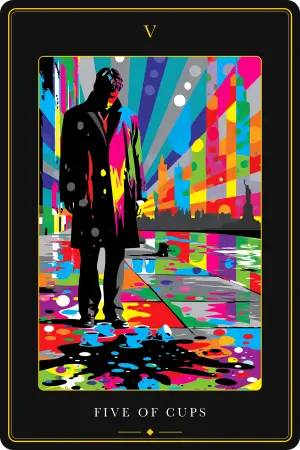


Minor Arcana · Cups (Water)
Six of Cups
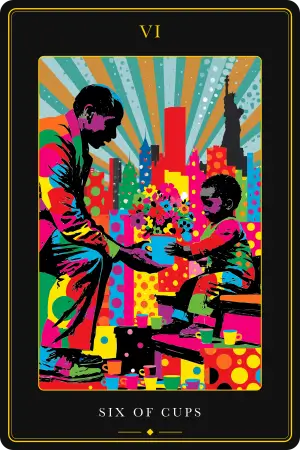
A man bends to a kid on the stoop and hands down a blue coffee cup overflowing with flowers: the old block passing the past to the present as a gift.
Card at a glance
- Numerology
- 6
- Element
- Water
- Astrology
- Sun in Scorpio (second decan)
- Kabbalistic path
- Tiphareth in Briah (Beauty)
- Timing
- Memory · early-to-mid November
- Yes / No
- Upright yes · Reversed no
Upright
Nostalgia
Memory
Reunion
Kindness
Roots
Innocence
Generosity
Belonging
Reversed
Living in the past
Toxic nostalgia
Stagnation
Clinging
Idealizing
Missed chances
Refusing change
Unfinished business
Six of Cups in each deck
Every deck reimagines the same archetype. Compare the art, then open a deck to read its full interpretation.
Imagery and symbolism
In the Tarot of New York City the Six of Cups moves the old Rider-Waite garden onto a brownstone stoop and repaints it in pop-art color: halftone dots, sunburst rays, and black silhouettes against saturated blocks of pink, red, and gold. The meaning holds steady underneath. This is still nostalgia, memory, kindness, and the past handed gently into the present.
The central act is the exchange. A grown man bends toward a small child seated on the stoop and hands over a blue cup spilling flowers. Where the RWS card showed two children, the New York card shows two generations. The giver is the block's past, the child is its future, and the cup passes between them with no transaction attached.
The cup itself is the deck's signature vessel, the blue Greek 'We Are Happy To Serve You' coffee cup that stands for the suit of Cups throughout the deck. Filling that humble paper cup with flowers is the whole alchemy of the card. An ordinary city object becomes something tender and unforgettable, grace served in a to-go cup.
The flowers bursting from it read as joy, innocence, and harmony, the sweetness of childhood that keeps blooming in memory long after the season ends. More cups stand scattered across the steps around the pair, six in all, each a vessel of remembered feeling filled and waiting in memory's stairwell.
The stoop replaces the RWS courtyard. In New York the stoop is where childhood happens and where three generations sit on the same steps, so it stands for roots, belonging, and the home ground you can always return to. Behind the pair the skyline rises in polka-dot color blocks, the present-day city, loud and changing, while sunburst rays give the whole scene the glow of a remembered afternoon.
In the distance stands the black silhouette of the Statue of Liberty, taking the place of the RWS watchman with his halberd. She is the protector-figure of this card, the watchful presence under which the exchange happens safely, and the deck's reminder that in this city nearly everyone's story of where they came from passes beneath her torch.
Core meaning
The Six of Cups is the return trip on a familiar line, back to the old block, the old crew, and the version of you that trusted the city before it rearranged you. In tarot numerology the sixes bring harmony and restoration after the conflict of the fives. Following the mourning of the Five of Cups, the Six is the decision to accept help, cross the bridge, and let warmth back in.
In this deck the card's heart is the gift freely given. The giver hands the flower-filled cup down to the child expecting nothing back, and that unconditional emotional sharing is what separates the Six of Cups from the more transactional charity of the Six of Pentacles. It is the coffee bought for the stranger behind you, the plate sent upstairs, the memory offered because someone should still carry it.
The card asks you to remember who you were before the world taught you shame or cynicism, and to receive the past as a gift rather than a trap. Memory here is a source of foundational love, something to honor and carry forward, not an address to move back into.
Upright meaning
Upright, the Six of Cups marks a period of warmth, emotional safety, and tenderness. Someone hands you a memory like a gift, and for a moment the whole neighborhood is intact again. It often signals reunions: a face from the old life found on a platform, a call from someone you grew up with, a visit to the stoop where everything started. It can also point to gifts and favors returned with no receipt kept.
In love it is the love that has history in it, the return of an old flame or childhood sweetheart, or an existing relationship entering a tender season of small gifts and shared rituals. It speaks of unconditional care, deep emotional safety, and intimacy that only accumulates with time. Resolve current conflicts by returning to the foundational love that started things.
In career it is the comfortable shift, a workplace with the warmth of a good block where colleagues have your back. Past projects and proven methods become present assets, and old professional connections resurface helpfully: the former boss with an opening, the mentor whose old advice suddenly applies. A previous employer may return with a new offer, and success comes from tapping youthful creativity.
In finances it is money that arrives from the past: an old debt repaid, a former client with new work, a small inheritance, or family help when the bank won't come through. This is financial warmth rather than fireworks, the recognition that your safety net was woven by hands that came before you. Old partnerships may revive profitably.
In health it favors inner-child work, play, and simple pleasures as a form of medicine. Nervous system regulation comes from safe, nostalgic, nurturing environments. The card leans toward movement that carries joy and memory, the sport you loved as a kid or home cooking from the family kitchen, and toward gratitude for a body that has carried you through this city.
Reversed meaning
Reversed, the Six of Cups is the express train that only runs backward. It points to living in a New York that no longer exists, mourning the old diner, the old rent, and the old crowd while refusing to accept the block as it is now. Memory turns into a cage. The past gets edited into a golden age that was never quite that golden, and the present never stands a chance in comparison.
Old grievances resurface: unfinished business with family, a friendship that ended badly, a wound from the old neighborhood that never closed. The reversal also warns of Peter Pan syndrome, the refusal to grow past childhood patterns, and of missed opportunities taken because the familiar felt safer than the new. In its heavier form it flags dependency on family money, old patrons, or past reputation instead of present earning power.
In love it is a relationship with the past in the driver's seat: clinging to an ex who no longer fits, measuring everyone new against an idealized memory, or running an existing couple entirely on golden-age routines until romance fades into quiet resentment.
In work and money it is the employee still living in the old office and the company still trading on what the neighborhood used to be, comparing every project to the glory days and reviving obsolete methods out of loyalty to how things were.
In health it is the mirror stuck on an old photograph, chasing the weight or figure of an earlier decade and refusing to adapt to the body's real changes. The reversal is not all shadow, though. In the right context it marks the moment a person forgives the past, steps off the old stoop, and finally moves into the present. If old losses keep resurfacing, the counsel is direct: work through them, settle the accounts, and let go.
Historical notes
The Six of Cups the New York deck restages was fixed by Pamela Colman Smith under Arthur Edward Waite in 1909. Her tableau set two figures in an old cobblestone courtyard backed by the stone walls of a large estate, with six chalices filled with five-pointed white flowers, one cup handed from a taller figure to a shorter one, and a watchman with a halberd walking away in the background. Waite described it plainly as children playing in a garden, and that reading of youth and sweet nostalgia became the mainstream one.
The imagery has drawn debate ever since. In Seventy-Eight Degrees of Wisdom, Rachel Pollack reads the taller figure's cumbersome mitten as a sign of restricted touch and unequal power, nostalgia that keeps a person from acting with full agency in the present. The watchman gets read three ways: as a protector patrolling the perimeter so innocence can flourish, as adult responsibility receding to permit play, or as the querent walking away from a memory rather than staying trapped in it.
Older decks stress different facets. The Tarot de Marseille of the 15th to 17th centuries arranged six stylized chalices symmetrically around central plant decorations, closer to a convivial table setting than a narrative scene, carrying the pre-occult sense of the number six as stability and beauty in the emotional realm.
Correspondences
Number. Six, the number of harmony, balance, love, and beauty. It marks the equilibrium between the material and the spiritual, in this deck's terms between the rent and the rooftop view. Six is also the number of obligation and care for others, the plate sent upstairs and the folded bills pressed into a younger hand, and it sits at the completion of one cycle and the threshold of the next.
Astrology. The Sun in the second decan of Scorpio, roughly the first half of November, which earned the card its Golden Dawn title, the Lord of Pleasure. Scorpio brings depth and the willingness to go underground into old feeling, while the Sun casts conscious light into those buried memories. On this card the Sun is literal, the sunburst rays blazing behind the skyline and lighting the stoop like a remembered afternoon.
Element. Water, the suit's element, poured in this deck from the blue Greek coffee cup: emotion, intuition, memory, the current that runs under the city the way its rivers run around it.
Kabbalah. Tiphareth, the sixth sphere on the Tree of Life, Beauty and Harmony at the exact center, the sphere of the Sun and of conscious awareness. Because Cups belong to the world of Briah, the card is Tiphareth in Briah, an idealized and crystallized moment of emotional beauty that feels frozen in time.
Elemental dignity. Among other Water cards the Six of Cups deepens into pure feeling and reverie. Earth cards ground the nostalgia into something built and lasting, Air cards can turn the memory analytical or cut it with detachment, and Fire cards push the sweetness toward restless action.
Psychological perspective
Psychologically the Six of Cups describes the return to the inner child and the healing that safety makes possible. The high walls of the old scene, restaged here as the enclosing block, keep the cynicism and responsibility of the adult world at bay so innocence can breathe. This is the psyche building a safe space, whether a real childhood home or a remembered one, and re-parenting the younger self who once lacked that shelter.
The card carries a divided consciousness. Smith drew the girl's head with a faint double face, an echo of Janus looking to past and future at once, the exact experience of standing in the present while memory pulls you backward. Handled well, that pull is nourishing. It steadies a person by reconnecting them to foundational love and to the values the block first taught them.
Handled poorly, the same attachment calcifies. The developmental task is to visit the courtyard of youth without moving in, to take the flowers from the old block's hands and then step back onto today's street. Nostalgia becomes a prison only when a person mistakes the memory for a place they can still live.
The Six of Cups across decks
The Six of Cups is a figure every tradition draws to its own emphasis. In the Rider-Waite-Smith deck it is two children in a courtyard exchanging flower-filled cups, with a guard in the background, keyed to nostalgia, safety, and generous giving. In the Tarot de Marseille it is six stylized chalices arranged symmetrically around floral decorations, a convivial table setting that stresses structural harmony and the continuous exchange of feeling.
Crowley and Lady Frieda Harris's Thoth deck names the card 'Pleasure' and draws copper lotus cups with water flowing in a harmonious stream. Here the deep waters of Scorpio stand for the alchemical stage of putrefaction, the breaking down of the ego, and the Sun for the gold recovered afterward, so the pleasure is the spiritual joy earned only after facing one's demons. The Wild Unknown shifts the scene entirely to an evergreen tree above ground with a vast rainbow-colored root system below, turning the card toward compassion and the unseen histories everyone carries. Modern indie decks push it further still, from Pavlov's adult self holding a lantern to guide his younger pre-transition self, to the Light Seer's man with his senior dog, which brings grief and the preciousness of fleeting memory into the card.
The Tarot of New York City keeps each of those functions and swaps the objects for the city's own. The courtyard becomes a brownstone stoop, the chalices become blue Greek coffee cups, and the background watchman becomes the Statue of Liberty. Under every version sits the same mandate: honor the past as a teacher and a source of love, and keep it from becoming a cage.
In combination and context
The Six of Cups takes much of its color from its neighbors and its position in the spread. Beside grounded, practical cards its warmth becomes something usable, an old connection that pays or a reunion that steadies the present. Beside heavy or anxious cards it reads as retreat, the comfort of the past used as an escape from today's rent and today's choices.
Position sharpens the reading. In the past foundation it says the present is built on roots, family, and formative years, and that returning to them holds an answer. Crossing the querent as the obstacle it points to nostalgia doing the blocking, rose-colored glasses aimed at an ex, a job, or an era that keeps real movement from happening. As advice it says take the trip, call the old friend, cook the family recipe, and give something freely yourself. As the outcome it promises reunion, warmth, and gifts arriving from old connections.
The card is also a noted repeat visitor, the kind that keeps falling out of the deck across shuffles. When it stalks a reader, the usual counsel turns inward, away from external romance and toward inner-child work and a memory the subconscious is insisting be addressed.
Questions for reflection
- Which memory of the old block still feeds me, and which one just keeps me sitting on a stoop that was demolished years ago?
- Where could I give something freely today, the way the giver on this card hands over the cup, with no score kept?
- If I visited my past like a garden instead of moving back into it, what one feeling would I carry forward into the present?
The general meaning follows the Rider-Waite-Smith reading — the reference used across Tarot Academy. Open a specific deck above for its own interpretation.
Frequently asked questions
Explore the Tarot
Latest Posts
Discover the ancient wisdom of tarot cards and unlock the mysteries of your spiritual journey. Our blog is your gateway to understanding the rich symbolism, meanings, and practical applications of tarot reading.




















































