
 EN (English)


Minor Arcana ·
Five of Teacups
A knocked pot and a spreading stain, with two cups still steaming at your elbow: grief that has not yet looked up.
Card at a glance
- Numerology
- 5
- Element
- Water
- Astrology
- Mars in Scorpio (1st decan)
- Kabbalistic path
- Geburah (Severity)
- Timing
- Late autumn · first decan of Scorpio · near Allhallowtide
- Yes / No
- Upright no · Reversed yes
Upright
grief
loss
spilled bond
regret
mourning
disappointment
dwelling on the past
self-reproach
Reversed
acceptance
forgiveness
healing
reaching for what remains
release
recovery
warmth returning
Five of Teacups in each deck
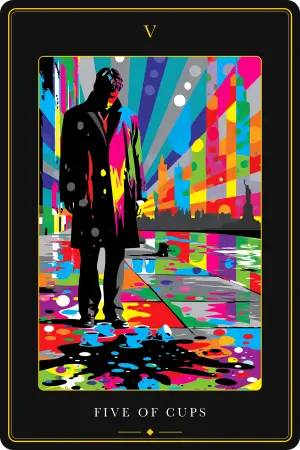
Every deck reimagines the same archetype. Compare the art, then open a deck to read its full interpretation.
Imagery and symbolism
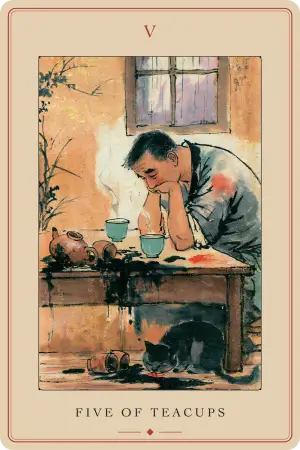
In the Tarot of Beijing the Five of Teacups is set in the back room of a teahouse. A middle-aged man leans over the table, chin sunk into his hand, eyes lowered. A clay pot lies knocked on its side, a cup overturned beside it, and dark tea has run across the boards and dripped to the floor. He sees nothing else.
The spill is the heart of the card. In this deck a cup offered with both hands is an offered heart, so tea poured out and wasted is affection, trust, or hope that can never be gathered back into the pot. The stain is drawn in heavy ink, the one place where the deck's calm brush lines lose their composure, the way grief breaks the composure of a life.
At his elbow stand two celadon cups, still full and still steaming, their teal glaze one of the deck's two accent colors. The steam rises in two pale threads right past his lowered face. These are the bonds and comforts the accident never touched, and the tragedy of the card is that they sit closer to him than the spill and he does not see them.
Under the table a black cat has come to lap at the spilled tea, its small red tongue the deck's vermilion spark of life touching the darkest ink on the card. The cat replaces the distant bridge and castle of the older tradition, so here hope is not on the horizon but underfoot. Behind the man a paper window glows rose and violet with evening, the day of the loss ending on its own, and a spray of blossoming branch leans in from the upper corner. A patch of vermilion on his shoulder marks the warmth still in him, worn where he cannot see it, exactly like the two full cups.
Core meaning
The Five of Teacups is the shattering of emotional balance. Five breaks the settled square of the four, and in the Qabalah it belongs to Geburah, Severity, ruled by Mars: the force that overturns stagnant form so feeling can move again. In the suit of Teacups that force tips the pot and floods the querent with sorrow and regret.
Its defining feature is the narrowness of grief. Three vessels are spilled and two stand full, and the man sees only the three. In the teahouse of this deck the card names the moment loss shrinks the field of view so completely that present warmth and future paths drop out of it. It does not deny that something real ran off the table. It warns against the distortion that calls the whole table ruined while two cups are still steaming at your elbow, and against letting the good tea go cold while you mourn the spilled.
Upright meaning
Upright, the Five of Teacups is active mourning. The querent sits over a spilled bond, fixed on the overturned pot, unable to lift their eyes to what survived. The card validates the pain rather than hurrying past it: the dark stain and the bowed head are a reminder that grief has to be sat with, named once and plainly, and let to steep before it can be poured out. The two full cups are the eventual message, but only when the man is ready to see them.
In love. A spilled heart: a breakup being mourned, a betrayal replayed, or a living relationship in which one partner sits with their face in their hands and sees only what went wrong. Grieve honestly, since the loss is real, then turn toward the warmths that survived, the loyalty and shared mornings currently ignored. Forgiveness of your partner and of yourself is the cloth that wipes this table.
In career. A setback grieved like any loss: a project that collapsed, a promotion given to someone else, a valued colleague gone. The workplace can feel dominated by what went wrong. Three vessels are down and two are full, so grieve the lost project, extract the lesson, and turn your chair toward the work that still steams before it cools.
In finances. Spilled money you keep staring at: a failed investment, a deal that tipped over, funds that ran off the table. The danger is the fixation rather than the loss, recalculating the stain while savings, income, and usable skills stand untouched at your elbow. Make an honest accounting of what was actually lost against what merely feels lost.
In health. Grief carried in the body, hunched over the table with energy pooling downward like the spilled tea. Sorrow easily slides into neglect: skipped walks, careless meals, sleep given over to brooding. Let the emotion flow rather than dam it, then straighten your back toward the evening light in the window.
Reversed meaning
Reversed, the mourning is ending. The table is being wiped, the pot set upright, and the man begins to feel the warmth of the two untouched cups against his palms. It brings acceptance, forgiveness of self and others, and the decision to stop returning to the stain long after it has dried. Sometimes it shows the opposite: someone who keeps circling the dry mark, unable to accept the tea is gone, and if the grief has steeped into bitterness the card advises asking for help.
In love. The slow lifting of the head after heartbreak. You think of the person, or the ending, without the old flood of pain. Owning your own hand in what tipped the pot, without drowning in blame, turns out to be the most healing admission of all. It brings readiness for warmth again, whether reconciliation or a new cup offered across a new threshold.
In career. The turn from mourning to rebuilding. The failed project becomes a line in your experience rather than an open wound, and you can mention it without your voice tightening. Make peace where there were conflicts, and trust that the skills which survived the hard period are now seasoned, the way a well-used pot seasons.
In finances. The end of mourning over a loss and the start of recovery. You look at the numbers without flinching, admit your part in the spill, and rebuild on what survived. The card also warns against the opposite failure, pretending the spill never happened and repeating the same careless pour, so learn exactly how the pot tipped and set the new one further from the edge.
In health. Reconciliation with the body you have today. The period of mourning over what the mirror or the diagnosis showed comes to an end, and old habits of food, movement, and rest are revisited without self-punishment. Interest returns as a walk becomes a habit and sleep repairs.
Historical notes
The scenic Five of Cups most readers know is a Rider-Waite-Smith invention. Pamela Colman Smith, working under A. E. Waite, turned an old numbered pip into a full scene: a cloaked mourner over three spilled cups, two more standing unseen behind, a bridge across a river to a distant castle. The Golden Dawn system behind the deck fixed the darker machinery, Mars in Scorpio and the fifth sphere Geburah, a triple dose of Martian severity inside the water of feeling.
Crowley and Lady Frieda Harris's Thoth deck titles the card "Disappointment," the Golden Dawn's "Lord of Pleasure Lost." A calendrical reading adds a layer: the first decan of Scorpio falls near late October, around Allhallowtide and the festivals of the dead, which reframes the spilled wine as a libation poured out for those who have passed.
The Tarot of Beijing keeps the structure and moves it indoors. The cloaked figure becomes an ordinary man in a teahouse, the cups become celadon teacups, and the wine becomes tea, which in this deck carries the weight the older card gave to blood and poison at once. The great change is the horizon. Where the Rider-Waite-Smith card sends its hope far away across a bridge to a castle, Beijing puts hope underfoot as a cat lapping at the spill, and lets the evening window do the work the distant keep once did.
Correspondences
Number. Five, the number of disturbance, movement, and change. It shatters the stable square of the four so feeling is forced out of stagnation. In every suit of this deck the five is the moment the calm brushwork breaks, and in the Teacups it tips the pot.
Astrology. The first decan of Scorpio, roughly October 23 to November 2, ruled by Mars. Mars is the hand that knocked the pot, bringing conflict and sharp endings, while Scorpio refuses to look away from the stain and insists on understanding exactly what was lost. Fire working through fixed water boils over into an intense, cutting grief.
Element. Water, the element of the whole suit: feeling, memory, and the bonds that pass between people like tea across a threshold. Here the water is spilled, emotion released suddenly and painfully.
Kabbalah. On the Tree of Life the fives belong to Geburah, Severity, ruled by Mars, the force that breaks down form to prevent decay. Numerology also ties five to The Hierophant (Key V), pointing toward counsel and support, and to Temperance (1 + 4 = 5), its antidote of patient integration.
Psychological perspective
The person of this card is caught in grief that refuses to be hurried. Their eyes stay on the overturned pot, replaying the moment it tipped, searching for the instant it could have been saved, while the two full cups at their elbow cool unnoticed. The deeper lesson is that loss hurts most where we resist the change: the harder the man clings to the spilled tea, the longer he suffers, and healing begins only when the resistance ends and the loss is accepted as real.
The deck sets its face against toxic positivity. Telling a grieving person to look on the bright side or to turn around before they are ready is spiritual bypassing, using uplift to skip a wound that will only resurface. The card also separates two kinds of pain. The Three of Swords is heartache, the mental cut of a harsh truth. The Five of Teacups is heartbreak, the raw flood of feeling after an ending, carried in the body as a heavy chest and a bowed head. Its gift is permission to mourn, with the quiet promise that the two cups will still be steaming when the tears have run their course.
The Five of Teacups across decks
Rider-Waite-Smith. The canonical Five of Cups is a cloaked mourner over three spilled cups, two standing unnoticed behind, a bridge and castle waiting across the river. The Beijing card keeps that exact geometry of three lost and two saved but trades the lone figure on open ground for a man at a teahouse table.
Tarot de Marseille. The older card is a plain arrangement of five cups with no human scene, the grief left implied by the number and suit. Beijing restores the human drama the Marseille pip leaves out, and stamps the same red seal that marks every card in the deck.
Crowley-Thoth. Crowley and Lady Frieda Harris strip the scene for the title "Disappointment," the severity of Geburah troubling the waters of Scorpio. The Tarot of Beijing meets the same severity in the dark ink of the stain, the one place its brush loses composure.
Modern reframings. Recent decks soften or widen the grief, some keeping the sun visible above turbulent waves, others spilling the cups on a shore where the loss soaks into sand. Beijing belongs to that movement, replacing the far bridge and castle with a cat under the table, so recovery is shown as near and already underway rather than waiting across a river.
In combination and context
The Five of Teacups pulls a spread toward loss and the work of grieving it. With the Tower it marks a sudden, disruptive breakup, the destruction necessary and the fallout severe. With the Two of Wands it becomes a pivot, grief giving way to ambition and a plan for a new path. With the Star or the Four of Swords it counsels genuine rest and healing rather than a rushed hope for reconciliation. With Death it points to the grief around a major life transition, and with the Ten of Swords to an absolute bottom from which the only way is up.
The most common question it answers is about an ex, and the answer is usually a caution. Reaching out tends to reopen the wound, so the deck's advice is to hold a quiet funeral for the bond and grieve it fully before acting on impulse. For someone single, it warns that unprocessed hurt is projecting onto new prospects and blocking connection. Position shapes it further: as advice it says feel the loss, name it once, and then turn toward the cups still warm; as an outcome it promises that recovery is possible once the mourning has been honored, in the direction the cat is already facing, toward what still steams.
Questions for reflection
- What has spilled on your table that you keep staring at, and which two cups are still steaming just past your face?
- Whose hand knocked the pot, and can you forgive it, even if it was your own?
- What is still full in your life right now, warm enough to lift before it goes cold?
The general meaning follows the Rider-Waite-Smith reading — the reference used across Tarot Academy. Open a specific deck above for its own interpretation.
Frequently asked questions
Explore the Tarot
Latest Posts
Discover the ancient wisdom of tarot cards and unlock the mysteries of your spiritual journey. Our blog is your gateway to understanding the rich symbolism, meanings, and practical applications of tarot reading.




















































