
 EN (English)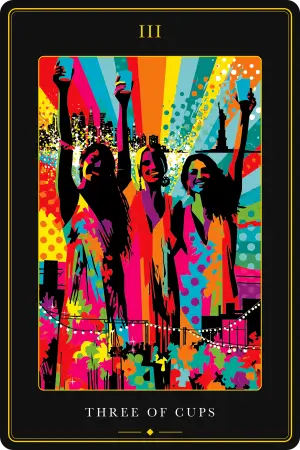


Minor Arcana · Cups (Water)
Four of Cups
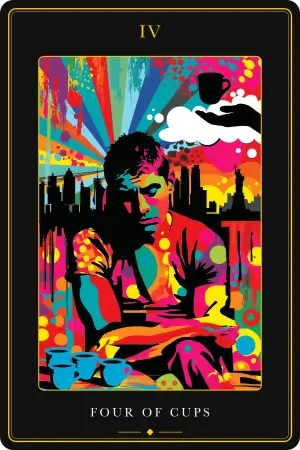
A black silhouette hunched on the stoop, three blue coffee cups at his feet and a fourth held out that he will not look up to see.
Card at a glance
- Numerology
- Four
- Element
- Water
- Astrology
- Moon in Cancer (3rd decan)
- Kabbalistic path
- Chesed (Mercy)
- Timing
- Late summer, the third decan of Cancer
- Yes / No
- Upright no, or wait · Reversed yes
Upright
Big-city apathy
The jaded New Yorker
Numbness
Contemplation
Missed opportunity
Withdrawal
Complacency
Reevaluation
Reversed
Looking up from the phone
Awakening
Re-engagement
New interest
A conscious no
Escapism
Stubbornness
Four of Cups in each deck
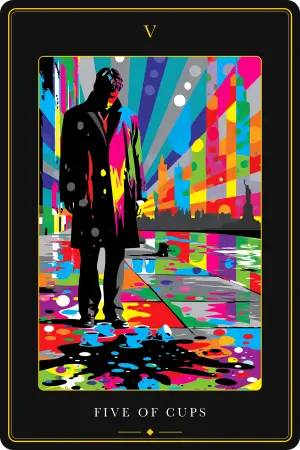
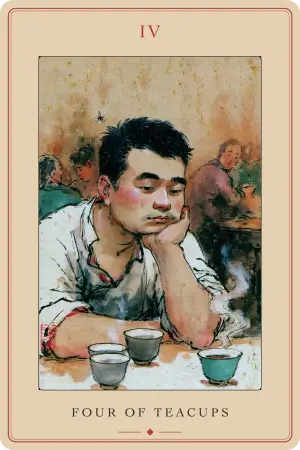
Every deck reimagines the same archetype. Compare the art, then open a deck to read its full interpretation.
Imagery and symbolism
The Tarot of New York City keeps the name Four of Cups and rebuilds the whole scene in its pop-art language: hard black silhouettes, comic-strip clouds, sunburst rays, and halftone dots in saturated color. The card is about a very specific city experience, the isolation you can feel in the middle of a crowd, on a block that never stops moving.
The central figure sits hunched forward, head bowed, one hand pressed to his brow. He is a flat black shape against the noise, soaked in the city's energy and registering none of it. This is the stoop posture, the self-absorption of someone doing their thinking with the phone in one hand and the day going past unwatched.
At his feet stand three full blue Greek coffee cups, the paper cup any New Yorker recognizes on sight. They are the pleasures and the stability he already has, the coffee already poured, and right now he finds them boring or not enough. From the upper corner a black hand reaches out of a white comic-strip cloud, holding a fourth cup. That is the new offer, the unexpected gift the city is trying to hand him, and it hovers unnoticed because he will not raise his head.
The background does the arguing the figure won't. It is an explosion of sunburst rays and halftone dots in hot pinks, oranges, and yellows, a city that is vivid and electric while his inner weather stays gray. The gap between the bright block and the flat mood is the card's whole point: reality is shaped by where you choose to aim your attention.
Core meaning
In this deck the Four of Cups is the jaded New Yorker, surrounded by options and unimpressed by all of them. It reads the classic tension of the card through a city lens. Four is stability, the four corners of a room and the four legs of the diner table, and here it is also the grid of the streets and the settled routine: the lease signed, the route memorized, the order that comes out as "the usual." Water is emotion, and it has to move to stay alive.
Hold water too tightly and it becomes a stagnant pool. That is the state the card describes. The grid that gives the city its order can harden into a rut, the same coffee and the same platform and the same conversations, until a person sits among full cups and feels nothing. There is no crisis and no real deprivation, only the flatness modern readers call "meh," the sense that the city has quietly lost its shine.
Among the four Minor Fours only Cups turns stability into apathy rather than rest or celebration, which is why this card carries a warning under its calm: emotion cannot survive without circulation, and loyalty to the familiar can cost you the offer floating right in front of your face.
Upright meaning
Upright, the Four of Cups is emotional withdrawal and the rut of the daily grind. The city keeps offering things, but the figure is focused inward, often dwelling on a past disappointment, and the rent starts to feel too high for a life that feels too small. It marks a real pause for introspection and warns against letting that pause become permanent stagnation. The advice the deck gives is blunt: you cannot find the answer by staring at the pavement, so get off the stoop and force yourself to engage with something new, because the cure for apathy is action.
In love. Emotional numbness or taking a partner for granted, the routine smothering the passion while you count flaws instead of the connection. For singles it is the jaded attitude toward dating, rejecting people before giving them a chance because you are sure you already know how it ends.
In career. Deep boredom and a mental check-out. The job hands you security, the three cups on the ground, but no fulfillment, and you may let a promotion or a lateral move drift past simply because you lack the energy to reach for it.
In finances. Stagnation dressed up as stability. The bills are paid and nothing is growing, and you dismiss new ways to earn before trying them, missing an improvement that is right in front of you.
In health. Physical lethargy following the sluggish mind, too apathetic to move or eat well, and a warning against ignoring small issues because addressing them takes effort the body has to be talked into.
Reversed meaning
Reversed, the numbness breaks. The figure finally looks up from the phone, notices the light on the fire escape, and decides to rejoin his own life. The emotional fog lifts and a clear path shows itself. It is the awakening, the end of a stretch of hiding, and a readiness to accept the opportunities that were walked past and to shake off the cynical armor. The deck's counsel is to take the offered hand and make up for lost time before the pattern sets again.
In love. The ice melting, a renewed appreciation for a partner and a conscious effort to reconnect, or for singles the end of a cynical phase and a real willingness to go on the date and let someone new in.
In career. The burnout fading and a new angle or project sparking interest, the moment you finally apply for the role or accept the offer you had dismissed and take control of your trajectory again.
In finances. A financial awakening, snapping out of the apathy and acting on the opportunity you ignored, a shift from a scarcity habit to an active one.
In health. Vitality returning, motivation to get moving, often sparked by trying a completely new form of exercise or breaking an old habit. The reversal has a shadow too. It can point to escapism through alcohol or drugs used to duck reality, or to plain stubbornness that wears out the friends still trying to help, and sometimes to too much time spent in trance or meditation and a need to get back to street-level reality.
Historical notes
The stoop and the coffee cups sit on top of a much older image. The three foundational decks each read this stillness differently, and the Tarot of New York City inherits all three. The Rider-Waite-Smith card, drawn by Pamela Colman Smith under A. E. Waite, shows a solitary youth beneath a large tree with his arms crossed, ignoring a cup held out from a grey cloud, poised somewhere between meditation and a sulk. The New York deck keeps that exact gesture of the offered cup refused, then trades the tree for the block, the youth for a black silhouette, and the divine hand for a comic-strip cloud.
The Tarot de Marseille, older and geometric, sets four stylized cups in the corners around a central flower, an image of emotional containment and the boundary that protects the core. Crowley and Lady Frieda Harris's Thoth deck names the card "Luxury" and gives it the darker subtitle "The Seeds of Decay," with four ornate cups on a restless sea of Cancer, sealed off from the outside world so that behind the golden glamour the still waters have begun to foul. That warning, comfort without growth breeding rot, is the same one the New York figure is living out while the city blazes behind him.
Correspondences
Number. Four: stability, structure, and boundaries, the four corners of a room and the grid of the city's streets. In the suit of Water that structure over-contains the emotion, holding it so firmly that it goes still.
Astrology. The card is the third decan of Cancer (about July 12 to 21), ruled by the Moon. The Moon rules Cancer, so this placement runs deep, prone to moodiness, introspection, and a retreat into the crab's shell. Here Cancer's need for emotional protection is pushed to an extreme and the shell has closed completely. The Moon governs the tides, and the reminder built into the card is that the water must eventually move again.
Element. Water, the element of emotion, intuition, and the unconscious, shown here as emotion turned inward and pooling rather than flowing.
Kabbalah. On the Tree of Life the Fours belong to Chesed, Mercy, the loving, structuring kindness of a secure upbringing. Its shadow is the comfort so complete that a person never leaves it, staying in the daydream instead of growing.
Elemental dignity. A Water card, it settles with Earth and can dampen Fire, while Air tends to disturb its heavy calm.
Psychological perspective
Psychologically, the New York Four of Cups is the risk hidden inside comfort, dressed as the hardened local who has trained himself not to react to anything. On the Tree of Life the card sits at Chesed, the mercy of a safe home, and esoteric readers name its shadow as arrested development: so enveloped in safety that a person refuses the friction the outside world requires for growth. The enchanted circle that protects a child has to be broken for the adult to emerge, and the settled New Yorker can mistake his rut for that circle.
The deck draws a sharp line between two kinds of withdrawal. One is the trance of isolation, the felt but false belief that you are alone and misunderstood, which pushes people away and repels new blessings until it becomes self-fulfilling. The other is mindful retreat, the strategic pause to still the emotional waves before clear thinking can return, the necessary go-inward-and-recharge that a chaotic city sometimes demands. Modern readers add that boredom is itself a luxury, since to sit on a stoop contemplating mild dissatisfaction means your survival needs are already met. The defining question is whether the walls are protecting the spirit or starving it.
The Four of Cups across decks
The card's older versions each frame apathy from a different angle, and the New York deck answers each of them with its own objects. In the Rider-Waite-Smith deck it is the solitary youth beneath the tree, the offered cup unseen, caught between ascetic clarity and childish sulk. In the Tarot de Marseille it is pure geometry, four cups walling off a central flower, emotion contained and boundaried rather than narrated. In the Thoth deck it is "Luxury" with its subtitle "The Seeds of Decay," ornate cups on the waters of Cancer whose sealed stillness is starting to foul.
The Tarot of New York City keeps the RWS narrative of the crossed-off figure and the ignored gift and relocates it to the sidewalk. The tree becomes the stoop, the meditative youth becomes a flat black silhouette with a hand to his brow, the three ground cups become blue Greek coffee cups, and the disembodied hand from the grey cloud becomes a black hand from a white comic-strip cloud. The distant divine light of the RWS sky becomes a sunburst of hot pink and orange halftone dots. Under every version sits the same warning about comfort held too long, and the same fourth cup waiting to be noticed.
In combination and context
The Four of Cups is a baseline of emotional stillness that neighbouring cards can break or deepen. Beside the Ace of Cups, the Ace becomes the literal fourth cup from the sky, and in dating it often shows one person offering an overflowing heart while the other stays withdrawn and unready. With the Hermit the withdrawal turns into chosen, peaceful solitude, someone thinking of the querent fondly from a distance yet preferring that distance. With the Fool or the Wheel of Fortune the stagnation is about to break, an impulse or a fated turn pulling the querent off the stoop and back onto the avenue.
Darker company sharpens the shadow. With Death a stale relationship or job is being ended by force, bored to death and collapsing to make room. With the Devil the escapism has hardened into addiction. In a yes-or-no reading the card is usually a no, or better a wait, until the perspective shifts, though for questions about setting a boundary or refusing a draining offer it becomes an emphatic yes. As advice it reads two ways: look up and engage if you have been hiding from the block, or give yourself the retreat and go with the flow if the city has been draining you.
Questions for reflection
- The city is still handing me a fourth cup right now. What is it, and why do I keep looking at the pavement instead?
- Are the walls I have built protecting my peace, or slowly starving me of the experiences I moved here for?
- Is my withdrawal a wise pause to recharge, or just the cynical armor I put on out of habit?
The general meaning follows the Rider-Waite-Smith reading — the reference used across Tarot Academy. Open a specific deck above for its own interpretation.
Frequently asked questions
Explore the Tarot
Latest Posts
Discover the ancient wisdom of tarot cards and unlock the mysteries of your spiritual journey. Our blog is your gateway to understanding the rich symbolism, meanings, and practical applications of tarot reading.




















































