
 EN (English)


Minor Arcana · Cups (Water)
Nine of Teacups
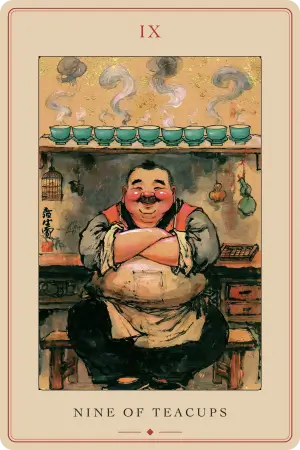
The wish card: a teahouse owner leans back, arms crossed, before nine full steaming cups, content because the wish came true.
Read the complete guide: The Nine of Cups in Tarot: A Complete Guide to Its Symbolism and Meaning
Card at a glance
- Numerology
- Nine
- Element
- Water
- Astrology
- Jupiter in Pisces · second decan
- Kabbalistic path
- Yesod (Foundation) in Briah
- Timing
- Second decan of Pisces · about March 1–10
- Yes / No
- Upright yes, conditionally · Reversed no
Upright
wish fulfilled
satisfaction
contentment
hospitality
generosity
emotional well-being
earned comfort
gratitude
Reversed
smugness
false fullness
overindulgence
complacency
hollow success
hoarding joy
self-deception
flat reward
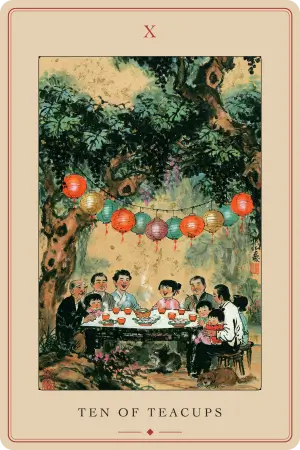
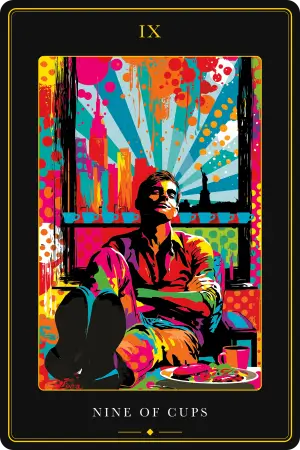
Nine of Teacups in each deck
Every deck reimagines the same archetype. Compare the art, then open a deck to read its full interpretation.
Imagery and symbolism
In the Tarot of Beijing the Nine of Cups is the Nine of Teacups, and it shows the teahouse owner at the end of a good day. He sits squarely in the center on his own bench, in his own establishment, arms crossed over a round belly, cheeks glowing vermilion, eyes closed into two happy lines. The pose is the traditional Rider-Waite Nine of Cups, the satisfied man before his arc of cups, here made into a Beijing innkeeper who has nothing left to prove and nowhere better to be.
Above his head nine teal gaiwan cups stand in a row on the shelf, every one full, every one steaming. The nine ribbons of steam rise into a gold-flecked sky like written characters, wishes already poured. In this deck an offered cup is an offered heart, so nine full cups over one man's head are nine wishes granted, kept warm, and ready to be shared.
On the wall behind him a birdcage holds a songbird, comfort that sings, beside dried gourds, the old Chinese emblem of blessing, health, and contained abundance. To his right on the counter lies an abacus at rest. The accounts are settled and the day counted, and the count came out well. He is not calculating anymore. He is enjoying.
A cloth towel is tucked over each forearm, the mark of a working host. His prosperity was not inherited or lucky. It is aproned, sleeves-rolled prosperity, earned pot by pot. The vermilion of his vest carries the deck's color of warmth and life, the teal of the cups its color of feeling. A sketched branch of bamboo and a small red seal sit on the wall at his side, and gold flecks drift through the upper air. Nothing in the scene is grand, and that is the point. In the Beijing deck a wish come true looks like a warm room, a full shelf, and a man who can finally sit down.
Core meaning
The Nine of Teacups is the wish card of the Beijing deck. It marks the moment long work turns into visible comfort: the establishment is running, the shelf is full, the regulars keep coming back. It points to emotional well-being, a satisfied heart, a household or venture that at last feeds its keeper. Desires ripen into reality now, and a request made in this season tends to be granted, because the person you are asking is, for once, entirely content.
The canonical Nine of Cups earns its nickname the same way, the wish granted, satisfaction reached after the sorrow of the earlier cups. What the teahouse setting adds is the source of the fullness. This happiness was worked for. The towels on his arms say the comfort is aproned and earned, not handed down, so the card reads less as luck and more as harvest. It is the tarot's permission slip to enjoy the fruit of your labor openly and without apology, to sit down at your own table for once and refill someone else's cup while yours is still warm.
Upright meaning
Upright, the Nine of Teacups says something you built has quietly arrived and it is time to enjoy it. Sit down in the middle of what you have made. Practice gratitude the teahouse way, by pouring for someone rather than only counting the cups. This is the right moment to voice a wish, ask a favor, or celebrate with the people who helped you get here. Ask him tonight, the deck says, because tonight he cannot say no.
In love. Deep, well-fed contentment: a bond in which both people are satisfied and know it. The relationship has become a warm room, a place each partner is glad to come home to, where the cup is refilled exactly when needed. Long-held romantic wishes are favored now. For those still looking, approach from fullness rather than hunger, since contentment is the most attractive lantern in the window.
In career. Effort turns into standing. Your skills are recognized, your corner runs smoothly, and colleagues come to you the way regulars come to a trusted counter. A wished-for outcome, a promotion or an approval or a request granted by management, is favored, so ask while the mood in the room is warm. The card also blesses plain professional contentment, work that fits and results you can point to.
In finances. The settled abacus: the accounts balance, and they balance well. It shows achieved prosperity, comfortable reserves, and income steady enough to stop watching it hourly. A hoped-for sum often arrives through goodwill, a satisfied client or a favor returned. Spend a little on genuine pleasure without guilt, and remember the teahouse rule that money, like tea, is at its best when some of it is poured for others.
In health. The glow of the well-hosted body: good appetite, sound sleep, ruddy cheeks, honest pleasure in physical life. Health goals reach a comfortable plateau, and the body, treated as a valued guest, repays the hospitality with energy. Satisfaction itself is medicine here, since a contented nervous system digests, sleeps, and heals better. Indulge in moderation and appreciate the body you have today.
Reversed meaning
Reversed, the Nine of Teacups shows the full shelf and the empty feeling. The cups are poured, but no one is drinking. The wish came true and brought less warmth than expected. It points to complacency, or a host so busy admiring his nine cups that the tea in all of them has gone cold. It can mean overindulgence, the third helping that kills the pleasure of the first, or a good mood spent on boasting rather than sharing. Distinguish the wish from the want: ask whether you desired the tea or only the row of cups for the neighbors to see, then return to what made the place warm in the first place.
In love. A relationship full on the shelf and cooling in the cup. Outwardly all is well, the household runs and the photos smile, yet one or both partners feel a puzzling emptiness at their own feast. It can show love maintained by habit rather than attention, or disappointment after a granted wish that did not transform what it was supposed to. The remedy is the teahouse remedy, to stop admiring the arrangement and pour.
In career. Success at work that has stopped nourishing. The position is respectable and the shelf technically full, and yet the days taste of nothing. It warns of coasting on old achievements and mistaking comfort for progress, or of a hoped-for reward that arrives and disappoints. Reassess what you actually want from the work rather than what looks good on the shelf.
In finances. Prosperity that looks better than it holds. The shelf is full but the pot may be empty, with funds spent on display and income eaten by indulgence. It can point to disappointment with money that was supposed to bring happiness, or to opportunities missed through complacency. Check what the abacus actually says rather than what your mood says, and postpone requests for loans or favors, since the granting season has paused.
In health. The shadow of the feast and its bill. Too many helpings and too much sitting with crossed arms, comfort sliding into heaviness or habits the body keeps gently protesting. It can also show the opposite, reaching a long-sought physical goal and still feeling dissatisfied because the expectation was perfection rather than health. Return to the middle of the teahouse: pleasure with measure, movement as a daily courtesy to the body.
Historical notes
The pip cards of the older Tarot de Marseille carry no scene. The Nine of Coupes is a geometric arrangement of nine vessels, often a 3x3 or floral pattern, and its meaning rests on the numerology of nine: clarity about well-being, harmony, and a sense of peace and wish fulfillment without any hint of smugness.
The Hermetic Order of the Golden Dawn formalized the correspondences and named the card the Lord of Material Happiness, a title that bridges the emotional realm of Cups with the tangible satisfaction usually tied to Pentacles. Their decanic image, drawn from texts like 777 and the Picatrix, is a grave man pointing to the sky, a reminder that fulfillment ultimately emanates from a higher source.
The most familiar picture came with the 1909 Rider-Waite-Smith deck, illustrated by Pamela Colman Smith under A.E. Waite. Waite described a goodly personage who has feasted to his heart's content, with abundant wine on the arched counter behind him. His well-fed figure, white tunic, red hat, and crossed arms became the card's signature, and modern readers have argued ever since over whether that posture reads as guarded peace or a smug merchant hoarding his joy. Aleister Crowley's Thoth deck simply titled the card Happiness, praising its luck and warning that if its waters cease to flow it curdles into self-indulgence and vanity.
The Tarot of Beijing keeps the RWS pose and answers the old debate in its own key. It makes the satisfied man a working teahouse owner with towels on his arms, so the crossed arms read as a host at rest rather than a merchant withholding. The wine becomes tea, the chalices become teal gaiwan, and the material happiness of the Golden Dawn title becomes a warm room at the end of an honest day.
Correspondences
Number. Nine, completion before renewal, the last single digit holding the accumulated experience of all the numbers before it. Here the fullness is literal, nine cups poured and none spilled, the emotional harvest of the whole suit gathered on one shelf. Beijing leans on an extra resonance: nine (九, jiǔ) sounds like 久, long-lasting, and was the imperial number, nine rows of nails on the gates of the Forbidden City and the Hall of Prayer built on nine-fold stones. It is the largest yang number, abundance at its peak, one step before it would tip into excess. The teahouse owner sits exactly on that step, and sits there comfortably.
Astrology. Jupiter in the second decan of Pisces, about March 1 to 10. Pisces gives the deep emotional register, the ability to feel a room and sense what a guest needs before he asks. Jupiter, the great benefic, gives expansion, generosity, and luck, the planet of the ever-refilling pot. In its own watery domicile Jupiter is abundance with a soul, prosperity that overflows toward others as the extra cup and the waved-away bill.
Element. Water, in this deck the water that has already been boiled, steeped, and poured, feeling brought to its ripest and most drinkable form.
Kabbalah. Yesod, Foundation, the ninth sphere on the Tree of Life, ruled by the Moon, in Briah the World of Creation that governs the suit of Cups. As Yesod in Briah the card is Water reflecting upon itself, the astral realm where wishes are gathered before they descend into the tangible reality of Malkuth. This is the esoteric logic behind the card's link to dreams and their granting.
Psychological perspective
The person of this arcana is generous, satisfied, and visibly at ease in a life of their own making. They built what they sit in, every bench and habit and friendship, and they know it without needing to say so. They are natural hosts whose pleasure genuinely doubles when it is shared, and their table has room for one more by reflex. Optimistic and grounded at once, they attract good fortune the way a warm doorway attracts guests on a cold evening. Having reached their goals, they are not restless for the next thing. They have learned the rare art of sitting still inside their own success.
The shadow is the host who counts cups instead of pouring them. Outwardly prosperous and jolly, inwardly unsettled: the achievements are real but the taste is gone. Some grow smug, showing the full shelf to every visitor. Some overindulge, one more helping and one more compliment, and grow number with each. Their central trouble is an inability to be present at their own feast, already imagining a bigger teahouse while the one they have, full and warm and theirs, sits enjoyed by everyone except its owner. Modern practitioners call this the hollow win, the promotion or relationship achieved that forces the question of whether the wish came from the soul or from ego and vanity.
The Nine of Teacups across decks
Rider-Waite-Smith. The 1909 card shows a well-fed man on a backless bench, arms crossed before an arc of nine gold chalices on a blue-draped counter. Waite read it as a wish assured and the future secured, though the crossed arms have kept readers arguing over pride and withholding ever since. Beijing keeps the pose and settles the argument toward earned rest.
Tarot de Marseille. The older card has no figure, only nine cups in a geometric or floral arrangement, and it reads through the numerology of nine as clarity about well-being and peaceful fulfillment. Beijing restores a scene but keeps that Marseille warmth, the wish granted without the smugness debate.
Crowley-Thoth. Crowley titled the card Happiness and painted nine cups overflowing with the waters of Briah from lotus blossoms, a near-perfect emotional equilibrium that he warned could stagnate into indulgence. The Beijing reversed card meets the same shadow as tea gone cold on a full shelf.
Golden Dawn. The Hermetic tradition named it the Lord of Material Happiness, a grave man pointing to the sky, fulfillment that acknowledges its divine source. The teahouse owner is the everyday version of that title, material happiness with the gravity swapped for a warm smile.
In combination and context
The Nine of Teacups is rarely read alone, and its neighbors decide whether the fullness pours or curdles. Beside the Courtyard Grandmother (the Empress) it deepens into sensual pleasure and abundant, maternal indulgence. With the Lovers it enriches the enjoyment of the senses and a harmonious partnership, and with the Two of Teacups it amplifies emotional union, adding reciprocal love to individual satisfaction.
Other cards pull against it. Beside the High Priestess its outward, sensual contentment conflicts with her call to inward withdrawal and quiet. With the Hermit, who shares the solitary nature of all nines, the friction is sharper, since the Hermit seeks austere enlightenment while the Nine of Teacups enjoys material comfort. Alongside the Four of Cups its ready acceptance of joy opposes that card's apathy and discontent, and the pairing asks whether you are refusing a cup already offered.
As a yes or no, the card is one of the strongest affirmatives in the deck, thanks to its wish-granting nature and the benefic Jupiter. The yes is conditional, though. Because nine nears the end of a cycle without completing it, you receive exactly what you asked for, which can trigger the be-careful-what-you-wish-for effect. In a question about reconciliation or communal success, the card's solitary, self-sufficient streak can even read as a no, a sign you will find greater peace by remaining content on your own.
Questions for reflection
- Which cup on your shelf used to be a dream? Name it plainly, the way the owner would, and admit that it came true and you were there.
- Are you pouring your contentment or only counting it, letting the tea go cold while you admire the full row?
- If you have a wish to voice, is the granting season open now, and who around you is in a mood warm enough to say yes?
The general meaning follows the Rider-Waite-Smith reading, the reference used across Tarot Academy. Open a specific deck above for its own interpretation.
Frequently asked questions
Explore the Tarot
Latest Posts
Discover the ancient wisdom of tarot cards and unlock the mysteries of your spiritual journey. Our blog is your gateway to understanding the rich symbolism, meanings, and practical applications of tarot reading.




















































