
 EN (English)



Major Arcana · XVII
The Star
Pamela Colman Smith's water-bearer, hope and healing poured back into the world once the Tower has fallen.
Card at a glance
- Numerology
- XVII
- Element
- Air
- Astrology
- Aquarius · Saturn and Uranus
- Kabbalistic path
- Tzaddi (Netzach → Yesod)
- Timing
- Late winter · Aquarius season
- Yes / No
- A gentle yes · with patience
Upright
hope
healing
renewal
faith
inspiration
serenity
authenticity
guidance
Reversed
despair
crisis of faith
disconnection
toxic positivity
false hope
self-doubt
The Star in each deck
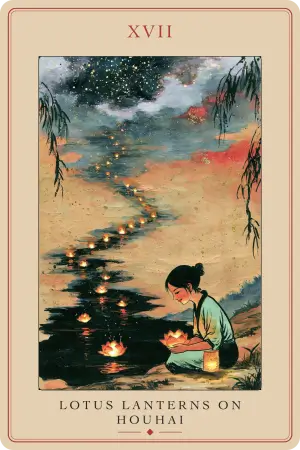
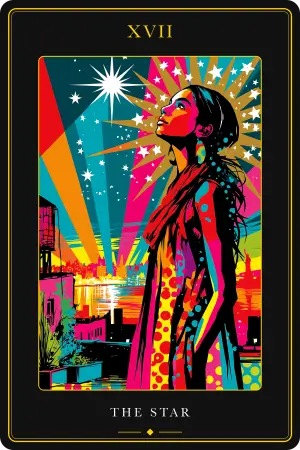
Every deck reimagines the same archetype. Compare the art, then open a deck to read its full interpretation.
Imagery and symbolism
Pamela Colman Smith drew the Rider-Waite-Smith Star in 1909 for William Rider & Son, and her rendering fixed the details most readers now picture. A nude woman kneels at the edge of a still pool beneath a wide sky lit by one large eight-pointed star and seven smaller ones. Smith gives the scene a calm, open palette and clean outlines, so the eye takes the symbols one at a time rather than reading the crowded emblem of the older decks.
Her nakedness is the point. Having come through the collapse of The Tower, she kneels with no ego and no image left to defend, her true self unadorned. One foot rests on the surface of the water, the fluid intuitive mind, while one knee presses into the earth, the solid conscious world, so her whole posture bridges the two realms.
She pours water from two pitchers. The stream from her right hand runs onto the dry land and splits into five rivulets for the five senses, grounding spiritual insight in ordinary life. The stream from her left hand pours back into the pool, refilling the subconscious wellspring and keeping the connection to the source open. Behind her, in a detail Smith added to the inherited template, a sacred ibis rests in an acacia tree. The ibis belongs to Thoth, the Egyptian god of wisdom and writing, so it marks the card as one of clarity and true expression, and the bird is known for its nerve in a storm: the last to take shelter and the first to return once the sky clears.
Core meaning
In the Rider-Waite-Smith reading the Star is the calm that follows catastrophe. The Tower tears down every false structure, and the emptiness it leaves is exactly where the naked truth of the Star can appear: a card of tranquility, healing, and quiet cosmic alignment. It is a return to authenticity, the self stripped of artifice and reconnected to the source, and it frames that moment as the Hero reaching the source of living water after a long journey.
Its work is to purify the past and fertilize the future, giving to the world freely without keeping score. The hope it offers is active rather than passive wishing. The Star guides the way a real star guides a sailor, a fixed light to steer by across a long night, and reaching it takes patience and the steady work of pouring the waters of life back out. Smith's card holds that promise plainly: even in the darkest night there is a guiding star, and the light to move toward it comes from turning inward.
Upright meaning
Upright, the Star is serenity, renewed faith, and healing after a hard passage. It restores hope and inspiration and points to a future that is genuinely possible, though it asks the querent to steer toward it patiently instead of expecting it overnight. In the Rider-Waite-Smith tradition it also carries self-confidence, perseverance, and trust in one's own intuition.
In love. Real healing after heartbreak, though the card carries a subtler warning too. A star is distant and untouchable, and it can mark the pedestal effect, where a person projects a flawless, almost divine image onto a partner until their human reality disappears. Read that way it points to unrequited feeling, or to being in love with the potential of a relationship rather than the grounded thing itself.
In career. Renewed inspiration and faith in a direction, a guiding light after a stretch of doubt. Progress is real but comes through patient navigation, not a sudden leap.
In finances. Quiet, cumulative good fortune rather than a jackpot. Where the Wheel of Fortune brings a sudden turn, the Star's luck is slow, sustained, and rewards patience.
In health. Recovery, restoration, and calm. This is the healing card of the deck, a return of energy and peace after strain.
Reversed meaning
Reversed, the Star reads as a crisis of faith. It warns of despair and disconnection on one side and of delusion and toxic positivity on the other: the desperation after a hard event that clings to unrealistic fantasy and refuses to see the red flags plainly in view.
There is a gentler reading as well. Trauma-informed practitioners point out that hopelessness is not always the enemy. In a genuinely abusive or immovable situation, releasing a specific painful hope can be an act of self-preservation, and a reversed Star may simply be telling the querent that their exhaustion is valid and that letting go is a form of self-love.
In love. Losing faith in connection, or clinging to a fantasy version of someone while ignoring who they actually are.
In career. Discouragement and a loss of the inspiration the upright card carries, or chasing a dream with no grounding under it.
In finances. Unrealistic optimism about money, or the despair that follows when a hoped-for outcome does not arrive.
In health. Emotional depletion and a sense of disconnection, or forcing positivity over a real need for rest and honesty.
Historical notes
By the time Waite and Pamela Colman Smith set to work in 1909, the kneeling water-bearer was already standard, inherited from the Tarot de Marseille, whose earliest precursor is the Cary Sheet of about 1500. What the Rider-Waite-Smith card added was refinement and legibility: the ibis in the acacia tree, the two clearly separated streams onto land and water, and the lush vegetation around the pool.
The image had traveled a long way to reach that point. Fifteenth-century Italian decks were unsettled about it: the Visconti-Sforza showed a clothed woman holding a single star, the Budapest deck a naked woman reaching to seize one, and the Rothschild and d'Este cards three men in Phrygian caps pointing at the heavens, easily read as the Magi following the Star of Bethlehem. The Minchiate deck even shows a crowned traveler lifting a chalice toward an eight-pointed star. By the sixteenth and seventeenth centuries the French decks turned instead to astronomers seated with calipers, measuring the sky, before the Marseille pattern settled on the woman pouring two jugs.
One oddity sits at the root of the Rider-Waite-Smith version. In his 1910 Pictorial Key to the Tarot, Waite still listed the card's old divinatory meanings as loss, theft, privation, and abandonment, with hope and bright prospects only as a second reading. That contradiction traces to the goddess Astraea, last of the celestials to leave a corrupt world for the heavens, so that what remains below is loss with only hope left behind, close kin to the hope trapped in Pandora's vessel.
Correspondences
Number. XVII, the seventeen, which reduces to eight (1+7) and links the Star to Strength. The vulnerability of the naked figure is not weakness; it takes real fortitude to stay that open.
Astrology. Aquarius, the fixed air sign of the visionary and the humanitarian, ruled traditionally by Saturn and in modern astrology by Uranus. The sign mirrors the water-bearer pouring truth out for the collective, and it shares the card's freedom of thought, rejection of convention, and love of justice.
Element. Air, the element of Aquarius, the clear mental sky behind the card's healing waters.
Kabbalah. In the Golden Dawn system the Hebrew letter is Tzaddi, the 'fishhook,' root of tzadik, the righteous one. The hook is mental angling, dropping a line into the deep waters of the subconscious (Yesod) to draw up higher emotion and truth (Netzach), along the twenty-eighth path. Crowley later disrupted this: reading 'Tzaddi is not the Star' in The Book of the Law, he swapped the card with The Emperor and reassigned it to the letter Heh, the 'window,' on the fifteenth path from Chokmah to Tiphereth.
Timing. Aquarius season, and a slow, patient tempo. As a yes or no the card is a gentle yes that asks you to keep steering toward the goal.
Psychological perspective
The naked figure is a portrait of authenticity after ego death, a person who no longer needs armor. Read through brain lateralization, her two hands do distinct work: the right hand, governed by the logical left hemisphere, pours onto the land, grounding insight in practical reality, while the left hand, governed by the intuitive right hemisphere, pours back into the pool, keeping the subconscious source replenished. Health in this card is the balance between the two.
Alejandro Jodorowsky names the card's shadow precisely. At its best the Star is the perfection of the gift, giving to the world without demanding anything back. Misapplied, it turns vampiric: if the figure pours only into the pool, into the past and the reservoir of old wounds, she becomes a bottomless pit of emotional reclamation, forever feeling unloved and demanding validation from everyone around her. There is an Aquarian loneliness in the card too, the outsider who carries cosmic water to a collective she never quite merges into, invested in humanity yet watching it from a careful distance.
The Star across decks
Set against its predecessors and rivals, the Rider-Waite-Smith Star shows what Smith chose to keep and what she added. She took the Marseille scene of a naked woman pouring two jugs by the water and gave it the ibis, the acacia, the split streams, and the readable open composition, turning a schematic emblem into a legible narrative image.
Early Italian and French decks. Before the water-bearer settled in, the card wandered through astronomers with calipers measuring the firmament and robed Magi in Phrygian caps pointing at the Star of Bethlehem, an intellectual, celestial reading later traded for the kneeling figure by the water.
Crowley-Thoth. Crowley and Lady Frieda Harris steep the card in Thelemic theology. The figure becomes Nuit, goddess of the infinite night sky and the totality of possibility, pouring from a gold and a silver cup to channel her energy into the material world, with echoes of Babalon, who accepts all experience. Here the card is the realization of one's True Will within the vastness of space.
Modern reclamations. Queer and feminist decks like the Earth Mother Magic Tarot recast the nudity as vulnerability rather than spectacle, the power of existing openly and unashamed, and insist a person need not be fully healed to deserve visibility. Others, like Lacey Bryant's Slow Tarot, relocate the card's healing into quiet domestic surrealism and the weight of ordinary memory.
In combination and context
The Star only makes full sense in sequence. It follows The Tower and precedes The Moon, and that placement is the reading: the Tower strips away the false self, and the Star is the authentic self and the peace that could not have existed before the illusion fell. Set beside the Wheel of Fortune, the contrast sharpens its meaning, since the Wheel's luck is sudden and the Star's is quiet, cumulative, and earned through patient navigation.
In love spreads the card takes its color from its neighbours. Paired with the Four of Cups or the Eight of Cups it often confirms unrequited feeling, a relationship that stays a distant wish rather than a lived reality, the querent enamored with an ideal on a pedestal. As an obstacle it names that very pedestal, the flawless image no real person can match.
As a yes or no it answers softly. Pulled for an anxious question like whether an exam will go badly, it is less a prediction than reassurance, a nudge to stop catastrophizing, trust the process, and let the outcome bring healing rather than dread.
Questions for reflection
- Now that the Tower has taken what it took, what authentic part of you is left that you no longer need to hide?
- Look at Smith's two pitchers: are you pouring your energy onto the fertile ground of the present, or only back into the pool of old wounds?
- Where is your hope a star to navigate by, and where has it become a fantasy you are hiding inside?
The general meaning follows the Rider-Waite-Smith reading — the reference used across Tarot Academy. Open a specific deck above for its own interpretation.
Frequently asked questions
Explore the Tarot
Latest Posts
Discover the ancient wisdom of tarot cards and unlock the mysteries of your spiritual journey. Our blog is your gateway to understanding the rich symbolism, meanings, and practical applications of tarot reading.




















































