
 EN (English)



Minor Arcana · Pentacles (Earth)
Page of Pentacles
Pamela Colman Smith's student in the open field: grounded curiosity and the first practical step, drawn in green, red, and gold.
Read the complete guide: Page of Pentacles Tarot Card: A Comprehensive Guide to Symbolism and Meaning
Card at a glance
- Numerology
- Page
- Element
- Earth
- Kabbalistic path
- Malkuth (Kingdom), Earth of Earth
- Timing
- Slow and steady, a long-term start
- Yes / No
- Upright yes, with effort · Reversed no
Upright
Student
New opportunity
Ambition
Practical study
Diligence
Manifestation
Attention to detail
Good news
Reversed
Procrastination
Lack of focus
Shiny object syndrome
Perfectionism
Material immaturity
Missed opportunity
Short-term thinking
Page of Pentacles in each deck
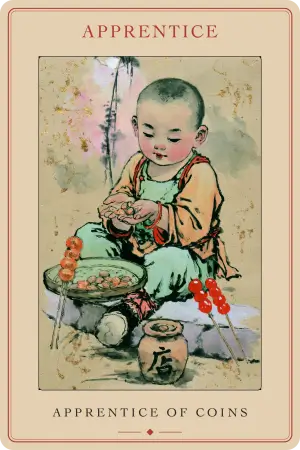
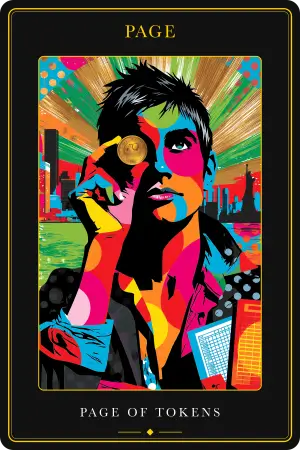
Every deck reimagines the same archetype. Compare the art, then open a deck to read its full interpretation.
Imagery and symbolism
Pamela Colman Smith drew the Page of Pentacles as a single youth standing in a broad green plain, holding one golden pentacle up to eye level and studying it with steady, absorbed curiosity. There are no crowds and no buildings, only open land, and that isolation is deliberate: it reads as deep concentration, the figure entirely given over to the object in his hands.
Every colour in Smith's palette carries the reading. The green tunic patterned with red floral motifs, finished with a red turban and a dark scarf, ties the growth and receptivity of Earth to a spark of passion and conscious mental focus. The flowers connect the Page to natural cycles, to the earth turning invisible intention into tangible form. The green field beneath his feet stands for a fertility that promises success in material matters and for a life energy that does not run out. Behind the figure lies ploughed earth, a sign that the groundwork is already done and the soil prepared, which hints at a mentor or an existing foundation. In the far distance sit a small stand of trees and a range of gentle mountains, the difficulties already overcome and the higher aspirations still ahead, their soft slopes saying the road is demanding yet walkable. Behind it all glows a bright yellow sky, Smith's marker of intelligence, energy, creativity, and an optimistic, energetic approach to whatever comes.
The posture is the hinge of the whole card. Where the Knight of Pentacles gazes out over his coin toward the horizon and the King rests a foot on his in mastery, this Page examines the coin closely, learning how the material world works before trying to shape it. His confident, steady stance carries both physical strength and a plain will to put effort toward material prosperity.
Core meaning
In the Rider-Waite-Smith reading, the Page of Pentacles is the student of the earth suit, the youngest court rank and the first spark of practical manifestation. He is the seed set in fertile soil: raw potential at the start of a long, patient endeavour, with a real thirst to learn and no wish to hurry. Where the King holds mastery, the Page holds beginnings.
Smith's card grounds this squarely in the practical worlds of money, work, and the body. As a court card of Earth it brings thought down into matter, and some readers frame the Page as the airy, thinking part of Earth, the mind bent on mastering something tangible. That is why the image reads so reliably as the student: attention focused, details noticed, knowledge put to use. As a Page he is also a messenger, and the news he carries tends to be material and constructive, the fruit of groundwork already laid rather than a bolt from the blue.
Upright meaning
Upright, this is the definitive student card of the deck. It asks the querent to take beginnings seriously and to meet a new skill with a beginner's mind, dropping the ego and learning the fundamentals honestly. It favours hands-on, practical study over abstract debate: the apprenticeship, the trade course, the marketable skill. It signals that a material or financial opportunity is forming, though it flatly refuses the fantasy of overnight windfalls in favour of slow, methodical building.
In love. A curious, early-stage attraction that studies before it commits. It can grow from shared practical ground such as work or study, and it deepens only with deliberate effort. Steady and sincere, though not yet the passion of a Knight or the commitment of a King.
In career. A strong sign for starting a course, taking an internship, or researching a new field. It rewards careful planning, budgeting, and the patient mastery of an established body of knowledge, and it often arrives with tangible good news like a job offer or an acceptance letter.
In finances. Seed money and modest first steps: a savings plan begun, a small opportunity spotted, the first bricks of a secure future laid with cautious, conservative care.
In health. A practical fresh start, learning how the body works and building routines that hold. The card is also one of the deck's strongest indicators of pregnancy, the seed planted and quietly gestating.
Reversed meaning
Reversed, the steady earth energy of Smith's field scatters. The eager student turns into the distracted procrastinator, and the fertile soil of potential goes unplanted. The clearest sign is a loss of focus and follow-through: the person who buys courses they never finish and jumps from hobby to hobby without mastering any, what tarot communities call shiny object syndrome, seduced by a new idea and gone the moment the dull, repetitive work begins.
Underneath, the block is rarely plain laziness. More often it is a fear of failure or a perfectionism fixed on the distant goal, freezing at the sheer size of the task. By refusing to break the ambition into daily, manageable steps, the querent stalls completely. The card can also show short-term thinking and material immaturity, chasing quick wins over patient building. In career burnout it points to a student who has lost the original joy of learning, and the advice is to reconnect with curiosity for its own sake.
In love. Interest that never matures into effort, a bond of pure convenience, or someone too immature to offer real commitment.
In career. Stalled study, procrastination, or a plan grandly announced yet never executed.
In finances. Impatience, risky unresearched schemes, and daydreams of luxury with none of the daily work to fund them.
In health. Good routines started and abandoned, or a grind that has drained the first motivation dry.
Historical notes
The Rider-Waite-Smith deck was published in 1909 by William Rider & Son, illustrated by Pamela Colman Smith under the direction of Arthur Edward Waite. Its great innovation was the Minor Arcana: Smith gave every pip card a full allegorical scene, where the older Tarot de Marseille had left the minors as plain geometric arrangements of suit symbols and saved illustrated figures for the trumps and courts. Her Page of Pentacles, a solitary youth studying a coin in an open field, is the image most readers still work from today.
Both Waite and Smith were members of the Hermetic Order of the Golden Dawn, and the deck's symbolism draws on its teachings and on the 19th-century occultist Eliphas Levi. The suit itself began as Coins or Deniers, tokens of the medieval merchant class and everyday commerce. In 1855 Levi popularised the word pantacle, the magical talisman, and recast the coins as instruments of protection and manifestation. Waite took up that shift and marked the coins with the pentagram inscribed in a circle to lift the suit from mere money to the whole material world and the alchemy of bringing spirit down into matter.
Correspondences
Rank. Page, the youngest of the court, the student and messenger of the suit. In the Thoth system this rank is retitled the Princess.
Astrology. Unlike the decan-ruling Knights, Queens, and Kings, the Pages hold no single sign. In the Golden Dawn system they govern a whole quadrant of the sky around the North Pole, and the Page of Pentacles rules the quarter containing Aries, Taurus, and Gemini, anchored by fixed, earthy Taurus. The deck's own reading gathers his character from the three earth signs together: the patience of Taurus, the detailed practicality of Virgo, and the grounded ambition of Capricorn.
Element. Earth, through the suit of Pentacles: work, body, money, and tangible results, here in its youngest and most receptive form.
Kabbalah. The Page sits in Malkuth, the Kingdom, which makes the card Malkuth in Malkuth, Earth of Earth, the densest and most physical point in the system. As the final Hé of the divine name she is the Daughter destined to become Queen, and she holds the power of Earth the Golden Dawn named Tacere, to keep silent.
Elemental dignity. As an Earth court card he steadies and grounds the cards around him, especially anxious Air and overflowing Water, anchoring a spread in the practical and achievable.
Psychological perspective
Psychologically, Smith's Page is the beginner's mind made into a stance. It is the willingness to be a novice without pretending to be further along than you are, to find the fundamentals genuinely interesting rather than beneath you. His whole developmental task is starting, turning a wish into one concrete step.
The shadow is where that step never comes. Over-intellectualising a physical task is exactly what stops it from happening: the querent thinks and plans and worries the goal to death instead of laying the first brick. When the Page keeps reappearing in readings, practitioners take it as a demand for grounding, a signal that the querent is lost in mental anxiety or emotional overwhelm and needs to come back to the body and the next doable action.
Page of Pentacles across decks
This deck is the home of the solitary student in the field, so it sets the reference the other traditions are read against. The older Tarot de Marseille carries no such scene: its court figure stands in the formal early style, its meaning taken from rank and suit rather than from a narrative image, and its minor pips are plain geometric coins.
Crowley and Harris's Thoth deck retitles the card the Princess of Disks and makes her the final materialisation of the earth element: a glowing young woman, often read as pregnant, holding a radiant disk and crowned with a winged ram's head that ties her to Aries and the creative power of the womb. Crowley called the Princesses an inertia of irresistible momentum, stable yet volatile, the point where energy is reabsorbed and the cosmic cycle closes. Modern decks tend to keep Smith's student-and-messenger core while updating the figure for their own readers.
In combination and context
In the RWS suit story the Page of Pentacles is the first stage of craftsmanship: he studies the material and plans the work, where the Eight of Pentacles then hammers it out in disciplined solitude and the Three of Pentacles brings the finished skill into collaboration. Set against the other Pages he is the slowest and most reliable, the one who grounds fire, water, and air by asking how a thing actually gets built. In modern love readings Smith's image of a youth staring at a coin has been reread as someone quietly keeping tabs through a phone screen, watching from a distance without making a move.
He also steadies whatever surrounds him. With the Tower he is the student who arrives the day after the collapse with seeds for the cleared ground. With the Five of Pentacles he offers a practical way out of scarcity, a new skill to rebuild on. With Justice he points to formal agreements and reading the fine print. With the Six of Swords he handles the logistics of the move, saving the money and facing the physical reality of leaving. As advice he says start small and do the work; as an outcome he promises earned, gradual success. In a yes-or-no reading he is a conditional yes, possible if the querent will put in the study and the effort.
Questions for reflection
- What skill am I genuinely curious about, and what would it take to begin it as an honest beginner?
- Where am I over-thinking a practical task instead of laying the first brick?
- Which ambition have I been announcing but never actually starting, and why?
Most common combinations with Page of Pentacles
The pairs readers meet most often with this card, read with both cards upright. Open one for the reversed readings.

The Tower
HarmoniousAfter a sudden collapse, the querent starts again as a learner with a practical first step.

Five of Pentacles
MixedMoney is short, and a new skill, course or entry-level job offers the practical way out.

Justice
HarmoniousA first step taken properly: a course, job or investment started on fair, clear terms.

Six of Swords
HarmoniousA move or recovery gets a practical plan: study, savings and first steps toward a steadier life.

Eight of Pentacles
HarmoniousFrom first curiosity to daily practice: a new skill, course or job taken up seriously.

Three of Pentacles
HarmoniousAn eager beginner finds a team or a teacher, and study turns into skill that others recognize.

Knight of Pentacles
HarmoniousStudy turns into steady work: a skill learned with care is put to use through patient, methodical effort.

King of Pentacles
HarmoniousApprentice and master: practical study backed by an experienced hand, with long-term financial growth in view.
Combinations are common patterns, not rules
The readings here describe how a pair most often reads. Check each one against two things before you apply it. The first is the question: the same pair says one thing about a relationship and another about a job offer, and the question decides which side of the pair matters. The second is the background, meaning what the querent already knows about the situation, the position each card holds in the spread, and the cards around the pair. When the question or the background points another way, go with them over the general reading. Each pair page lists the exceptions that come up most often.
The general meaning follows the Rider-Waite-Smith reading, the reference used across Tarot Academy. Open a specific deck above for its own interpretation.
Frequently asked questions
What does the Page of Pentacles mean in the Rider-Waite deck?
In the Rider-Waite-Smith deck the Page of Pentacles is the student of the earth suit. Pamela Colman Smith drew him alone in a green field, studying a single coin, which reads as grounded curiosity, a new financial or educational opportunity, and the first practical step toward a long-term goal built through patient work.
What do the colours and symbols mean in the Rider-Waite Page of Pentacles?
The green tunic and field stand for growth, fertility, and inexhaustible life energy; the red flowers and turban add passion and mental focus; the ploughed earth behind him shows groundwork already done; the gentle mountains are challenges overcome and goals ahead; and the bright yellow sky marks intelligence, energy, and optimism.
Is the Page of Pentacles a yes or no card?
It is generally a yes, but a conditional one. The outcome comes if the querent is willing to put in the time, study, and physical effort to build the foundation. It affirms starting and learning, not overnight results.
What does the Page of Pentacles mean in love?
In love it is a curious, early-stage attraction that studies before it commits, often growing from shared practical ground like work or study. It is steady and sincere but slow-moving, and it deepens only with deliberate effort rather than sweeping passion.
Does the Page of Pentacles indicate pregnancy?
Many readers treat it as one of the deck's strongest pregnancy indicators. The earth element governs fertility and growth, the single pentacle reads as a planted seed, and the Thoth Princess of Disks is depicted pregnant, so alongside cards like The Empress or Ace of Pentacles it strongly affirms new life.
What does the Page of Pentacles reversed mean?
Reversed, it points to procrastination and lost focus, the shiny object syndrome of starting many things and finishing none. Underneath it is often fear of failure or perfectionism that freezes at the size of the task, along with short-term thinking and material immaturity.
Explore the Tarot
Latest Posts
Discover the ancient wisdom of tarot cards and unlock the mysteries of your spiritual journey. Our blog is your gateway to understanding the rich symbolism, meanings, and practical applications of tarot reading.

















